
Home → Plays → Hamlet → Act 5 Scene 2 → Scene Analysis
Hamlet: Act 5, Scene 2 – analysis
The fencing match turns into a bloodbath where the King, Queen, Laertes, and Hamlet all die, leaving Horatio to tell the story.
Scene Profile – At a Glance
Location: A Hall in the Castle.
Characters: Hamlet, Horatio, Osric, King Claudius, Queen Gertrude, Laertes, Fortinbras, Ambassadors.
Key Event: The rigged duel leads to the deaths of the entire royal family; Fortinbras arrives to take the crown.
The Atmosphere: Formal, tense, violent, and ultimately tragic.
Key Quote: "The rest is silence."
Significance: The restoration of order through total destruction. The "rotten" state is purged, but at the cost of the hero’s life.
Scene Summary
Hamlet reveals to Horatio how he discovered the King’s plot on the ship to England. He stole the commission, rewrote it to order the execution of Rosencrantz and Guildenstern, and sealed it with his father’s signet ring. He expresses no guilt for their deaths ("They did make love to this employment"). Osric, a foolish courtier, enters to invite Hamlet to the duel with Laertes. despite a sense of foreboding ("thou wouldst not think how ill all’s here about my heart"), Hamlet accepts, citing the inevitability of fate ("the readiness is all").
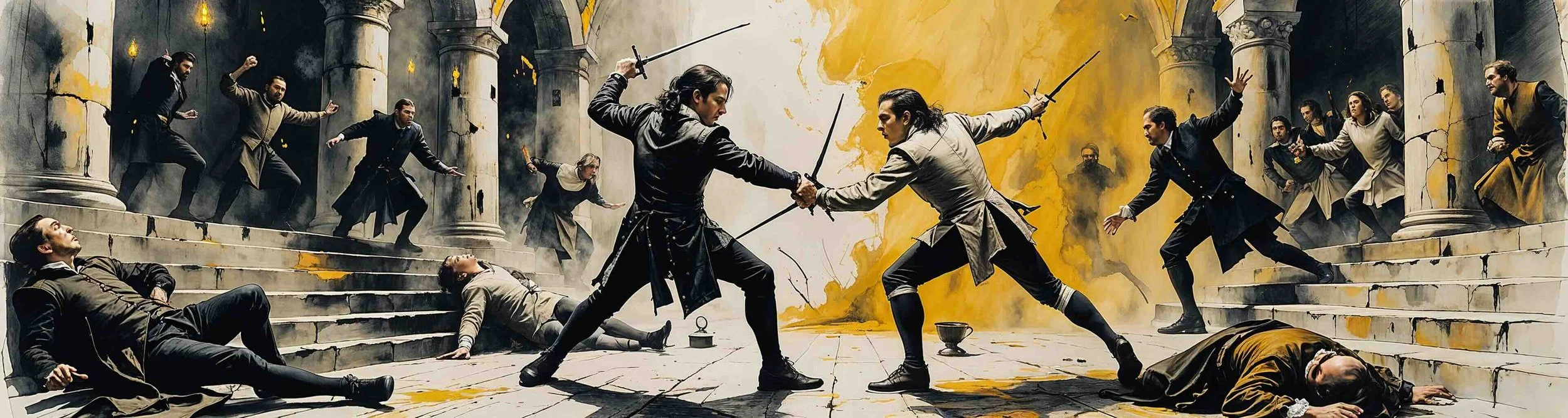
At the match, Hamlet apologises to Laertes. They fight. Hamlet wins the first two hits. Gertrude drinks to Hamlet from the poisoned cup, despite Claudius’s warning. She dies. Laertes wounds Hamlet with the poisoned rapier. In the scuffle, they exchange swords, and Hamlet wounds Laertes with the same poisoned blade. Laertes confesses the plot ("the King's to blame"). Hamlet stabs Claudius and forces him to drink the poison. Claudius dies. Laertes dies, asking for forgiveness. Hamlet prevents Horatio from drinking the poison so he can tell the story. Hamlet names Fortinbras his heir and dies. Fortinbras arrives, orders a military funeral for Hamlet, and claims the kingdom.
Context
The Duel: Fencing matches were popular court entertainment. The "treachery" lies in the violation of the sporting code. The exchange of rapiers allows for "poetic justice"—Laertes is killed by his own poison, emphasising the theme that "violence recoils upon the perpetrator."
The Union (Pearl): Claudius throws a "union" (a large pearl) into the cup, claiming it is a reward. In reality, this is likely the moment he poisons the wine. It symbolises how wealth and poison are indistinguishable in Claudius's court.
Fortinbras's Arrival: The entry of Fortinbras brings the play full circle. The threat from Act 1 Scene 1 finally arrives, but peacefully. It signifies the return of strong, masculine, medieval leadership to Denmark, replacing the corrupt machinations of Claudius and the philosophical paralysis of Hamlet.
Character Focus
Hamlet: The Tragic Hero
Hamlet dies not as a victim, but as a master of his fate. He has moved beyond the "antic disposition" and the paralysing doubt. He acts decisively to execute R&G, he fights boldly, and he kills the King without hesitation. His final concern is his "wounded name"—he wants the truth to be known, ensuring he leaves behind a legacy of honour, not madness.
Language and Technique
Prose vs Verse: Hamlet mocks Osric in prose, parodying the courtier's overly flowery language. This satire ("water-fly," "drossy age") provides a final moment of levity before the tragedy. When the duel begins, the play shifts into high verse for the climax.
Biblical Allusion: "There is a special providence in the fall of a sparrow." This references Matthew 10:29, implying that God controls even the smallest deaths. It marks Hamlet’s total surrender to Divine Will—he no longer tries to control the outcome.
Metaphor (The Net): As he dies, Laertes says he is "as a woodcock to mine own springe" (trap). It echoes Polonius’s earlier warning about "springes to catch woodcocks." The imagery of hunting and trapping closes the loop on the family's tragic machinations.
Key Quotes
Original:
There is a special providence in the fall of a sparrow. If it be now, ’tis not to come; if it be not to come, it will be now... the readiness is all. (Hamlet)
Shakespeare Retold (Modern Verse):
It’s predestined just like a sparrow’s death. If it is now, it won’t be later; if not later, now… The preparation’s key.
Analysis: Hamlet accepts death. He realises that timing is out of his hands. "The readiness is all" is the final answer to "To be or not to be." The question is no longer whether to live or die, but how to be ready for death when it comes.
_____
Original:
I am justly killed with mine own treachery. (Laertes)
Shakespeare Retold (Modern Verse):
I’m rightly dying by my own betrayal.
Analysis: Laertes recognises the moral justice of his death. The poison he bought to kill Hamlet has killed him. It validates the play's moral universe: those who use underhanded means will eventually be destroyed by them.
_____
Original:
The rest is silence. (Hamlet)
Shakespeare Retold (Modern Verse):
The rest is silence.
Analysis: Hamlet’s final words. For a character defined by words—soliloquies, puns, plays, and arguments—death is simply the cessation of speech. He passes the burden of speaking to Horatio.
Study Prompts (with suggested answers)
-
Benchmark Points:
Fatalism ("the readiness is all").
Pride/Honour.
Desire to reconcile with Laertes.
Suggested Answer: Hamlet agrees because he has surrendered to fate ("special providence"). He feels a "gaingiving" (premonition) but dismisses it, believing that if his time has come, he cannot avoid it. He also wishes to prove himself against Laertes and perhaps make amends for Polonius's death.
-
Benchmark Points:
"Heaven make thee free of it."
The exchange of swords/forgiveness.
Contrast with his treatment of Claudius.
Suggested Answer: Yes. In his dying moments, Laertes asks for an exchange of forgiveness ("Mine and my father's death come not upon thee"). Hamlet accepts ("Heaven make thee free of it"), absolving Laertes of the treachery. This moment of grace distinguishes the two young men from the "damned" King.
-
Benchmark Points:
To tell the story ("report me and my cause").
To prevent historical distortion.
As the witness/audience surrogate.
Suggested Answer: Horatio attempts to drink the poison ("I am more an antique Roman than a Dane") to die with his friend. Hamlet stops him because if Horatio dies, no one will know the truth about Claudius's treachery. Horatio must live to "speak to the yet unknowing world" and clear Hamlet’s name.
-
Benchmark Points:
Respect for Fortinbras's action.
Political necessity (avoiding civil war).
Restoration of order.
Suggested Answer: Hamlet gives his "dying voice" to Fortinbras because he admires the Norwegian Prince’s decisiveness and honour (seen in Act 4 Scene 4). Politically, it ensures a peaceful transition of power, preventing Denmark from falling into chaos after the royal family is wiped out.
-
Benchmark Points:
"They did make love to this employment."
Coming between "mighty opposites."
Hamlet's lack of guilt.
Suggested Answer: Hamlet feels no guilt because he believes they willingly participated in the King's plot ("baser nature comes between the pass... of mighty opposites"). To Hamlet, they were willing tools of a tyrant, and their destruction is a natural consequence of meddling in high-stakes politics.