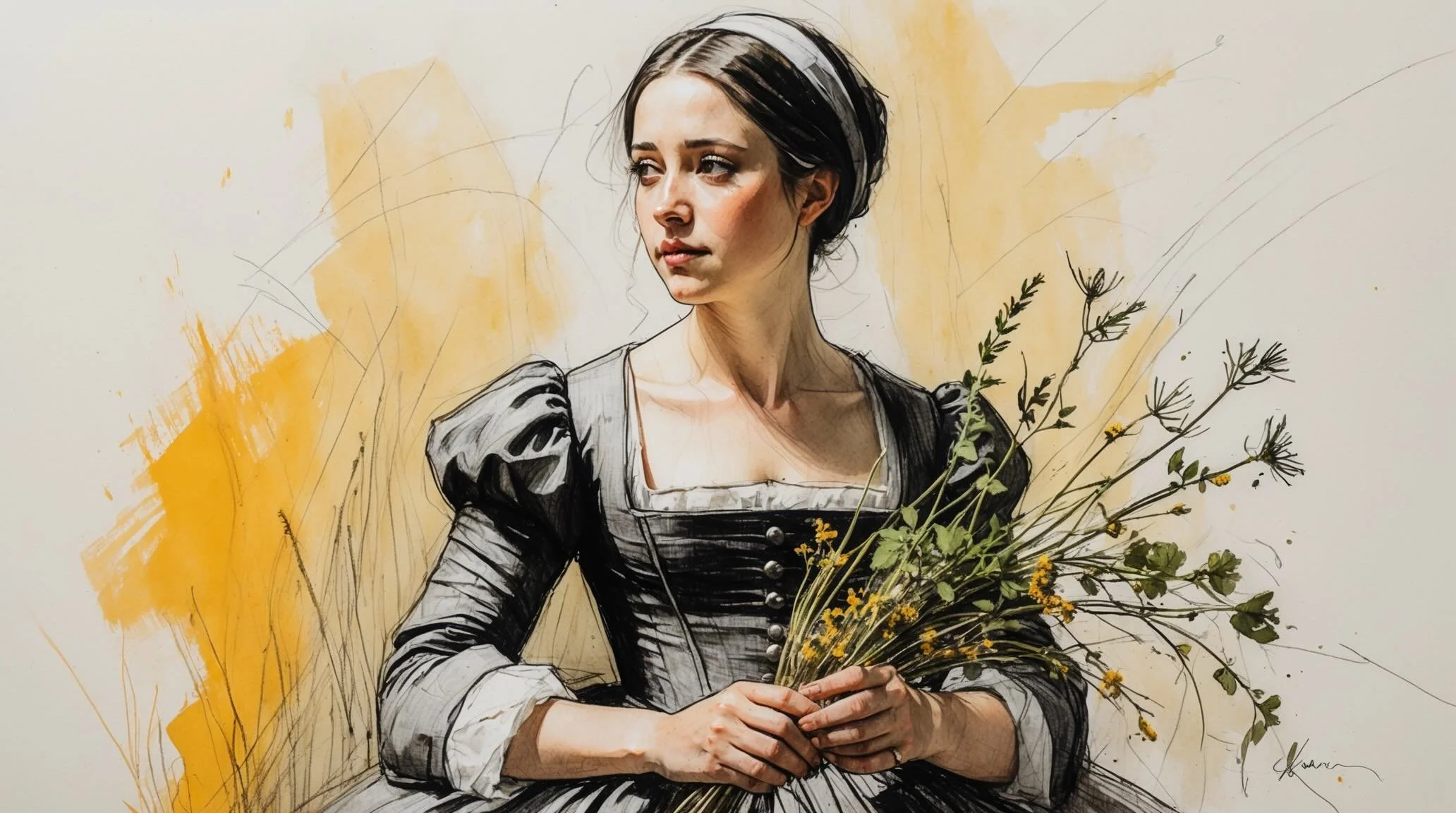
Character Profile – At a Glance
- Role: Daughter of Polonius, sister to Laertes, and the tragic love interest of Prince Hamlet.
- Key Traits: Obedient, fragile, empathetic, and ultimately disillusioned.
- The Core Conflict: Ophelia is trapped between her genuine affection for Hamlet and the rigid demands of filial duty imposed by her father and brother.
- Key Actions: Returns Hamlet’s love letters under duress; unwittingly acts as a spy for the King and Polonius; succumbs to madness and eventually drowns.
- Famous Quote:
"O, what a noble mind is here o’erthrown!
The courtier’s, soldier’s, scholar’s, eye, tongue, sword;
The expectancy and rose of the fair state,
The glass of fashion and the mould of form,
The observed of all observers, quite, quite down!"
(Act 3, Scene 1) - The Outcome: Driven to madness by Hamlet’s rejection and her father’s death, she dies by drowning in a stream – an event often interpreted as a passive suicide.
The Victim of Patriarchal Authority
Ophelia is perhaps the most defenceless character in the Shakespearean canon, defined largely by the men who surround her. Her identity is not her own; it is a construct of her father Polonius’s ambition and her brother Laertes’s protective, yet stifling, moralising. In the early acts of the play, Ophelia’s speech is peppered with phrases of submission. She is a vessel for the anxieties of the men in her life regarding gender, female sexuality, and social standing.
Original
I shall obey, my lord.
(Act 1, Scene 3)
Shakespeare Retold (Modern Verse)
I will obey you, lord.
This brief response encapsulates her entire social existence. By surrendering her agency to Polonius, she inadvertently sets the stage for her own destruction. Her behaviour is a reflection of the courtly expectations of Elsinore, where a daughter’s honour is a commodity to be guarded and traded by her male relatives.
Love, Betrayal, and the "Nunnery"
The relationship between Hamlet and Ophelia is defined by a profound lack of communication. While Hamlet uses Ophelia as a foil for his "antic disposition," Ophelia genuinely suffers the brunt of his psychological cruelty. In the famous nunnery scene, Hamlet’s vitriol is directed not just at Ophelia, but at womankind in general. This betrayal is twofold: she is forced to lie to the man she loves while being publicly humiliated by him.
Original
Could beauty, my lord, have better commerce than with honesty?
(Act 3, Scene 1)
Shakespeare Retold (Modern Verse)
My lord, could beauty better interact with honesty?
Ophelia’s confusion here highlights her innocence. She cannot reconcile the Hamlet she once knew – the "glass of fashion" – with the cruel, cynical figure standing before her. Her heartbreak is not merely romantic; it is an existential crisis brought about by the total collapse of her social and emotional world.
Madness as a Language of Protest
Ophelia’s eventual descent into madness is the only time she is granted a truly distinct voice. While Hamlet’s madness is calculated and performative, Ophelia’s is visceral and genuine. Through her flower imagery and bawdy songs, she expresses the repressed frustrations and sexual anxieties that she was forced to hide behind a mask of maidenly decorum. In the flower-distribution scene she hands out symbolic herbs – "There’s rosemary, that’s for remembrance; pray, love, remember" and "There’s fennel for you, and columbines" – before keeping "rue" for herself, the herb of regret (Act 4, Scene 5).
By distributing these flowers, Ophelia silently indicts the survivors of the play. The "rue" she gives to Queen Gertrude and keeps for herself symbolises the shared sorrow and guilt of the court. In her broken state, she finds a tragic form of honesty that was impossible when she was sane and "obedient," revealing the deep corruption that has destroyed her family.
"We can imagine Hamlet’s story without Ophelia, but Ophelia literally has no story without Hamlet."
— Lee Edwards, "The Labors of Psyche," Critical Inquiry, 1979
Key Quotes
Quote 1
O, what a noble mind is here o’erthrown!
The courtier’s, soldier’s, scholar’s, eye, tongue, sword;
The expectancy and rose of the fair state,
The glass of fashion and the mould of form,
The observed of all observers, quite, quite down!
(Act 3, Scene 1)
Shakespeare Retold (Modern Verse)
Oh no, his gracious mind is now bewitched,
Confusing strengths of prince, soldier and scholar!
He is our cherished heir to rule our country,
Epitomising our civility,
Looked up to and revered, but now a mess!
Quote Analysis: Spoken immediately after the brutal "nunnery" confrontation, this quote illustrates Ophelia’s deep empathy. Despite being verbally abused, her primary concern is for Hamlet’s lost sanity rather than her own broken heart. It also serves as the audience’s best description of the noble Renaissance prince Hamlet used to be.
Lord, we know what we are, but know not what we may be.
(Act 4, Scene 5)
Shakespeare Retold (Modern Verse)
Lord, we know what we are, but know not what we may be.
Quote Analysis: Spoken during her madness, this line carries a profound philosophical weight regarding the loss of self and the terrifying unpredictability of fate in the Danish court. It reflects her own tragic transformation from an obedient courtier into a shattered victim.
I would give you some violets, but they withered all when my father died...
(Act 4, Scene 5)
Shakespeare Retold (Modern Verse)
There’s a daisy for you. I’d give you violets, but they all withered when father died...
Quote Analysis: Violets traditionally represent faithfulness and integrity. By stating they "withered," Ophelia suggests that with the death of Polonius, the virtues he demanded of her – and the moral fabric of Elsinore itself – have also perished.
He is dead and gone, lady,
He is dead and gone;
At his head a grass-green turf,
At his heels a stone.
(Act 4, Scene 5)
Shakespeare Retold (Modern Verse)
He is dead and gone, lady,
He is dead and gone;
At his head a grass-green turf,
At his heels a gravestone.
Quote Analysis: Through this simple, haunting ballad, Ophelia processes the trauma of her father’s unceremonious and secret burial. The rhyme scheme mimics a nursery rhyme, contrasting her youthful innocence with the grim reality of death and political cover-ups.
Key Takeaways
- Symbol of Innocence: Ophelia represents the collateral damage of political intrigue, illustrating how the corruption of Denmark destroys the pure and defenceless.
- Patriarchal Critique: Her character serves as a scathing critique of the limited agency afforded to women in Elizabethan society, who were entirely dependent on male relatives.
- Thematic Mirror: Her genuine, involuntary madness acts as a powerful foil to Hamlet’s strategic, feigned madness, highlighting the difference between intellectual play and true psychological fracture.
- Nature and Beauty: Her death, surrounded by flowers and water (Act 4, Scene 7), cements her as a figure of tragic, aestheticised beauty, immortalising her as a victim of a corrupt world.
Study Questions and Analysis
How does Ophelia’s madness differ from Hamlet’s?
The difference is one of Shakespeare’s most carefully constructed pieces of dramatic counterpoint. It works at every level the play can produce.
The most obvious contrast is in declaration. Hamlet announces his "antic disposition" in A1S5, immediately after the Ghost’s exit. The audience is therefore alerted, before any "mad" behaviour begins, that Hamlet’s strangeness is a deliberate strategic performance designed to cover his investigation of Claudius. Ophelia produces no equivalent declaration. Her madness, when it arrives in A4S5, has had no prior announcement, no strategic framing, no protective rhetorical structure. The audience encounters it unmediated by the meta-theatrical commentary Hamlet has built around his own performance. The arrangement is itself evidence of the asymmetry in the two characters’ relationships to language.
The second contrast is in public and private behaviour. Hamlet’s "mad" behaviour is calibrated to its audience. He is most-mad in front of Polonius, Rosencrantz and Guildenstern, and Claudius – figures whose deception is the strategic point – and least-mad in private (the soliloquies) and with Horatio (the trusted confidant). Ophelia’s madness operates by no such calibration. The A4S5 scene puts her in front of the king, the queen, and (later) her brother, with no apparent capacity to modulate the performance for different audiences. Hamlet retains the strategic capacity Ophelia has lost. The loss is precisely what marks her madness as genuine.
The third contrast is linguistic. Hamlet’s mad speech operates by ironic wordplay, multilayered punning, and the deliberate construction of statements that can be read as either sense or nonsense depending on the listener’s investment. The "fishmonger" exchange with Polonius in A2S2 is the structural example. Hamlet’s surface absurdity contains a coded insult – Polonius as pimp, deploying his daughter as bait – that Polonius can recognise but can’t directly address. Ophelia’s mad speech operates by a different mechanism. The flower distribution scene in A4S5 deploys a coded language – the Elizabethan symbolism of plants – that requires the audience to translate from symbolism to political meaning rather than from surface absurdity to ironic critique.
Elaine Showalter’s 1985 essay "Representing Ophelia" named the distinction directly. Madness in Renaissance drama is gendered, and the female version operates by different conventions than the male version. Hamlet’s madness is melancholy intellectualised into performance. Ophelia’s is what the period’s medical vocabulary would have called "erotomania" or "hysteria" – a feminised category produced by frustrated sexual and filial attachment rather than by metaphysical contemplation.
The deeper argument is that Ophelia’s madness is, paradoxically, the more honest. Hamlet’s strategic performance lets him keep the rhetorical control that has been his characteristic mode throughout the play. Ophelia’s genuine collapse reveals the suppressed contents – sexual desire, anger at her father’s manipulation, awareness of the political machinations she has been used to enable – that her sane obedience had been required to conceal. The irony is exact. Madness liberates Ophelia into the speech her sanity had prohibited. Hamlet’s strategic madness operates as continuation of the controlled rhetorical project that constitutes his sanest mode.
What is the significance of the "nunnery" scene for Ophelia’s character development?
The A3S1 nunnery scene is the turning point in Ophelia’s trajectory through the play. The cruelty it documents works at levels the surface narrative of romantic rejection doesn’t exhaust.
The setup is exact. Polonius and Claudius have arranged for Ophelia to meet Hamlet in a location where they can watch from concealment. Ophelia has been told to return Hamlet’s earlier love-tokens and to draw him into conversation that will reveal whether his strange behaviour comes from frustrated love (Polonius’s theory) or from something more dangerous to the regime.
Ophelia, by A3S1, has been positioned by every male figure in her life as an instrument. Her father has deployed her as bait. The king has approved the deployment. Her brother (in his A1S3 warnings before leaving for France) has already constrained her sexual choices by warning her against Hamlet’s "unmastered importunity." The scene therefore opens with Ophelia in a position no other character in the play occupies in such concentrated form – used simultaneously by three male authority figures, none of whom has consulted her on her own desires.
Hamlet’s cruelty in the scene gets steadily worse. The opening exchange – Ophelia returning the love-tokens – is conducted at a register of formal courtesy that gives no indication of what’s coming. The "Where’s your father?" question is the pivot. Ophelia lies ("At home, my lord"), and most productions read the lie as the moment Hamlet realises Ophelia is acting as Claudius’s agent rather than as an autonomous romantic interlocutor.
From this point in the scene, the verbal assault intensifies. The instruction "Get thee to a nunnery" is repeated five times across the scene, each repetition adding pressure to the original. The pun is the mechanism. The Elizabethan slang sense of "nunnery" was "brothel" – the convent and the brothel were both, in the period’s idiom, places where women were kept out of normal sexual circulation. The instruction operates simultaneously as the conventional religious recommendation (withdraw from sexual life into the convent) and as a cruel sexual accusation (become the prostitute your sexual availability has already made you). The cumulative effect is to deliver, in a single scene, the most concentrated verbal cruelty in the play.
The function for Ophelia’s development is exact. Before A3S1, Ophelia has been an obedient daughter operating within the constraints her father has imposed. Her A1S3 line to Polonius – the body section’s verse pair on this page – names the position. After A3S1, that position has become impossible. Hamlet, the man she has been told (variously by Polonius in A1S3, by Laertes in A1S3, and by her own inclination) to either love or not-love depending on her authority figures’ shifting instructions, has just delivered the most direct possible cruelty toward her. The patriarchal triple-bind – father, lover, king – within which her identity has been organised has been exposed as a structure that produces destruction rather than protection.
Her response after Hamlet’s exit – "O, what a noble mind is here o’erthrown!" (Key Quote 1 on this page) – is one of the most carefully composed pieces of speech she delivers in the play. The significance is that her primary concern in the moment is still for Hamlet’s lost nobility rather than for her own broken position. The empathy in the lament is the play’s clearest evidence of the asymmetry of the cruelty. Hamlet has destroyed Ophelia. Ophelia is mourning Hamlet.
Elaine Showalter’s 1985 essay "Representing Ophelia" names the mechanism. The nunnery scene is the play’s most direct evidence of the cost of male psychological turmoil paid by the women adjacent to it. Ophelia’s trajectory from A3S1 forward is one of steady disintegration that her sanity has no resources to resist.
To what extent is Ophelia responsible for her own tragic end?
The question is one of the most-discussed problems in modern Ophelia criticism. The answer the play permits is that "responsibility" may be the wrong category to apply to a character whose agency has been systematically denied.
The evidence on Ophelia’s choices is exact. She has, by the play’s beginning, no apparent independent existence. The A1S3 scene with her father and brother is the first substantial piece of evidence on her position. Laertes instructs her on her sexual conduct toward Hamlet. Polonius instructs her to break off contact with Hamlet. Ophelia’s response to both – the "I shall obey, my lord" line that anchors the body verse pair on this page – is the same. Her existence is organised so that her conduct is determined by male instruction. The rare moments at which she might be said to make autonomous choices (the secret correspondence with Hamlet referenced in A2S1, her appearance at his closet in distress) are themselves framed by the play as consequences of male behaviour rather than as instances of her own will.
The A3S1 nunnery scene confirms the pattern. Ophelia has been positioned by her father and the king as bait. She has been told to act in ways that will produce information for them. Her behaviour in the scene follows these instructions rather than any independent decision-making process. The A4S5 madness scene is the play’s first instance of speech that hasn’t been authored for her by a male figure – and the speech is, by the play’s framing, the result of psychological collapse rather than of liberated choice.
The question of suicide complicates the responsibility frame. The A4S7 willow speech, delivered by Gertrude, frames Ophelia’s death as a tragic accident. A willow branch breaks. Ophelia falls into the brook. Her clothes drag her under as she sings snatches of old tunes.
The A5S1 gravediggers’ scene complicates the framing further. The First Gravedigger names the question explicitly. Was Ophelia’s death "a wilful death" or did she "drown herself in her own defence"? The period’s category of "self-defence" is a piece of legal-theological technicality. A person whose drowning isn’t deliberate but is caused by mental incapacity may, depending on the coroner’s interpretation, be eligible for Christian burial. One whose drowning is wilful is not. The priest’s complaint at the burial confirms the political-theological management at work. Ophelia’s funeral rites have been "enlarged" beyond what the doubtful death would normally permit. The inference is that her drowning has been classified as not-quite-suicide for the political convenience of allowing her a Christian burial.
The deeper argument is that the question "to what extent is Ophelia responsible for her tragic end" assumes a framework of agency the play has, on its own evidence, systematically denied her. Lee Edwards’s 1979 essay "The Labors of Psyche" – quoted on this page – named the problem. Ophelia has no story without Hamlet. The agency the conventional tragic frame requires has been so completely organised around male characters’ choices that the question of her own responsibility can’t really be asked.
Her tragedy works by a different mechanism than Hamlet’s. Hamlet has too much agency and can’t deploy it. Ophelia has too little agency and is destroyed by its absence. The answer the play permits is that Ophelia’s tragedy is, in fact, the destruction of someone who never had the agency to be responsible. The argument the play commits to is that the patriarchal system that produced this asymmetry is itself the responsibility-bearing entity for her death.
How do the floral metaphors in Act 4 contribute to our understanding of Ophelia?
The A4S5 flower distribution scene is one of the most carefully constructed pieces of coded political-emotional communication in Shakespeare. The symbolic vocabulary it deploys is Ophelia’s first piece of speech in the play that hasn’t been authored for her by a male figure.
The Elizabethan flower-symbolism vocabulary the scene draws on was a stable cultural code that an attentive contemporary audience would have read with confidence.
Rosemary signified remembrance. Pansies (from the French pensées) signified thoughts. Fennel signified flattery, and in some readings infidelity. Columbines signified ingratitude or marital faithlessness. Rue signified regret and sorrow, with the additional pun on "ruth," meaning pity. Daisy signified innocence or, in some readings, dissembling. Violets signified faithfulness and integrity.
Ophelia’s distribution of these flowers works by carefully calibrated political-personal targeting that the staged action makes explicit. To Laertes, she gives rosemary and pansies – remembrance and thoughts, the conventional symbols of grief at a brother’s loss. To Claudius (most productions stage this distribution) she gives fennel and columbines – flattery and infidelity, the implicit accusation that the new king is both a flatterer and an adulterer. To Gertrude, she gives rue – regret and sorrow, the implicit accusation that the queen has cause to lament her remarriage. To herself, she keeps rue as well – the acknowledgement that the queen’s situation and her own are not, finally, dissimilar.
The closing line of the distribution – preserved as Key Quote 3 on this page – names the deepest argument. Violets are the symbols of faithfulness and integrity. Their withering at the moment of Polonius’s death is the play’s clearest evidence of the consequences of the Polonius killing – not the personal grief of Ophelia’s filial loss, but the collapse of the moral order Polonius’s continued political-rhetorical functioning had been precariously maintaining.
The function the flowers perform in Ophelia’s characterisation is exact. Throughout the play, Ophelia has been denied the linguistic resources by which the male characters operate. She doesn’t soliloquise. Her speech in sanity is largely made up of responses to male instruction. She doesn’t, in her sanity, articulate political or moral positions on the events surrounding her. The flower scene is the first time Ophelia operates with linguistic agency comparable to the male characters’.
The irony is that this agency is available only through her madness. Ophelia in sanity could not have delivered a coded political critique of the court. Ophelia in madness can do so because the conventional restrictions on female speech have, in the moment of mental collapse, been suspended. Elaine Showalter’s 1985 essay "Representing Ophelia" named the mechanism. Madness operates, in Renaissance drama, as the only register at which women can deliver the protest their sane positions prohibit.
The deeper argument is that Ophelia, in distributing the flowers, shows greater linguistic-political competence than she has been allowed to display in any prior scene in the play. The cost of showing it is the loss of the social position that had constrained her to silence. The flowers are, on this reading, the play’s sharpest writing on the relationship between female speech and female destruction. Ophelia speaks freely only at the moment speech has stopped being useful to her survival.
What does Ophelia’s death by drowning symbolise?
The decision to kill Ophelia by drowning, offstage, and to have her death narrated by Gertrude in one of the most aestheticised speeches in the play is one of the most carefully considered pieces of dramatic engineering in Shakespeare.
The contrast with the play’s other deaths is exact. The play’s male deaths are violent, sword-related, public, and immediate. Polonius dies behind the arras with Hamlet’s blade through his body. The King is killed onstage by the poisoned sword and the poisoned cup combined. Laertes dies of the poisoned sword wound he had intended for Hamlet. Hamlet himself dies of the same wound, with Horatio onstage to receive his final speech.
Ophelia’s death is exceptional. It is slow, aestheticised, offstage, and narrated rather than enacted. It works by passive submission to natural elements rather than by violent confrontation. It is described in poetic language that converts the death into a tableau of floating flowers and singing maidens rather than presenting it as the consequence of any direct human agency.
The cultural-symbolic register the death operates within is gendered with precision. Drowning has, in the period’s iconographic tradition, been the conventional "feminine" death – a slow surrender to fluid elements rather than the violent confrontation that the masculine death conventions require. The philosopher Gaston Bachelard’s twentieth-century analysis of water imagery in L’Eau et les Rêves (1942) named the mechanism. Water, in Western symbolic systems, has consistently been coded as feminine, maternal, and absorbing. Drowning operates as the symbolic return to the maternal element rather than as confrontation with external violence. Ophelia’s death by drowning therefore operates as the dramatic conclusion of the gendered trajectory the play has been developing throughout.
The A4S7 narration adds further complication. Gertrude’s "willow grows aslant a brook" speech aestheticises the death in registers that almost no other death in Shakespeare receives. Ophelia is described floating mermaid-like, singing snatches of old tunes.
...till that her garments, heavy with their drink,
Pulled the poor wretch from her melodious lay
To muddy death.
(Act 4, Scene 7)
Shakespeare Retold (Modern Verse)
And soon her clothes were heavy by the water,
And pulled the poor girl, singing on her back,
To die a muddy death.
The aesthetic-poetic register is exact. The function is to convert what is, on its surface, a probable suicide into a beautiful natural accident.
The A5S1 gravediggers’ scene confirms the management. The First Gravedigger questions whether Ophelia’s death qualifies for Christian burial under the period’s canonical rules on suicide. The priest at the funeral complains that her rites have been "enlarged" beyond what would normally be permitted. The inference is that political-theological pressure has been applied to classify the death as not-quite-suicide.
The cultural after-life of Ophelia’s death extends the argument. John Everett Millais’s 1852 painting Ophelia, with its floating figure in the brook surrounded by carefully botanically accurate flowers, has become one of the canonical images of Western art’s investment in the aestheticised female death. The painting hangs in Tate Britain and its iconography has organised four centuries of subsequent representations. Elaine Showalter’s 1985 essay "Representing Ophelia" traced the visual after-life of the death through Victorian painting, photography, and (subsequently) film, and named the mechanism. Ophelia’s death has been repeatedly aestheticised because the aestheticisation operates as cover for the political and sexual cruelty the play documents her as suffering.
The deeper argument the play commits to is that Ophelia, in death, is denied even the agency of having committed suicide. The A4S7 willow speech may be the kindest gesture Gertrude makes in the play – the protective conversion of a probable suicide into a beautiful accident that permits Christian burial – but the cost is that Ophelia’s final act of will, if it was an act of will, has been retroactively converted into the consequence of natural forces beyond her control.
What is the relationship between Ophelia and Gertrude?
The pairing of Ophelia and Gertrude is one of the play’s most carefully constructed pieces of female-female counterpoint. The asymmetries between them work as one of Shakespeare’s most pointed pieces of writing on the available positions for women within Elsinore’s patriarchal system.
The fact is exact. Ophelia and Gertrude are the only two female speaking parts in the play. (The Player Queen is a male actor performing a female role within Hamlet’s commissioned theatrical, with lines written by Hamlet rather than spoken by an autonomous female character.) Shakespeare gives the play’s gendered analysis to a polarised pair. Gertrude, the mature queen who has navigated the political system through marriage and survival. Ophelia, the young noblewoman who has been positioned by male authority figures as an instrument and is destroyed by her inability to resist that positioning.
The play’s evidence on the relationship is sparse but pointed.
Their direct interactions are limited. In A3S1, Gertrude is present when Polonius and Claudius arrange the nunnery-scene encounter, though she doesn’t speak during the planning. Her brief contribution to the scene is to express the conventional patriarchal hope that Ophelia’s beauty and virtues will resolve Hamlet’s strangeness and return him to his accustomed way.
In A4S5, Gertrude initially refuses to see the mad Ophelia ("I will not speak with her"), then relents when Horatio intercedes. The arrangement suggests Gertrude has perceived the political risk Ophelia’s mad speech may produce, but is constrained by the demands of court propriety to receive her.
The A4S7 willow speech is Gertrude’s most direct contribution to the Ophelia material. Gertrude was not, by any textual evidence, present at Ophelia’s drowning. She can’t, on any realistic reading, have witnessed the events the speech describes. The detailed account is an imaginative reconstruction Gertrude has chosen to produce. The function – converting a probable suicide into a beautiful accident that permits Christian burial – operates as Gertrude’s most direct protective gesture toward the younger woman. The maternal register the speech adopts is the play’s clearest evidence of the relationship Gertrude has, however inadequately, been trying to develop.
The A5S1 graveyard exchange completes the arrangement. Gertrude, scattering flowers in the open grave, names the relationship that has been latent throughout.
I hoped thou shouldst have been my Hamlet’s wife;
I thought thy bride-bed to have decked, sweet maid,
And not have strewed thy grave.
(Act 5, Scene 1)
Shakespeare Retold (Modern Verse)
I hoped you would have been my Hamlet’s wife;
I thought I’d throw these on your bridal-bed
And not across your grave.
The maternal-aspirational register is exact. Ophelia is the daughter-in-law Gertrude might have had. The speech is Gertrude’s first explicit articulation of the relationship that has been structurally available but has gone publicly unacknowledged.
The deeper argument is that the asymmetries between Gertrude and Ophelia are the play’s most direct evidence of the gendered options available within the Elsinore system. Gertrude has the agency Ophelia lacks. Carolyn Heilbrun’s 1957 reading argued that Gertrude is the more "strong-minded, intelligent, succinct" of the two women, and the asymmetry is exact. Gertrude has used the patriarchal system rather than been destroyed by it. Ophelia, lacking the resources Gertrude has been able to deploy, is destroyed by her inability to resist the positions she has been placed in.
The argument the play commits to is that Ophelia is what Gertrude might have been if she hadn’t survived her own initiation into the system. Gertrude is what Ophelia might have become if she had been able to navigate the patriarchal arrangement that destroyed her.
Is Ophelia a feminist character or merely a patriarchal victim?
The question is itself a piece of evidence on the critical tradition’s discomfort with Ophelia. The answer modern feminist criticism has produced is more nuanced than the surface alternatives propose.
The textual evidence supports the patriarchal-victim reading. Ophelia is, throughout the play’s first three acts, the figure with the least apparent agency. Directed by her father. Warned by her brother. Used as bait by the king. Verbally assaulted by her lover. Consistently denied the linguistic resources by which the male characters articulate their interior lives. The arrangement is exact. Ophelia doesn’t soliloquise. Her speech in sanity is largely made up of responses to male instruction. Her position within the court is entirely dependent on male relatives’ standing.
Lee Edwards’s 1979 essay "The Labors of Psyche" – quoted on this page – named the fact with precision. Ophelia has no story without Hamlet. The dependency operates at the level of dramatic possibility rather than merely of plot.
The feminist-character reading complicates this analysis in interesting ways. Elaine Showalter’s 1985 essay "Representing Ophelia: Women, Madness, and the Responsibilities of Feminist Criticism" was the founding text of modern feminist Ophelia criticism. Showalter’s argument is that Ophelia operates as a figure of female speech-under-prohibition who, in her madness, achieves the political-erotic articulation her sanity has been required to suppress.
The A4S5 flower scene, on Showalter’s reading, is the play’s clearest evidence of the proto-feminist register Ophelia is capable of producing. Her coded political critique of the court – rosemary for Laertes, fennel for Claudius, rue for Gertrude, withered violets for the moral collapse Polonius’s death has produced – operates as a more sophisticated piece of political-emotional analysis than any speech she has been permitted in her sanity.
The bawdy songs of the scene name the sexual and political content her decorous behaviour had been required to suppress.
By Gis and by Saint Charity,
Alack, and fie for shame!
Young men will do’t, if they come to’t;
By cock, they are to blame.
(Act 4, Scene 5)
Shakespeare Retold (Modern Verse)
By Jesus and Saint Charity,
Oh dear, this is a shame!
Young men will shag at half-a-chance;
By cock, they are to blame!
The argument is that Ophelia in madness articulates the analysis Ophelia in sanity could not have produced.
The deeper argument modern criticism has developed is that the surface alternatives the question proposes – feminist character or patriarchal victim – operate as a false binary. Ophelia is, on the play’s evidence, both. She is the patriarchal victim whose destruction the play documents with precision. She is also the figure of female protest who, in her destruction, articulates the critique of the system that destroyed her.
Janet Adelman’s 1992 reading in Suffocating Mothers developed the pairing. Ophelia is destroyed by the same maternal-anxiety mechanism that produces Hamlet’s misogynistic generalisation from Gertrude to womankind. Her destruction is the play’s clearest evidence of the cost of male psychological turmoil paid by the women adjacent to it. Sharon Hamilton’s reading in Shakespeare’s Daughters (2003), and the various feminist productions of the 1990s and 2000s – Melissa Murray’s 1979 agitprop adaptation in which Ophelia joins a feminist guerrilla commune is one example – have variously tried to recuperate her as a figure of resistance.
The answer the play permits is exact. Ophelia is the patriarchal victim whose destruction is the necessary condition of any feminist reading of her. Any feminist reading must address both the impossibility of her resistance within the play’s framework and the reality of her articulate protest in the only register the play has made available to her. The question is therefore not whether she is feminist or victim. The question is whether the arrangement that requires her destruction in order to permit her articulation is itself the play’s most pointed piece of feminist analysis.