Disease and Corruption
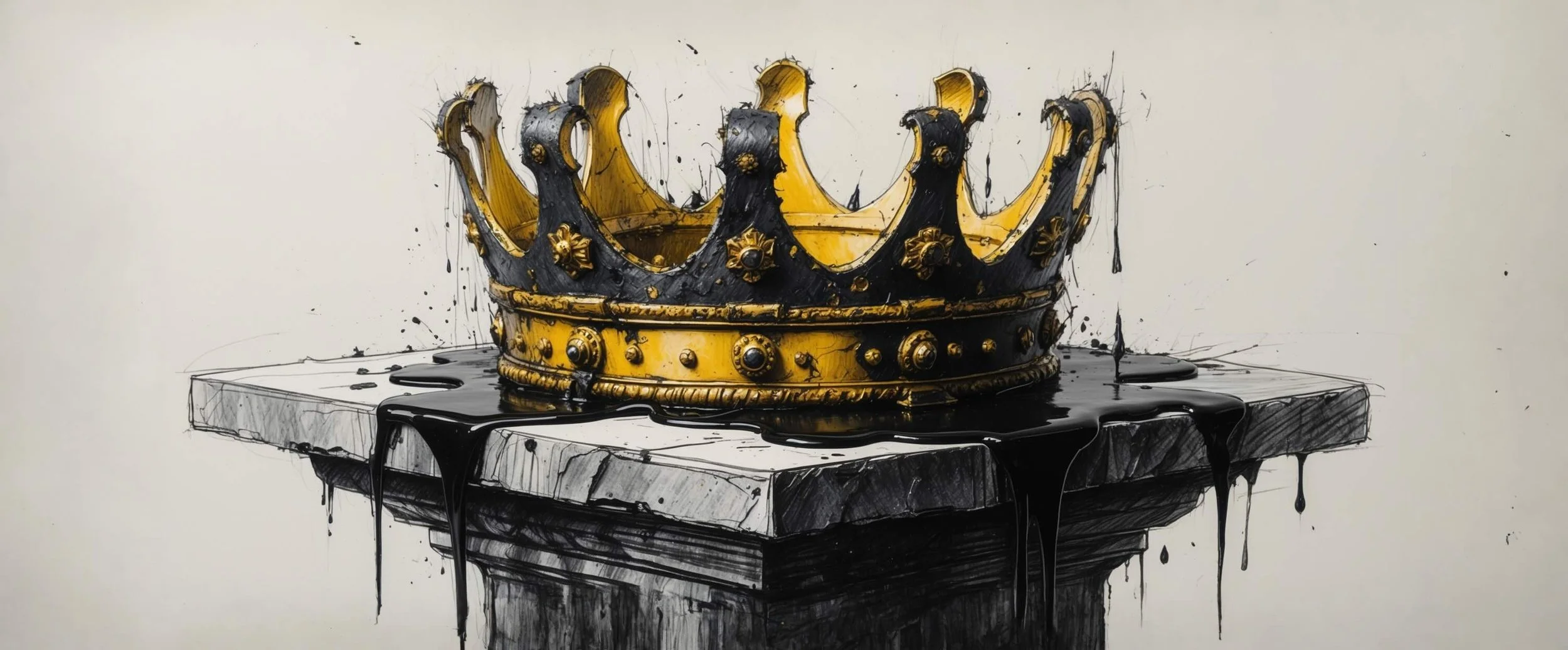
Theme Profile – At a Glance
- Focus: Rottenness as the play's master-image – the way disease, poison and decay carry the moral and political corruption of Denmark.
- Key Characters: King Claudius, Prince Hamlet, The Ghost, Queen Gertrude, Polonius.
- The Core Tension: A poison poured in one ear has spread through a whole kingdom. The sickness is hidden, and the cure may be as deadly as the disease.
- Key Manifestations: The Ghost's tale of the poison in the ear; the "unweeded garden" soliloquy; Claudius's "rank" offence; the ulcer and impostume images of Acts 3 and 4; the final poisoned cup and blade.
- Famous Quote:
"Something is rotten in the state of Denmark."
(Act 1, Scene 4) - The Outcome: The hidden corruption surfaces and consumes everyone it has touched. The royal house is poisoned to death, and a foreign prince inherits a state that had to be emptied before it could be cleansed.
The Sickness Beneath the Surface
More than any other Shakespeare play, Hamlet thinks in the language of the body. Where Macbeth reaches for blood and King Lear for the storm, Hamlet reaches again and again for the imagery of rot, ulcers, impostumes and infection. The kingdom is not simply badly governed – it is ill. Something has gone wrong beneath the skin of Denmark, and the play keeps pressing on the swelling to show how deep it goes.
The keynote is struck early, in the very first soliloquy, before Hamlet knows anything of murder. The world itself already tastes of decay.
Original
Fie on't! Ah fie! 'Tis an unweeded garden,
That grows to seed; things rank and gross in nature
Possess it merely. That it should come to this!
(Act 1, Scene 2)
Shakespeare Retold (Modern Verse)
Damn it! Oh, damn! It's a neglected garden,
Once planted, but now overrun with weeds,
Destroying what it was. How could this happen?
The garden is Eden after the Fall: a place meant to be cultivated, now choked by "things rank and gross." That single word "rank" – overgrown, foul-smelling, festering – will recur through the play like a returning symptom. Hamlet senses the corruption before he can name its source. His instinct that the world has spoiled is, it turns out, exactly right. The garden has a serpent in it, and the serpent now wears the crown.
The Poison in the Ear
The literal origin of the play's disease is a poison, and Shakespeare makes it a poison poured into a sleeping man's ear. It is a grotesquely intimate crime – murder delivered through the organ of listening, of trust, of confession. When The Ghost describes his death, he describes an infection running through the whole nation at once.
Original
A serpent stung me; so the whole ear of Denmark
Is by a forged process of my death
Rankly abused: but know, thou noble youth,
(Act 1, Scene 5)
Shakespeare Retold (Modern Verse)
A serpent bit me; so now all of Denmark
Has heard a made-up lie of how I died
Through pure deception; but know this, young man,
The image is precise. It is not one man's ear that has been poisoned but "the whole ear of Denmark" – the entire kingdom has swallowed a lie. The private murder and the public deception are the same act of corruption, working at two scales. The poison that killed one king is now circulating through the body politic, and everyone in Denmark has, without knowing it, been infected by the cover story. The serpent that "did sting thy father's life" now wears his crown, and the rot at the top has begun to spread downward.
The Rank Offence and the Rotten King
If Denmark is diseased, Claudius is the disease. He is the usurper, the poisoner, the incestuous brother – and the play's most concentrated images of corruption gather around him. The astonishing thing is that he knows it. Alone at prayer, Claudius diagnoses his own sin in exactly the play's controlling vocabulary.
Original
O, my offence is rank it smells to heaven;
It hath the primal eldest curse upon't,
A brother's murder.
(Act 3, Scene 3)
Shakespeare Retold (Modern Verse)
This crime of mine now stinks to highest heaven!
It's cursed like Cain who executed Abel,
So murdering his brother.
"Rank" again, and now the corruption is olfactory: the sin literally stinks, rising to heaven like the smell of something rotting. Claudius reaches for the oldest crime of all – Cain's murder of Abel – the first brother-killing, the original spoiling of the human family. The corruption of Denmark is not merely a present political problem; it is a re-enactment of the Fall itself. And the man at the centre of it can name his own decay perfectly while remaining powerless to repent of it. Self-knowledge, in this play, is no cure.
The Ulcer That Mines All Within
The most sustained disease image comes in the closet scene, when Hamlet confronts Gertrude. He warns her not to comfort herself that his words are merely madness, because to do so would be to let the real sickness fester unseen. The metaphor he chooses is medical and exact.
Original
It will but skin and film the ulcerous place,
Whilst rank corruption, mining all within,
Infects unseen.
(Act 3, Scene 4)
Shakespeare Retold (Modern Verse)
For that will only hide the real infection,
Which, left unchecked, will spread throughout your soul,
Corrupting from within.
This is the play's whole vision of corruption in three lines. A thin film of healthy-looking skin grows over the ulcer; underneath, the infection goes on "mining all within," hollowing out the body while the surface looks intact. It is the perfect figure for a court where everything appears orderly and a marriage looks like a celebration, while beneath the surface the rot eats steadily through. Denmark's tragedy is that the disease is invisible until it has done its work. By the time the corruption surfaces – in the final scene's pile of bodies – there is nothing left to save.
"He is the ambassador of death walking amid life."
— G. Wilson Knight, The Wheel of Fire, 1930
Key Quotes on Disease and Corruption
Quote 1
The leperous distilment; whose effect
Holds such an enmity with blood of man
That swift as quicksilver it courses through
The natural gates and alleys of the body,
(Act 1, Scene 5)
Shakespeare Retold (Modern Verse)
That toxic arsenic, whose swift effect
Contaminates the flowing blood of man,
The same as mercury will swiftly flow
Throughout the body's arteries and veins,
Quote Analysis: The Ghost's account of his own poisoning is the play's most literal image of corruption, and it sets the pattern for everything figurative that follows. The "leperous distilment" does not merely kill – it courses through "the natural gates and alleys of the body," curdling the blood like sour milk. The detail matters because it teaches us how to read the rest of the play. When Hamlet later talks of ulcers and impostumes, he is not reaching for fanciful metaphors; he is describing what we have already watched happen to a real body. The political corruption of Denmark is built on this one act of physical poisoning, and the imagery never lets us forget it.
In the rank sweat of an enseamed bed,
Stewed in corruption, honeying and making love...
(Act 3, Scene 4)
Shakespeare Retold (Modern Verse)
Within a horrid, semen covered bed,
Dripping with corrupting, sordid sex...
Quote Analysis: Here the disease imagery turns sexual, and Hamlet's disgust is at its most violent. The marriage bed of his mother and uncle is "rank" – that recurring word again – and "stewed in corruption," as though the act of love had become a process of rot. For Hamlet, the incest is not a separate crime from the murder but the same corruption seen from another angle: a moral sickness that has spoiled the most intimate space in the kingdom. The harshness of the language tells us how completely he has come to see Denmark's decay in physical terms. Where others see a remarriage, he smells putrefaction.
This is the imposthume of much wealth and peace,
That inward breaks, and shows no cause without
Why the man dies.
(Act 4, Scene 4)
Shakespeare Retold (Modern Verse)
It's like an abscess, caused with wealth and peace,
That bursts inside a man without revealing
The cause of death.
Quote Analysis: An "imposthume" is an abscess – a swelling full of poison that grows in secret and bursts inwardly, killing without any visible wound. Hamlet uses the image to describe the war for a worthless patch of Polish ground, but it carries far beyond that. It is a diagnosis of a whole society grown sick on "wealth and peace," where prosperity has bred a hidden rottenness that "shows no cause without." The line crystallises the play's central worry: that the most dangerous corruption is the kind that cannot be seen from outside, that looks like health right up to the moment it kills.
For like the hectic in my blood he rages,
And thou must cure me: till I know 'tis done,
Howe'er my haps, my joys were ne'er begun.
(Act 4, Scene 3)
Shakespeare Retold (Modern Verse)
For he is coursing through my veins like fever,
And you must cure me. Till I hear it's done,
Despite my fortunes, joy has not begun.
Quote Analysis: The irony here is total. Claudius, the source of Denmark's disease, now speaks of Hamlet as if Hamlet were the fever in his blood that must be cured. The poisoner casts himself as the patient. He plans to have Hamlet killed in England as a doctor might lance an infection – "thou must cure me" – which means murder has become, in his mind, a form of medicine. The disease language has turned back on the diseased man, and he cannot hear it. The man who poured poison in his brother's ear now imagines that one more death will make him well.
Key Takeaways
- Rot Is the Master-Image: Hamlet thinks in the language of disease – ulcers, impostumes, infection, poison. The imagery is the argument: Denmark is a sick body, not just a badly run state.
- The Poison Spreads from the Top: Claudius's crime is a literal poisoning that becomes a political one. The murder of one king infects "the whole ear of Denmark."
- Corruption Hides Beneath the Skin: The most frightening sickness in the play is the kind that "mines all within" while the surface looks healthy. The court looks orderly until the rot finally surfaces.
- The Cure Is as Deadly as the Disease: Everyone tries to treat the corruption by adding more of it. Claudius "cures" himself with murder, and the final cure empties the whole kingdom.
Study Questions and Analysis
Why is disease imagery so important in Hamlet?
Disease imagery is not decoration in Hamlet – it is the play's way of thinking. Shakespeare reaches repeatedly for ulcers, impostumes, infection, "rank" growth and poison, and the pattern is dense enough that critics have treated it as a key to the whole work.
The foundational study is Caroline Spurgeon's 1935 Shakespeare's Imagery and What It Tells Us, which counted and categorised Shakespeare's images play by play. Spurgeon found that the dominant image-pattern in Hamlet is that of sickness, disease and blemish in the body – an ulcer or tumour secretly destroying a body that looks well on the surface – and she read this as Shakespeare's picture of the unwholesome moral condition of Denmark. Once you see the pattern, it is everywhere: the "unweeded garden," the "ulcerous place," the "imposthume," the "hectic" in Claudius's blood.
Wolfgang Clemen's 1951 The Development of Shakespeare's Imagery developed the point, treating the disease and decay imagery not as isolated metaphors but as a connected atmosphere that the audience absorbs almost without noticing. The images do not just describe corruption; they make the audience feel that the whole world of the play is unwell.
The deeper reason the imagery matters is that it solves a dramatic problem. The corruption at the heart of Denmark is hidden – a secret murder, a concealed usurpation, a marriage that looks like a celebration. The disease imagery gives Shakespeare a way to keep that hidden rottenness present in the audience's mind even in scenes where no one mentions the crime. The court can look perfectly healthy while every image reminds us that it is dying from within.
What does "Something is rotten in the state of Denmark" actually mean?
The line is spoken by Marcellus in A1S4, as he and Horatio follow Hamlet and the Ghost into the dark. It is one of the most quoted lines in the play, and it works on two levels at once.
On the surface, it is a reaction to the supernatural: a dead king is walking the battlements in armour, and that is a sign that something has gone badly wrong. But the word "rotten" reaches past the ghost to the political and moral state of the kingdom. Marcellus does not yet know about the murder, the usurpation or the incest – and yet his instinct names exactly what is wrong. The word feels truer than the speaker can possibly understand.
This is one of Shakespeare's favourite techniques: a minor character voices a truth he cannot fully grasp. "Rotten" introduces the play's controlling metaphor in a single word – decay, putrefaction, a body spoiling from within. Everything that follows, from the unweeded garden to the festering ulcer, elaborates this one image. The corruption is not a problem the kingdom has; it is a condition the kingdom is. The state itself is the rotting thing.
A. C. Bradley, in his 1904 Shakespearean Tragedy, located the play's atmosphere precisely in this sense of a noble world poisoned at its source – a court of real warmth and intelligence in which something has gone fundamentally and fatally wrong. Marcellus's line is where that atmosphere first becomes audible.
How is Claudius the source of the play's corruption?
Claudius is not merely a corrupt man in a healthy kingdom; he is the infection itself. The disease imagery of the play radiates outward from his single original crime – the poisoning of his brother – and Shakespeare is careful to make the political corruption a direct consequence of the physical one.
The crime begins as a literal poisoning, recounted by the Ghost in A1S5. The poison is poured into a sleeping ear and runs through the body curdling the blood. From there the corruption becomes political: a usurped throne, a hasty incestuous marriage, a kingdom told a "forged" story about how its king died. The remarkable thing is that Claudius can diagnose his own rottenness with complete clarity.
O, my offence is rank it smells to heaven;
It hath the primal eldest curse upon't,
A brother's murder.
(Act 3, Scene 3)
Shakespeare Retold (Modern Verse)
This crime of mine now stinks to highest heaven!
It's cursed like Cain who executed Abel,
So murdering his brother.
The word "rank" ties his private sin to the public sickness: the same adjective that describes the unweeded garden and the enseamed bed now describes his soul. By linking his murder to Cain and Abel, Claudius admits that his crime is the oldest corruption of all. Yet self-knowledge does not heal him – "Pray can I not," he confesses moments later. G. Wilson Knight's 1930 The Wheel of Fire offered a famously contrarian reading, arguing that Claudius runs a warm and capable court and that Hamlet is the diseased, death-bringing element within it. Most readers resist Knight's defence of the murderer, but his essay is valuable precisely because it forces the question of where the play locates its sickness – in the usurper, or in the avenger who carries death wherever he goes.
How does the "ulcer" imagery connect corruption and concealment?
The ulcer is the play's central image because it is corruption that hides. Hamlet uses it in the closet scene to warn Gertrude that flattering herself about his madness would only let the deeper sickness fester.
It will but skin and film the ulcerous place,
Whilst rank corruption, mining all within,
Infects unseen.
(Act 3, Scene 4)
Shakespeare Retold (Modern Verse)
For that will only hide the real infection,
Which, left unchecked, will spread throughout your soul,
Corrupting from within.
The medical detail is exact: a thin layer of skin grows over the wound, the surface looks healed, and underneath the infection goes on "mining all within." This is corruption that works precisely because it cannot be seen. It is the perfect figure for a court built on concealment – a smiling king, a celebratory wedding, a kingdom that appears stable while the rot eats through its core.
This is why the disease theme and the appearance-versus-reality theme are inseparable in Hamlet. Corruption that announced itself could be cut out; corruption that "infects unseen" is fatal. Claudius understands this perfectly and weaponises it, hoping, as he says in the closet of his own conscience, to keep his disease from "divulging." The whole tragedy turns on the gap between a healthy-looking surface and the sickness mining away beneath it. The ulcer is the play's argument compressed into a single, unforgettable image.
Why does Shakespeare make the murder weapon a poison?
The choice of poison – rather than a sword or a public execution – is central to the play's meaning, and Shakespeare draws our attention to it twice over: once in the original murder, and again in the final scene, where poison kills nearly everyone left alive.
Poison is the perfect weapon for a play about hidden corruption. It is secret, internal and silent. It does its work from within, leaving no visible wound, and it spreads. The Ghost's account makes the physical process vivid.
And a most instant tetter barked about,
Most lazar-like, with vile and loathsome crust,
All my smooth body.
(Act 1, Scene 5)
Shakespeare Retold (Modern Verse)
And quickly I was covered in a rash,
Like leprosy, with awful, ugly blisters
Covering my skin.
The poison turns the dead king's "smooth body" into something "lazar-like" – leprous, crusted, loathsome. Even the literal poisoning is described as a disease. And the method matters thematically: poison administered through the ear is corruption delivered through trust and language, the very channels by which a court is supposed to communicate honestly. The crime that founds the play is an abuse of intimacy.
The poison then returns structurally at the end. The cup, the "union" pearl, the envenomed blade – the corruption that began as one secret poisoning becomes a public, indiscriminate killing that takes Gertrude, Laertes, Claudius and Hamlet together. The disease that started in one ear finishes by consuming the whole royal body. Poison is not just the weapon; it is the play's theory of how corruption works – invisibly, internally, and until it has spread too far to stop.
How are disease and moral corruption linked in the play?
The link is the play's deepest move: physical sickness and moral evil are described in the same words, so that the audience cannot separate them. When Hamlet talks of rot, ulcers and infection, he is always talking about sin at the same time – and when Claudius talks of sin, he reaches instinctively for the language of disease.
This fusion is what gives the imagery its force. The "unweeded garden" is both an overgrown plot and a fallen moral world. The "rank" offence both stinks physically and offends heaven. The enseamed bed is both a sexual image and a moral one – love "stewed in corruption." Shakespeare never lets the audience treat the disease as merely metaphorical; the literal poisoning at the play's root keeps the physical and the moral welded together.
Wolfgang Clemen argued in 1951 that this is precisely how Shakespeare's mature imagery works – not as isolated comparisons but as a sustained atmosphere in which the moral condition of a world is felt through its physical images. In Hamlet, the result is that Denmark's moral corruption is never abstract. We do not simply know the kingdom is wicked; we are made to feel that it is ill, with a sickness we can almost smell.
There is a theological dimension too. The imagery repeatedly recalls the Fall – the spoiled garden, the curse of Cain, the serpent in the orchard. The corruption of Denmark is presented as a local re-enactment of the original corruption of humankind, which is why it feels less like a crime to be solved than a sickness to be endured. The moral and the medical are, in this play, the same diagnosis.
Does the corruption get cured by the end of the play?
This is the bleakest question the theme raises, and the play's answer is deeply ambivalent. The corruption is removed, but only by destroying almost everything it had infected – and the play is sceptical that you can cure this kind of sickness without killing the patient.
Throughout the play, every attempt to treat the corruption only adds more of it. Claudius's repeated logic is that disease must be met with drastic remedy.
Deliberate pause: diseases desperate grown
By desperate appliance are relieved,
(Act 4, Scene 3)
Shakespeare Retold (Modern Verse)
Must seem unbiased. Hideous diseases
Are cured by equally as awful treatment,
Claudius uses the language of medicine to justify murder: a "desperate" disease – Hamlet – requires "desperate appliance." But every cure in the play is itself an act of corruption. Claudius treats the sickness with more poisoning; Hamlet treats it with more killing. By the final scene, the "cure" has emptied the stage of the entire royal house.
What remains is genuinely cleansing in only one limited sense. The poisoned bloodline is gone, and A. C. Bradley read the close of Shakespearean tragedy as restoring a kind of moral order at a catastrophic price – the evil is purged, but so is almost everything good. Fortinbras arrives to take a throne swept clean by death rather than healed. The corruption is not so much cured as burned out, and the kingdom that survives is one in which there was nothing left to infect. Whether that counts as a cure or simply as the end of the disease is the question the play leaves deliberately open.