Julius Caesar: Act 1, Scene 1 – Analysis
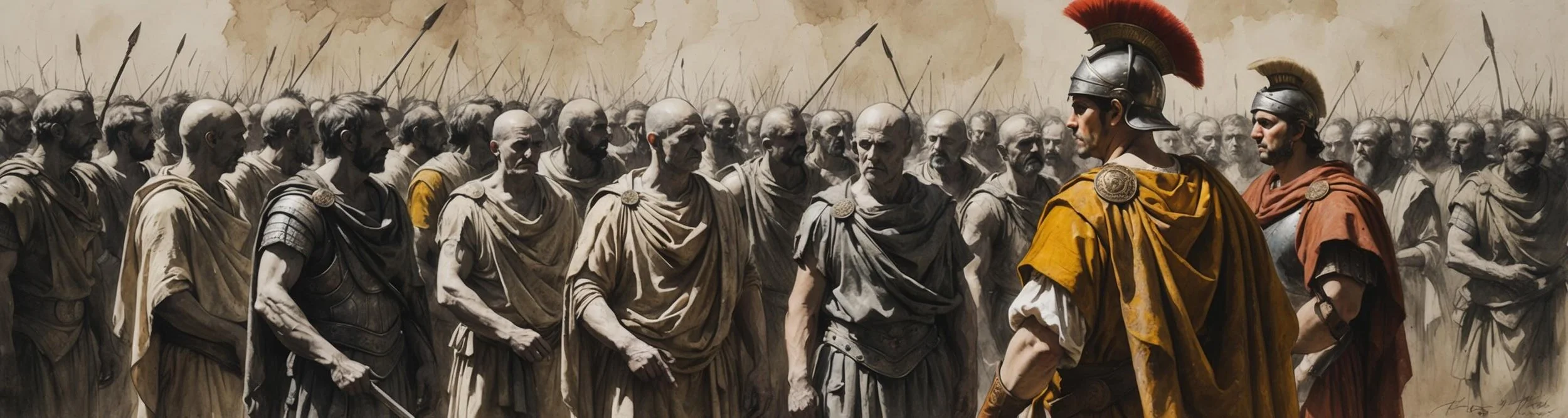
Scene Profile – At a Glance
- Location: A street in Rome.
- What Happens: Two tribunes, Flavius and Marullus, scold a crowd of working men for taking a holiday to celebrate Caesar's triumph, and drive them home.
- Key Characters: Flavius and Marullus (tribunes), and a carpenter and a cobbler from the crowd.
- Dramatic Function: The opening scene sets the play's political temperature: Rome is divided over Caesar before he ever appears on stage.
- Famous Quote:
"You blocks, you stones, you worse than senseless things!"
(Marullus, Act 1, Scene 1) - Why It Matters: It shows the fickle Roman crowd and the fear Caesar's rise already provokes – the unease that the conspiracy will soon exploit.
Scene Summary
The play opens on a Roman street crowded with ordinary working men who have downed tools to enjoy a public holiday. Two tribunes – officials meant to protect the common people – are furious to find them idle and out of their work clothes. Flavius demands to know their trades.
A carpenter answers plainly, but a cobbler teases Marullus with a string of puns on his job, calling himself a "mender of bad soles". Once the joking stops, the men admit they have come out to cheer Caesar as he returns in triumph.
This is what enrages the tribunes. Marullus reminds the crowd how they once cheered for Pompey, the very man Caesar has just defeated, and shames them for their disloyalty. The chastened commoners slip away, and Flavius and Marullus agree to strip the celebratory decorations from Caesar's statues, hoping to check his growing power before it climbs out of reach.
The Crowd and the Cobbler
Shakespeare opens not with his great men but with ordinary Romans, and he gives them prose rather than verse – the everyday speech of the street. The cobbler's cheeky wordplay sets the tone: he describes himself as a mender of "bad soles", punning on the shoes he repairs and the souls he might save, and refuses to give a straight answer until pressed. It is light comedy, but it carries a serious point. These are the people whose support makes or breaks a leader, and they are easily swayed and quick to celebrate whoever is winning.
Original
A trade, sir, that, I hope, I may use with a safe conscience; which is, indeed, sir, a mender of bad soles.
(Second Commoner, Act 1, Scene 1)
Shakespeare Retold (Modern Verse)
My job, sir, which may I say that I'm proud of, is mending broken souls.
The humour also does something cleverer. By letting the cobbler run rings around an angry official, Shakespeare shows the tribunes' authority is not as solid as they think. The crowd obeys in the end, but only after being told off, and the same crowd will later be turned with equal ease by Mark Antony. The fickleness introduced here as a joke becomes deadly serious by the play's middle.
Marullus and the Memory of Pompey
The mood darkens the moment Caesar's name is mentioned. Marullus rounds on the crowd with a long, rhythmic speech that reminds them how they once climbed walls and towers, children in their arms, to cheer Pompey through these same streets. Now they dress up to applaud the man who spilled Pompey's blood. The rebuke is built on a single charge: ingratitude.
Original
And do you now strew flowers in his way
That comes in triumph over Pompey's blood?
(Marullus, Act 1, Scene 1)
Shakespeare Retold (Modern Verse)
And aren't you throwing flowers in his path
To celebrate his murdering of Pompey?
Marullus's anger is also fear. A crowd that switches its love so quickly is dangerous, because it can be steered by whoever speaks to it most powerfully. The tribunes sense that Caesar is using these celebrations to build a cult around himself, and that the people are happy to play along. Their attempt to shame the crowd is really an attempt to slow a tide they can feel rising.
Clipping Caesar's Wing
Left alone, the tribunes turn from telling-off to action. They split up to tear the decorations – the "trophies" and "ceremonies" – from Caesar's statues. Flavius explains their thinking in an image that gives the scene its sharpest political point.
Original
These growing feathers plucked from Caesar's wing
Will make him fly an ordinary pitch,
Who else would soar above the view of men
And keep us all in servile fearfulness.
(Flavius, Act 1, Scene 1)
Shakespeare Retold (Modern Verse)
By stopping Caesar's fans, we'll clip his wings
And bring him down to earth with all of us
Instead of soaring high above us all,
Repressing us through scared obedience.
The image of a bird whose feathers must be plucked before it climbs too high captures the fear running under the whole play: that one man is about to rise so far above the rest that everyone else will live in "servile fearfulness". The tribunes act first, but they act small, fiddling with statues. Within scenes, others will decide that only Caesar's death can clip the wing for good.
Language and Technique
- Prose for the crowd: The commoners speak in everyday prose, marking them out from the verse-speaking tribunes and the noblemen to come – class is built into the sound of the speech.
- Punning: The cobbler's jokes on "soles" / "souls" and on "mending" lighten the opening while quietly showing that authority can be mocked.
- Rhetorical questions: Marullus fires question after question at the crowd ("Wherefore rejoice? What conquest brings he home?"), a technique of public persuasion the play will return to again and again.
- Bird imagery: Flavius's picture of plucking feathers from Caesar's "wing" turns abstract fear of tyranny into one clear, physical image.
Key Quotes from Act 1, Scene 1
Quote 1Hence! Home, you idle creatures get you home:
Is this a holiday? What! Know you not,...
(Flavius, Act 1, Scene 1)
Shakespeare Retold (Modern Verse)
Come on, clear off back home, you lazy buggers!
D'you think this is a day off? Don't you know,...
Wherefore rejoice? What conquest brings he home?
What tributaries follow him to Rome,
To grace in captive bonds his chariot-wheels?
(Marullus, Act 1, Scene 1)
Shakespeare Retold (Modern Verse)
Why are you celebrating? What's he won?
Which foreign princes has he overthrown?
How many slaves are tied behind his cart?
Knew you not Pompey? Many a time and oft
Have you climbed up to walls and battlements,
To towers and windows, yea, to chimney-tops,
Your infants in your arms, and there have sat...
(Marullus, Act 1, Scene 1)
Shakespeare Retold (Modern Verse)
Don't you remember Pompey? Many times
You climbed upon the walls and battlements,
Up towers, to windows, even chimney tops,
Your children in your arms, and there you sat...
Key Takeaways
- Rome is divided: Before Caesar appears, the play shows a city split between his supporters and those who fear him.
- The crowd is fickle: The same people who once adored Pompey now cheer the man who killed him – a fickleness that drives the later action.
- Class is audible: The commoners speak comic prose; the tribunes speak verse. Status is built into how characters sound.
- Fear of one-man rule: Flavius's image of clipping Caesar's wing introduces the play's central anxiety about unchecked power.
Study Questions and Analysis
Why does Shakespeare begin the play with ordinary citizens rather than Caesar?
Opening with tribunes and tradesmen rather than with Caesar himself is a deliberate choice that shapes how we read everything that follows. Instead of meeting Caesar as a hero, we first hear him discussed – and the discussion is hostile. The crowd's holiday mood and the tribunes' anger establish the central political question of the play before its central figure has spoken a word: is Caesar a saviour or a threat?
The scene also plants the idea of the crowd as a force in its own right. M. W. MacCallum, in his 1910 study Shakespeare's Roman Plays and Their Background, stressed how seriously Shakespeare takes the Roman populace as a political player, and that interest begins here. The people who cheer Caesar in this scene are the same people Brutus and then Antony will compete to control in Act 3, so showing how changeable they are at the outset prepares us for the forum scenes, where their change of heart decides the fate of Rome.
What is the effect of the cobbler's punning?
The wordplay does more than raise a laugh. By having a tradesman tie an official in knots with jokes about "soles" and "souls", Shakespeare quietly undercuts the tribunes' authority and shows that the common Romans are not simply stupid – they are quick, evasive, and able to mock their supposed betters when it suits them.
It also sets up a contrast in register. The play moves between the plain prose of the street and the high verse of the senate, and this opening exchange tunes our ear to both. The comedy is the lightest moment in a play that turns very dark very fast, and its lightness is part of the design: the holiday spirit the tribunes try to crush is exactly the popular feeling Caesar has learned to harness.
How does Marullus persuade the crowd, and why does it matter for the rest of the play?
Marullus does not lecture the crowd so much as work on their emotions. He uses a barrage of rhetorical questions, a vivid memory of their past devotion to Pompey, and a sharp accusation of ingratitude. The technique is pure persuasion, and it succeeds: the commoners leave "tongue-tied in their guiltiness".
Run to your houses, fall upon your knees,
Pray to the gods to intermit the plague
That needs must light on this ingratitude.
(Marullus, Act 1, Scene 1)
Shakespeare Retold (Modern Verse)
Run home, and fall upon your knees to pray
That gods will halt their plague upon you all
That you deserve for your ingratitude.
This matters because the play is, among other things, a study of rhetoric and crowd control. Marullus shows that the Roman people can be moved by a skilful speaker; Brutus and Antony will later prove the same point on a far larger stage. The forum scene in Act 3 is essentially this exchange writ large, with the survival of the republic in the balance.
What does the imagery of clipping Caesar's wings suggest about the play's politics?
Flavius imagines Caesar as a bird that will "soar above the view of men" unless his "growing feathers" are plucked. The image frames the play's argument in miniature: Caesar's power is rising, and the question is whether ordinary checks can hold it down or whether something more drastic is needed.
It is also quietly ominous. Plucking feathers is a small, almost domestic act, but the logic behind it – that Caesar must be cut down before he climbs too high – is the same logic that will lead Cassius and Brutus to the knives. The tribunes try the gentle version and are, we later learn, "put to silence" for it. Their failure suggests that, in this Rome, half-measures against Caesar do not survive.
Is the scene sympathetic to Caesar or to those who oppose him?
Shakespeare is careful not to settle the question. The tribunes are protecting the republic against one man's dominance, which can look noble; but they are also sour, snobbish, and quick to bully a holiday crowd, which is not attractive. Caesar, meanwhile, is absent and so cannot defend himself, yet the very celebrations the tribunes resent suggest he is genuinely loved.
This even-handedness is typical of the play. Ernest Schanzer, in The Problem Plays of Shakespeare (1963), argued that Julius Caesar deliberately refuses to give us a clear hero or villain, holding rival political readings open so that the audience must weigh them. That balancing act starts in this first scene: we are given reasons to fear Caesar and reasons to distrust his opponents, and we are left to judge.