
Home → Plays → Julius Caesar → Characters
Julius Caesar: Characters
Julius Caesar character analysis for all 8 main characters — Brutus, Julius Caesar, Mark Antony, Cassius, Portia, Calpurnia, Octavius and Casca. Each profile explores the character's psychology, motivation, and tragic flaw, supported throughout by a modern verse translation and key quotes.
A complete character study guide and revision resource for GCSE, A-Level, AP English, IB, and undergraduate Shakespeare — equally useful to teachers and actors. Select a character below to begin.
Julius Caesar
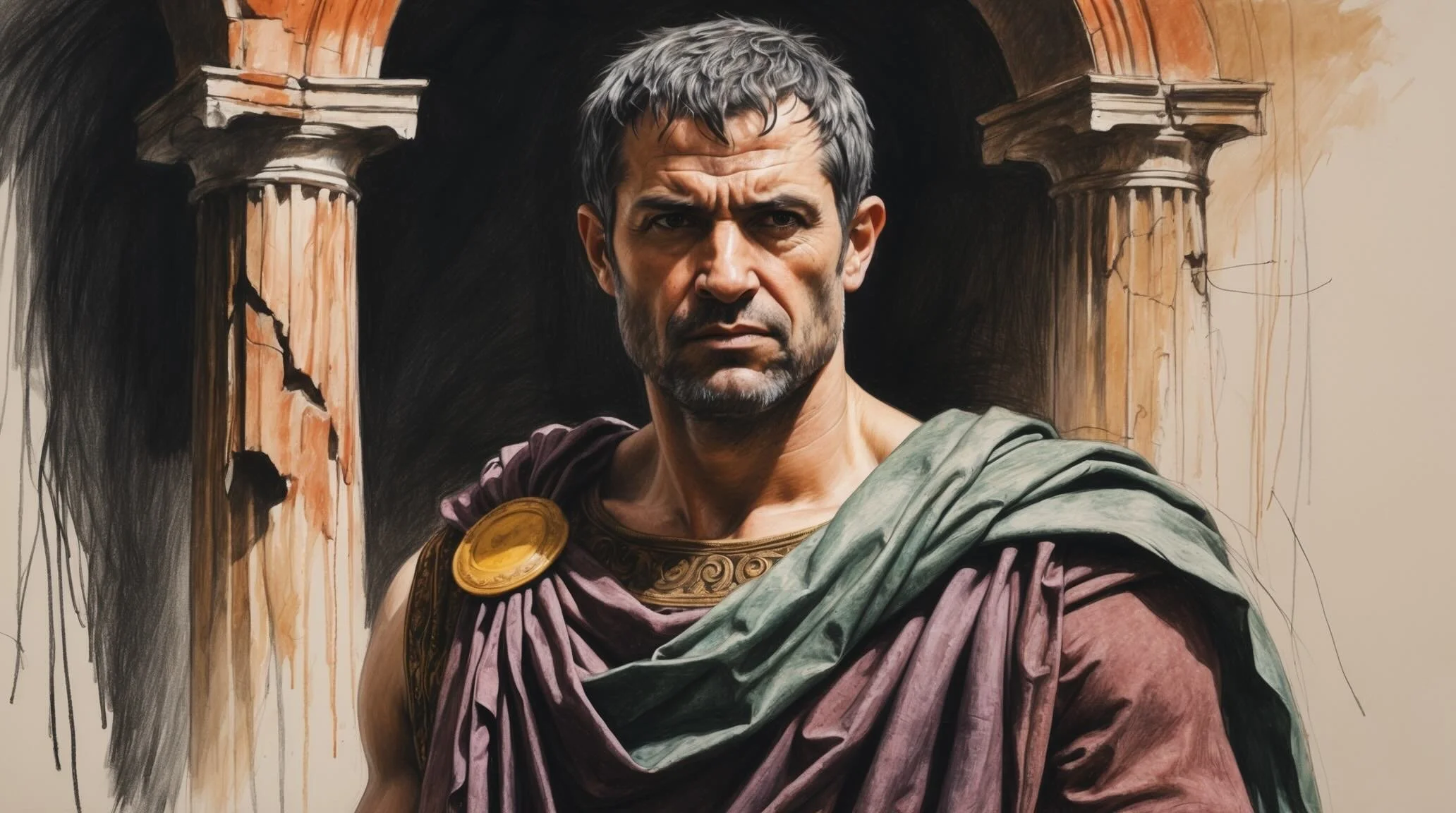
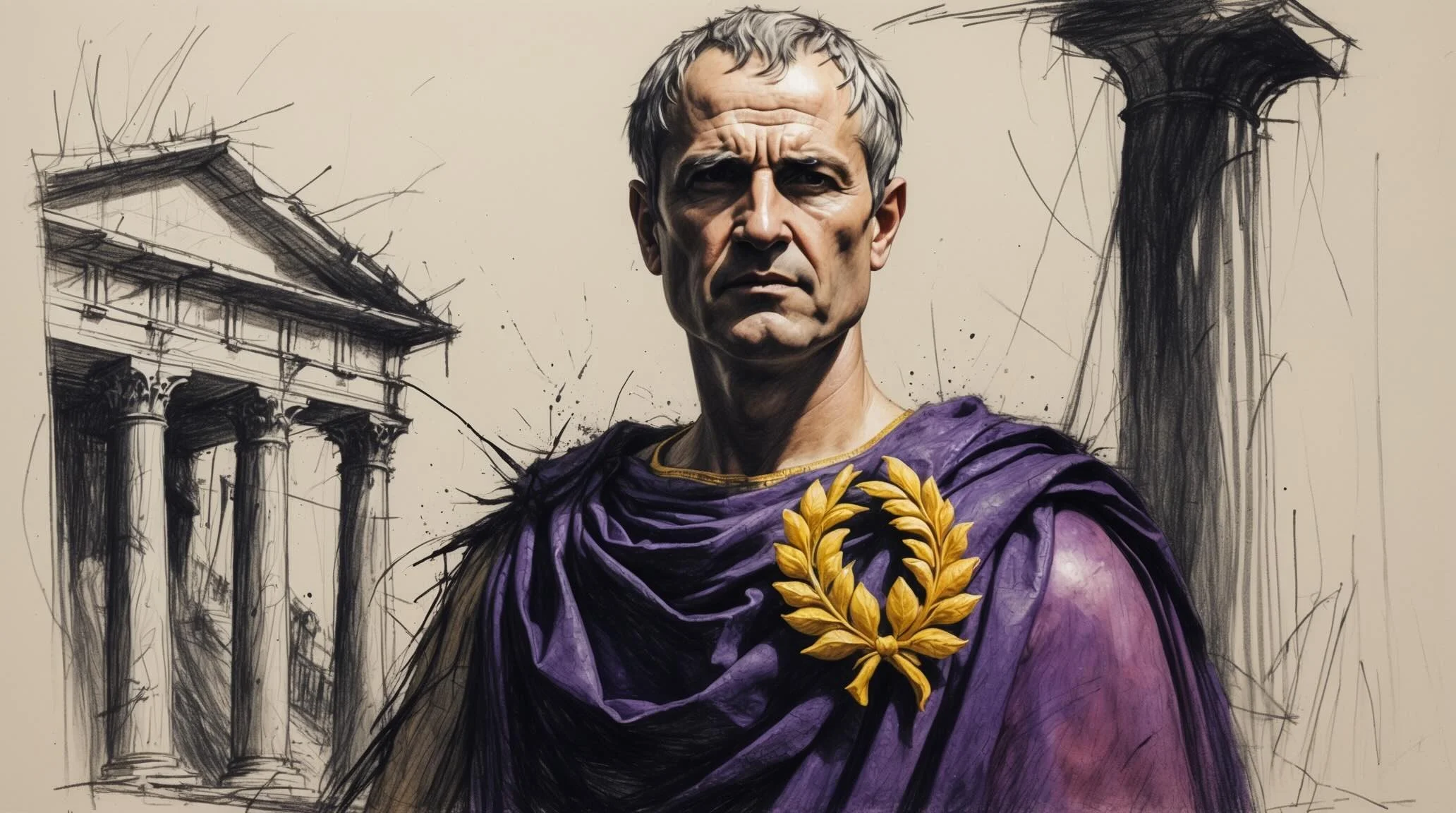
The play's title character: general, dictator of Rome, whose murder turns the whole tragedy.
Mark Antony
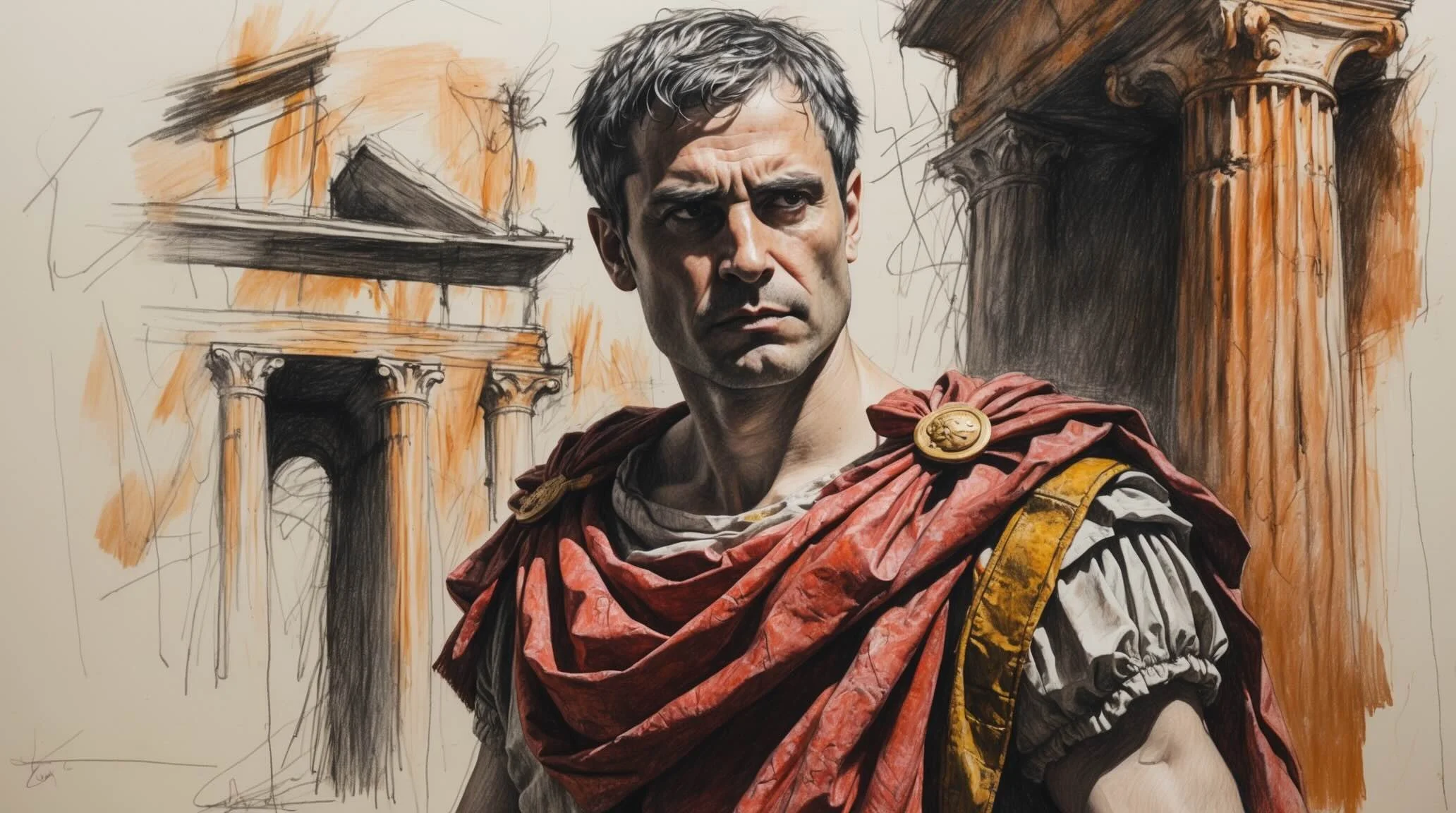
Caesar's closest friend and the play's finest orator, whose funeral speech turns Rome against the conspirators.



Supporting Cast
Beyond the eight figures who carry the main action, Julius Caesar is populated by senators, conspirators, citizens, and soldiers whose presence shapes the play in ways the central drama does not always make explicit. The wider cast is grouped below by their function within the political world of Rome.
The Other Conspirators
Decius Brutus
The flatterer who talks Caesar out of staying home on the Ides by reinterpreting Calpurnia's dream as a sign of imperial promise. Without his persuasion, Caesar never reaches the Senate.
Trebonius
The tactical conspirator who draws Mark Antony aside as Caesar enters the Capitol, ensuring the strike happens without intervention. A small role; without it, no assassination.
Metellus Cimber
The kneeling petitioner whose plea for his banished brother is the planned cue. At Caesar's refusal — "I could be well moved, if I were as you" — the daggers come out.
Cinna
A minor conspirator who delivers Cassius's forged letters to Brutus's window. Shares a name with Cinna the Poet, whose mistaken death in Act 3 turns the coincidence into the play's bleakest joke.
Caius Ligarius
The sick man who rises from his bed to join the conspiracy on Brutus's reputation alone — the play's clearest evidence of the moral authority Brutus carries within the plot.
Caesar's Rome
Lepidus
The third triumvir alongside Antony and Octavius, dismissed by Antony as "a slight unmeritable man" fit only to be sent on errands. Survives the play, diminished.
Popilius Lena
The senator whose whispered word to Caesar moments before the strike briefly terrifies the conspirators that the plot has been discovered. A single line of dialogue, perfectly placed.
Artemidorus
The sophist who tries to give Caesar a written warning naming each conspirator by name. Caesar refuses to read what concerns himself most — "What touches us ourself shall be last served."
The Soothsayer
The unnamed figure whose "Beware the Ides of March" opens the play's prophetic register. Correct in every detail; ignored as a matter of imperial principle.
Publius
The elderly senator brought along to lend dignity to Caesar's procession. Present at the assassination but spared by Brutus, who orders him kept safe from the crowd's panic.
The People of Rome
Flavius and Marullus
The tribunes who open the play, scattering the celebrating crowd and stripping decorations from Caesar's statues. "Put to silence" off-stage — the first political casualties of Caesar's rise.
The Cobbler
The witty plebeian who jests with the tribunes about mending soles and souls, establishing the social register of Rome's streets in the play's opening minutes.
The Plebeians
The collective body of Roman citizens whose loyalty swings within minutes from Brutus to Antony during the funeral orations — the fastest political reversal in the Shakespearean canon.
Cinna the Poet
Torn apart by the mob for sharing the conspirator's name — and for his bad verses. The play's savage joke about how political violence finds its targets.
The Camp at Philippi
Lucius
Brutus's young boy servant, who falls asleep playing music on the eve of the battle. The only figure in the play whose function is purely tender.
Pindarus
Cassius's bondman, who holds the sword Cassius runs upon at Philippi. Freed by the act, he flees Rome forever.
Titinius
Cassius's lieutenant, sent to scout the field and mistakenly thought captured. His return finds Cassius dead by Pindarus's hand, and he kills himself with the same sword.
Strato
The servant who steadies Brutus's sword so that Brutus can run upon it. The last gentle act in a brutal play.
Messala
Friend to both Brutus and Cassius, the messenger who brings the news of Portia's death. Survives Philippi and goes over to Antony's side, as Brutus had urged.
Lucilius
Brutus's loyal officer, who pretends to be Brutus to allow him to escape. Antony, recognising the honourable deception, spares him and welcomes him into his own service.
Young Cato
Marcus Cato's son and Portia's brother, killed at Philippi defending Brutus's cause — the Stoic family's last sacrifice to the dying Republic.
Others
Cicero
The famous orator, briefly present during the storm in Act 1, Scene 3; reported off-stage as one of seventy-odd senators marked for death on the triumvirs' proscription list in Act 4.
The Carpenter
The commoner questioned by the tribunes in the play's opening lines, before the Cobbler takes over the exchange with his punning on soles and awls.
The Poet
A figure separate from Cinna the Poet, who interrupts Brutus and Cassius's tent reconciliation at Sardis with a clumsy plea to "love, and be friends," and is dismissed by Brutus as a "jigging fool."
Varro and Claudius
Brutus's servants who sleep in his tent at Sardis while Lucius plays music. Their presence on stage frames the Ghost of Caesar's first appearance to Brutus.
Clitus, Dardanius, and Volumnius
Brutus's three followers at Philippi, each in turn asked by him to hold his sword for his suicide; each refuses. Strato eventually does the office.
The Ghost of Caesar
The apparition that appears to Brutus on the eve of Philippi, identifying itself as "thy evil spirit." Returns wordlessly on the battlefield as Brutus's defeat closes in.
Servants and Messengers
The various unnamed figures who carry word between the play's factions: Caesar's servant reporting the augurers' findings, Antony's servant requesting an audience, Octavius's servant announcing his approach to Rome. Each delivers plot but has no character of his own.
Frequently asked questions about the characters in Julius Caesar
Who are the main characters in Julius Caesar?
The play has eight significant figures. Brutus is a Roman senator and the play's true protagonist by every traditional measure. He is the principled conspirator whose tragic arc the action follows.
Julius Caesar is the play's title character — victorious general, dictator of Rome, and the man whose assassination at the centre of Act 3 pivots the entire tragedy.
Mark Antony is Caesar's closest friend and the play's most accomplished orator. His funeral oration turns Rome against the conspirators in a single afternoon. Cassius is the conspiracy's instigator and the play's most calculating mind — the man who manipulates Brutus into joining the plot.
Portia is Brutus's wife and Cato's daughter. She is the most articulate woman in the play. Calpurnia is Caesar's wife and the play's accurate prophetess.
Octavius is Caesar's adopted heir and the future Augustus — the cold political inheritor who closes the play. Casca is a senator and conspirator, the cynical eyewitness to the Lupercal crown ceremony and the man who strikes Caesar first.
Who is the protagonist of Julius Caesar?
The title is misleading.
By every traditional measure — longest part, most soliloquies, the tragic arc, the play's moral weight — Brutus is the central figure, not Caesar. Caesar himself is dead by the midpoint of Act 3. He has fewer than 150 lines across the entire play. And he shares the second half with characters who outweigh him in stage time and rhetorical reach.
Brutus, by contrast, has 194 speeches — the highest of any character. He has the orchard soliloquy of 2.1, the funeral oration of 3.2, the quarrel and reconciliation with Cassius in 4.3, and the suicide at Philippi in 5.5.
Hazlitt, writing in 1817, was one of the earliest critics to make this case explicitly, and modern criticism has largely confirmed it.
Antony's eulogy in 5.5 — "This was the noblest Roman of them all" — names Brutus, not Caesar, as the figure whose death is the play's emotional peak.
Marjorie Garber, in Shakespeare After All, suggests the play has effectively two endings. One is tragic (Brutus's). One is imperial (Octavius's). The tragic ending — and therefore the play's protagonist — is Brutus.
Why is the play named after Caesar if Brutus is the protagonist?
The choice is one of Shakespeare's most-debated decisions, and several explanations work together.
First, the practical reason. Caesar is the historical figure whose death the audience already knows about. Naming the play after him orients them to the action being staged.
Second, the political reason. The title carried a particular weight in 1599. Elizabeth I was nearing the end of her reign without a named successor, and a play about the assassination of a popular ruler in republican Rome could speak to English anxieties without speaking too directly.
Third, the deeper reason. Caesar's name is itself the play's central political object — the inheritance that passes from Julius to Octavius, the cult around which the conspiracy organises, the spirit that "ranges for revenge" through the second half of the action.
Cassius's dying line — "Caesar, thou art revenged, even with the sword that killed thee" — names what the play has been showing throughout. Even after his death, Caesar is the figure the action is about.
The title is, in this sense, accurate. Brutus carries the tragic arc. But Caesar's name is the political fact the play is investigating.
What roles do the women play in Julius Caesar?
The play has only two named women — Portia and Calpurnia — and Shakespeare uses them with care.
Both wives are placed in adjacent scenes (2.1 and 2.2) for direct comparison. Both kneel to their husbands. Both are right. Both are overridden.
Portia, Brutus's wife and the daughter of Cato the Younger, argues from logic and family lineage in 2.1. She proves her resolve by giving herself a thigh wound. She dies offstage by swallowing burning coals — an act consistent with her father's stoic suicide tradition.
Calpurnia, Caesar's wife, argues from dreams and omens in 2.2. She briefly persuades Caesar to stay home. She is overruled within fifty lines by Decius Brutus's flattering reinterpretation of her dream.
Hazlitt's 1817 reading captures the pairing exactly: "the interest which Portia takes in Brutus and that which Calphurnia takes in the fate of Caesar are discriminated with the nicest precision."
Both women are accurate. Both are unable to govern the catastrophe their accuracy predicts. The pairing is one of Shakespeare's most pointed commentaries on the limits of female political voice in the Roman world the play depicts.
How are the conspirators differentiated from each other?
The play takes considerable care to give each conspirator a distinct political and philosophical character.
Brutus is the principled Stoic — the man joining for the "common good to all," whose moral seriousness Antony will later acknowledge.
Cassius is the calculating manipulator — the conspiracy's first mover, whose "mixed nature of motives" (Hazlitt's phrase) combines republican principle with personal grievance and a hot temper.
Casca is the cynic — prose-spoken, contemptuous of public ceremony, and the man who strikes Caesar first with "Speak, hands for me!"
Decius Brutus, though a smaller part, is the flatterer who reinterprets Calpurnia's dream and brings Caesar to the Senate. The play also includes Cinna, Trebonius, Metellus Cimber, and Ligarius — each given a particular role in the planning and execution.
The differences matter because Antony's funeral oration depends on them. When Antony names "envious Casca" and "well-belovèd Brutus" in turn, he is using the distinctions the play has built to assign each conspirator a different moral charge.
Antony's final eulogy — "all the conspirators save only he / Did that they did in envy of great Caesar" — confirms the pattern. Brutus alone joined for principled reasons. The others are distinguished from him by motive.
Who survives the play's catastrophe?
The play ends with most of its central figures dead.
Caesar is murdered at the centre of Act 3. Cassius takes his own life on his birthday at Philippi in 5.3. Brutus follows him by running on Strato's sword in 5.5.
Portia has died offstage between Acts 3 and 4 by swallowing burning coals. Casca disappears from the action after the assassination scene and is presumed killed in the general defeat at Philippi. Calpurnia vanishes from the play after 2.2 and is not heard from again.
The survivors are Antony, Octavius, and the lesser figures of the triumvirate.
Antony has won the war. But as Marjorie Garber notes in Shakespeare After All, his "predilection for chaos makes him more suited to misrule than to rule." Shakespeare's later play Antony and Cleopatra will track his eventual defeat by Octavius at Actium.
Octavius survives as the play's quietly rising figure. He speaks the closing lines and begins the long political settlement that history records he will found as the emperor Augustus.
The republic the conspiracy claimed to defend has not survived. The empire that follows will outlast the actors in its founding by four centuries.
How does the Julius Caesar character set compare to Shakespeare's other tragedies?
Julius Caesar is one of Shakespeare's most distinctively political tragedies, and the cast reflects the genre.
Where Hamlet shows us a court, Lear a kingdom, and Othello a marriage, Julius Caesar shows us a republic — and the cast is the political class of late republican Rome. There are eight significant named figures, all of them senators, generals, or wives of senators.
The play has no domestic subplot in the formal sense. No fool. No comic relief in the manner of the porter in Macbeth or the gravediggers in Hamlet.
The characters are also unusually male-centred in their major exchanges. The two longest scenes between any two characters are both between men: the temptation of Brutus by Cassius in 1.2, and the quarrel between the same two men in 4.3.
Hazlitt judged the play "inferior in interest to Coriolanus, and both in interest and power to Antony and Cleopatra." Modern criticism has largely set this verdict aside. The play's compression and political seriousness have, if anything, gained in standing.
What it lacks in domestic warmth it makes up for in political sharpness. The character set is the small group of figures around whom an entire republic falls. The play's cold focus on this group is one of the things that makes it, even now, the most-staged of Shakespeare's Roman plays.