Julius Caesar
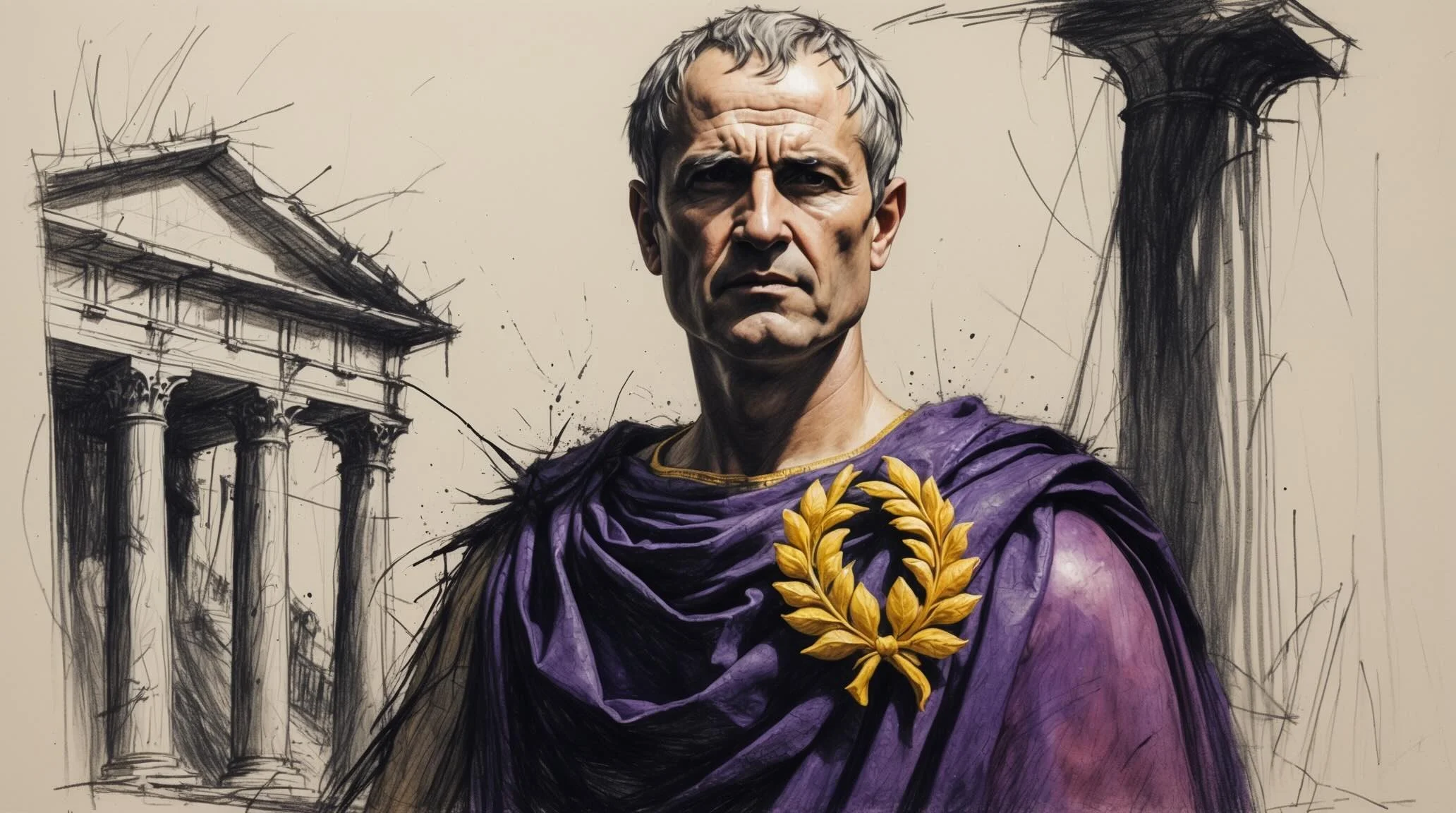
Character Profile – At a Glance
- Role: The play’s title character: general, dictator of Rome, and husband of Calpurnia. His murder at the centre of the play is the hinge the whole tragedy turns on.
- Key Traits: Charismatic and commanding in public; privately superstitious and physically frail. He is deaf in one ear, prone to fits, and increasingly given to talking about himself in the third person.
- The Core Conflict: He has built a public image so godlike that he can no longer hear an ordinary warning – from his wife, the soothsayer, or his own priests. On the morning of the ides, that refusal kills him.
- Key Actions: Returns in triumph in A1S1; refuses the crown three times at the Lupercal in A1S2; brushes off the soothsayer in A1S2 and again in A3S1; nearly stays home in A2S2 until Decius Brutus reinterprets Calpurnia’s dream as a vision of glory; refuses to recall Cimber from exile in A3S1; is stabbed with "Et tu, Brute! Then fall, Caesar"; returns as a ghost to Brutus in A4S3.
- Famous Quote:
"Et tu, Brute! Then fall, Caesar."
(Act 3, Scene 1) - The Outcome: Murdered in the Senate at the play’s midpoint; his ghost appears to Brutus in Act 4; his name passes to Octavius, who will rule as Augustus. The play named after him spends its whole second half on the consequences of his death.
The Soothsayer’s Warning
Caesar’s first appearance, in the Lupercal procession of A1S2, turns on one small moment. As he passes through the crowd, a soothsayer calls out to him, and the short exchange that follows is the play’s first glimpse of the gap between the public Caesar and the private one.
The exchange is brief and pointed:
Original
SOOTHSAYER: Beware the ides of March.
CAESAR: What man is that?
BRUTUS: A soothsayer bids you beware the ides of March.
CAESAR: Set him before me; let me see his face.
CASSIUS: Fellow, come from the throng; look upon Caesar.
CAESAR: What say'st thou to me now? Speak once again.
SOOTHSAYER: Beware the ides of March.
CAESAR: He is a dreamer; let us leave him: pass.
(Act 1, Scene 2)
Shakespeare Retold (Modern Verse)
SOOTHSAYER: Beware of March 15th.
CAESAR: Which man said that?
BRUTUS: A fortune teller warns of March 15th.
CAESAR: Bring him before me; let me see his face.
CASSIUS: Come from the crowd, dear man; look upon Caesar.
CAESAR: What do you say now? Tell me once again.
SOOTHSAYER: Beware of March 15th.
CAESAR: This man is mad. Let’s leave him. Carry on.
Watch the shape of it. Caesar hears the warning, calls the man forward to look at him, hears it a second time, and then waves it away in a single word: "dreamer." He is not deaf to the warning and he is perfectly able to act on it. What he will not do is be the kind of man who takes a fortune-teller seriously in public. The same scene quietly tells us the rest: that Caesar is going deaf in one ear, that he is subject to the falling sickness, that Cassius once had to haul him, exhausted, out of the Tiber. So from his very first scene there are two Caesars on stage at once – the towering public figure walking through Rome, and the ageing, ailing, superstitious body underneath. That split is the whole of Shakespeare’s portrait, and it only widens from here.
The Night Before the Ides
By A2S2 Caesar is up in the night in his nightgown, unable to sleep. Calpurnia has been crying out in her dreams, the priests cannot find a heart in the sacrificed animal, and the night is full of bad omens. His answer to all this is one of his most famous speeches – and one the play places with deliberate irony.
Original
Cowards die many times before their deaths;
The valiant never taste of death but once.
Of all the wonders that I yet have heard.
It seems to me most strange that men should fear;
Seeing that death, a necessary end,
Will come when it will come.
(Act 2, Scene 2)
Shakespeare Retold (Modern Verse)
Cowards die many times before their deaths;
The bravest only die a single time.
Of all the strange things I’ve heard people say,
The strangest thing to me is men that fear death,
For death is something that comes to us all,
And comes when it will come.
The lines are calm, Stoic, and magnificent – and the man saying them has, minutes earlier, been pacing the house over his wife’s nightmares, and will, minutes later, agree to stay home because she kneels to him. Shakespeare is making a point with that placement. The philosophy is real Caesar: this is genuinely how he wants to face death. But the shaken husband who would rather not go out today is real Caesar too. Both are true at once, and the play never lets us forget it. When Decius Brutus arrives, he knows exactly which of the two to play to. The moment he reframes Calpurnia’s bloody dream as a dream of glory, the public Caesar – the one who would sooner die than be seen taking orders from his wife – is the Caesar who calls for his robe.
The Refusal in the Senate
A3S1 is the play’s hinge, and Caesar’s grandest statement of himself lands just before the knives come out. Metellus Cimber is begging for his banished brother to be recalled; Caesar, ringed by senators, refuses in one of the longest portraits of public self-image anywhere in Shakespeare.
Original
But I am constant as the northern star,
Of whose true-fixed and resting quality
There is no fellow in the firmament.
The skies are painted with unnumbered sparks,
They are all fire and every one doth shine,
But there’s but one in all doth hold his place:
So in the world; ’tis furnished well with men,
And men are flesh and blood, and apprehensive;
Yet in the number I do know but one
That unassailable holds on his rank,
Unshaked of motion: and that I am he...
(Act 3, Scene 1)
Shakespeare Retold (Modern Verse)
But I’m as steady as the sky’s North Star,
That sits unmoving each and every night;
There’s nothing in the heavens that’s more stable.
The skies shine with innumerable stars;
They all glow brightly, shining in the night.
But there is only one that doesn’t move.
The world is just the same; it’s full of men,
All made the same, with intellect and fear.
But out of all these men, I know just one
Whose own opinion never will be altered
By outside influence; and that is me.
This is the play’s bleakest joke. Caesar has spent the whole morning being moved – moved to stay home by his wife’s dream, moved to change his mind again by Decius’s flattery, moved to ignore the soothsayer one last time – and here he stands, in front of the very men who have come to kill him, declaring himself the one fixed point in the sky that nothing can move. It is also his last chance to be moved, and he refuses it. The conspirators strike within fifteen lines, and his final answer to a kneeling petitioner is to ask whether a mere man could shift a mountain. The figure who has just called himself as constant as the stars dies because he would not, one last time, bend to listen.
The Death and the Ghost
Caesar’s murder is one of the most studied moments in all of Shakespeare, and what carries down four centuries is the four-word recognition he gives Brutus’s blade.
Original
Et tu, Brute! Then fall, Caesar.
(Act 3, Scene 1)
Shakespeare Retold (Modern Verse)
And you as well, Brutus? Then Caesar dies.
Half Latin, half English, half question, half surrender – it is the most concentrated piece of stage-writing in the play. The historical Caesar, in Plutarch, says nothing when he sees Brutus among his killers; the Latin tag was already a stage cliché before Shakespeare used it. What Shakespeare adds is the second half: "Then fall, Caesar." Seeing Brutus is not just a personal blow; it is the moment Caesar gives himself leave to die. The man who has insisted all play that he cannot be moved accepts death the instant he sees that the friend he trusted most has joined the rest. And death does not end him. He comes back as a ghost in A4S3 – "thy evil spirit," he tells Brutus – and the second half of the play, for all his physical absence, is largely the working-out of his revenge. The dying Cassius says it outright at Philippi: "Caesar, thou art revenged, even with the sword that killed thee." The man dies in Act 3; the spirit does not.
"We do not much admire the representation here given of Julius Caesar, nor do we think it answers to the portrait given of him in his Commentaries. He makes several vapouring and rather pedantic speeches, and does nothing. Indeed, he has nothing to do."
— William Hazlitt, Characters of Shakespeare’s Plays, 1817
Key Quotes
Quote 1
Let me have men about me that are fat;
Sleek-headed men and such as sleep o’ nights...
(Act 1, Scene 2)
Shakespeare Retold (Modern Verse)
Make sure I am surrounded by large men,
Well groomed, and make sure they are fully rested.
Quote Analysis: Caesar wants comfortable, well-fed men around him, not the lean and watchful sort. It sounds like a throwaway preference, but it is really a shrewd read on Cassius, and it shows a Caesar who can see the danger clearly. The tragedy is that seeing it changes nothing: he names the threat and then walks straight into it, because acting on the warning would mean admitting he can be threatened at all.
Quote 2
Yond Cassius has a lean and hungry look;
He thinks too much: such men are dangerous.
(Act 1, Scene 2)
Shakespeare Retold (Modern Verse)
Cassius, over there, looks lean and hungry.
He thinks too much, and men like him are dangerous.
Quote Analysis: One of the most quoted character-judgements in Shakespeare, and a strikingly accurate one. Caesar sizes up Cassius in a sentence and gets him exactly right. It is proof that Caesar is no fool – his instincts are sharp. What undoes him is not blindness but pride: he sees the danger plainly and then declines to be the kind of man who acts on what he sees.
Quote 3
The cause is in my will: I will not come;
That is enough to satisfy the senate.
(Act 2, Scene 2)
Shakespeare Retold (Modern Verse)
My wish will be reason. I won’t come.
That is enough to satisfy the Senate.
Quote Analysis: Deciding, for the moment, to stay home, Caesar gives no reason beyond his own wish – and treats that as reason enough for the Senate. It is the autocrat speaking plainly: his will is its own justification. The irony is sharp. Minutes later he reverses the decision to avoid looking ruled by his wife, which shows that even this "will" can be steered – by anyone who flatters the public Caesar rather than crosses him.
Quote 4
Hence! Wilt thou lift up Olympus?
(Act 3, Scene 1)
Shakespeare Retold (Modern Verse)
Do you think you’ll move a mountain?
Quote Analysis: Caesar’s last full sentence before the blades fall, thrown at a conspirator kneeling to plead. To ask him to change his mind, he says, is like trying to lift a mountain. It is the northern-star boast in miniature – pure, immovable self-belief – and it lands seconds before the murder proves how movable he was all along. The line is the play’s final, savage demonstration of the gap between the Caesar in Caesar’s head and the man on the Senate floor.
Key Takeaways
- The Public and the Private Self: Caesar is two men at once – the public colossus and the ageing, ailing private body – and the gap between them is the heart of the play’s portrait of him.
- The Fatal Pattern: He hears every warning – the soothsayer, Calpurnia, the priests, Artemidorus – and dismisses each one, not because he cannot hear it but because heeding it would mean admitting he can be warned at all.
- Dies in Act 3, Wins by Act 5: The play named after him spends its whole second half on the fallout of his death. Cassius’s dying line, "Caesar, thou art revenged," only says aloud what the structure has already made plain.
- The Title Character, Not the Lead: Caesar has fewer than 150 lines and is dead by the midpoint, yet the action orbits him from start to finish. He is the play’s centre of gravity rather than its protagonist.
Study Questions and Analysis
Is Caesar the protagonist of his own play?
The question has split critics since the early nineteenth century, and the play’s own choices make it a hard one. Caesar is dead by the middle of Act 3, has fewer than 150 lines, and shares the second half with Brutus, Antony, Cassius, and Octavius, all of whom outweigh him in stage time. By every usual measure of a tragic lead, Brutus is the centre: the longest part, the most soliloquies, the moral arc the play follows. William Hazlitt, writing in 1817, was openly let down by Shakespeare’s Caesar, judging that he "makes several vapouring and rather pedantic speeches, and does nothing." Modern criticism has moved past Hazlitt’s disappointment but has not put Caesar back at the centre. Marjorie Garber, in Shakespeare After All (2004), suggests the play has two endings, one tragic and focused on Brutus, one imperial and focused on Octavius, with Caesar presiding over both rather than driving either. The most useful answer is probably that Caesar is the play’s centre of gravity rather than its protagonist: the figure everything orbits, but not the figure whose inner journey the play actually tracks.
Why does Caesar speak about himself in the third person?
It is one of the play’s most-noted habits, and it grows as the action goes on. In A1S2 he does it occasionally; by A2S2 he does it more; by A3S1 he does it almost constantly. The clearest single instance comes when he overrides Calpurnia’s fears.
Yet Caesar shall go forth; for these predictions
Are to the world in general as to Caesar.
(Act 2, Scene 2)
Shakespeare Retold (Modern Verse)
But Caesar will go out, for these predictions
Are for the world in general, not just Caesar.
Several things are happening at once. Rhetorically, talking about "Caesar" as if he were someone else lets him summon his own reputation as a separate, public thing to argue from. Psychologically, it puts distance between the man and the name, and by Act 3 he is living more in the name than in the body. Dramatically, Shakespeare uses it to mark the split between the legend ("Caesar") and the human being actually speaking. The habit peaks in the murder itself – "Then fall, Caesar" – where the dying man names the falling figure in the third person, as though it is the public role, not the body, that is being killed. Within a few acts Octavius will inherit that name, and with it, in part, the third-person manner.
Is Caesar a tyrant, or is the conspiracy unjustified?
The play keeps the answer open on purpose, and modern criticism reads that openness as the point. The case for tyranny rests on what Caesar might do, not what he has done. In the action of the play he never claims the crown; he refuses it three times in public at the Lupercal; he keeps the outward forms of the republic. Cassius’s argument is about the direction of travel: the cult of personality, the gathering power, the fear that the next offer of the crown will be the one Caesar accepts. The case against the conspiracy rests on the gap between intention and evidence. Caesar is shown to be arrogant, vain, and superstitious, none of which is a capital crime, and he is given lines that show his settled refusal to fear anything at all.
Caesar shall forth: the things that threatened me
Ne’er looked but on my back; when they shall see
The face of Caesar, they are vanished.
(Act 3, Scene 1)
Shakespeare Retold (Modern Verse)
Caesar will leave. The things that threaten me
Look at me from behind. But when they’ll see
The face of Caesar, they will disappear.
Brutus’s own soliloquy in A2S1 – "It must be by his death" – is one of Shakespeare’s most honest portraits of a man arguing himself into an act he cannot quite justify. The play allows both readings and settles neither. The deeper question, which Marjorie Garber and others have pressed, is whether the killing, justified or not, was politically intelligent – and on that the play’s answer, the empire that follows, is not ambiguous at all.
What is the significance of Caesar’s deafness?
The detail is tiny and Shakespeare mentions it only once, but the placement is exact. In A1S2, having just delivered a sharp and accurate reading of Cassius as a dangerous man, Caesar turns to Antony and asks to be addressed on his good side, because the other ear cannot hear. The two halves of the moment sit side by side: he sees the danger clearly, and in the same breath presents an ear that physically cannot take in a warning. It comes right after one of his most revealing lines about himself.
I rather tell thee what is to be feared
Than what I fear; for always I am Caesar.
(Act 1, Scene 2)
Shakespeare Retold (Modern Verse)
I’m telling you the things that should be feared,
But not that which I fear, for I am Caesar.
The deaf ear becomes a quiet figure for the larger pattern. Caesar hears what he chooses to hear; the warnings he ignores all play long are not warnings he cannot receive but warnings he has decided, on one side, not to take in. "For always I am Caesar" is the whole of it – the public self that cannot afford to admit fear, presented to the world while the private man turns his good ear away. Modern productions have made a great deal of the detail; it is one of the most economical images of the man behind the legend.
Why does Caesar return as a ghost?
The ghost comes to Brutus at Sardis in A4S3, the night before the march to Philippi, and names itself only as "thy evil spirit." The appearance is short – under ten lines – and it does little more than promise to meet Brutus again at Philippi, which it does, in the shape of the battle that destroys him. Mechanically, Shakespeare takes the apparition from Plutarch. Dramatically, it does several jobs at once. It confirms that the play’s second half, for all Caesar’s absence, is largely his revenge, a reading the dying Cassius makes explicit in A5S3 with "Caesar, thou art revenged, even with the sword that killed thee." It unsettles the conspirators’ moral footing: Brutus has insisted the killing was necessary and honourable, and the ghost suggests, without quite arguing it, that something in the play’s universe disagrees. And it lets Shakespeare shrink the whole politics of the play into a single private haunting – the man who killed Caesar in the body is now hunted by him in spirit, and the chase ends with Brutus dead on the same kind of self-held blade.
How accurate is Shakespeare’s Caesar to the historical figure?
The play takes large liberties, most of them on purpose. Shakespeare compresses the timeline brutally: the assassination, the funeral, Antony’s oration, the will, and the arrival of Octavius all seem to happen in a single day, when in history they were spread over more than two months. He stages the murder on the Capitol rather than in the Curia of Pompey, where it actually took place. He merges the two Battles of Philippi, fought twenty days apart. He invents "Et tu, Brute" outright; the historical Caesar, in Plutarch, says nothing on seeing Brutus, and the Latin tag was already proverbial on the Elizabethan stage. He also leaves out much of what made the real Caesar formidable and popular: the Gallic Wars, the affair with Cleopatra (saved for Antony and Cleopatra), the political reforms. The Caesar of the play is a portrait of the man in his last weeks only: already a dictator, increasingly autocratic, and visibly edging towards a crown his public refusals have made convenient to claim. William Hazlitt’s 1817 complaint that this Caesar does not match the one in his own Commentaries is fair as far as it goes, but it misreads the intent. Shakespeare is not writing a biography; he is writing the tragedy of a single political moment, and that moment needs exactly the Caesar he has built.
What does Caesar’s death cost Rome?
The most direct answer comes from Antony in A3S1, alone with the body, in the prophecy the rest of the play sets about fulfilling: civil war will sweep Italy, and Caesar’s spirit, "ranging for revenge," will "cry Havoc, and let slip the dogs of war." It is borne out almost at once – the proscriptions of A4S1, the wars of Acts 4 and 5, the deaths of Brutus, Cassius, Portia, and many of the senators. The conspirators believed killing Caesar would save the republic; the play shows it did the opposite. Marjorie Garber notes that the figure who closes the action, Octavius, is a colder and more efficient heir to Caesar’s name than Caesar ever was, and the empire he founds will outlast the old republic by four centuries. The cost of Caesar’s death, in the play’s reckoning, is the death of the very thing the conspiracy set out to protect. Brutus’s tragedy, and arguably the play’s central lesson, is that he could not see this coming and could not have stopped it if he had. The conspirators’ principles were real; their reading of where their action would lead was catastrophically wrong.