Octavius
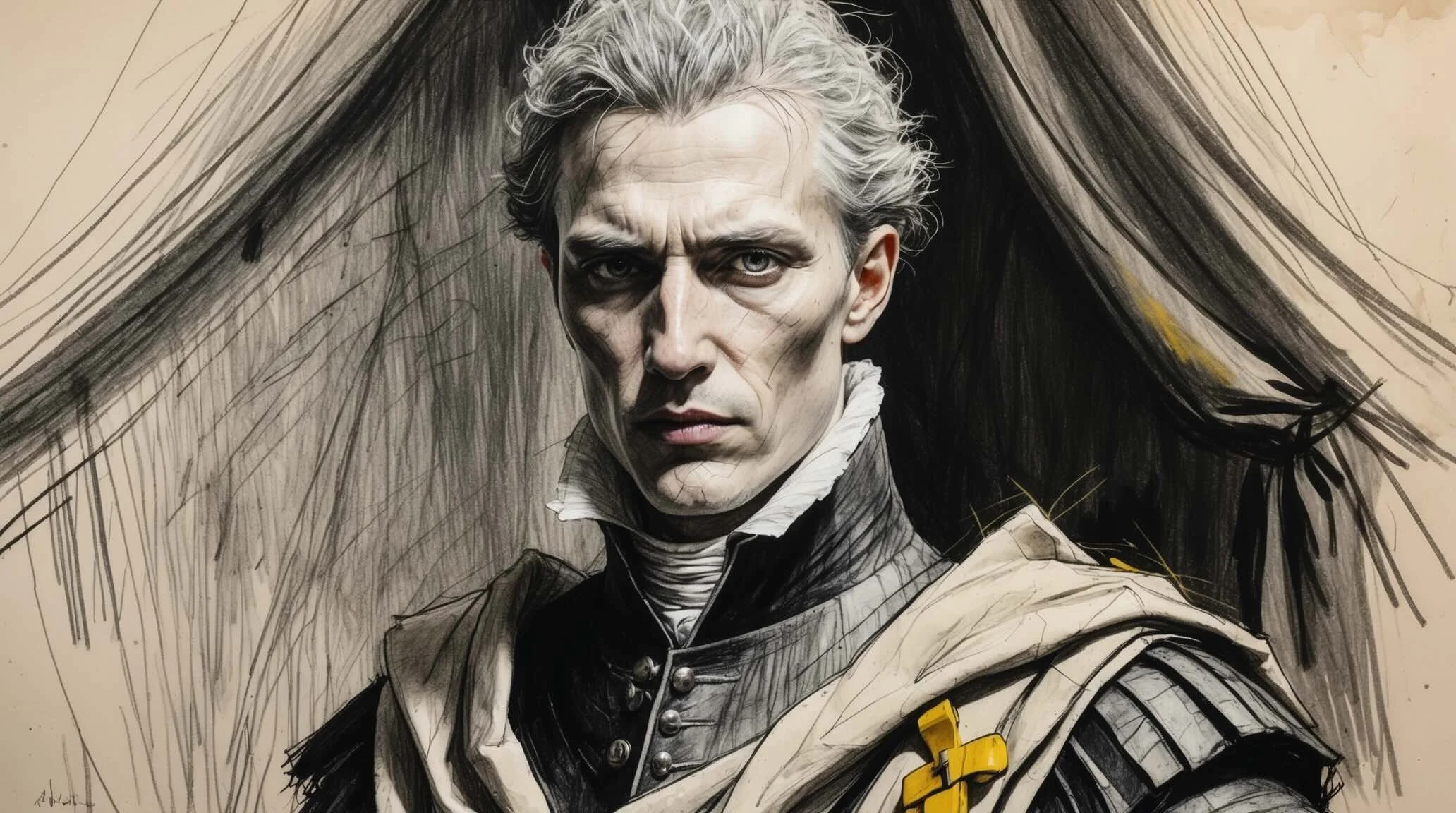
Character Profile – At a Glance
- Role: Caesar’s adopted heir and the third man of the Triumvirate, alongside Mark Antony and Lepidus. The play’s quietly rising figure: the future Augustus, in his first Shakespearean appearance.
- Key Traits: Cool, brief, and calculating. He marks men for death without flinching, grows steadily more assertive, and quietly gets the better of Antony by the end.
- The Core Conflict: His great-uncle has been murdered, and he is claiming the name. He must make himself a power fast, among older and more eloquent men, keeping Antony useful but never dominant.
- Key Actions: Sits at the proscription table in A4S1, marking names for death and overruling Lepidus; meets Brutus and Cassius at the Philippi parley in A5S1, swearing not to sheathe his sword until Caesar’s wounds are avenged; speaks the play’s final lines, ordering full military honours for the body of Brutus.
- Famous Quote:
"I do not cross you; but I will do so."
(Act 5, Scene 1) - The Outcome: Survives the play; ends it as the senior partner of the victorious faction; orders Brutus’s burial with full honours. The play’s last lines – "let’s away, / To part the glories of this happy day" – are his, and they carry the tragedy out into the empire that history records he would found.
The Boy at the Proscription Table
Octavius enters the play late, in A4S1, and it is one of Shakespeare’s quietest character introductions. He is at a table with Antony and Lepidus, and the three of them are marking the names of men who must be killed. The casualness of the scene is its whole horror.
Original
Your brother too must die; consent you, Lepidus?
…
Prick him down, Antony.
(Act 4, Scene 1)
Shakespeare Retold (Modern Verse)
Your brother too must die. Agreed, Lepidus?
…
Then mark his name down, Antony.
The two lines do an enormous amount of work. The youngest man in the room, the one with the least military experience, the figure others will dismiss within minutes as a "peevish schoolboy," is the one running the table. He proposes that Lepidus’s brother must die. He gives Antony the order to mark the name down. From its very first scene, the triumvirate is being shown to take its lead from Octavius, not to humour him. And the proscriptions – historically one of the bloodiest acts of late-republican politics – are conducted here with no flourish, no justification, and no visible regret. The man who will become Augustus has, in effect, already arrived; what this scene quietly shows Antony is that he is the junior partner.
The Quiet Refusal
The most revealing moment of the scene comes once Lepidus has been sent off on an errand and Antony, alone with Octavius, launches into a long contemptuous speech – Lepidus is "a barren-spirited fellow," fit only to be used "as a property," a horse to be ridden and turned loose. Octavius’s reply, set against all that heat, is almost offhand.
Original
You may do your will;
But he’s a tried and valiant soldier.
(Act 4, Scene 1)
Shakespeare Retold (Modern Verse)
Do as you please,
But he’s a tried and tested fearless soldier.
Here is the register Octavius will use again and again: brief, factual, and immune to Antony’s rhetorical heat. Antony has just spent twenty lines on contempt; Octavius answers in eight words and a comma. He does not deny Antony’s right to use Lepidus as he likes – "you may do your will" – but he will not join in the scorn either. A small, true fact ("a tried and valiant soldier") is set quietly against a long oration, and the placement is the whole point. Antony has not yet learned what the audience is being shown: that Octavius does not need to out-argue him. He only needs to outlast him.
The Crossing at Philippi
By A5S1, the play’s final movement, Octavius has come into focus. Antony gives him a tactical instruction; in front of the army, on the field, Octavius refuses it.
The exchange, in full:
Original
ANTONY: Octavius, lead your battle softly on,
Upon the left hand of the even field.
OCTAVIUS: Upon the right hand I; keep thou the left.
ANTONY: Why do you cross me in this exigent?
OCTAVIUS: I do not cross you; but I will do so.
(Act 5, Scene 1)
Shakespeare Retold (Modern Verse)
ANTONY: Octavius, lead your troops up stealthily
Along the left-hand flank of that flat field.
OCTAVIUS: I’ll take the right, and you can have the left.
ANTONY: Why contradict me at this crucial moment?
OCTAVIUS: I do not contradict you; I’ll obey you.
The joke at the heart of this is structurally serious. "I do not cross you; but I will do so" denies contradiction in the very breath that performs it: he tells Antony he is not crossing him while telling Antony that he is. The move is so quick that Antony – and many readers – let it slide, but it is the clearest sign in the play that Octavius has stopped accepting Antony’s seniority. He will obey, but only once obedience has been redefined to include doing the opposite. The military question (left flank or right) is trivial. The political one – who is actually in charge of the alliance – is not, and it has just been settled, in five lines, on the field.
The Final Word
Octavius speaks the play’s last lines, and the choice is one of Shakespeare’s most pointed pieces of structural commentary. Brutus is dead by his own hand; Cassius is dead; Antony has just delivered the famous eulogy ("This was a man!"); and the figure who steps forward to close the tragedy is the youngest man on stage.
Original
According to his virtue let us use him,
With all respect and rites of burial.
Within my tent his bones to-night shall lie,
Most like a soldier, ordered honourably.
So call the field to rest; and let’s away,
To part the glories of this happy day.
(Act 5, Scene 5)
Shakespeare Retold (Modern Verse)
Just like his traits, let’s treat him just the same,
With full respect and sacred rites of burial.
His corpse will lie within my tent tonight,
Just as a soldier would, with all the honour.
Tell all the troops to rest; let’s go away
And share the glories of this happy day.
The closing speech is short, formal, and politically perfect. Octavius accepts Antony’s praise of Brutus, orders full honours for the dead conspirator, and claims the body for his own tent – a quiet move that places Brutus, in death, under Octavius’s roof rather than Antony’s. Then he dismisses the field with "this happy day." The phrase is the speech’s deliberate jolt. The day has ended with Brutus, Cassius, Portia, and Caesar all dead and the republic in ruins, secured by means that included the killing of Lepidus’s brother and Antony’s nephew. To call it "happy" is either tone-deaf or coldly controlled, and the play does not tell us which. The last words belong to the man whose political instinct the whole second half has been quietly establishing – and the future the tragedy closes out into is the empire he will found.
"Octavius describes himself as ’another Caesar,’ avenging the memory of the first, although Octavius is less human, less flesh-and-blood, than Julius Caesar ever was."
— Marjorie Garber, Shakespeare After All, 2004
Key Quotes
Quote 1
I was not born to die on Brutus’ sword.
(Act 5, Scene 1)
Shakespeare Retold (Modern Verse)
I wasn’t born to die by Brutus’ sword.
Quote Analysis: Octavius’s reply to Brutus’s challenge at the parley, and the clearest statement of his sense of his own destiny. He does not refuse the fight on grounds of prudence; he refuses it on grounds of historical placement. He was born for something other than dying on a field at Philippi, and he says so without elaboration. The quiet certainty is what unsettles the moment – Brutus answers with patrician scorn, but Octavius has already moved on, and history, the audience knows, will prove him right.
Quote 2
All that served Brutus, I will entertain them.
(Act 5, Scene 5)
Shakespeare Retold (Modern Verse)
If you served Brutus, you can work for me.
Quote Analysis: Spoken almost in passing in the final scene, this is the victor’s housekeeping. The men who fought against him are simply absorbed into his service – no grudge, no triumph, just an efficient redistribution of useful people. It is the same coolness that ran the proscription table, turned now to consolidation rather than killing. The republic’s last soldiers become Octavius’s employees, and the line shows how naturally he thinks in terms of the order that comes after the fighting.
Key Takeaways
- The Cold Inheritor: Octavius’s job in the play is to inherit Caesar’s name without Caesar’s humanity – the warmth, charisma, and physical presence are gone, and what is left is pure political competence.
- The Proscription Scene: His first appearance shows him calmly at the table where Roman lives, including his colleagues’ relatives, are being marked for death – and the calm is the point.
- The Final Authority: "I do not cross you; but I will do so" is Shakespeare’s most economical demonstration of how Octavius works: he denies contradiction in the breath that enacts it, and the move is unanswerable.
- The Voice That Closes the Play: The last words of the tragedy are his, and the future they open onto is the imperial Rome that history records he will found.
Study Questions and Analysis
How does Octavius’s role change between Act 4 and Act 5?
The shift is one of the most discussed in the play. Marjorie Garber, in Shakespeare After All (2004), notes its precision: described early on by Cassius as "a peevish schoolboy" with no weight or experience, by Act 5 Octavius "is clearly the power to be reckoned with." The change is never announced; it is performed across small moments. In A4S1 he is the one proposing deaths at the proscription table; in A5S1 he refuses Antony’s tactical order with the cool "I do not cross you; but I will do so"; by the end of A5S5 he is ordering Brutus’s funeral honours and speaking the play’s last words. The transformation is essentially temporal: the rest of the cast is dying or losing, and Octavius, by surviving, listening, and never over-reaching, is consolidating. Garber’s structural reading of the play – that each act gives its centre to one figure, ending with Octavius – captures the architecture. The final act is his, and the consolidation of his power is part of what it dramatises.
What is the significance of the proscription scene in A4S1?
It is one of Shakespeare’s coldest pieces of political theatre, and one of the play’s most underdiscussed scenes. The Triumvirate – Antony, Octavius, and Lepidus – sit at a table marking the names of men to be killed in the reckoning after Caesar’s assassination, and the casualness is the horror. Lepidus consents to the death of his own brother in exchange for the death of Antony’s nephew; Octavius proposes deaths and keeps the list moving; and the moment Lepidus leaves on an errand, Antony delivers a long, contemptuous speech dismissing him as a useful animal. The scene does several things at once. It shows the cost of stability under the Triumvirate, which the play treats less as a settlement than as a transaction in human lives. It establishes Octavius’s coolness with the ledger of death, foreshadowing the ruler he becomes. And it quietly tells the audience that the men now in charge are, in their own way, no less ruthless than the Caesar whose murder they are avenging. The proscriptions were among the most violent acts in late-republican memory; Shakespeare gives them three pages, and three pages are enough.
How does Octavius compare to Antony as a political figure?
This is the play’s most important political contrast in its closing acts. Marjorie Garber puts the essential point sharply: Antony’s "predilection for chaos makes him more suited to misrule than to rule." Antony is a brilliant orator and manipulator of crowds, the man whose funeral oration in A3S2 turns the city against the conspirators in a single afternoon – and he is also incapable of stopping. Once the chaos he has unleashed is loose, he becomes a participant in it rather than its director. Octavius is the opposite. He does not give speeches; he gives instructions. He does not work crowds; he works tables. He does not need to win arguments; he needs only to outlast them. The Philippi exchange – "I do not cross you; but I will do so" – is the contrast in miniature: Antony issues an order, Octavius refuses it, Antony demands an explanation, and Octavius declines to give one. The style that wins the long game is not Antony’s eloquence but Octavius’s quietness. History confirms it: within fifteen years of the play’s events, Octavius would defeat Antony at Actium and become Augustus.
Why does Octavius speak the play’s final lines?
It is one of Shakespeare’s most pointed structural decisions. The expected closer is Antony, who has just delivered the eulogy on Brutus ("This was a man!") and been the commanding voice of the second half. Instead the last word goes to Octavius, in a speech that is brief, formal, and politically calculated: he accepts Antony’s praise of Brutus, orders full military honours, claims the corpse for his own tent, and ends with "let’s away, / To part the glories of this happy day." Applied to a battle that has produced the deaths of Brutus, Cassius, and so many others, and confirmed the end of the republic, "this happy day" is the play’s most jarring closing note. Marjorie Garber suggests the play has, in effect, two endings: one centred on Brutus’s tragedy, one on Octavius and the march of empire. By giving the final words to Octavius, Shakespeare closes out into the second – into the empire the audience knows is coming, and that the play has been quietly preparing for since Octavius first sat down at the proscription table. The tragedy of Brutus is finished; the rule of Augustus is beginning.
Is Octavius a sympathetic character?
The play does not ask us to like him, and modern criticism tends to read him as a deliberately cold figure – efficient, unsentimental, and uninterested in the emotional registers that animate Brutus, Cassius, and Antony. He has no soliloquies, no friendships shown on stage, no romance, no domestic scene, no confidant. What the play gives him instead is competence: at the proscription table, on the parley field, in the closing scene. Marjorie Garber’s description – that he is "less human, less flesh-and-blood, than Julius Caesar ever was" – captures the choice exactly. Shakespeare is not interested in making Octavius likeable; he is interested in showing how the kind of man who becomes Augustus operates. Whether that reads as admirable or chilling depends partly on one’s politics and partly on one’s view of the play’s argument about Roman history. What is undeniable is that Octavius works: he survives, he wins, he speaks the final lines, and he closes the play out into an empire that will shape Western politics for four centuries. The play’s refusal to say whether this is a good thing is, in some readings, its most important political gesture.
How does the play’s view of Octavius prepare for Antony and Cleopatra?
Shakespeare’s later play Antony and Cleopatra (c. 1607) returns to many of the same figures about a decade on, and Octavius – now usually called Caesar – is one of its central characters. The continuities are striking. The cool, ledger-keeping young man who runs the proscription table in Julius Caesar is recognisably the same man who, in the later play, runs the war that defeats Antony at Actium. The style is consistent: brief, factual, uninterested in display, willing to wait. So is the contrast with Antony, who in the later play is operatic, romantic, and self-destructive while Octavius stays reserved, calculating, and successful. Read together, the two plays sketch a sustained argument about what replaces the world of republican Rome – and the answer, both times, is Octavius. By the closing line of Julius Caesar, Shakespeare has already begun drawing the man who will, in the sequel, preside over the settlement that founds the Augustan empire. The cold inheritor still has further to go.
What does Octavius’s name change to "Caesar" signify?
The shift is small but heavily charged: it is the play’s clearest demonstration of how a name can become an inheritance. Octavius was Caesar’s great-nephew and adopted heir, and on Caesar’s death he claimed the right to the name. By Act 5, Antony and the messengers around him address him as "Caesar" with growing frequency, and Octavius claims the name himself in his vow at Philippi.
Never, till Caesar’s three and thirty wounds
Be well avenged; or till another Caesar
Have added slaughter to the sword of traitors.
(Act 5, Scene 1)
Shakespeare Retold (Modern Verse)
Not till all thirty-three of Caesar’s wounds
Have been avenged, or I, Caesar Octavius,
Have slaughtered all the traitors with my sword.
The original’s "another Caesar" is exactly the inheritance he is claiming, and the modern verse makes it explicit by naming him "Caesar Octavius." He is not Caesar’s spiritual heir – he has none of the charisma, the oratory, or the physical presence – but he is the legal claimant of the name, and in the world the play closes out into, the name turns out to matter more than any of the personal qualities the first Caesar had. The Caesar-spirit, in this reading, has simply found a new home: colder, less human, and built to last for centuries.