Mark Antony
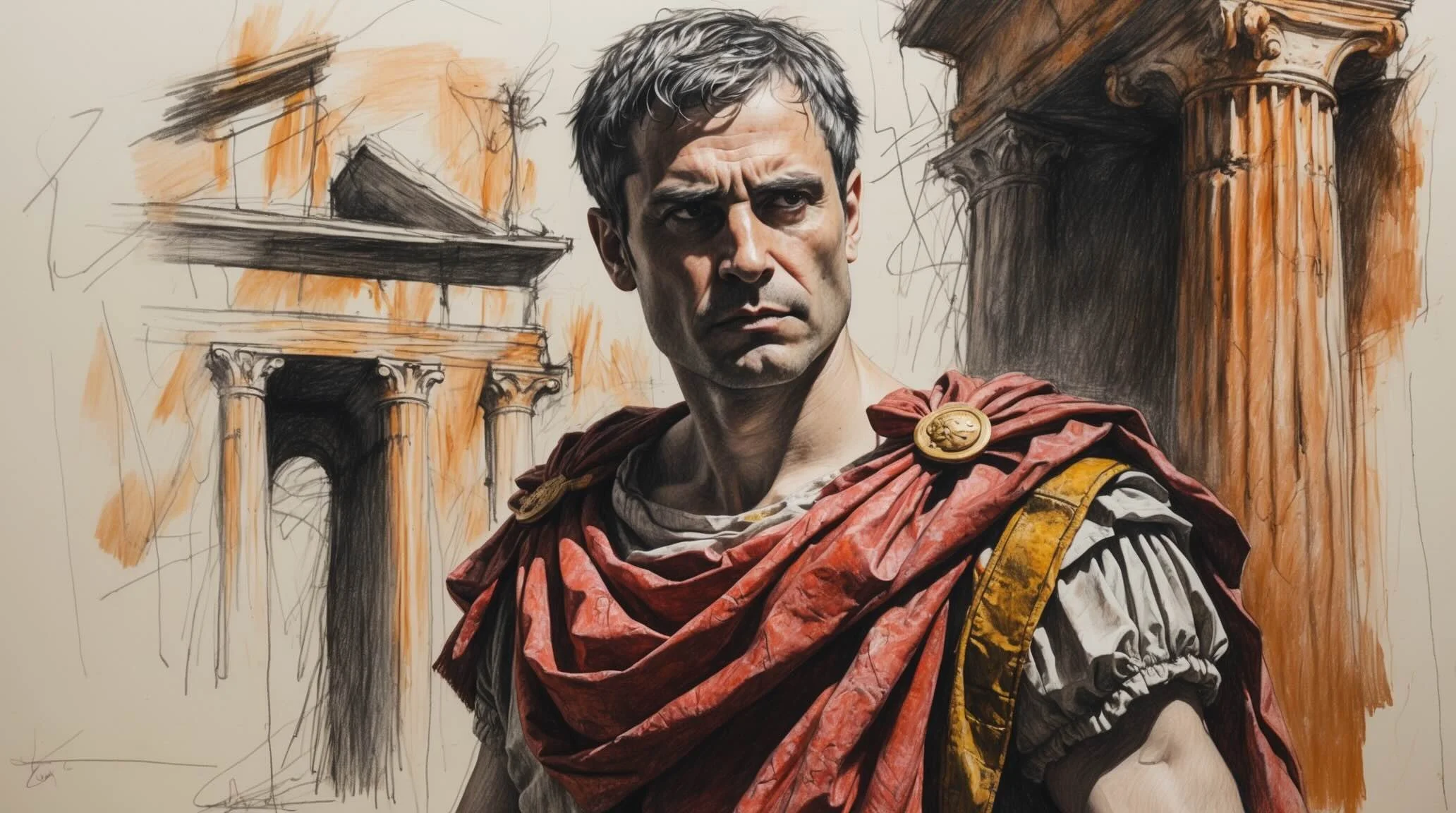
Character Profile – At a Glance
- Role: Caesar’s closest friend and the play’s finest orator. His funeral speech in A3S2 turns Rome against the conspirators in a single afternoon.
- Key Traits: Eloquent, theatrical, and opportunistic, yet truly loyal to Caesar. He waits with great patience, then cannot stop the chaos once he has loosed it.
- The Core Conflict: He shakes the bloody hands of his friend’s killers, talks his way onto the funeral platform, and uses it to destroy them. Governing the chaos that follows proves much harder.
- Key Actions: Runs the Lupercal race in A1S2; comes to the Senate after the murder and shakes the conspirators’ bloody hands in A3S1; delivers the funeral oration in A3S2 that turns the city; sits at the proscription table in A4S1; commands at Philippi beside Octavius in A5S1; speaks the "This was a man" eulogy over Brutus’s body in A5S5.
- Famous Quote:
"Friends, Romans, countrymen, lend me your ears;
I come to bury Caesar, not to praise him."
(Act 3, Scene 2) - The Outcome: Survives as the senior partner – for now – of the new triumvirate; eulogises Brutus as "the noblest Roman of them all"; and quietly cedes the play’s final words, and the future, to Octavius. Shakespeare’s later Antony and Cleopatra tracks what happens next.
The Watcher in the Wings
Antony’s early lines are short, deferential, and exact. In A1S2 he runs the Lupercal race and speaks to Caesar in the language of pure obedience. The conspirators read him as harmless: in private, Cassius presses for Antony to be killed alongside Caesar, and Brutus overrules him on the grounds that Antony is only a part of Caesar and will be powerless once Caesar is gone.
Original
For Antony is but a limb of Caesar:
Let us be sacrificers, but not butchers, Caius.
…
And for Mark Antony, think not of him;
For he can do no more than Caesar’s arm
When Caesar’s head is off.
(Act 2, Scene 1)
Shakespeare Retold (Modern Verse)
For Antony is just a limb of Caesar.
Let’s make a sacrifice, but not a murder.
…
And do not think about Mark Antony:
He will be as much use as Caesar’s arm
When Caesar’s lying dead.
Sparing Antony is the conspiracy’s costliest mistake, and the play knows it. Cassius, whose political eye is consistently sharper than Brutus’s, names the danger, and Brutus waves it away. The Antony of the first two acts has given them every reason to feel safe: he is publicly subservient to Caesar, linked with sport and revelry rather than scheming, and has no power base of his own. What they cannot see – and what the play is quietly preparing the audience to see – is that the man who has spent two acts in studied quietness is the man best placed to do something extraordinary in the third.
The Hands Shaken in Blood
Antony’s first big scene after the assassination is one of Shakespeare’s great studies of political nerve. He walks alone into a Senate full of the men who have just killed his friend, and does the unthinkable: he shakes every one of their hands.
Original
Let each man render me his bloody hand:
First, Marcus Brutus, will I shake with you;
Next, Caius Cassius, do I take your hand;
Now, Decius Brutus, yours: now yours, Metellus;
Yours, Cinna; and, my valiant Casca, yours;
Though last, not last in love, yours, good Trebonius.
(Act 3, Scene 1)
Shakespeare Retold (Modern Verse)
Let each of you give me your bloodied hand.
First, Marcus Brutus, I will shake your hand.
Next, Caius Cassius, I will shake yours too.
Now, Decius Brutus, yours; now yours Metellus;
Yours, Cinna; and, my valiant Casca, yours;
Last, but by no means least, Trebonius.
The handshakes are pure theatre, and entirely deliberate. Every conspirator who takes the offered hand confirms, in front of the others, that Antony has accepted the new order; every clasp binds them a little tighter to the belief that he is no threat. The audience knows what they do not. Antony has already sent his servant ahead to kneel to Brutus and win him safe passage; he has already decided what he means to do. The handshakes are the cover under which he makes his one real request – to be allowed to speak at the funeral. In the moment it sounds like a grieving friend asking a small thing. It is the request that will end the conspirators’ regime within a day.
The Funeral Oration
A3S2 is the most celebrated speech in any of the tragedies, and one of the most studied in all of English. Antony is allowed to speak on two conditions: that he will not blame the conspirators, and that he will follow Brutus. He keeps both to the letter. Within ninety lines he has used them to take the city apart.
Original
Friends, Romans, countrymen, lend me your ears;
I come to bury Caesar, not to praise him.
The evil that men do lives after them;
The good is oft interred with their bones;
So let it be with Caesar. The noble Brutus
Hath told you Caesar was ambitious:
If it were so, it was a grievous fault,
And grievously hath Caesar answered it.
…
For Brutus is an honourable man;
So are they all, all honourable men...
(Act 3, Scene 2)
Shakespeare Retold (Modern Verse)
Friends, Romans, countrymen, lend me your ears.
I’m here to bury Caesar, not to praise him.
The bad things people do live on post death;
But they take good things with them to their grave.
And so it is with Caesar. Noble Brutus
Has told you all that Caesar was ambitious.
If that is true, it is a dreadful fault,
And dreadfully has Caesar paid the price.
…
For Brutus is an honourable man,
Just like them all, all honourable men...
The genius of the speech is that it never breaks its promise. The opening – "Friends, Romans, countrymen" – puts Antony on a level with the crowd; the disclaimer – "not to praise him" – heads off the charge that he is there to eulogise; and the refrain "Brutus is an honourable man" starts as deference and, by its seventh return, has curdled into open mockery. Antony never once contradicts Brutus directly. He simply hands the crowd, item by item, the evidence that Brutus is wrong: the ransoms Caesar poured into the public purse, his tears for the poor, the crown refused three times at the Lupercal, and finally the will, with its gift to every citizen. By the time he lifts the bloody mantle and reads the will aloud, the crowd is a riot, and the conspirators are fleeing Rome. Left alone, watching the chaos pour out into the streets, he gives it a single, chilling blessing and lets it run. He has not lost control of the city; he has released it exactly on cue.
The Eulogy and the Empire
Antony’s last great speech is delivered over Brutus’s body at Philippi, and it is one of the most generous things he does in the play. The man Brutus’s plot nearly destroyed gives his warmest lines to the man who tried to destroy him.
Original
This was the noblest Roman of them all:
All the conspirators save only he
Did that they did in envy of great Caesar;
He only, in a general honest thought
And common good to all, made one of them.
His life was gentle, and the elements
So mixed in him that Nature might stand up
And say to all the world ’This was a man!’
(Act 5, Scene 5)
Shakespeare Retold (Modern Verse)
He was the noblest Roman of them all.
Except for him, all of the other henchmen
Did what they did to Caesar out of envy.
He was the only honest man who thought
About the greater good of everyone.
He led a gentle life and all his traits
Were so well balanced, nature could stand up
And say to all the world, ’This was a man!’
This is the funeral oration’s mirror image – built to honour rather than destroy, but no less calculated for that. The praise is sincere; Antony does admire Brutus’s seriousness. But it works for him too. By singling Brutus out as the one honest man among the plotters, Antony sorts the principled threat from the merely envious one, recasts the whole conspiracy as a small band of envious men led astray by a good man’s mistake, and so quietly tidies the ground for the new regime. And he hands the play’s last word to Octavius without a flicker of struggle. This is a man who has won the war and knows it – and who is already, though he does not see it, walking towards the future that Antony and Cleopatra will not let him keep.
"Mark Antony’s speech over the dead body of Caesar has been justly admired for the mixture of pathos and artifice in it."
— William Hazlitt, Characters of Shakespeare’s Plays, 1817
Key Quotes
Quote 1
O, pardon me, thou bleeding piece of earth,
That I am meek and gentle with these butchers!
(Act 3, Scene 1)
Shakespeare Retold (Modern Verse)
Forgive me, bleeding corpse, becoming dust,
That I am soft and gentle with these butchers.
Quote Analysis: Alone with the body, the public mask slips and the real Antony shows. He apologises to the dead Caesar for shaking the killers’ hands – and the word he reaches for, "butchers," tells us exactly what he thinks of them, moments after smiling at each one. The lines hold both halves of Antony at once: the genuine grief, and the cold resolve already forming beneath it. This is the man the conspirators decided was harmless.
Quote 2
If you have tears, prepare to shed them now.
(Act 3, Scene 2)
Shakespeare Retold (Modern Verse)
If you have tears, prepare to shed them now.
Quote Analysis: The hinge of the funeral oration, spoken as Antony prepares to lift Caesar’s torn cloak and show the crowd each wound. Up to here he has worked by argument; now he turns to pure feeling, and tells the crowd, in effect, what to feel before they feel it. It is stage-management of grief – he cues the tears and then supplies the reason for them. The line is so plain that James leaves it untouched in the modern verse: it needs no updating.
Quote 3
Now let it work. Mischief, thou art afoot,
Take thou what course thou wilt!
(Act 3, Scene 2)
Shakespeare Retold (Modern Verse)
Now let that work. There’s mischief in the air;
Do what you will.
Quote Analysis: Alone again after the crowd has stampeded off to riot, Antony watches his work go and gives it his blessing. There is no horror in the line, no second thought – only satisfaction. It is the clearest proof that the chaos was the plan. He has not been swept along by events; he has set them loose and is content to let them run wherever they go.
Quote 4
These many, then, shall die; their names are pricked.
(Act 4, Scene 1)
Shakespeare Retold (Modern Verse)
Then, all these men will die; we’ve marked their names.
Quote Analysis: At the proscription table in A4S1, the orator becomes the executioner. Marking names for death is now routine business, conducted in a flat administrative tone – a far cry from the man weeping over Caesar’s wounds two acts earlier. The line shows the cost of what Antony has unleashed: the same skill that moved a crowd now signs lists, and the grief has hardened into the cold arithmetic of power.
Key Takeaways
- The Misjudged Threat: Brutus’s choice to spare Antony in A2S1, against Cassius’s warning, is the conspiracy’s costliest error – and Antony’s first three acts slowly prove Cassius right.
- The Hands Shaken in Blood: His handshake with each conspirator in A3S1 is one of Shakespeare’s great feats of nerve, and the cover under which he wins the funeral platform.
- The Funeral Oration: In a single afternoon his speech turns a whole city against the men who killed Caesar – and sets the rest of the play’s politics in motion.
- The Generous Eulogist: His closing tribute to Brutus is real admiration and quiet dominance at once, and it hands the play’s final word to Octavius.
Study Questions and Analysis
Why did the conspirators spare Antony?
The decision is taken in A2S1, against Cassius’s clear warning, and it is the conspiracy’s costliest error. Brutus’s case is twofold. First, the killing has to be honourable rather than indiscriminate – a sacrifice, not a slaughter – and adding Antony’s death to Caesar’s would turn a principled act into a massacre. Second, he believes Antony is harmless once Caesar is gone, no more dangerous than a hand once the head is off. Both arguments are wrong, and the play makes plain that Cassius, the sharper political reader of the two, knows they are wrong even as Brutus makes them. The mistake matters because it leaves the entire politics of the day after the assassination in Antony’s hands. Had Antony died with Caesar, the conspiracy might have held; with Antony alive, free, and brilliant at the platform, it is finished within a day. William Hazlitt, writing in 1817, caught the deeper pattern behind the blunder: "those who mean well themselves think well of others, and fall a prey to their security."
What makes Antony’s funeral oration so effective?
William Hazlitt, in 1817, put it best: the speech works through "the mixture of pathos and artifice." The pathos is real – Antony’s grief, his tears, the unveiling of the wounded body all genuinely move the crowd – and the artifice is the machinery that turns that grief into a weapon. He never openly contradicts Brutus, because the terms of his permission forbid it. Instead he works by irony, repeating "Brutus is an honourable man" until the phrase curdles and the crowd hears its opposite. And he works by accumulation: the ransoms, the tears for the poor, the thrice-refused crown, the will. Each item is technically praise of Caesar rather than attack on Brutus, but together they make Brutus’s charge of "ambition" impossible to believe. The emotional turn comes when he asks the crowd to ready their tears and lifts the torn cloak.
This was the most unkindest cut of all...
(Act 3, Scene 2)
Shakespeare Retold (Modern Verse)
This cut here was the cruellest cut of all...
By the time he reads the will aloud, he has turned a wary crowd into a mob. It is the most studied piece of public rhetoric in Shakespeare, and deservedly so.
How does Antony’s character change across the play?
The shift is one of the play’s most discussed, and it is really a revelation rather than a change. The Antony of the first two acts is publicly loyal to Caesar, linked with sport and pleasure, and politically invisible enough that the conspirators judge him not worth killing. The Antony of Act 3 walks alone into a Senate full of armed men, shakes their hands, wins the funeral platform, and turns the city against them in an afternoon. Nothing in him has grown; a character who has been working in deliberate quietness simply steps into the light. Marjorie Garber, in Shakespeare After All (2004), marks the limit of that revelation: Antony is superb at unleashing chaos and much weaker at controlling it. By Acts 4 and 5 he has been folded into the triumvirate, has presided over the proscriptions, and is being steadily outmanoeuvred by the younger Octavius. Garber’s phrase – that Antony’s "predilection for chaos makes him more suited to misrule than to rule" – names his ceiling exactly. He is not the man who builds the empire; he is the man who clears the ground for the one who does.
Is Antony loyal to Caesar or politically opportunistic?
The play allows both, and the honest answer is that he is both at once. The loyalty is real. His grief alone with the body in A3S1 is some of the most concentrated devotion in Shakespeare, and the funeral speech draws much of its force from feeling that is not performed.
O mighty Caesar! Dost thou lie so low?
(Act 3, Scene 1)
Shakespeare Retold (Modern Verse)
Is that you lying there, oh mighty Caesar?
The opportunism is just as real. Antony sees at once that the murder has opened a power vacuum, that the conspirators have not thought past the act itself, and that the funeral is the way to fill it. The two motives do not fight; they reinforce each other. His love for Caesar gives him the authority to mourn convincingly, and his opportunism tells him what to do with that authority. By the time he stands over Brutus’s body in A5S5, both have delivered the same result: Antony is alive, the conspirators are dead, and the murdered man’s friend now runs Rome. Loyalty without opportunism would not have won the funeral; opportunism without loyalty would never have moved the crowd.
What is the significance of "Cry havoc, and let slip the dogs of war"?
The line, spoken alone over Caesar’s body in A3S1, is Shakespeare’s sharpest image of the moment violence slips its leash. Antony has just played the reconciled enemy with the conspirators; the instant they leave, the mask drops and he prophesies – accurately – the civil war to come.
Cry ’Havoc’, and let slip the dogs of war;
That this foul deed shall smell above the earth
With carrion men, groaning for burial.
(Act 3, Scene 1)
Shakespeare Retold (Modern Verse)
Declare, ’Carnage!’ unleashing vicious soldiers,
And this foul deed will stink to highest heaven
By piled-up rotting corpses seeking graves.
The image comes from hunting – the hounds are held until the hunter slips them – and Antony casts himself, by implication, as the hunter. The chaos he describes is not something he watches from the side; it is something he means to release. What makes the moment chilling, in Marjorie Garber’s reading, is its honesty: Antony is not telling himself a comforting story about reluctant violence. He announces, to the corpse and to us, that he is about to use Caesar’s death to set a war loose across Italy. The prophecy comes true, and the play asks us to remember, all the way through, that Antony chose it.
How does Antony compare to the other major figures in the play?
The contrast with Brutus is the play’s clearest ethical pairing. Brutus is principled, philosophical, and politically naive; Antony is opportunistic, gifted, and politically shrewd. Brutus loses; Antony wins. The play refuses to flatten this into a simple verdict – Brutus’s principles are real and taken seriously, and Antony’s victory is real and not pretended away. The contrast with Cassius is subtler. Both are operators who read people well and manipulate them; what sets Antony apart is scale. Cassius works in private – forged letters, quiet conversations – while Antony works in front of crowds, and by Act 3 that difference is decisive: Cassius’s scheming produces a successful murder but a doomed faction, while Antony’s produces a successful counter-revolution. The contrast with Octavius is the quietest and, in Marjorie Garber’s reading, the most telling. Antony looses the chaos and is soon out of his depth in it; Octavius stays quiet, watches, and inherits the empire. By the end of Act 5 Antony is Octavius’s senior partner; by Antony and Cleopatra he will be his defeated rival.
Why does Antony eulogise Brutus so warmly?
The "noblest Roman of them all" speech in A5S5 is one of the most generous moments in the play, and several motives work together in it. The first is honest admiration: Antony recognises that Brutus, alone of the conspirators, acted for the common good rather than out of envy, and the play has shown the audience exactly that throughout. The second is political. By setting Brutus apart from the rest, Antony shrinks the conspiracy in hindsight to a knot of envious men led astray by one mistaken idealist, which makes the new regime’s settlement look the more legitimate. The third is performance. Antony has spent the play proving that his words shape political reality, and the eulogy is his last and most gracious demonstration of it: the speech that unmade Brutus’s life in A3S2 now remakes his reputation in death. Both are acts of power. The generosity is the magnanimity of the clear winner – and, by handing the final word to Octavius rather than keeping it, Antony shows that even his generosity now has a ceiling.