Cassius
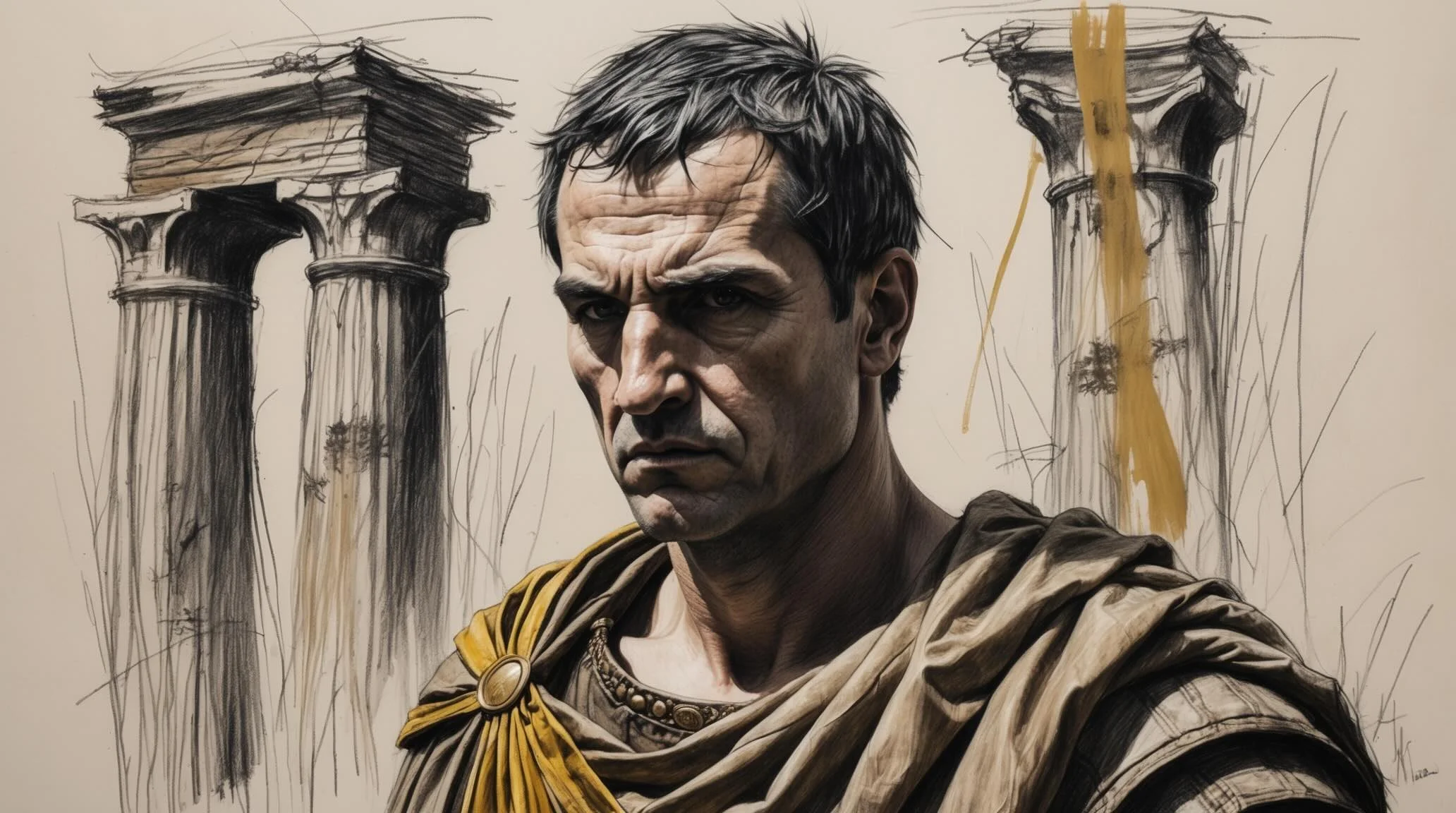
Character Profile – At a Glance
- Role: A senator and the conspiracy’s instigator, whose envy of Caesar and shrewd reading of Brutus pull the assassination plot into being.
- Key Traits: Shrewd, envious, and irritable, yet deeply loyal to Brutus. He flares into rage and remorse alike, and reads other people better than anyone else in the play.
- The Core Conflict: His hatred of Caesar is part principle, part grudge. Knowing the plot needs Brutus to succeed, he sets about manipulating the friend who sees it all less clearly than he does.
- Key Actions: Tempts Brutus into the conspiracy in A1S2 with the "fault, dear Brutus" speech and the forged letters; argues unsuccessfully against sparing Antony in A2S1; quarrels with Brutus over money and honour in A4S3; takes his own life at Philippi in A5S3, on his birthday, wrongly believing the battle lost.
- Famous Quote:
"The fault, dear Brutus, is not in our stars,
But in ourselves, that we are underlings."
(Act 1, Scene 2) - The Outcome: Dies by his own sword at Philippi, on his birthday, ordering his slave Pindarus to strike him with the same weapon he used on Caesar – a symmetry he names in his last words: "Caesar, thou art revenged, even with the sword that killed thee."
The Architect of the Conspiracy
Cassius’s first big scene is one of Shakespeare’s clearest studies of political seduction. He and Brutus are watching the Lupercal offstage; Cassius has his friend alone for the first time in days; and the speech he builds – flattering, mocking, philosophical, and personal by turns – is the moment the conspiracy is born.
Original
Why, man, he doth bestride the narrow world
Like a Colossus, and we petty men
Walk under his huge legs and peep about
To find ourselves dishonourable graves.
Men at some time are masters of their fates:
The fault, dear Brutus, is not in our stars,
But in ourselves, that we are underlings.
(Act 1, Scene 2)
Shakespeare Retold (Modern Verse)
Why, man, he’s standing over all he reigns,
Much like a giant, whilst we minions
Walk under his huge legs and scurry round
To find ourselves a wretched place to die.
At times, men master their own destiny.
The fault has not been preordained, dear Brutus;
The fault is ours, for we’re subservient.
Every move here is calculated. The Colossus image makes Caesar enormous and the rest of Rome tiny, and it slots Brutus in among the "petty men" who must act or stay buried. The famous "fault, dear Brutus" line does two jobs at once: it rejects fatalism – men can master their fates – and it turns that into a goad, since the only thing left to blame is their own passivity. And "underlings" is aimed with precision: Brutus, descended from the man who drove out Rome’s kings, cannot easily swallow being told he is anyone’s subordinate. Cassius is reading his friend with extraordinary accuracy, and within forty lines Brutus has agreed to think on what he has heard. The plot has not yet been named, but it has started.
The Plotter Alone
The most revealing moment of Cassius’s first act is the soliloquy that closes the scene. Brutus has gone; Cassius is alone; and the man we have just watched working on his friend drops the public manner and tells us exactly what he has been doing.
Original
Caesar doth bear me hard; but he loves Brutus:
If I were Brutus now and he were Cassius,
He should not humour me. I will this night,
In several hands, in at his windows throw,
As if they came from several citizens,
Writings all tending to the great opinion
That Rome holds of his name; wherein obscurely
Caesar’s ambition shall be glanced at...
(Act 1, Scene 2)
Shakespeare Retold (Modern Verse)
Caesar does hate my guts, but he love Brutus.
If I were him and he were me, I would not
Be made to change my mind so easily.
Tonight, with different handwriting, I’ll throw
Notes at his window, like from citizens,
That all express the common strong opinion
That Romans think so much of him; between
The lines he’ll sense of Caesar’s grand ambition...
In private, Cassius admits three things plainly: that Caesar dislikes him, that Caesar loves Brutus, and that Brutus is more easily worked on than he himself would be. Then he sets out the forgery – letters tossed through Brutus’s window in disguised hands, as if from anxious citizens, all praising Brutus and hinting at Caesar’s ambition. The plan is deliberately indirect. Cassius does not need to argue Brutus into the plot face to face; he only needs to arrange the conditions in which Brutus argues himself into it. The grievance behind it is mixed – a personal grudge, real republican principle, and the sting of being passed over – and that mixture is exactly what makes him so hard to deflect.
The Quarrel That Almost Breaks the Cause
A4S3, the long quarrel scene at Sardis, is one of Shakespeare’s great studies of friendship under strain. Brutus has condemned one of Cassius’s men for taking bribes; Cassius defended him; the defence was ignored; and now Brutus has accused Cassius of corruption to his face. What follows is the most concentrated portrait of Cassius’s volatility in the play.
Original
There is my dagger,
And here my naked breast; within, a heart
Dearer than Plutus’ mine, richer than gold:
If that thou be’st a Roman, take it forth;
I, that denied thee gold, will give my heart:
Strike, as thou didst at Caesar; for, I know,
When thou didst hate him worst, thou lovedst him better
Than ever thou lovedst Cassius.
(Act 4, Scene 3)
Shakespeare Retold (Modern Verse)
This is my dagger,
And this, my chest; behind it lies my heart,
And in it lies more gold than Pluto’s mine.
And if you are a Roman, take it all
As I denied you gold, you have my heart.
Stab me just like at Caesar, for I know
When you despised him most, you loved him more
Than ever you loved me.
This is the emotional centre of the scene and one of the most extreme bursts of feeling anywhere in the tragedies. Cassius bares his chest, hands Brutus his dagger, dares him to strike as he struck Caesar, and accuses him of having loved Caesar – even at his worst – more than he has ever loved Cassius. The charge stings because it is partly true: the play has hinted all along that Brutus’s bond with Caesar was one of complicated reverence, while his bond with Cassius is warmer but less deep. And the whole speech is pure Cassius – his rage and his remorse are inseparable, and his way of mending the breach is to cast himself as the wronged party in the most theatrical terms available. Within a hundred lines the two are reconciled and drinking together, Brutus reveals that Portia is dead, and Cassius, stunned, asks how he ever escaped being killed for crossing such a man. The friendship is extreme, fragile, and finally unbreakable.
The Death by Symmetry
A5S3 finds Cassius on a hill above Philippi, his eyesight failing, watching what he wrongly takes to be the capture of his friend Titinius. It is the conspiracy’s last and most painful failure to read its own situation. Cassius does not wait for confirmation. He calls his slave Pindarus and holds him to an oath sworn long ago.
Original
This day I breathed first: time is come round,
And where I did begin, there shall I end;
My life is run his compass.
…
Caesar, thou art revenged,
Even with the sword that killed thee.
(Act 5, Scene 3)
Shakespeare Retold (Modern Verse)
My birthday; I first breathed this day. But now
I’m back to where I started, and will end;
My life has run its course.
…
Caesar, you’ve got revenge.
And even with the sword that you were killed by.
The death is one of Shakespeare’s most concentrated images of tragic symmetry. It is Cassius’s birthday; he dies on the same sword he used to kill Caesar; he has misread the field, taking Titinius’s welcome by friends for capture by enemies. Each detail is exact. The man who boasted in A1S2 that the fault lies not in our stars dies because his own faults – his impatience, his volatility, his refusal to wait one more minute – have finally produced the disaster he spent the play trying to prevent. "Caesar, thou art revenged, even with the sword that killed thee" is the play’s most economical statement of what the assassination cost: the plot that began in Cassius’s grievance ends in his suicide, with Caesar’s killer cut down by Caesar’s weapon. The symmetry is the play’s, not Cassius’s. He simply lives just long enough to see it.
"Cassius was better cut out for a conspirator. His heart prompted his head. His habitual jealousy made him fear the worst that might happen, and his irritability of temper added to his inveteracy of purpose, and sharpened his patriotism. The mixed nature of his motives made him fitter to contend with bad men."
— William Hazlitt, Characters of Shakespeare’s Plays, 1817
Key Quotes
Quote 1
I had as lief not be as live to be
In awe of such a thing as I myself.
(Act 1, Scene 2)
Shakespeare Retold (Modern Verse)
I’d rather I was dead than live my life
In awe of one as ordinary as me.
Quote Analysis: The taproot of Cassius’s whole quarrel with Caesar. He would sooner be dead than spend his life in awe of a man no greater than himself – and that is the heart of it: not that Caesar is a tyrant, but that Caesar is ordinary, and yet has been raised above everyone. The republican principle and the personal envy are fused here into a single feeling, which is exactly why Cassius can never quite separate them, and never needs to.
Quote 2
Cassius from bondage will deliver Cassius...
(Act 1, Scene 3)
Shakespeare Retold (Modern Verse)
I’ll kill myself to free myself from slavery.
Quote Analysis: In the storm of A1S3, Cassius declares that no tyranny can hold a man who is willing to die: he can always free himself by his own hand. It is the republican creed at its starkest – liberty or death, with suicide as the final guarantee of freedom – and it is also, in hindsight, a grim piece of foreshadowing. The deliverance he promises himself here is exactly the one he takes at Philippi, by his own sword.
Quote 3
How ’scaped I killing when I crossed you so?
(Act 4, Scene 3)
Shakespeare Retold (Modern Verse)
How come you didn’t kill me when I crossed you?
Quote Analysis: Spoken in the quarrel scene the instant Cassius learns that Portia is dead, this is the whole of his character in one line. The rage of a moment ago collapses at once into tenderness and shame: he is astonished Brutus did not strike him, now that he knows what grief Brutus was carrying through the argument. No one else in the play turns on a sixpence like this. His feeling is always total, and always ready to reverse.
Quote 4
O, coward that I am, to live so long,
To see my best friend ta’en before my face!
(Act 5, Scene 3)
Shakespeare Retold (Modern Verse)
Oh, what a coward I am that I’ve lived
To see my best friend captured in full view.
Quote Analysis: The thought that drives Cassius to his death, spoken as he watches Titinius apparently taken on the field. The same impulsiveness that made him a brilliant conspirator now kills him: he reaches a verdict before the facts are in, brands himself a coward, and acts on it within seconds. The cruel irony is that Titinius is safe and the verdict is wrong – but Cassius, true to himself to the last, cannot bear to wait and find out.
Key Takeaways
- The Engineer of the Plot: Cassius is the conspiracy’s first mover; without him there is no assassination, and his soliloquies show him doing the calculation in real time.
- The Mixed Motives: His hatred of Caesar is political, personal, and emotional all at once – and that very mixture is what makes him so hard to answer or talk out of action.
- The Volatile Friend: The quarrel scene of A4S3 is the play’s most extreme portrait of friendship under strain, and Cassius’s bared-breast speech brings its whole register – fierce, fragile, finally unbreakable – into focus.
- The Death by Symmetry: His suicide on his birthday at Philippi, by the same sword he used on Caesar, is one of Shakespeare’s most concentrated images of tragic irony.
Study Questions and Analysis
Why does Cassius hate Caesar?
The reasons pile up across his speeches, and the play does not rank them. He resents Caesar personally: he once had to haul a struggling Caesar out of the Tiber, and that memory sits badly beside the public worship Caesar now receives. He resents him professionally: Caesar distrusts him and prefers Brutus, and the slight rankles. He resents him politically: he believes Roman liberty is being strangled by the cult of one man, and the move to crown Caesar at the Lupercal turns that fear into urgency. And beneath all three runs a temperament permanently set to grievance, with Caesar simply the target to hand. The clearest statement of the feeling is his amazement that so ordinary a man has risen so far above everyone else.
Ye gods, it doth amaze me
A man of such a feeble temper should
So get the start of the majestic world
And bear the palm alone.
(Act 1, Scene 2)
Shakespeare Retold (Modern Verse)
It does amaze me
That such a man, who clearly is a weakling,
Could get so far ahead in this fine world
And claim victory alone.
William Hazlitt, writing in 1817, caught why this matters: "the mixed nature of his motives made him fitter to contend with bad men." A man with one clean grievance can be answered; a man with four overlapping ones is far harder to deflect, to satisfy, or to talk out of action.
How does Cassius manipulate Brutus into joining the conspiracy?
The manipulation is gradual, runs on more than one channel, and is acutely well judged. In A1S2 he works on Brutus directly, opening with a flourish about where his real subject lies.
Well, honour is the subject of my story.
(Act 1, Scene 2)
Shakespeare Retold (Modern Verse)
Well, honour is the subject of my story.
From there he flatters Brutus’s lineage, belittles Caesar with the swimming-the-Tiber story and the falling sickness, and goads Brutus’s pride with the charge of being an "underling." None of it, on its own, would be enough. The second channel is the one that does the real work: the forged letters tossed through Brutus’s window, written in different hands as if from independent citizens. By making Brutus believe that all of Rome shares his unease, Cassius turns his own private grievance into Brutus’s public duty – and Brutus’s "It must be by his death" soliloquy is the result. The genius of it is that by the time Brutus commits, he believes he is acting on his own conscience. Cassius has done what good manipulators do: made the target’s decision feel like the target’s own.
What is the significance of Caesar’s "lean and hungry look" speech?
The speech, delivered by Caesar to Antony in A1S2, is one of the play’s sharpest character-readings and one of its most ironic failures of nerve.
Yond Cassius has a lean and hungry look;
He thinks too much: such men are dangerous.
(Act 1, Scene 2)
Shakespeare Retold (Modern Verse)
Cassius, over there, looks lean and hungry.
He thinks too much, and men like him are dangerous.
Caesar’s read is exactly right – he goes on to note that Cassius reads much, observes everything, and is never at ease while he beholds a greater than himself. And then he throws the warning away, adding that he says what is to be feared rather than what he fears, "for always I am Caesar." That is the play’s whole point in miniature. Caesar sees the danger clearly and refuses to act on it, because acting would mean admitting that Caesar can be afraid. By this stage Cassius has already set the manipulations running. Caesar’s eye is perfect; his political instinct is fatal.
Why does the quarrel between Brutus and Cassius matter?
The quarrel scene of A4S3 is the longest single exchange between any two characters in the play, and it matters in three ways. First, it shows the conspiracy buckling under its own consequences: Brutus has condemned one of Cassius’s men for bribery, Cassius has defended him, and the principles that once united them are now setting them against each other. Second, its emotional swing – Cassius baring his chest, the reconciliation, the news of Portia’s death and Cassius’s stunned response – is the play’s fullest portrait of a friendship that is real, fragile, and lethal. William Hazlitt, writing in 1817, thought the contrast of "the one heat, the other coolness" admirably done, and judged that Cassius’s cry on hearing of Portia’s death "gives double force to all that has gone before." Third, and most importantly, it exposes that the two leaders run on incompatible registers: Brutus the Stoic, Cassius something closer to a hot-tempered Epicurean. Their reconciliation is genuine, but the gap it reveals will not survive Philippi, where Brutus’s insistence on giving battle on open ground overrides Cassius’s caution and produces the disaster that kills them both.
How does Cassius’s death function in the play?
Mechanically, Cassius dies because he misreads the field at Philippi: he sees Titinius ringed by horsemen and assumes capture rather than welcome, and chooses suicide rather than wait for the truth. Structurally, the death does several things at once. It is the play’s sharpest image of the conspiracy’s central failing – an inability to read its own situation – delivered through the very misreading that kills him minutes before the news that would have saved him. It is also the play’s clearest image of tragic symmetry: Cassius dies on his birthday, by the same sword he used on Caesar, in an act he names himself – "Caesar, thou art revenged, even with the sword that killed thee." And it clears the stage for Brutus’s end. The plot was Cassius’s project, and Brutus joined it on Cassius’s argument; with Cassius gone, Brutus is left alone with the consequences, and his own suicide follows within a hundred lines. William Hazlitt located the deeper failure in the conspirators’ very virtues: "the friends of liberty trust to the professions of others because they are themselves sincere, and endeavour to secure the public good with the least possible hurt to its enemies." Their decency, taken together, was never enough.
Is Cassius a villain or a tragic hero?
The play allows both, and modern criticism has moved firmly towards the second. Older readings cast Cassius as the conspiracy’s villain – the Iago-like figure who works a noble Brutus into a ruinous act – and there is some textual warrant: the soliloquy ending A1S2 shows him forging letters to engineer Brutus’s consent, and Caesar’s "lean and hungry look" marks him as the dangerous one. But that reading undersells the play’s interest in his moral seriousness. He truly believes Caesar’s crowning will end the republic; he is willing to die for that belief, and at Philippi he does. He is also capable of remorse on a startling scale, as the quarrel scene shows. William Hazlitt’s line catches the synthesis: "the mixed nature of his motives made him fitter to contend with bad men." Cassius is neither pure villain nor pure hero. He is the play’s most effective political operator, and that effectiveness demands compromises the more idealistic Brutus could never make. The play does not judge him; it shows what he costs.
How does Cassius compare to Iago and other Shakespearean manipulators?
The comparison lights things up but should not be pushed too hard. Cassius shares with Iago the ability to read a target precisely, to turn that target’s virtues against him, and to work by indirect means – letters, suggestions, conversations engineered to produce the wanted conclusion. What sets him apart is the absence of motiveless malignity. Where Iago’s reasons in Othello multiply into a heap of half-explanations, Cassius’s motives are visible, mixed, and political: he has reasons, names them, and acts. The deeper difference is his relationship to the man he works on. Iago hates Othello; Cassius loves Brutus. The forged letters of A1S2 are answered, four acts later, by the bared chest of A4S3 – and that contradiction is the whole portrait. Cassius will manipulate Brutus into the plot and will die on his own birthday to keep that plot from collapsing, and both are true at once. He is, in that sense, a more humane and more politically serious figure than Iago: a manipulator whose scheming serves an end he genuinely believes in, and whose love for the man he manipulates is real, and finally fatal.