Brutus
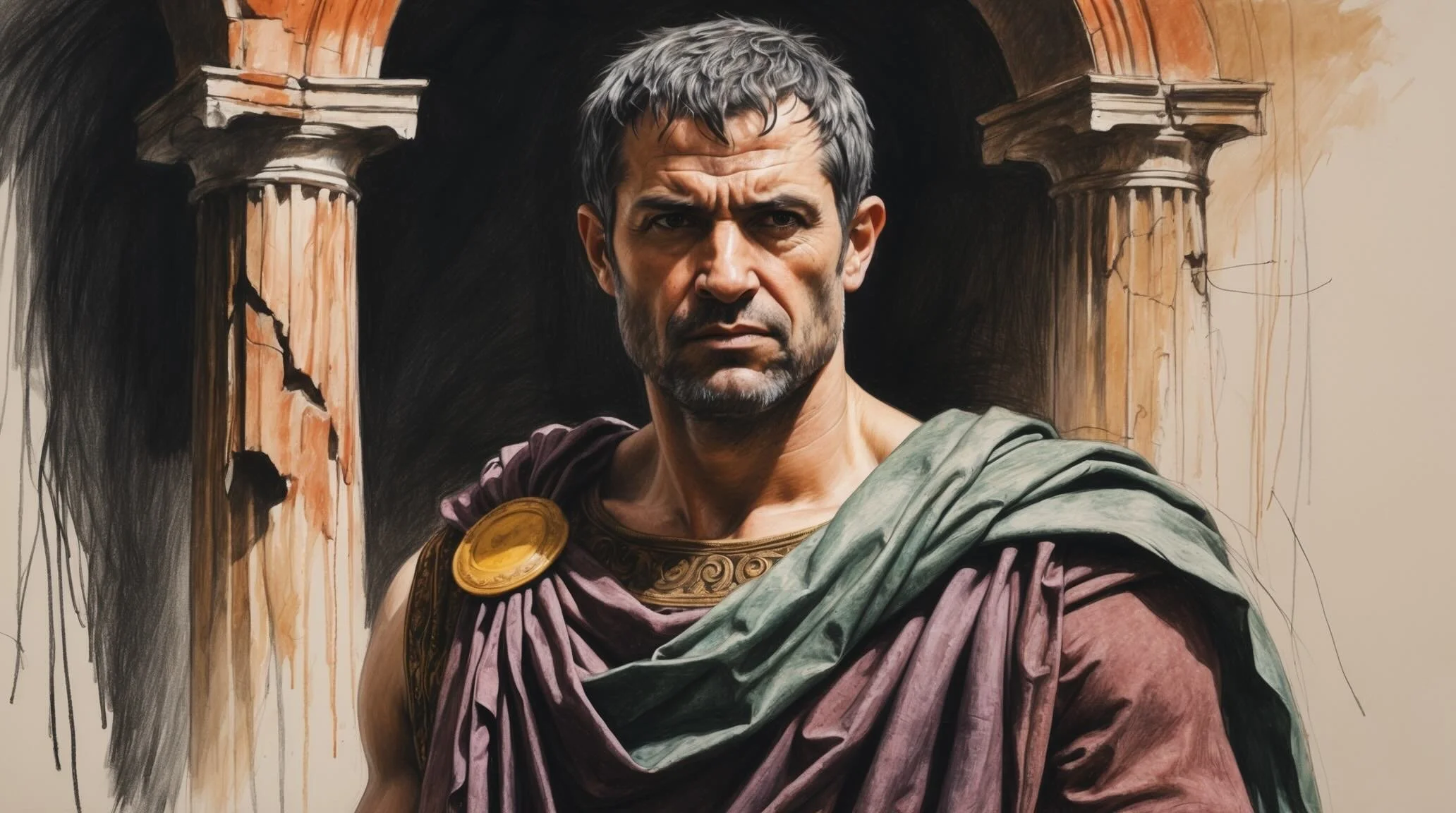
Character Profile – At a Glance
- Role: A Roman senator, husband of Portia, and the real centre of the play. He has the longest part, the most soliloquies, and the tragic arc the play takes most seriously.
- Key Traits: Honourable, thoughtful, and principled. He is loyal to his friends and calm under pressure – but so sure of his own good intentions that he keeps misreading the people around him.
- The Core Conflict: He loves Caesar as a man but fears him as a ruler. He joins a plot he did not start, on an argument he half-talks himself into, and spends the rest of the play paying for it.
- Key Actions: Is won over by Cassius in A1S2; talks himself into the killing in his A2S1 soliloquy; insists on sparing Antony; strikes Caesar last and hears "Et tu, Brute"; gives the funeral speech in A3S2; quarrels with and forgives Cassius in A4S3; sees Caesar’s ghost; and takes his own life at Philippi.
- Famous Quote:
"Not that I loved Caesar less, but that I loved Rome more."
(Act 3, Scene 2) - The Outcome: Defeated at Philippi, he dies on his servant Strato’s sword. Antony calls him "the noblest Roman of them all," and Octavius has him buried with full honours.
Talking Himself Into It
Brutus’s first scene alone, in his orchard at night in A2S1, is one of Shakespeare’s clearest pictures of a good man arguing himself into a terrible act. He has been turning the conspiracy over since Cassius first approached him; forged letters have been pushed through his window; he cannot sleep. And the speech he makes to himself begins with the decision already taken.
Original
It must be by his death: and for my part,
I know no personal cause to spurn at him,
But for the general. He would be crowned:
How that might change his nature, there’s the question.
(Act 2, Scene 1)
Shakespeare Retold (Modern Verse)
The only way’s to kill him; for my part
I have no reason to lash out at him
But for the greater good. He would be king:
And how would he behave then? That’s the question.
Notice the order. "It must be" comes first; the reasons come afterwards. Brutus has settled on the killing and then goes looking for grounds to support it. What he finds is honest enough to be damning: he admits he has "no personal cause" to attack Caesar, and that Caesar has not actually done anything wrong yet. The whole case rests on what Caesar might turn into once he is crowned. To bridge that gap, Brutus reaches for his famous image – treat Caesar as a "serpent’s egg," and "kill him in the shell" before it can hatch into anything dangerous. It is a way of justifying an attack on a man for a crime he has not committed. The unsettling thing is how calm it sounds. Brutus delivers the argument with the steady, reasonable manner of a man working through a problem, and that reasonableness is exactly what lets him talk himself past his own doubts. His decency is real; so is the blind spot that lets it lead him here.
The Funeral Speech
A3S2 is the great test of Brutus’s political judgement, and he fails it. He has agreed to let Antony speak at Caesar’s funeral, on terms he thinks are safe: Antony will speak second, will not attack the conspirators, and will keep to honest mourning. Brutus goes first, in plain prose, and gives a speech that is admired, carefully balanced, and a complete political disaster.
Original
If then that friend demand why Brutus rose against Caesar, this is my answer: – Not that I loved Caesar less, but that I loved Rome more. Had you rather Caesar were living and die all slaves, than that Caesar were dead, to live all free men? As Caesar loved me, I weep for him; as he was fortunate, I rejoice at it; as he was valiant, I honour him: but, as he was ambitious, I slew him.
(Act 3, Scene 2)
Shakespeare Retold (Modern Verse)
If you then demand to know why I killed Caesar, this is why: it’s not that I did not love Caesar, but that I loved Rome more. Would you prefer he lived but we all die slaves, or Caesar dead, we all live as free men? As Caesar loved me, I cry for him; I’m happy he was lucky; I respected his bravery. But his ambition caused me to kill him.
This is Brutus thinking out loud in public. The famous line – "not that I loved Caesar less, but that I loved Rome more" – sums up how his mind works: feeling turned into duty by an act of reasoning. The speech is built like an argument, with its neat matching clauses weighing Caesar’s qualities against Brutus’s responses. And it almost works. The crowd is won over and would, the play suggests, have gone home convinced – if Antony had not been waiting his turn. The problem is not what Brutus says but how he says it. He offers a careful case where the moment calls for feeling. Antony, listening, understands the crowd far better. Within a few minutes of Brutus’s "I pause for a reply," the city is rioting and Brutus is on the road out of Rome.
The Quarrel and the Tide
A4S3 shows Brutus under real strain, and contains his sharpest – and most damaging – piece of judgement. He and Cassius have just patched up a bitter argument; the news of Portia’s death has arrived. The question now is military: march on the enemy at Philippi, or wait for them. Cassius wants to wait. Brutus disagrees, and makes his case in one of the most quoted speeches in the play.
Original
There is a tide in the affairs of men,
Which, taken at the flood, leads on to fortune;
Omitted, all the voyage of their life
Is bound in shallows and in miseries.
On such a full sea are we now afloat;
And we must take the current when it serves,
Or lose our ventures.
(Act 4, Scene 3)
Shakespeare Retold (Modern Verse)
The strength of men can ebb and flow, like tides do,
And they succeed if, at high tide, they act;
But, if they don’t, they’ll journey through their life
Stuck in the mud of low tide, in despair.
And we now find ourselves floating at high tide
And so we have to act when timing’s right
Or lose the fight.
The speech is beautiful and wrong. The idea – that there are moments you must seize or lose for good – is true; Brutus has simply misjudged whether this is one of them. Cassius, whose military instincts are consistently sharper, gives way anyway, and the decision to march to Philippi turns out to be the mistake that loses the war. This is the pattern of the whole tragedy in miniature. Brutus is genuinely gifted at reasoning his way to a conclusion, and that gift keeps leading him, with great eloquence, to the wrong one.
The Death
A5S5 finds Brutus on the field at Philippi, his army broken, Cassius already dead, and only a handful of men left. He turns to his servant Strato and asks him to hold the sword he will run onto.
Original
Caesar, now be still:
I killed not thee with half so good a will.
(Act 5, Scene 5)
Shakespeare Retold (Modern Verse)
Caesar, rest; I’m through.
I was just half as sure when killing you.
Two lines, and they carry the weight of the whole play. Brutus speaks to Caesar, not to the men around him – an admission that the friend he killed has shadowed every step since. The second line is the hardest piece of self-knowledge the play gives him: he killed Caesar for an idea, and he is killing himself with far more certainty, because the idea has failed and the man is still gone. The play does not turn on Brutus for this. Antony’s tribute is warm and, the play suggests, fair, and Brutus is buried with full honours. But the political verdict is plain: the plot failed, the republic is lost, and the empire that follows will long outlast the men who tried to stop it.
"The whole design to liberate their country fails from the generous temper and overweening confidence of Brutus in the goodness of their cause and the assistance of others. Thus it has always been. Those who mean well themselves think well of others, and fall a prey to their security."
— William Hazlitt, Characters of Shakespeare’s Plays, 1817
Key Quotes
Quote 1
Let us be sacrificers, but not butchers, Caius.
(Act 2, Scene 1)
Shakespeare Retold (Modern Verse)
Let’s make a sacrifice, but not a murder.
Quote Analysis: Talking the others out of killing Antony alongside Caesar, Brutus draws the line that defines how he sees the whole plot. He wants it to feel like a solemn act of principle, not butchery – a "sacrifice," not a "murder." The wish is sincere, and it is also his first fatal mistake: sparing Antony leaves alive the one man who can turn the funeral against him. Brutus wants clean hands in an act that cannot be kept clean.
Quote 2
Set honour in one eye and death i’ the other,
And I will look on both indifferently...
(Act 1, Scene 2)
Shakespeare Retold (Modern Verse)
I’ll ponder death and honour equally
And treat them with impartiality...
Quote Analysis: His answer to Cassius early in the play, and the clearest statement of the value that rules him. He will weigh honour against death on equal terms and choose without flinching. It is an admirable claim – and the seed of the tragedy. A man who puts honour above his own life will put it above good sense too, and make the noble choice even when it is the ruinous one.
Quote 3
There is no terror, Cassius, in your threats,
For I am armed so strong in honesty...
(Act 4, Scene 3)
Shakespeare Retold (Modern Verse)
There’s nothing scary in your threats, Cassius,
For I’m so sure of my integrity...
Quote Analysis: The high point of the quarrel, with the alliance close to breaking. Brutus claims his own honesty makes him untouchable – threats simply slide off him. It is a striking picture of moral self-belief, and also of his blind spot. He is so certain he is right that he treats it as armour, and that same certainty stops him hearing Cassius on the one question – Philippi – that decides the war.
Quote 4
O Julius Caesar, thou art mighty yet!
Thy spirit walks abroad and turns our swords
In our own proper entrails.
(Act 5, Scene 3)
Shakespeare Retold (Modern Verse)
Oh Julius Caesar, you’re remaining strong;
Your spirit walks with us and turns our swords
To slash our stomachs open.
Quote Analysis: Standing over Cassius’s body, Brutus says aloud what the second half of the play keeps showing: the dead Caesar is still the strongest force on the field. The conspirators’ own swords are turning back on them. It is the recognition his death scene will complete – killing Caesar did not free Rome from him, it only changed the shape his power takes.
Key Takeaways
- The Real Lead: Longest part, most soliloquies, the tragic arc – by every usual measure, Brutus is the play’s central figure, whatever the title says.
- The Self-Persuader: His "It must be by his death" soliloquy is a study of a good man building the case for a decision he has already made.
- Eloquence That Loses: His funeral speech and his "tide in the affairs of men" speech are both admired – and both lead straight to disaster.
- The Tragedy of a Good Man: Brutus means well and assumes others do too, and that trust is exactly what destroys him.
Study Questions and Analysis
Is Brutus the protagonist of Julius Caesar?
By every usual measure, yes. Brutus has the largest role in the play, the most soliloquies, and the tragic journey – from the orchard scene of A2S1 to his suicide in A5S5 – that the play treats most seriously. The title is slightly misleading: the play is named for the man whose death turns the plot, but the story it tells is Brutus’s. William Hazlitt, writing in 1817 in Characters of Shakespeare’s Plays, was among the first critics to argue this directly, and most modern readings agree. Antony’s closing tribute – "This was the noblest Roman of them all" – is paid to Brutus, not Caesar. Marjorie Garber, in Shakespeare After All (2004), suggests the play has two endings: a tragic one centred on Brutus, and an imperial one centred on Octavius. The tragic ending belongs to Brutus. He is the one figure whose inner struggle, decisive action, and costly death the play follows all the way through, and that arc is what makes a protagonist – whoever’s name is on the cover.
Why does Brutus join the conspiracy?
The reasons are tangled, and the play is careful to show that Brutus does not fully understand them himself. His A2S1 soliloquy opens with the decision already made and then assembles the case for it – which is itself revealing. He admits he has no personal grievance against Caesar; the whole argument rests on what Caesar might become if he is crowned. The key image is the serpent’s egg.
And therefore think him as a serpent’s egg
Which, hatched, would, as his kind, grow mischievous,
And kill him in the shell.
(Act 2, Scene 1)
Shakespeare Retold (Modern Verse)
And so, let’s think he’s like a serpent’s egg now,
That, when it’s hatched, will grow to someone dangerous,
And so we’ll kill him in the shell.
Strip it back and the logic is troubling: kill the snake before it has done anything, on the grounds that snakes turn out venomous. Several pressures push Brutus to it. There is genuine principle – he is descended from the Brutus who drove out Rome’s kings, and he has inherited a hatred of one-man rule. There is Cassius’s steady manipulation, including those forged letters, which makes Brutus’s private worry feel like public opinion. And there is Brutus’s own self-image as the man who acts when others hesitate. Together it is enough. The soliloquy makes clear that the decision needs the talking-into – that Brutus has to argue himself across a gap the evidence does not close.
Why is Brutus’s funeral speech less effective than Antony’s?
Brutus’s speech in A3S2 is admired, balanced, and politically fatal. He builds it like a proof: matched clauses, careful antithesis, a reasoned case for the killing. The famous line – "not that I loved Caesar less, but that I loved Rome more" – is the whole thing in miniature, love subordinated to duty by an act of reasoning. The crowd accepts it, briefly; they even call for Brutus to take Caesar’s place. They would have walked away convinced if Antony were not waiting. The trouble is the form, not the content. Brutus chooses prose where the moment wants verse, and reason where it wants feeling – and then makes a fatal procedural error by letting Antony speak after him with the body in view. Antony offers grief, Caesar’s wounds, and the will; Brutus offered an argument. By the end, the crowd that cheered Brutus has become the mob that drives him out. The contrast is the play’s clearest study of two kinds of politics: reasons against bodies, and in the heat of the funeral, bodies win. The play never says Brutus’s reasons are wrong – only that, in the world it shows, reasons are not enough.
What is Brutus’s tragic flaw?
The usual answer – and the one William Hazlitt gives in 1817 – is that Brutus’s virtues are his flaw. He is honourable, sincere, and confident that his cause is good, and those very qualities make him a poor reader of people and politics. Hazlitt puts it directly: "the whole design to liberate their country fails from the generous temper and overweening confidence of Brutus in the goodness of their cause and the assistance of others." Look at the pattern. He spares Antony because killing him would turn the plot into a massacre – noble, and suicidal. He lets Antony speak because silencing him would be tyranny – noble, and suicidal. He marches to Philippi because waiting would look like cowardice – noble, and suicidal. Each time, his principles hand him the wrong tactic. Later critics sharpen this without overturning it: in a 1971 essay, Gordon Ross Smith argued that Brutus’s "virtue is the splendid muffling that clothes his will" – that the image of himself as a good man is its own kind of pride. The two readings sit together comfortably. Brutus’s flaw is not a vice but a virtue with no political sense to check it, and the tragedy is that the world he is acting in gives him no credit for being right about everything except what to do.
How does Brutus compare to Hamlet, Lear, and Othello?
The comparisons are revealing. Like Hamlet, Brutus is a thinker, given to soliloquies that argue with themselves; the difference is that Hamlet’s tragedy is delay, while Brutus’s is the wrong action taken decisively. Like Lear, he makes a catastrophic misjudgement rooted in a noble self-image; the difference is that Lear’s image is of authority and Brutus’s is of virtue, which fail in different ways. Like Othello, he is steered by a more politically astute friend – Cassius works on Brutus in A1S2 much as Iago works on Othello, and the forged letters do the job of the planted handkerchief. But Cassius, unlike Iago, believes in the cause he is selling, and the bond between them is brotherly rather than poisonous. What sets Brutus apart from all three is the public scale of his story. Hamlet, Lear, and Othello are undone in essentially private tragedies of grief, rage, and jealousy; Brutus’s downfall is political, and what destroys him is not a passion but a kind of high-minded misreading that brings down a republic.
Does Brutus regret killing Caesar?
The play’s answer shifts as it goes, and the shift is one of its most interesting things to track. In Acts 1 and 2, Brutus is sure the killing is necessary; the orchard soliloquy ends with the decision firmly made. In Act 3, just after the assassination, he is still publicly committed, urging the others to mark themselves with Caesar’s blood as a badge of the deed.
And let us bathe our hands in Caesar’s blood
Up to the elbows, and besmear our swords...
(Act 3, Scene 1)
Shakespeare Retold (Modern Verse)
And let us wipe our hands in Caesar’s blood
Up to our elbows and smear it on our swords...
That is a man performing certainty. By Act 4 the certainty has cracked. The quarrel with Cassius shows him under strain, and the news of Portia’s death lands in the middle of it like a bill coming due. The ghost of Caesar, naming itself "thy evil spirit," brings the haunting into the open. By Act 5 the regret is the centre of his experience. His last words – "Caesar, now be still: / I killed not thee with half so good a will" – say it plainly. Yet it is not a retraction. Brutus never says the killing was wrong; he says he is killing himself more willingly than he killed Caesar. The distinction is exact, and it is the most honest reckoning the play allows him – not "I was wrong," but "this I can do with my whole heart, and that I could not."
Why is Brutus called "the noblest Roman of them all"?
The line is Antony’s, spoken over Brutus’s body in A5S5, and it is a remarkable act of generosity. Antony, whose funeral speech destroyed Brutus’s cause, now mourns him in terms so warm they have become the standard summary of his character. His reasoning is precise.
All the conspirators save only he
Did that they did in envy of great Caesar;
He only, in a general honest thought
And common good to all, made one of them.
(Act 5, Scene 5)
Shakespeare Retold (Modern Verse)
Except for him, all of the other henchmen
Did what they did to Caesar out of envy.
He was the only honest man who thought
About the greater good of everyone.
Antony sets Brutus apart from the rest of the plotters on exactly the grounds the play has insisted on throughout. Cassius joined partly out of envy and grievance; Casca out of sour contempt; the others for motives the play barely bothers to name. Brutus alone acted for what he believed was the good of all. The tribute does not say he was right – it says he was honest. That distinction is the play’s own, and in his last great speech Antony grants Brutus the verdict the whole tragedy has been building towards: the cause failed and the republic fell, but the man who acted for it was not corrupt. He was, in the play’s chosen word, noble.