Casca
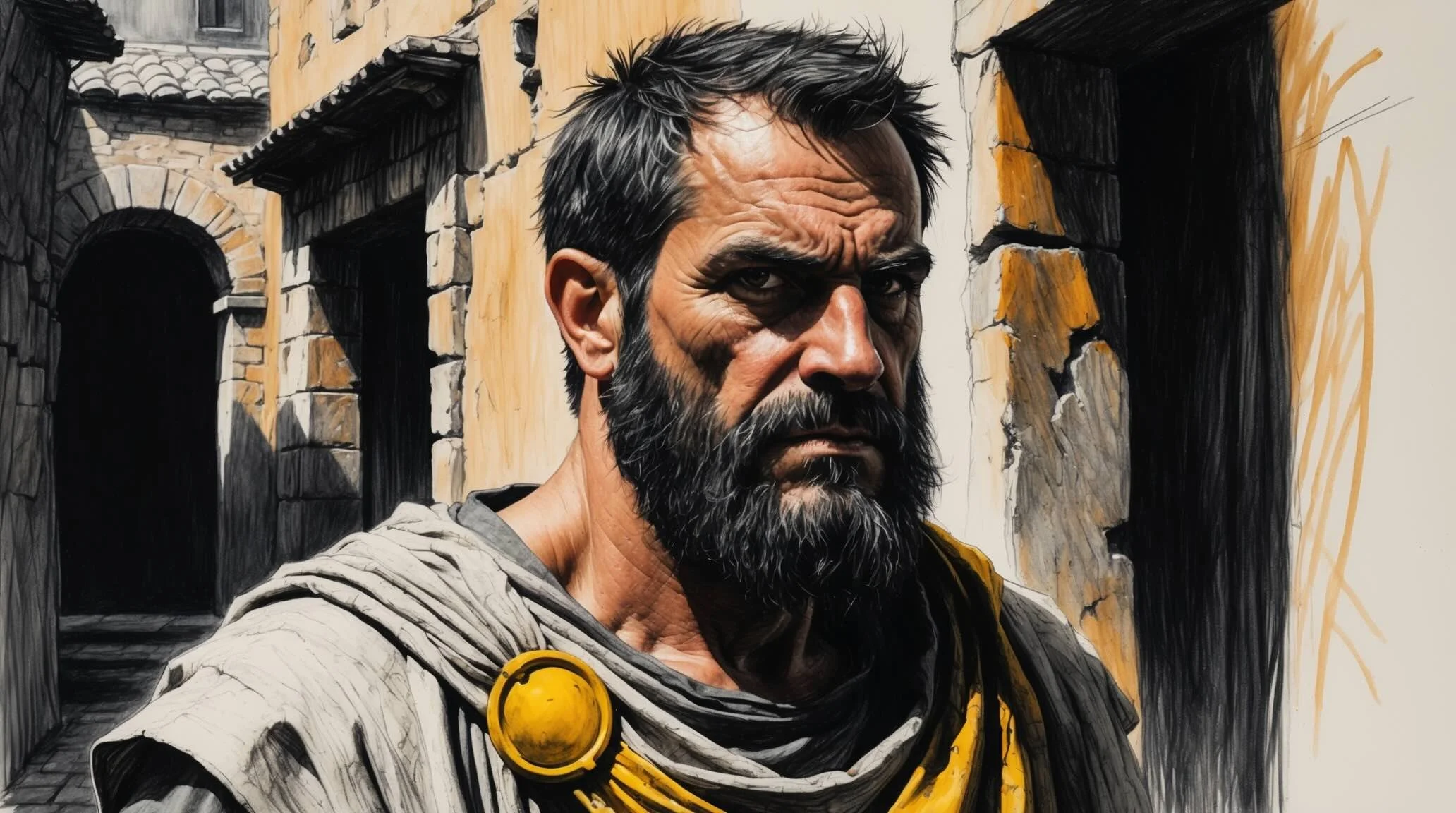
Character Profile – At a Glance
- Role: A senator and conspirator: the sour, plain-spoken eyewitness who reports the Lupercal crown ceremony, and the man who lands the first blade on Caesar.
- Key Traits: Sardonic, blunt, and observant. He speaks plain prose in public, yet the storm reduces him to terrified verse – the play’s most caustic voice, and its first blade.
- The Core Conflict: His public manner is dismissive and prose-bound, but the night’s prodigies tip him into verse-pitched terror. Once he decides Caesar must die, he is the first, without hesitation, to strike.
- Key Actions: Reports the crown ceremony with cynical contempt to Brutus and Cassius in A1S2; describes the storm’s prodigies to Cicero and is recruited by Cassius in A1S3; cries "Speak, hands for me!" and stabs Caesar first in A3S1.
- Famous Quote:
"For mine own part, it was Greek to me."
(Act 1, Scene 2) - The Outcome: Disappears from the stage after the assassination; the play never names him among the dead at Philippi, and he is presumed killed in the general defeat of the conspirators’ faction alongside Cassius and Brutus.
The Cynical Eyewitness
Casca’s first big scene is one of Shakespeare’s most pointed studies of political theatre reported by a witness who refuses to take it seriously. Brutus and Cassius, having watched Caesar processed off to the Lupercal, pull Casca aside to learn what happened. The account he gives is detailed, accurate – and utterly dismissive.
Original
I can as well be hanged as tell the manner of it: it was mere foolery; I did not mark it. I saw Mark Antony offer him a crown; – yet ’twas not a crown neither, ’twas one of these coronets; – and, as I told you, he put it by once: but, for all that, to my thinking, he would fain have had it.
(Act 1, Scene 2)
Shakespeare Retold (Modern Verse)
I’d hang myself easier than explain it. It was pure foolishness; I didn’t watch it. I saw Mark Antony give him a crown – in fact, a coronet and not a crown – and, like I said, he turned it down, but I felt that secretly he wanted it.
This is Casca’s signature mode: contempt delivered in plain prose. The patricians around him speak verse; Casca speaks the language of a man who will not dignify the spectacle he is reporting. And yet the detail is exact – he registers that the diadem was a coronet rather than a crown, that Caesar feigned reluctance, that the crowd’s enthusiasm was orchestrated. The cynicism does real work. Casca is handing Brutus and Cassius precisely the reading they want – that Caesar coveted the crown – while making plain, through his tone, how completely he despises the "rabblement" whose cheering makes the offer possible. It will not be his only register, but in this scene it is the play’s most caustic voice.
The Foreign Tongue
The line that has since entered English as a permanent idiom comes a little later in the same conversation, when Cassius asks what Cicero said during the ceremony.
Original
Nay, an I tell you that, I’ll ne’er look you i’ the face again: but those that understood him smiled at one another and shook their heads; but, for mine own part, it was Greek to me.
(Act 1, Scene 2)
Shakespeare Retold (Modern Verse)
I don’t speak Greek, so if I tell you, I can’t look truthfully at you. But those who speak Greek smiled at each other as they shook their heads. But it was Greek to me.
Cicero, the scene tells us, made a small speech in Greek – the language of the cultured Roman elite, chosen to make a point those without Greek would miss. Casca, patrician enough to be in the room but rough enough not to follow, captures his own place in that hierarchy in a single phrase. "It was Greek to me" is a confession of exclusion, and characteristically it is a refusal to apologise for it. The line has lasted four centuries because of its economy: Casca is not asking to be taught. He names his ignorance and moves on. The plain-spoken disdain for elite affectation that runs through him is at its most concentrated right here.
The Storm-Stricken Witness
A1S3 shows an entirely different Casca. The storm that breaks over Rome the night before the ides has shaken him into verse, into terror, and into the full apocalyptic register that will be Calpurnia’s the next morning.
Original
Are not you moved, when all the sway of earth
Shakes like a thing unfirm? O Cicero,
I have seen tempests, when the scolding winds
Have rived the knotty oaks, and I have seen
The ambitious ocean swell and rage and foam,
To be exalted with the threatening clouds:
But never till to-night, never till now,
Did I go through a tempest dropping fire.
(Act 1, Scene 3)
Shakespeare Retold (Modern Verse)
Aren’t you disturbed that our unstable world
Shakes like it’s going to fall? Oh, Cicero,
I’ve witnessed storms where stinging, biting winds
Have splintered gnarly oak trees, and I’ve seen
The ocean waters rise with raging waves
That reach up to the black and thunderous clouds;
But not before tonight, never before,
Have I been in a storm that’s spitting fire.
The change of register is the scene’s whole point. The man who could not be bothered to watch the crown ceremony is now reporting a sky that rains fire. He has moved from prose to verse, from contempt to dread, from the political theatre he sneered at to a cosmic theatre he cannot dismiss. Shakespeare is making a careful argument: Casca’s cynicism is real, but it is not bottomless. There is a scale of experience above which his disdain cannot operate, and the storm has reached it. The conspiracy Cassius is about to recruit him into depends partly on this – a man who has just watched the heavens come apart is far readier for desperate action than the man who mocked the rabble’s chapped hands an afternoon earlier.
The First Hand on the Blade
The conspirators have surrounded Caesar in the Senate. Metellus Cimber pleads for his banished brother as a pretext; the others move into position; Caesar has just refused, in his grandest statement of self-belief, to be moved at all. And Casca – the prose-spoken cynic of A1S2, the storm-struck witness of A1S3 – strikes first.
Original
Speak, hands for me!
(Act 3, Scene 1)
Shakespeare Retold (Modern Verse)
Hands, do my wishes!
Three words, and Casca’s whole arc resolves into a blade. The line hands agency from speech to the body: language, which has been Casca’s medium for cynical reporting and apocalyptic terror alike, is yielded to the hands. "Speak, hands for me" is the play’s most economical image of the moment conspiracy passes from talk into act, and the choice to give it to Casca rather than to Brutus or Cassius is one of Shakespeare’s quietest decisions. The man who would not dignify the ceremony with verse will not dignify the killing with rhetoric. He simply moves. Antony will later sharpen the moment into an accusation – "the envious Casca" who made a "rent" in Caesar’s mantle – but Casca himself is already gone. After this scene the play does not need him, and it does not pretend it does.
Key Quotes
Quote 1
A common slave – you know him well by sight –
Held up his left hand, which did flame and burn
Like twenty torches joined, and yet his hand,
Not sensible of fire, remained unscorched.
(Act 1, Scene 3)
Shakespeare Retold (Modern Verse)
A common slave – you’d know him if you saw him –
Held up his left hand, which was burning brightly,
Like twenty flares together, though his hand,
Unsensitive to fire, remained unburnt.
Quote Analysis: One of the prodigies Casca reports during the storm, and proof of how far the night has shaken him. The man who refused to "mark" the crown ceremony is now recounting a miracle in close, awed detail: a slave whose hand blazed like twenty torches and was not burned. The plain prose of the afternoon is gone, replaced by the careful verse of a frightened witness. The same eye that earlier saw only "foolery" now sees portents everywhere – and Cassius is about to use exactly that receptiveness to recruit him.
Quote 2
It is the part of men to fear and tremble,
When the most mighty gods by tokens send
Such dreadful heralds to astonish us.
(Act 1, Scene 3)
Shakespeare Retold (Modern Verse)
It is the job of men to fear and tremble
When all the mighty gods deliver omens
Through dreadful premonitions sent to scare us.
Quote Analysis: Casca’s piety laid bare. Where the afternoon’s cynic mocked everything, the storm’s witness now declares that fear is the proper response when the gods send warnings. It is the clearest sign that his contempt was only ever a working register for ordinary politics – faced with what he takes for divine signs, he is as devout and as frightened as anyone. The line also primes him perfectly for Cassius, who will reframe these "dreadful heralds" as omens against Caesar within a few dozen lines.
Key Takeaways
- The Cynic’s Voice: Casca’s prose-spoken contempt in A1S2 – the "tag-rag people," the "mere foolery" – is the play’s most sustained satire on Roman public spectacle.
- The Reluctant Mystic: The storm of A1S3 reveals a Casca capable of verse-pitched terror; the cynicism is a working register, not a worldview, and the prodigies break it open.
- The First to Strike: His "Speak, hands for me!" launches the assassination, and giving the first blade to the play’s most contemptuous voice is one of the act’s quietest commentaries on conspiracy.
- The Vanishing Conspirator: After A3S1 Casca disappears; he is presumed killed at Philippi but never named, a silence that fits his role as the conspiracy’s edge rather than its centre.
Study Questions and Analysis
Why does Casca speak in prose when most other patricians speak in verse?
It is one of Shakespeare’s most pointed uses of register as character. The patricians of the play – Brutus, Cassius, Antony, Caesar himself – speak almost entirely in iambic pentameter, the verse line that signals education, dignity, and elite standing. Casca, in A1S2, speaks prose, and the difference is the whole substance of his characterisation in that scene. Some readings tie the choice to Cynic philosophy specifically – the school that scorned elite affectation and elaborate language in favour of plain, biting speech. Others take it more practically: prose is the perfect vehicle for cynical reportage, and the contrast with the verse around him makes his contempt land harder. Either way, the shift in A1S3 is what makes the device significant. When Casca moves into verse for the storm, the man who would not dignify the crown ceremony is suddenly dignifying the prodigies. Shakespeare uses the change of register to tell us that something has reached him which the political theatre could not.
What is the significance of Casca’s "It was Greek to me"?
The line is one of Shakespeare’s most enduring gifts to English idiom – the source of the modern "it’s Greek to me," meaning incomprehensible – and it does real thematic work. Cicero, Rome’s most famous orator, has just spoken in Greek, the language of the cultured elite. Those who understood him "smiled at one another and shook their heads"; Casca did not. The line is funny because it carries no embarrassment: Casca admits his ignorance and declines to apologise for it. It also names, in passing, the play’s larger concern with how political truth travels. Cicero seems to be saying something that matters; the people who understood him reacted as though it did; but those who did not – Casca, and presumably much of the crowd – never learn what was said. The play’s politics keep working this way: the truth exists, but it circulates in registers the people who most need it cannot reach. Casca’s confession is the first instance of the pattern.
How does Casca’s manner change between Act 1, Scene 2 and Act 1, Scene 3?
The change is the play’s clearest demonstration of how thin the cynic’s posture finally is. In A1S2 he speaks prose, calls the populace "tag-rag," dismisses the crown ceremony as "mere foolery," and refuses to be impressed even by Cicero. In A1S3 he speaks verse, describes a storm "dropping fire," reports a slave whose hand burned without scorching and a lion that padded past him in the street, and is recruited by Cassius within fifty lines. The shift is not inconsistency but revelation. Casca’s contempt for ordinary political theatre is real, but it operates only at the scale of ordinary political theatre. When the night offers him cosmic prodigies, the cynicism cracks and the man underneath turns out to be as superstitious as Calpurnia. The play uses the moment to make a quiet argument: people who refuse to take politics seriously are not necessarily harder to recruit into desperate action – they may be easier, because their disbelief in ordinary politics leaves a vacuum that extraordinary politics can fill.
Why is Casca chosen to strike Caesar first?
The decision is made by Cassius in the planning of A2S1 – "Casca, you shall be the first to stab at Caesar" – and it is shrewd in several ways. Mechanically, Casca stands closest to Caesar and is least likely to be suspected: he has passed for one of Caesar’s faction in public, so he is not the man Caesar is watching. Symbolically, the choice serves the conspiracy’s need to spread the act across many hands. Brutus has insisted that the killing be honourable rather than personal; if Brutus struck first, the deed would belong to him alone, and the claim to be acting for Rome rather than from private grievance would weaken. Casca’s blade comes first, the others follow, and Brutus comes last – a sequence that makes the killing collective. There is also a quiet elegance in handing the first blow to the play’s most caustic voice. The man who would not dignify Caesar’s ceremony with verse is the man who refuses to dignify his death with words. "Speak, hands for me" is the cleanest possible authorisation for what the conspiracy has already decided.
What does Antony’s "envious Casca" tell us about Casca’s reputation?
In the funeral oration of A3S2, Antony moves through Caesar’s wounds in turn, naming the man who made each cut, and Casca’s comes with a single loaded adjective.
See what a rent the envious Casca made...
(Act 3, Scene 2)
Shakespeare Retold (Modern Verse)
Check out this cut that jealous Casca made.
"Envious Casca" is one of Antony’s most efficient pieces of reframing. Casca is, in the play’s own terms, the cynic – the man whose contempt for political theatre is consistent and open. Antony recasts that contempt as envy: Casca did not see through Caesar’s ceremony, the phrase implies, he simply resented the man at the centre of it. The recasting is not necessarily fair, but it is rhetorically devastating. By the time Antony has fixed each conspirator with a single damning epithet, the crowd has the moral frame it needs to riot. The label sticks because it is partly true and entirely usable – exactly the kind of language Antony has spent the play mastering.
Is Casca a Cynic in the philosophical sense?
The reading has been put forward by modern critics, including Marshall Bradley, whose 1994 Literature & Theology essay treats Casca as a Cynic counterpart to Brutus’s Stoicism and Cassius’s Epicureanism. The case rests on several features of his manner: he speaks plain prose where the elite speak verse; he is contemptuous of public ceremony and affectation; he prefers blunt observation to refined argument; and he is unmoved by the rhetorical resources – Greek oratory, ceremonial procession – that the rest of his class admires. These are recognisable Cynic markers. The reading is not universally held; older criticism tends to treat Casca as simply rough and disagreeable rather than philosophically placed. But it gives a useful frame for the apparent gap between his contempt in A1S2 and his terror in A1S3. The Cynic scorns human politics; he need not scorn cosmic power. If Casca is a Cynic, the storm scene is the moment his position meets something it was never built to handle.
What happens to Casca after the assassination?
The play does not say. Casca speaks his last line in A3S1 – "Speak, hands for me!" – and vanishes from the action. He is not named among the conspirators at Philippi in Act 5, he is given no death scene, and no character reports his fate. Historically, the real Servilius Casca fled Rome with the conspirators and was reportedly killed in the aftermath of Philippi, and the play quietly absorbs him into the general defeat of their faction. The omission fits his structural role: he is the conspiracy’s edge, the first hand on the blade, but never its centre. Once the act is done, Shakespeare turns to the figures whose moral and political weight the play most cares about – Brutus, Cassius, Antony – and lets the smaller ones disappear. The silence is not disrespect; it is economy. Casca has done what the play needed of him, and the play does not pretend it needs more.