
Home → Plays → Macbeth → Act 1 Scene 2 → Scene Analysis
Macbeth: Act 1, Scene 2 – analysis
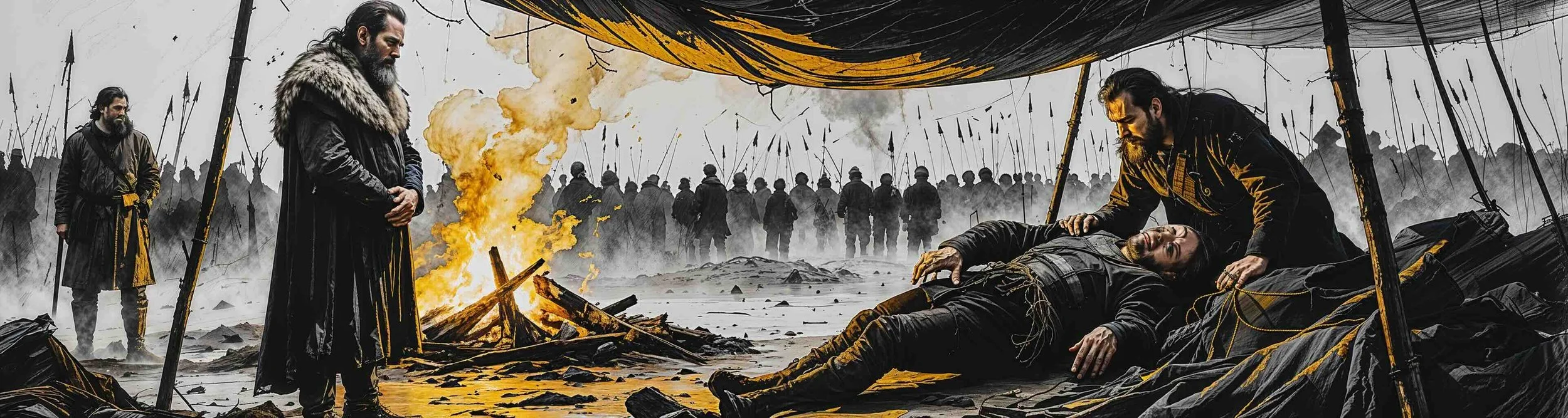
A wounded captain reports Macbeth's brutal heroism in battle to King Duncan, who rewards Macbeth with the title of a condemned traitor.
Scene Profile – At a Glance
Location: A camp near Forres.
Characters: King Duncan, Malcolm, Donalbain, Lennox, A Bleeding Captain (Sergeant), Ross.
Key Event: Duncan learns of Macbeth's victory over the rebels and the Norwegian army, and orders the execution of the traitorous Thane of Cawdor.
The Atmosphere: Violent, urgent, bloody, and triumphant.
Key Quote: "For brave Macbeth—well he deserves that name— / Disdaining fortune, with his brandished steel..."
Significance: Establishes Macbeth as a fiercely loyal, incredibly violent, and universally praised warrior, making his subsequent fall from grace profoundly tragic.
Scene Summary
King Duncan and his sons (Malcolm and Donalbain) meet a bleeding Captain returning from the battlefield. The Captain reports that the battle was balanced on a knife-edge until "brave Macbeth" carved his way through the enemy forces to reach the rebel leader, Macdonwald. Macbeth ruthlessly executed him by slicing him open from the navel to the jaw ("nave to the chaps") and placing his head on the battlements. The Captain explains that no sooner had they defeated the rebels than the Norwegian King launched a fresh attack. Rather than showing fear, Macbeth and Banquo fought back with the ferocity of eagles and lions, bathing in their enemies' blood. The wounded Captain is taken away for medical help. The Thane of Ross arrives and confirms the victory, adding that the Thane of Cawdor aided the Norwegian King as a traitor. King Duncan orders Cawdor’s immediate execution and decrees that his title and lands will be given to Macbeth as a reward for his valour.
Context
The Violence of the Era: The brutal violence described in this scene (unseaming a man, putting his head on a spike) was not seen as horrific by the characters, but as the pinnacle of honour and loyalty. In 11th-century Scotland (and to an Elizabethan audience), a man's worth was intrinsically linked to his ability to dispense violent justice on behalf of his King.
The Great Chain of Being: Macdonwald and the Thane of Cawdor committed treason, a disruption of the natural order and a crime against God (who appointed the King). Macbeth's violent suppression of these traitors is viewed as a restoration of holy order.
Character Focus
Macbeth: The Loyal Warrior
We do not see Macbeth in this scene; we only hear about him. This is a deliberate dramatic technique to build his reputation. He is characterised entirely by his physical prowess, his bloody sword, and his absolute loyalty to Duncan. He is the ultimate defender of the realm. However, his capacity for extreme violence is established early on, foreshadowing that this same violence will soon be turned against the King he is currently defending.
Language & Technique
Simile & Animal Imagery: The Captain compares the exhausted armies to "two spent swimmers, that do cling together." Later, he compares Macbeth and Banquo to apex predators fighting weaker prey: "As sparrows eagles, or the hare the lion." This imagery aligns Macbeth with nobility and terrifying natural strength.
Visceral Imagery (Blood): The scene is drenched in blood. The Captain is physically bleeding, and he describes Macbeth's sword as "smoked with bloody execution." Blood here symbolises honour and bravery. Later in the play, the symbolism of blood will twist into a representation of guilt and inescapable sin.
Irony: The scene ends with Duncan transferring the title of Cawdor to Macbeth: "What he hath lost, noble Macbeth hath won." The dramatic irony is sharp: Duncan is replacing one traitor who plotted against him with another man who will shortly do exactly the same, but with deadly success.
Key Quotes
Original:
For brave Macbeth—well he deserves that name—
Disdaining fortune, with his brandished steel,
Which smoked with bloody execution,
Like valour’s minion carved out his passage... (Captain)
Shakespeare Retold (Modern Verse):
For brave Macbeth – he well deserves that title –
Despite the odds against him, raised his sword,
Dripping with blood from those he’d killed before,
And like a gallant son, carved out a path…
Analysis: The Captain strips Macbeth of his humanity, turning him into a personification of war itself. By calling him "valour's minion" (the chosen servant of courage), he elevates Macbeth to a mythological status. The sword "smoking" with hot blood emphasises the frenzied pace of the slaughter.
Original:
Till he unseamed him from the nave to the chaps,
And fixed his head upon our battlements. (Captain)
Shakespeare Retold (Modern Verse):
Until he’d gutted him from neck to belly
And stuck his chopped-off head upon our fort.
Analysis: A remarkably graphic description of violence. To "unseam" is a tailor's term, suggesting Macbeth ripped the rebel open as easily as tearing a piece of cloth. It establishes Macbeth's physical brutality, setting a bloody precedent for the rest of the play.
Original:
Except they meant to bathe in reeking wounds,
Or memorise another Golgotha,
I cannot tell. (Captain)
Shakespeare Retold (Modern Verse):
If they were striving for their rival’s bloodbath
Or recreating where Jesus had died,
I cannot say.
Analysis: A powerful biblical allusion. Golgotha was the "place of the skull" where Christ was crucified. The Captain suggests the battlefield was so drenched in death it was as if Macbeth and Banquo were trying to recreate the site of the crucifixion, equating their violence with monumental, earth-shattering sacrifice.
Original:
No more that thane of Cawdor shall deceive
Our bosom interest: go pronounce his present death,
And with his former title greet Macbeth. (King Duncan)
Shakespeare Retold (Modern Verse):
The thane of Cawdor will not cheat and harm
What we hold dear again; put him to death,
And grant his former title to Macbeth.
Analysis: Duncan acts decisively to punish treason and reward loyalty. "Bosom interest" means vital state secrets or his own heart's trust. The rhyming couplet seals the transfer of power, but it carries a dark irony: the title of Cawdor is cursed with treachery.
Study Prompts (with suggested answers)
-
Benchmark Points:
Visual impact of violence.
First-hand reliability of the report.
Establishes a gritty, martial atmosphere.
Suggested Answer: The bleeding Captain provides a shocking, visual representation of the brutal war raging off-stage. His wounds prove he was in the thick of the fight, making his report reliable. He brings the visceral reality of the battlefield directly to the King, setting a violent tone for the play from the very start.
-
Benchmark Points:
"Brave Macbeth" and "Valour's minion."
Unstoppable physical force.
Absolute loyalty to the crown.
Suggested Answer: Macbeth is built up as a legendary, almost superhuman warrior. He is defined by his courage ("brave Macbeth") and his extreme capacity for violence. Crucially, this violence is currently sanctioned by the state; he is seen as a heroic defender of order, making his later betrayal all the more shocking to the audience.
-
Benchmark Points:
The Captain's physical wounds.
"Smoked with bloody execution."
Blood as a symbol of honour, not guilt.
Suggested Answer: In this scene, blood is a badge of honour. The Captain's wounds earn him Duncan's praise, and Macbeth's blood-soaked sword is celebrated as a tool of justice. This establishes a baseline; as the play progresses, the meaning of blood will invert (just as the Witches promised), shifting from a symbol of noble bravery to a permanent stain of treacherous guilt.
-
Benchmark Points:
Disruption of order.
The transfer of the title to Macbeth.
Foreshadowing.
Suggested Answer: Cawdor's treason introduces the theme of betrayal and the idea that outward appearances cannot be trusted. By giving Cawdor's title to Macbeth, Duncan inadvertently passes on the mantle of the traitor. It heavily foreshadows Macbeth's own future actions, suggesting that whoever holds the title of Cawdor is destined to betray the King.
-
Benchmark Points:
Echoes the Witches' paradox ("lost and won").
Situational irony regarding the title.
Duncan's misplaced trust.
Suggested Answer: The line echoes the Witches' prophecy from Scene 1 ("When the battle's lost and won"), subtly linking Duncan's decree to supernatural forces. The intense dramatic irony lies in Duncan's belief that he is replacing a traitor with a loyal friend, when in fact, he is simply giving power to the man who will soon murder him.