
Home → Plays → Macbeth → Act 1 Scene 3 → Scene Analysis
Macbeth: Act 1, Scene 3 – analysis
The Witches intercept Macbeth and Banquo on the heath, delivering prophecies that instantly awaken Macbeth's dark ambition for the crown.
Scene Profile – At a Glance
Location: A blasted heath.
Characters: First Witch, Second Witch, Third Witch, Macbeth, Banquo, Ross, Angus.
Key Event: The Witches prophesy that Macbeth will be Thane of Cawdor and King, and that Banquo's descendants will be kings. Ross and Angus arrive to confirm Macbeth is the new Thane of Cawdor.
The Atmosphere: Eerie, psychologically tense, and transformative.
Key Quote: "So foul and fair a day I have not seen."
Significance: The inciting incident of the play. The Witches plant the seed of ambition, and the immediate fulfillment of the first prophecy makes Macbeth believe the second is inevitable.
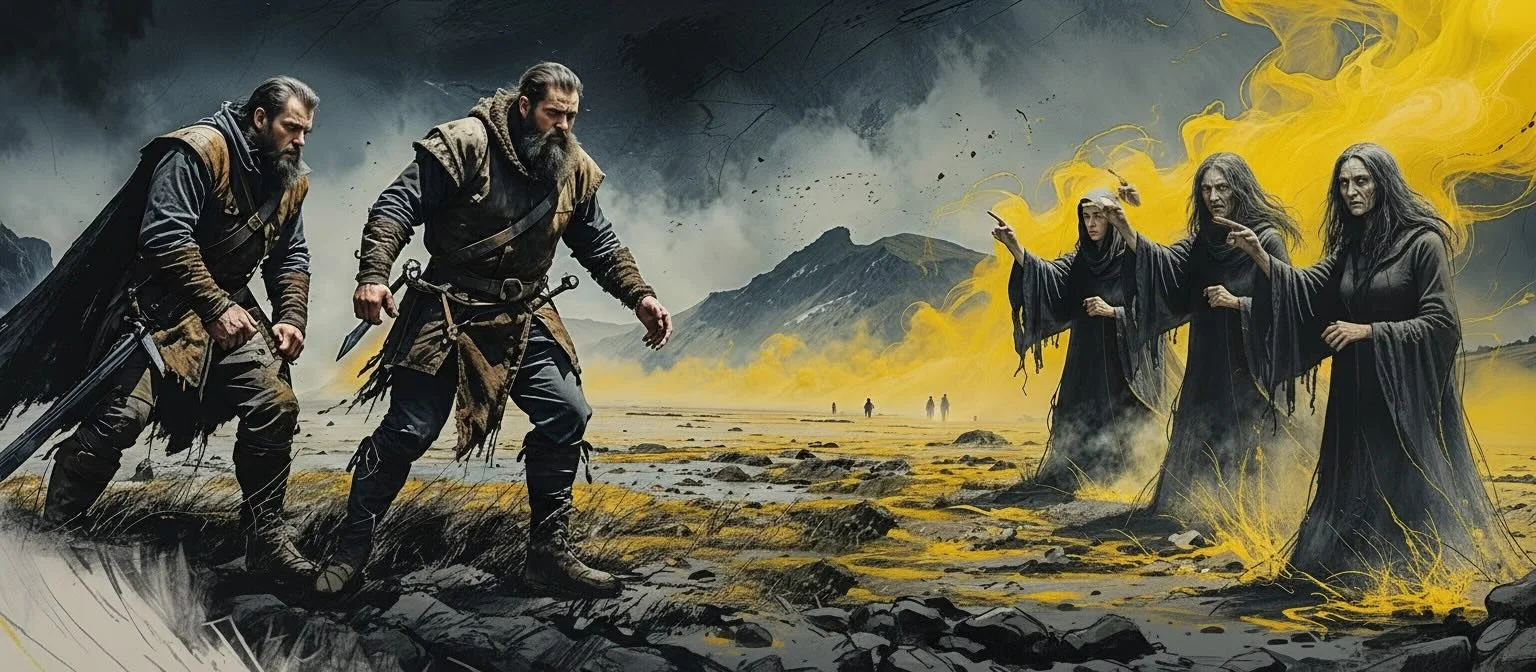
Scene Summary
The Three Witches recount their recent malicious acts, including cursing a sailor because his wife refused to share her chestnuts. A drum signals Macbeth’s approach. Macbeth and Banquo encounter the Witches, who look withered, wild, and unnaturally bearded. The Witches hail Macbeth with three titles: Thane of Glamis (his current title), Thane of Cawdor, and "King hereafter." Banquo, noting Macbeth’s sudden fear, asks for his own prophecy. The Witches tell Banquo he will be "lesser than Macbeth, and greater" and that he will father a line of kings, though he will not be one himself. The Witches vanish into thin air. Moments later, Ross and Angus arrive from the King. They inform Macbeth that Duncan has rewarded him with the title of Thane of Cawdor. Macbeth is stunned; the first prophecy has come true. In a series of private asides, Macbeth wrestles with a terrifying thought: the temptation to murder Duncan to achieve the final prophecy. He temporarily resolves to let fate take its course without taking action ("If chance will have me king, why, chance may crown me").
Context
The Limits of Witchcraft: The First Witch describes torturing the sailor by controlling the winds, but she admits, "Though his bark cannot be lost, / Yet it shall be tempest-tossed." This is crucial Elizabethan theology: witches could cause suffering and manipulate the elements, but they could not destroy a soul or force a human to act. Macbeth's choices remain his own.
Banquo as a Foil: Banquo (who King James I claimed as an ancestor) responds to the Witches with skepticism and moral caution. He warns Macbeth that evil forces ("instruments of darkness") often tell partial truths to trap humans into damning themselves. He stands as the voice of reason against Macbeth's immediate plunge into ambition.
Character Focus
Macbeth: The Awakening
Macbeth’s opening line ("So foul and fair a day...") immediately links his subconscious to the Witches' earlier chant. When he hears the prophecy of becoming King, he "starts" (flinches in fear). This suggests the ambition to be King was already inside him; the Witches merely voiced his darkest, most secret desire. His brilliant, heroic exterior begins to crack as he imagines a murder so horrific it makes his "seated heart knock at [his] ribs."
Language & Technique
The Aside: Shakespeare uses the aside (a character speaking their inner thoughts aloud, unheard by others on stage) extensively here. It creates a split reality: publicly, Macbeth is a loyal, humble servant thanking the messengers; privately, his mind is consumed by "horrid images" of regicide.
Clothing Metaphor: When told he is the new Thane of Cawdor, Macbeth asks, "Why do you dress me in borrowed robes?" This motif of ill-fitting clothing runs throughout the play, symbolising titles and powers that do not rightfully belong to the person wearing them.
Paradox: The Witches speak in riddles and paradoxes to Banquo: "Lesser than Macbeth, and greater," "Not so happy, yet much happier." This linguistic trickery reflects the deceptive nature of the supernatural world, promising much but hiding the true cost.
Key Quotes
Original:
So foul and fair a day I have not seen. (Macbeth)
Shakespeare Retold (Modern Verse):
Such dismal weather on this fateful day.
Analysis: Macbeth's very first line in the play mirrors the Witches' paradox from Scene 1. "Foul" refers to the bloody, brutal battle and the terrible weather; "fair" refers to their glorious victory. It instantly connects his mindset to the supernatural evil of the weird sisters.
Original:
And oftentimes, to win us to our harm,
The instruments of darkness tell us truths,
Win us with honest trifles, to betray's
In deepest consequence. (Banquo)
Shakespeare Retold (Modern Verse):
And oftentimes, to get us into trouble,
Satanic forces feed us half the truth
To coax us with minutia, then betray us
With devastating impact.
Analysis: Banquo recognises the trap. He correctly diagnoses the Witches' methodology: the forces of evil ("instruments of darkness") use small, verifiable truths (the Cawdor title) as bait to lure humans into committing damning acts ("deepest consequence").
Original:
My thought, whose murder yet is but fantastical,
Shakes so my single state of man that function
Is smothered in surmise, and nothing is
But what is not. (Macbeth)
Shakespeare Retold (Modern Verse):
My thought of murder, now just fantasy,
Is shaking me so much, I barely function
Through overwhelming thoughts, and nothing's real
But my imagination.
Analysis: The mere thought of murdering the King (which is only a fantasy or "fantastical" at this point) completely paralyses Macbeth physically and mentally. His grip on reality is slipping; the imaginary future ("what is not") feels more real to him than the present moment.
Original:
If chance will have me king, why, chance may crown me,
Without my stir. (Macbeth)
Shakespeare Retold (Modern Verse):
If fate will make me king, then fate might crown me
Without my intervention.
Analysis: Macbeth tries to suppress his murderous thoughts. He reasons that if fate ("chance") has decreed he will be king, fate can make it happen without him having to lift a finger ("without my stir"). It is a momentary victory for his conscience, though it will not last.
Study Prompts (with suggested answers)
-
Benchmark Points:
Macbeth's fear and obsession.
Banquo's skepticism and intellectual curiosity.
Banquo's moral warning.
Suggested Answer: Macbeth is immediately entranced and fearful; he demands they speak further and is "rapt withal" (spellbound). He internalises the prophecy as a call to action. Banquo, conversely, treats them like a curiosity. He questions their physical reality (noting their beards) and warns Macbeth that they are likely agents of evil trying to trick them into damnation.
-
Benchmark Points:
Establishes the limits of their power ("bark cannot be lost").
Shows their petty, malicious nature.
Foreshadows Macbeth's sleeplessness.
Suggested Answer: The story establishes the theological rules of Shakespeare's universe: the Witches can create terrible storms and cause suffering (making the sailor sleep-deprived), but they cannot actually destroy the ship ("his bark cannot be lost"). This proves they cannot force Macbeth to murder Duncan; they can only manipulate the environment around him. He retains free will.
-
Benchmark Points:
Titles as clothing.
The theme of usurpation.
Macbeth's initial sense of honour.
Suggested Answer: Macbeth compares the title of Cawdor to "borrowed robes" because he believes the current Thane still lives. This clothing metaphor is used throughout the play to represent power that is not rightfully earned. It symbolises the discomfort of a usurper trying to wear the majesty of a true king.
-
Benchmark Points:
Macbeth's internal psychological shift.
Reality vs. Imagination.
The power of ambition.
Suggested Answer: Macbeth is so consumed by his ambition and the imagined future (murdering Duncan to become King) that his present physical reality fades away. The fantasy ("what is not") has completely taken over his mind, showing how quickly and powerfully the Witches' suggestion has corrupted his thoughts.
-
Benchmark Points:
The "horrid image" of murder.
His physiological reaction (heart knocking).
His final conclusion ("chance may crown me").
Suggested Answer: No, he does not definitively decide to commit murder here. While his mind immediately jumps to the "horrid image" of assassination, his conscience is still strong enough to cause him intense physical anxiety. By the end of the scene, he decides to be passive, hoping that if fate wants him to be King, it will happen "without my stir" (without him taking action).