
Home → Plays → Macbeth → Act 1 Scene 4 → Scene Analysis
Macbeth: Act 1, Scene 4 – analysis
King Duncan names his son as the official heir, creating a fatal obstacle that forces Macbeth to choose the path of murder.
Scene Profile – At a Glance
Location: Forres. The Palace.
Characters: King Duncan, Malcolm, Donalbain, Lennox, Attendants, Macbeth, Banquo, Ross, Angus.
Key Event: Duncan officially names his eldest son, Malcolm, the Prince of Cumberland (heir to the throne), and announces his visit to Macbeth's castle.
The Atmosphere: Outwardly joyous and formal, inwardly treacherous.
Key Quote: "Stars, hide your fires; / Let not light see my black and deep desires."
Significance: Duncan's political manoeuvre closes the door on Macbeth inheriting the throne legally, acting as the catalyst that turns Macbeth's passive fantasy into active, murderous intent.
Scene Summary
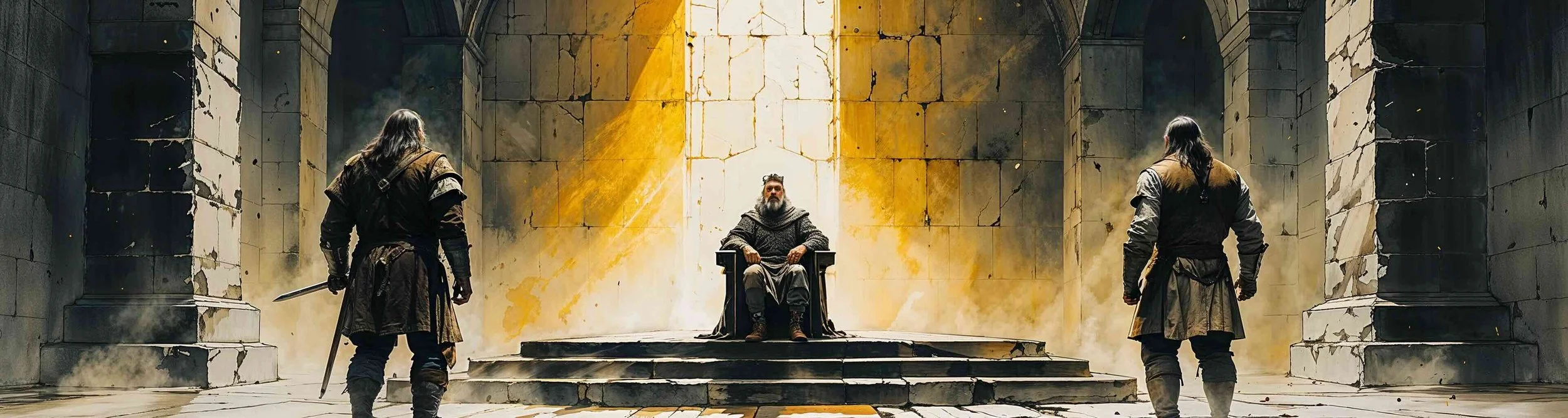
At the royal palace in Forres, Malcolm reports to King Duncan that the traitorous Thane of Cawdor has been executed. Malcolm describes how Cawdor died with deep repentance and noble dignity. Duncan laments that it is impossible to read a man's true character from his face, admitting he built an "absolute trust" in Cawdor. At that exact moment, Macbeth and Banquo enter. Duncan greets Macbeth with overwhelming gratitude, claiming he cannot praise or reward him enough. Macbeth humbly replies that serving the King is its own reward. Duncan then makes a major public announcement: he establishes his estate upon his eldest son, Malcolm, naming him the Prince of Cumberland (the official heir to the throne). He also announces his intention to visit Macbeth's castle in Inverness. Macbeth excuses himself to ride ahead and prepare his home for the King. In a private aside, Macbeth realises that Malcolm's new title is a massive obstacle that he must either trip over or "o'erleap." He calls upon the stars to extinguish their light so that no one can witness his dark and murderous intentions.
Context
Tanistry vs. Primogeniture: In 11th-century Scotland (the historical setting of the play), kingship was not automatically passed to the eldest son (primogeniture). The successor was often chosen from a pool of eligible royal relatives (a system called tanistry), frequently favouring the strongest warrior. By officially naming Malcolm the Prince of Cumberland, Duncan is attempting to secure a direct bloodline succession, legally blocking Macbeth's legitimate claim to be elected King.
The Noble Death: Cawdor's execution reflects the Elizabethan and Jacobean ideal of dying well. A traitor who confessed, repented, and faced the axe with courage could partially restore his honour in his final moments.
Character Focus
King Duncan : The Trusting Monarch
Duncan is portrayed as a benevolent, generous, and divinely appointed King. However, his fatal flaw is his naivety. He is a poor judge of character, completely failing to recognise treachery. He admits he was utterly fooled by the first Thane of Cawdor, and seconds later, he throws that exact same "absolute trust" onto the second Thane of Cawdor (Macbeth). His goodness makes Macbeth's eventual crime seem all the more horrific.
Language & Technique
Dramatic Irony: The timing of Macbeth's entrance is a masterpiece of dramatic irony. Just as Duncan says there is "no art to find the mind's construction in the face" (meaning you cannot spot a traitor by looking at him), Macbeth walks in. Duncan immediately showers him with trust, entirely unaware that the new Cawdor is already plotting his assassination.
Plant and Agricultural Imagery: Duncan speaks of Macbeth like a gardener speaks of a crop: "I have begun to plant thee, and will labour / To make thee full of growing." This aligns Duncan with the natural, life-giving order of the world. Macbeth's impending treason is therefore framed as a crime against nature itself.
Light and Dark Imagery: Macbeth demands that the "Stars, hide your fires." Light represents goodness, heaven, and transparency, whilst darkness represents evil, concealment, and hell. Macbeth is actively choosing the dark, wanting to hide his actions not just from other people, but from the sight of heaven.
Key Quotes
Original:
There’s no art
To find the mind’s construction in the face:
He was a gentleman on whom I built
An absolute trust. (King Duncan)
Shakespeare Retold (Modern Verse):
One is unable
To know another's thoughts by how they look:
He was a gentleman in whom I'd built
An absolute trust.
Analysis: Duncan admits his inability to read people's true intentions. "The mind's construction" refers to a person's inner thoughts and morality. It establishes the theme of deceptive appearances (fair being foul) and highlights Duncan's vulnerability as a ruler who trusts too freely.
Original:
I have begun to plant thee, and will labour
To make thee full of growing. (King Duncan)
Shakespeare Retold (Modern Verse):
I gave you chance to grow, and now I'll work hard
To see your full potential bloom.
Analysis: Duncan uses natural imagery to describe his relationship with his subjects. A good king acts as a gardener to his country, nurturing his loyal thanes so they may prosper. This positions Duncan as a source of life and growth, contrasting sharply with the death and decay Macbeth will bring.
Original:
The Prince of Cumberland! That is a step
On which I must fall down, or else o'erleap,
For in my way it lies. (Macbeth)
Shakespeare Retold (Modern Verse):
The Prince of Cumberland! That is a challenge
To trip me up, unless I overcome it,
For it stands in my way.
Analysis: Malcolm’s new title forces Macbeth’s hand. He can no longer rely on "chance" to crown him, as he hoped in the previous scene. He views Malcolm as a physical barrier ("a step") that he must violently jump over ("o'erleap"). This is the moment his passive ambition turns into active plotting.
Original:
Stars, hide your fires;
Let not light see my black and deep desires:
The eye wink at the hand; yet let that be,
Which the eye fears, when it is done, to see. (Macbeth)
Shakespeare Retold (Modern Verse):
Stars, do not shine,
So folk can't see these dark desires of mine;
Eyes, do not watch the actions of my hand
Till done, then my scared eyes will understand.
Analysis: Macbeth invokes darkness to conceal his treason. He wants his "eye" (his conscience and reason) to be blind to what his "hand" (his physical action) is doing. It shows he is fully aware of the horrific immorality of the murder, yet he is committed to executing it anyway.
Language & Technique
Dramatic Irony: The timing of Macbeth's entrance is a masterpiece of dramatic irony. Just as Duncan says there is "no art to find the mind's construction in the face" (meaning you cannot spot a traitor by looking at him), Macbeth walks in. Duncan immediately showers him with trust, entirely unaware that the new Cawdor is already plotting his assassination.
Plant and Agricultural Imagery: Duncan speaks of Macbeth like a gardener speaks of a crop: "I have begun to plant thee, and will labour / To make thee full of growing." This aligns Duncan with the natural, life-giving order of the world. Macbeth's impending treason is therefore framed as a crime against nature itself.
Light and Dark Imagery: Macbeth demands that the "Stars, hide your fires." Light represents goodness, heaven, and transparency, whilst darkness represents evil, concealment, and hell. Macbeth is actively choosing the dark, wanting to hide his actions not just from other people, but from the sight of heaven.
Key Quotes
Original:
There’s no art
To find the mind’s construction in the face:
He was a gentleman on whom I built
An absolute trust. (King Duncan)
Shakespeare Retold (Modern Verse):
One is unable
To know another's thoughts by how they look:
He was a gentleman in whom I'd built
An absolute trust.
Analysis: Duncan admits his inability to read people's true intentions. "The mind's construction" refers to a person's inner thoughts and morality. It establishes the theme of deceptive appearances (fair being foul) and highlights Duncan's vulnerability as a ruler who trusts too freely.
Original:
I have begun to plant thee, and will labour
To make thee full of growing. (King Duncan)
Shakespeare Retold (Modern Verse):
I gave you chance to grow, and now I'll work hard
To see your full potential bloom.
Analysis: Duncan uses natural imagery to describe his relationship with his subjects. A good king acts as a gardener to his country, nurturing his loyal thanes so they may prosper. This positions Duncan as a source of life and growth, contrasting sharply with the death and decay Macbeth will bring.
Original:
The Prince of Cumberland! That is a step
On which I must fall down, or else o'erleap,
For in my way it lies. (Macbeth)
Shakespeare Retold (Modern Verse):
The Prince of Cumberland! That is a challenge
To trip me up, unless I overcome it,
For it stands in my way.
Analysis: Malcolm’s new title forces Macbeth’s hand. He can no longer rely on "chance" to crown him, as he hoped in the previous scene. He views Malcolm as a physical barrier ("a step") that he must violently jump over ("o'erleap"). This is the moment his passive ambition turns into active plotting.
Original:
Stars, hide your fires;
Let not light see my black and deep desires:
The eye wink at the hand; yet let that be,
Which the eye fears, when it is done, to see. (Macbeth)
Shakespeare Retold (Modern Verse):
Stars, do not shine,
So folk can't see these dark desires of mine;
Eyes, do not watch the actions of my hand
Till done, then my scared eyes will understand.
Analysis: Macbeth invokes darkness to conceal his treason. He wants his "eye" (his conscience and reason) to be blind to what his "hand" (his physical action) is doing. It shows he is fully aware of the horrific immorality of the murder, yet he is committed to executing it anyway.
Language & Technique
Dramatic Irony: The timing of Macbeth's entrance is a masterpiece of dramatic irony. Just as Duncan says there is "no art to find the mind's construction in the face" (meaning you cannot spot a traitor by looking at him), Macbeth walks in. Duncan immediately showers him with trust, entirely unaware that the new Cawdor is already plotting his assassination.
Plant and Agricultural Imagery: Duncan speaks of Macbeth like a gardener speaks of a crop: "I have begun to plant thee, and will labour / To make thee full of growing." This aligns Duncan with the natural, life-giving order of the world. Macbeth's impending treason is therefore framed as a crime against nature itself.
Light and Dark Imagery: Macbeth demands that the "Stars, hide your fires." Light represents goodness, heaven, and transparency, whilst darkness represents evil, concealment, and hell. Macbeth is actively choosing the dark, wanting to hide his actions not just from other people, but from the sight of heaven.
Key Quotes
Original:
There’s no art
To find the mind’s construction in the face:
He was a gentleman on whom I built
An absolute trust. (King Duncan)
Shakespeare Retold (Modern Verse):
One is unable
To know another's thoughts by how they look:
He was a gentleman in whom I'd built
An absolute trust.
Analysis: Duncan admits his inability to read people's true intentions. "The mind's construction" refers to a person's inner thoughts and morality. It establishes the theme of deceptive appearances (fair being foul) and highlights Duncan's vulnerability as a ruler who trusts too freely.
Original:
I have begun to plant thee, and will labour
To make thee full of growing. (King Duncan)
Shakespeare Retold (Modern Verse):
I gave you chance to grow, and now I'll work hard
To see your full potential bloom.
Analysis: Duncan uses natural imagery to describe his relationship with his subjects. A good king acts as a gardener to his country, nurturing his loyal thanes so they may prosper. This positions Duncan as a source of life and growth, contrasting sharply with the death and decay Macbeth will bring.
Original:
The Prince of Cumberland! That is a step
On which I must fall down, or else o'erleap,
For in my way it lies. (Macbeth)
Shakespeare Retold (Modern Verse):
The Prince of Cumberland! That is a challenge
To trip me up, unless I overcome it,
For it stands in my way.
Analysis: Malcolm’s new title forces Macbeth’s hand. He can no longer rely on "chance" to crown him, as he hoped in the previous scene. He views Malcolm as a physical barrier ("a step") that he must violently jump over ("o'erleap"). This is the moment his passive ambition turns into active plotting.
Original:
Stars, hide your fires;
Let not light see my black and deep desires:
The eye wink at the hand; yet let that be,
Which the eye fears, when it is done, to see. (Macbeth)
Shakespeare Retold (Modern Verse):
Stars, do not shine,
So folk can't see these dark desires of mine;
Eyes, do not watch the actions of my hand
Till done, then my scared eyes will understand.
Analysis: Macbeth invokes darkness to conceal his treason. He wants his "eye" (his conscience and reason) to be blind to what his "hand" (his physical action) is doing. It shows he is fully aware of the horrific immorality of the murder, yet he is committed to executing it anyway.
Language & Technique
Dramatic Irony: The timing of Macbeth's entrance is a masterpiece of dramatic irony. Just as Duncan says there is "no art to find the mind's construction in the face" (meaning you cannot spot a traitor by looking at him), Macbeth walks in. Duncan immediately showers him with trust, entirely unaware that the new Cawdor is already plotting his assassination.
Plant and Agricultural Imagery: Duncan speaks of Macbeth like a gardener speaks of a crop: "I have begun to plant thee, and will labour / To make thee full of growing." This aligns Duncan with the natural, life-giving order of the world. Macbeth's impending treason is therefore framed as a crime against nature itself.
Light and Dark Imagery: Macbeth demands that the "Stars, hide your fires." Light represents goodness, heaven, and transparency, whilst darkness represents evil, concealment, and hell. Macbeth is actively choosing the dark, wanting to hide his actions not just from other people, but from the sight of heaven.
Key Quotes
Original:
There’s no art
To find the mind’s construction in the face:
He was a gentleman on whom I built
An absolute trust. (King Duncan)
Shakespeare Retold (Modern Verse):
One is unable
To know another's thoughts by how they look:
He was a gentleman in whom I'd built
An absolute trust.
Analysis: Duncan admits his inability to read people's true intentions. "The mind's construction" refers to a person's inner thoughts and morality. It establishes the theme of deceptive appearances (fair being foul) and highlights Duncan's vulnerability as a ruler who trusts too freely.
Original:
I have begun to plant thee, and will labour
To make thee full of growing. (King Duncan)
Shakespeare Retold (Modern Verse):
I gave you chance to grow, and now I'll work hard
To see your full potential bloom.
Analysis: Duncan uses natural imagery to describe his relationship with his subjects. A good king acts as a gardener to his country, nurturing his loyal thanes so they may prosper. This positions Duncan as a source of life and growth, contrasting sharply with the death and decay Macbeth will bring.
Original:
The Prince of Cumberland! That is a step
On which I must fall down, or else o'erleap,
For in my way it lies. (Macbeth)
Shakespeare Retold (Modern Verse):
The Prince of Cumberland! That is a challenge
To trip me up, unless I overcome it,
For it stands in my way.
Analysis: Malcolm’s new title forces Macbeth’s hand. He can no longer rely on "chance" to crown him, as he hoped in the previous scene. He views Malcolm as a physical barrier ("a step") that he must violently jump over ("o'erleap"). This is the moment his passive ambition turns into active plotting.
Original:
Stars, hide your fires;
Let not light see my black and deep desires:
The eye wink at the hand; yet let that be,
Which the eye fears, when it is done, to see. (Macbeth)
Shakespeare Retold (Modern Verse):
Stars, do not shine,
So folk can't see these dark desires of mine;
Eyes, do not watch the actions of my hand
Till done, then my scared eyes will understand.
Analysis: Macbeth invokes darkness to conceal his treason. He wants his "eye" (his conscience and reason) to be blind to what his "hand" (his physical action) is doing. It shows he is fully aware of the horrific immorality of the murder, yet he is committed to executing it anyway.
Study Prompts (with suggested answers)
-
Benchmark Points:
The theme of honourable death.
The contrast with his treacherous life.
The foreshadowing of Macbeth's own trajectory.
Suggested Answer: Malcolm reports that Cawdor died better than he lived, confessing his treasons and throwing away his life "as 'twere a careless trifle." It establishes the idea that a person can seek redemption through a noble death. Ironically, the second Thane of Cawdor (Macbeth) will also live as a traitor but will not find the same peace or repentance in his final moments.
-
Benchmark Points:
His speech about trusting the wrong man.
Macbeth's immediate entrance.
Duncan's continued blindness to deception.
Suggested Answer: The dramatic irony peaks when Duncan laments that he cannot read a man's face, having placed "absolute trust" in the traitorous Cawdor. The very moment he finishes this thought, Macbeth enters. Duncan immediately transfers this exact same blind trust to Macbeth, completely unaware that the new Cawdor is already harbouring thoughts of regicide.
-
Benchmark Points:
Historical context of Scottish succession.
The end of Macbeth's passive hopes.
The catalyst for active plotting.
Suggested Answer: By naming Malcolm as the official heir, Duncan legally blocks Macbeth from taking the throne through natural or electoral means. In the previous scene, Macbeth hoped that "chance may crown me / Without my stir." Malcolm's promotion destroys that hope. It acts as the catalyst that forces Macbeth to realise that if he wants to be king, he must commit murder.
-
Benchmark Points:
Duncan as a nurturing gardener.
The natural order of the kingdom.
Contrast with Macbeth's unnatural desires.
Suggested Answer: Duncan tells Macbeth, "I have begun to plant thee," using agricultural imagery to show that a good king nurtures his subjects to help them thrive. This aligns the King with the healthy, natural order of life. Macbeth's plot to kill Duncan is therefore not just a political crime, but a crime against nature that will bring disease and barrenness to Scotland.
-
Benchmark Points:
Awareness of evil ("black and deep desires").
The desire to separate thought from action ("eye wink at the hand").
The commitment to the deed.
Suggested Answer: It reveals that Macbeth is not a sociopath; he has a strong moral compass and is fully aware that his desires are "black" and evil. He asks the stars to hide their light because he is ashamed of his own thoughts and fears the judgement of heaven. He wants his "eye" to be blind to his "hand's" actions, showing a desperate psychological need to disconnect his conscience from his ambition.