
Home → Plays → Macbeth → Act 1 Scene 6 → Scene Analysis
Macbeth: Act 1, Scene 6 – analysis
King Duncan arrives at Macbeth's castle, oblivious to the treachery hidden behind Lady Macbeth's welcoming smiles.
Scene Profile – At a Glance
Location: Inverness. Macbeth's castle.
Characters: Lady Macbeth, A Messenger, Macbeth.
Key Event: Lady Macbeth decides Duncan must die tonight and takes immediate control of the murder plot.
The Atmosphere: Dark, claustrophobic, intense, and supernatural.
Key Quote: "Look like the innocent flower, / But be the serpent under 't."
Significance: Introduces Lady Macbeth as the driving force behind the tragedy, subverting traditional gender roles and committing herself entirely to evil.
Scene Summary
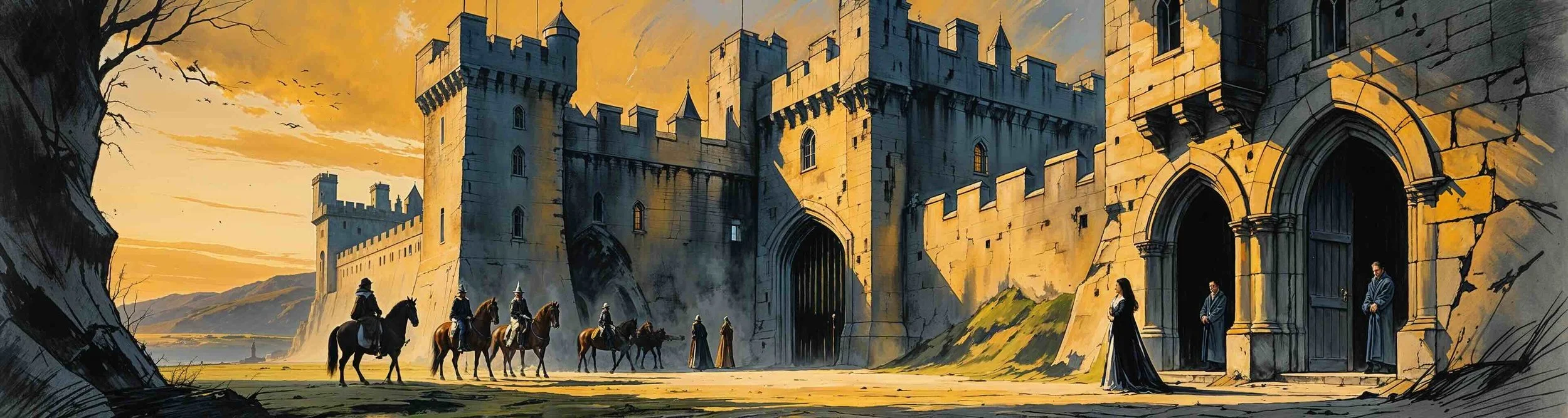
King Duncan, accompanied by his sons and noblemen, arrives outside Macbeth's castle at Inverness. Duncan remarks on the sweet and pleasant air surrounding the estate. Banquo agrees, pointing out that the "martlet" (a summer bird) has built its nests on the castle walls, which he interprets as a sign that the location is healthy and blessed by heaven. Lady Macbeth emerges to greet them. Duncan thanks her for her hospitality, affectionately apologising for the trouble his visit causes while framing it as a mark of his deep love for their family. Lady Macbeth responds with exaggerated humility and flowery language, claiming that all her efforts are "poor and single" compared to the immense honours the King has bestowed upon their house. Duncan asks to be taken to Macbeth, expressing his great affection for the Thane, and the royal party enters the castle.
Context
The Sacred Duty of Hospitality: In medieval Scotland, the relationship between a guest and a host was sacred. A host was morally and culturally bound to protect their guest from harm. By inviting the King into her home with the secret intention of murdering him, Lady Macbeth is committing a profound sacrilege that violates the foundational laws of human society.
Dramatic Irony: This scene relies entirely on dramatic irony. The audience has just watched Lady Macbeth invoke the "smoke of hell" to mask her murderous blade. Now, they watch the gentle King praise the "heavenly" atmosphere of the very place where he will be butchered.
Character Focus
King Duncan: The Sacrificial Lamb
Duncan’s essential goodness, naivety, and poetic appreciation of nature are fully displayed here. He represents the divine, natural order of kingship. His graciousness makes him a highly sympathetic figure. Because he is so openly loving and trusting, the Macbeths' plot is rendered not just treasonous, but utterly monstrous and deeply cowardly.
Language & Technique
Sensory Imagery: Duncan and Banquo use words like "pleasant," "sweetly," "delicate," and "heaven's breath." This creates a false sense of security and starkly contrasts with the dark, choking, and unnatural imagery ("raven," "thick night") used by Lady Macbeth in the preceding scene.
Avian Metaphor: Banquo points out the "temple-haunting martlet" (a type of swallow known for nesting on churches). This bird is associated with peace, summer, and the building of life. This directly and chillingly contrasts with the "hoarse raven" (a bird of death and ill omen) that Lady Macbeth mentioned moments before.
Hyperbole and Sycophancy: Lady Macbeth's welcome is full of exaggerated, obsequious language ("In every point twice done, and then done double"). This linguistic excess is a marker of her deception; she is overcompensating with verbal flattery to hide her murderous intent, perfectly executing her plan to "look like the innocent flower."
Key Quotes
Original:
This castle hath a pleasant seat; the air
Nimbly and sweetly recommends itself
Unto our gentle senses. (King Duncan)
Shakespeare Retold (Modern Verse):
This castle's in a lovely spot; the breeze
Is so delightful here, it leaves one feeling
Relaxed and mellow.
Analysis: Duncan’s opening lines establish the tragic irony of the scene. He senses only peace, sweetness, and gentle air in a place the audience knows has just been dedicated to demonic spirits. It underscores his fatal inability to perceive hidden evil.
Original:
This guest of summer,
The temple-haunting martlet, does approve
By his loved mansionry that the heaven's breath
Smells wooingly here. (Banquo)
Shakespeare Retold (Modern Verse):
This migrating bird,
The house martin, that nests in steeples, likes it
So much it builds its home here, on the winds
That lure it in.
Analysis: Banquo observes that birds have made their nests on the castle walls, associating the building with "heaven's breath" and a "temple." This aligns the King's presence with holy, natural creation, which Macbeth and Lady Macbeth are about to violently sever.
Original:
All our service
In every point twice done, and then done double,
Were poor and single business to contend
Against those honours deep and broad wherewith
Your majesty loads our house. (Lady Macbeth)
Shakespeare Retold (Modern Verse):
My service
If doubled, then if doubled once again,
Would still be insignificant compared
To such a great an honour that we have
Our king within our house.
Analysis: Lady Macbeth uses the language of accounting and debt ("done double," "poor and single," "loads"). She presents herself as an overly humble servant indebted to the King. The audience, however, knows she is actively planning to "repay" him with a dagger.
Study Prompts (with suggested answers)
-
Benchmark Points:
Duncan's praise of the castle's peacefulness.
The audience's knowledge of the murder plot.
The stark contrast between appearance and reality.
Suggested Answer: Dramatic irony occurs because the audience knows Lady Macbeth is plotting to murder Duncan, but Duncan is completely unaware. The tension peaks when Duncan praises the castle's "pleasant seat" and sweet air. The audience feels a sense of dread watching the innocent King walk willingly into a death trap, deceived by his own trusting nature and his host's false smiles.
-
Benchmark Points:
The raven vs. the martlet.
Death and darkness vs. life and heaven.
Lady Macbeth's perspective vs. Banquo's perspective.
Suggested Answer: In Act 1, Scene 5, Lady Macbeth references the "raven," a scavenger bird associated with death, doom, and dark omens, croaking the "fatal entrance" of Duncan. In Scene 6, Banquo observes the "martlet," a bird associated with churches ("temple-haunting"), summer, and the creation of new life. This contrast highlights the horrific gap between the murderous reality inside the castle and the peaceful illusion presented to the outside world.
-
Benchmark Points:
Highly formal and structured verse.
Exaggerated humility ("twice done, and then done double").
Total emotional control.
Suggested Answer: Her language reveals her absolute emotional control and capacity for deception. She speaks in highly formal, exaggerated, and sycophantic verse, hiding her "direst cruelty" behind the mask of a perfectly subservient hostess. She is flawlessly executing her own advice to "be the serpent under 't," showing no signs of guilt or hesitation.
-
Benchmark Points:
Lady Macbeth taking control of the public face.
Macbeth's internal struggle with his conscience.
The difficulty of hiding his true emotions.
Suggested Answer: Macbeth's absence is notable. It suggests he is inside the castle, likely wrestling with his conscience. In the previous scene, Lady Macbeth warned him that his face was like "a book where men may read strange matters." He is absent because he lacks her sociopathic ability to smile at a man he is planning to murder; he cannot yet perfectly separate his inner guilt from his outward appearance.
-
Benchmark Points:
"Fair is foul, and foul is fair."
The corruption of a safe haven.
The subversion of hospitality.
Suggested Answer: The castle visually represents the "fair is foul" paradox. From the outside, it is "fair"—a beautiful, sweet-smelling sanctuary blessed by nature. On the inside, it is "foul"—a slaughterhouse where treason and murder are being plotted. It symbolises how easily evil can hide behind a beautiful, respectable facade.