
Home → Plays → Macbeth → Act 1 Scene 7 → Scene Analysis
Macbeth: Act 1, Scene 7 – analysis
Macbeth wrestles with his conscience and decides against the murder, until Lady Macbeth violently attacks his manhood to force his compliance.
Scene Profile – At a Glance
Location: A room in Macbeth's castle.
Characters: Macbeth, Lady Macbeth.
Key Event: Macbeth decides to abandon the plot to kill King Duncan, but Lady Macbeth manipulates and shames him into committing the murder.
The Atmosphere: Tense, psychological, emotionally abusive, and decisive.
Key Quote: "False face must hide what the false heart doth know."
Significance: This is the ultimate turning point of Macbeth's moral compass. He clearly understands the evil of the act, yet consciously chooses to commit it, cementing his tragic fall.
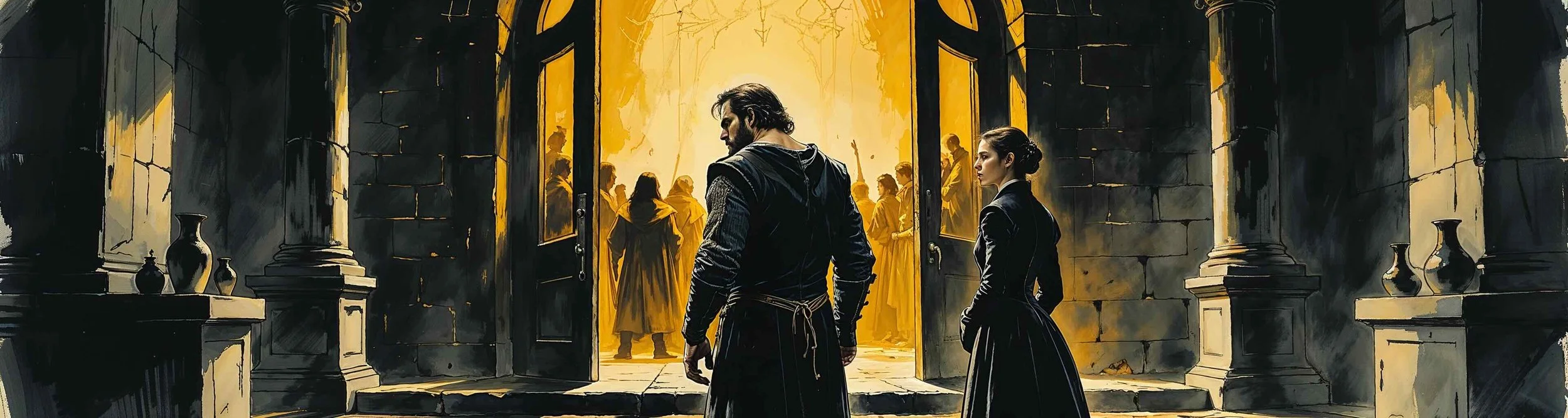
Scene Summary
Macbeth leaves the banquet hosting King Duncan to deliver a profound soliloquy. He wrestles with his conscience, listing the many reasons he should not kill the King. He fears the earthly consequences (revenge and justice) and acknowledges his sacred duties to protect Duncan as his kinsman, his subject, and his host. Furthermore, he admits Duncan has been an exceptionally virtuous and mild ruler, whose murder would cause universal outrage. Macbeth concludes he has no valid motive other than "vaulting ambition," which often ends in disaster, and decides to abandon the plot.
Lady Macbeth enters to find him. When Macbeth declares, "We will proceed no further in this business," she launches a vicious psychological attack. She accuses him of cowardice, compares his changing mind to being drunk, and questions his love for her. To prove her own ruthless commitment, she chillingly states she would have dashed her own smiling baby's brains out rather than break a promise to him. Overwhelmed by her rhetoric and her practical plan to drug Duncan's guards and frame them for the murder, Macbeth submits. He marvels at her masculine spirit and resolves to commit the "terrible feat."
Context
The Rules of Hospitality: Macbeth explicitly mentions his duty as a host ("who should against his murderer shut the door, / Not bear the knife myself"). In medieval Scotland, violating the laws of hospitality was considered one of the most heinous crimes a person could commit, second only to regicide.
Divine Right of Kings: Duncan's "virtues / Will plead like angels." The Jacobean belief that Kings were appointed by God means that Duncan's murder is not just a political assassination; it is an apocalyptic offence against heaven itself, threatening to tear the fabric of nature apart.
Character Focus
Macbeth: The Conscious Fall
This scene is vital because it proves Macbeth is not a mindless monster or a victim of fate. His soliloquy shows profound moral intelligence; he knows exactly why the murder is wrong and recognises the spiritual and physical dangers. His fall is therefore entirely conscious. He allows his moral reasoning to be overridden by his wife's attacks on his masculinity, showing that his fear of appearing weak is stronger than his fear of damnation.
Language & Technique
Euphemism: Throughout his soliloquy, Macbeth cannot bring himself to say the words "murder" or "kill." He refers to the act as "it," "the assassination," "the deed," and "this blow." This linguistic avoidance reveals his deep psychological discomfort and guilt.
Equestrian Metaphor: Macbeth compares his ambition to a rider trying to leap onto a horse but jumping too far and falling on the other side ("Vaulting ambition, which o'erleaps itself / And falls on the other"). It perfectly predicts his tragic trajectory.
Violent Imagery: Lady Macbeth's speech about the baby ("plucked my nipple from his boneless gums, / And dashed the brains out") uses shocking, grotesque imagery. It shatters the contemporary ideal of maternal tenderness, showcasing her absolute commitment to the "direst cruelty" she prayed for in Scene 5.
Key Quotes
Original:
If it were done when 'tis done, then 'twere well
It were done quickly: if the assassination
Could trammel up the consequence, and catch
With his surcease success... (Macbeth)
Shakespeare Retold (Modern Verse):
If there's no retribution, it's as well
To do it quickly. If the assassination
Could catch all consequences in a net,
Concluding it successfully…
Analysis: Macbeth wishes that the murder could be an isolated event with no ripple effects. He wants the act ("it") to be final the moment it is committed. The repetition of "done" highlights his obsession with finality and his dread of the inevitable consequences that will haunt him.
Original:
I have no spur
To prick the sides of my intent, but only
Vaulting ambition, which o'erleaps itself
And falls on the other. (Macbeth)
Shakespeare Retold (Modern Verse):
There’s no more
That’s motivating me to act, except
Ambition, like a man mounting his horse
And falling off the other side.
Analysis: Macbeth uses a horse-riding metaphor to admit he has no justifiable reason to kill Duncan. His only motivation is "vaulting ambition," which he recognises is a dangerous and self-destructive force that causes people to overreach and destroy themselves.
Original:
I dare do all that may become a man;
Who dares do more is none. (Macbeth)
Shakespeare Retold (Modern Verse):
I dare to do all things that make a good man;
Those who dare more aren’t men.
Analysis: Macbeth defends his masculinity. He argues that true manhood is bound by moral limits; a real man acts with honour and restraint. To do "more" (to commit a horrific, treacherous murder) strips a person of their humanity and turns them into a monster.
Original:
I would, while it was smiling in my face,
Have plucked my nipple from his boneless gums,
And dashed the brains out, had I so sworn as you
Have done to this. (Lady Macbeth)
Shakespeare Retold (Modern Verse):
But I know, as the baby smiled back at me,
I'd pluck my nipple from its toothless mouth
And smash its brains out, had I sworn as you have
To do it.
Analysis: This is Lady Macbeth's most horrific line. She weaponises her femininity and maternal capability to shame her husband. By claiming she would brutally murder her own nursing infant rather than break a vow, she sets an impossible standard of ruthless commitment that forces Macbeth to yield.
Original:
Away, and mock the time with fairest show:
False face must hide what the false heart doth know. (Macbeth)
Shakespeare Retold (Modern Verse):
Go back and pass the time without a mention,
And smile to hide the source of our intention.
Analysis: The scene, and the first act, concludes with this rhyming couplet. Macbeth has fully committed to the murder. The line perfectly mirrors his wife's earlier instruction to "look like the innocent flower," sealing their partnership in deception and treason.
Study Prompts (with suggested answers)
-
Benchmark Points:
Fear of consequences ("we still have judgement here").
Duties of kinship and hospitality.
Duncan's virtues as a King.
Suggested Answer: Macbeth uses logic and morality to talk himself out of the murder. He fears the immediate earthly consequences—that violence will breed more violence against him. He also acknowledges his sacred duties to protect Duncan as his relative, his king, and his guest. Finally, he admits Duncan is such a good and humble king that his murder would cause widespread outrage and mourning, leaving Macbeth with no valid excuse except selfish ambition.
-
Benchmark Points:
Accusations of cowardice.
Questioning his love for her.
The "dashed the brains out" comparison.
Suggested Answer: Lady Macbeth uses brutal psychological manipulation. She attacks his core identity as a warrior by calling him a coward ("live a coward in thine own esteem") and compares his wavering ambition to the hangover of a drunkard. She twists his refusal into a rejection of her love, and finally, uses the horrifying image of murdering her own baby to shame him for breaking his promise to her.
-
Benchmark Points:
Macbeth: Manhood means acting with moral honour.
Lady Macbeth: Manhood means ruthless ambition and fulfilling desires.
The pressure of societal expectations.
Suggested Answer: Macbeth argues that a true man acts with honour and within moral boundaries ("I dare do all that may become a man"). Lady Macbeth subverts this by equating manhood solely with power, violence, and the courage to take what one wants regardless of morality. She convinces him that by committing the murder, he will be "so much more the man."
-
Benchmark Points:
Rejection of maternal instincts.
Unwavering commitment to a vow.
Shock value and manipulation.
Suggested Answer: The speech is a terrifying display of Lady Macbeth's dedication to evil. By vividly describing the murder of her own nursing infant, she utterly rejects the natural, maternal role expected of women. She uses this horrific image to demonstrate her unbreakable commitment to her promises, effectively bullying Macbeth into matching her level of sociopathic resolve.
-
Benchmark Points:
Macbeth's submission to the plan.
The focus on framing the chamberlains.
The final rhyming couplet.
Suggested Answer: The scene ends with Macbeth completely yielding to his wife's will. He is impressed by her "undaunted mettle" and agrees to the plot to drug the guards and frame them with bloody daggers. His final line, "False face must hide what the false heart doth know," signifies his total surrender to deception and evil, closing the first Act with his moral downfall complete.