Macbeth: Act 2, Scene 1 – Analysis
Scene Profile – At a Glance
- Location: The courtyard of Macbeth's castle at Inverness, late at night.
- What Happens: Banquo and his son Fleance cross the dark courtyard, uneasy about the witches' prophecy. After they leave, Macbeth sees a phantom dagger leading him towards Duncan's chamber, and the ringing of a bell sends him off to commit the murder.
- Key Characters: Macbeth, Banquo, and Fleance.
- Dramatic Function: The threshold scene. Macbeth's last soliloquy before the murder shows a mind unravelling, and the bell is the cue that turns intention into action.
- Famous Quote:
"Is this a dagger which I see before me,
The handle toward my hand?"
(Macbeth, Act 2, Scene 1) - Why It Matters: This is the hinge of the play. Everything before it is temptation and debate; the bell at the end of the scene commits Macbeth to regicide and to his own destruction.
Scene Summary
It is past midnight in the courtyard of Macbeth's castle. Banquo walks with his young son Fleance, who carries a torch. Banquo is tired but cannot sleep, troubled by "cursed thoughts" he does not name. He hands his sword to Fleance, then takes it back when he hears someone approaching in the dark.
It is Macbeth. Banquo tells him that Duncan has gone to bed delighted with his welcome, and has sent gifts, including a diamond for Lady Macbeth. Banquo mentions that he dreamt of the three witches, and Macbeth, pretending indifference, suggests they talk about the prophecy another time. Banquo agrees, but only if he can keep his conscience clear. He and Fleance go in to sleep.
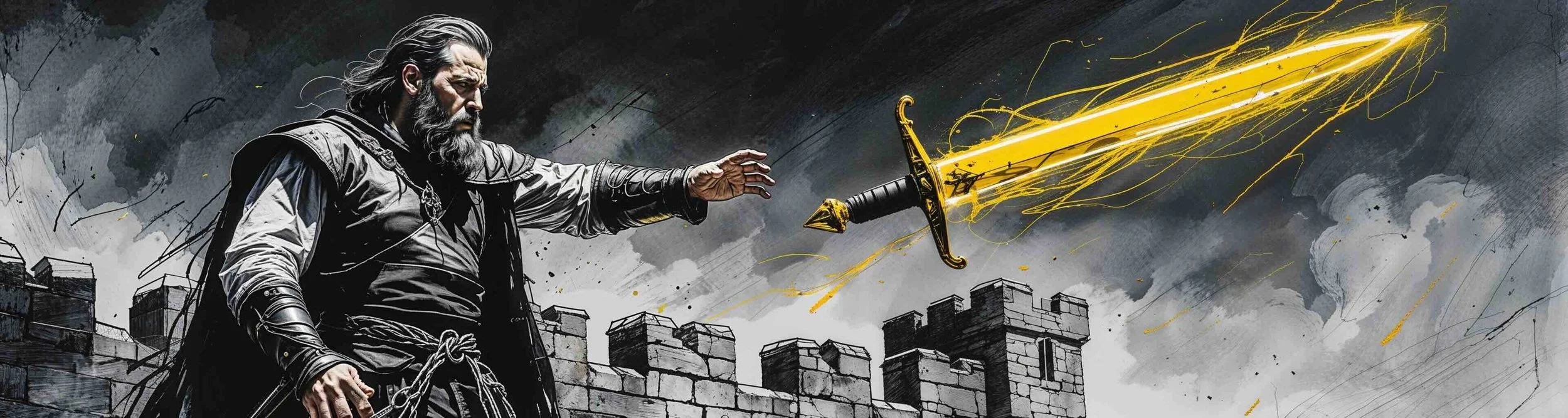
Left alone, Macbeth sends his servant to tell Lady Macbeth to ring the bell when his drink is ready. Then a vision appears: a dagger hanging in the air, its handle towards his hand, leading him towards Duncan's room. He cannot grasp it, and soon sees blood on its blade. He recognises it as a creation of his own guilty mind, yet it points him to the murder he is about to commit. The bell rings, and Macbeth goes to kill the king.
Banquo's Restless Conscience
The scene opens not with Macbeth but with Banquo, and the contrast is deliberate. Banquo, too, has heard the witches and felt the pull of their promise that his descendants will be kings. Yet where Macbeth acts, Banquo prays to be kept from temptation. He is exhausted, weighed down by "a heavy summons", but refuses sleep because of the dark thoughts that come with it.
Original
A heavy summons lies like lead upon me,
And yet I would not sleep: merciful powers,
Restrain in me the cursed thoughts that nature
Gives way to in repose!
(Banquo, Act 2, Scene 1)
Shakespeare Retold (Modern Verse)
Exhaustion is a heavy weight upon me,
But I can't sleep. Oh, decent powers to rest,
Please stop me from the curse of having nightmares
And let me sleep instead!
This is the moral measure of the play. Banquo feels the same dangerous ambition Macbeth feels, but he resists it and asks heaven for help. By placing this small prayer just before Macbeth's dagger soliloquy, Shakespeare gives us a man who chooses conscience over desire, so that Macbeth's opposite choice looks all the starker. The "cursed thoughts" of the night belong to both men; only one of them surrenders to them.
The Air-Drawn Dagger
Once Macbeth is alone, the courtyard becomes the stage for the most famous hallucination in Shakespeare. A dagger appears before him, its handle turned towards his hand as if inviting him to take it. He reaches for it and grasps nothing, yet it will not disappear. The vision is so vivid that he must reason with himself to decide whether it is real.
Original
Is this a dagger which I see before me,
The handle toward my hand? Come, let me clutch thee.
I have thee not, and yet I see thee still.
(Macbeth, Act 2, Scene 1)
Shakespeare Retold (Modern Verse)
Is this a dagger that I see before me,
The handle pointing at my hand? I'll hold it.
It isn't really there, yet I can see it.
The dagger is the play's first great image of guilt made visible. Macbeth himself diagnoses it as "a dagger of the mind, a false creation", born of his "heat-oppressed brain" – he knows it is not real, and still it leads him. The vision externalises his intention: the weapon points the way he was already going. When blood appears on the blade "which was not so before", his imagination is running ahead of the act, dressing the future murder in its evidence before he has even climbed the stairs.
The Bell and the Point of No Return
The soliloquy darkens as Macbeth's mind fills with images of a wicked, sleeping world: witchcraft, the howling wolf, and Tarquin the rapist stalking towards his victim. He imagines the very stones of the earth crying out his whereabouts and begs them to stay silent. Then the bell rings, the signal he arranged, and his hesitation ends.
Original
I go, and it is done; the bell invites me.
Hear it not, Duncan; for it is a knell
That summons thee to heaven or to hell.
(Macbeth, Act 2, Scene 1)
Shakespeare Retold (Modern Verse)
If I begin, it will be done; the bell rings.
Don't hear it, Duncan, for this ringing bell
Will summons you to heaven or to hell.
The bell turns a meditation into a deed. Macbeth has talked himself to the brink throughout the scene, knowing that "words to the heat of deeds too cold breath gives" – that thinking too long will cool his nerve. The ringing bell is "a knell", a funeral bell, and Macbeth hears it as Duncan's death-toll. The rhyming couplet snaps the soliloquy shut, and with it the play crosses from temptation into murder; nothing after this point can be undone.
Language and Technique
- Soliloquy: The dagger speech lets the audience inside Macbeth's mind at the moment of greatest pressure, watching his reason wrestle with his desire.
- Hallucination and the supernatural: The phantom dagger blurs the line between the real and the imagined, a pattern of waking nightmares that will haunt both Macbeths.
- Darkness imagery: "Now o'er the one halfworld / Nature seems dead" turns the night into an accomplice, a world of sleeping innocence and prowling evil.
- Allusion: Comparing himself to Tarquin, the legendary Roman rapist, casts the murder as a violation of a sleeping, defenceless victim.
- Rhyming couplet: The scene ends on a closed, chiming couplet ("knell"/"hell"), sealing the decision and ringing like the bell itself.
Key Quotes from Act 2, Scene 1
Quote 1Art thou not, fatal vision, sensible
To feeling as to sight? Or art thou but
A dagger of the mind, a false creation,
Proceeding from the heat-oppressed brain?
(Macbeth, Act 2, Scene 1)
Shakespeare Retold (Modern Verse)
And is this fateful sight perceivable
By touch as well as sight? Or is it merely
A dagger in my mind, that I've imagined,
A vision from my overactive brain?
Thou marshall'st me the way that I was going;
And such an instrument I was to use.
(Macbeth, Act 2, Scene 1)
Shakespeare Retold (Modern Verse)
It's leading me to somewhere I was going,
And I was going to use a dagger like this.
Thou sure and firm-set earth,
Hear not my steps, which way they walk, for fear
Thy very stones prate of my whereabout,
And take the present horror from the time,
Which now suits with it.
(Macbeth, Act 2, Scene 1)
Shakespeare Retold (Modern Verse)
This solid earth,
Don't make a sound when I walk, just in case that
These stones make noise, revealing where I am,
And break the eery silence of this night
That match my plans.
Key Takeaways
- Banquo is Macbeth's moral mirror: He feels the same temptation but prays to resist it, throwing Macbeth's choice into sharp relief.
- The dagger is guilt made visible: Macbeth knows the vision is "a false creation" of his mind, yet it leads him to the murder all the same.
- Imagination runs ahead of the act: Blood appears on the blade before any blood is shed, showing how vividly Macbeth pictures the crime.
- The bell is the point of no return: Once it rings, hesitation ends and Macbeth commits himself to killing Duncan.
- Darkness is an accomplice: The scene's imagery of night, witchcraft, and silence makes the natural world seem complicit in the murder.
Study Questions and Analysis
Why does Shakespeare begin the scene with Banquo rather than Macbeth?
Beginning with Banquo sets up a deliberate contrast. Banquo has heard the same prophecy as Macbeth, and the witches promised that his line, not his own person, would be royal. He admits to "cursed thoughts" stirred by the night, which suggests he feels the pull of ambition too. The crucial difference is what he does with it: he prays to "merciful powers" to restrain those thoughts rather than acting on them.
By staging this small act of resistance immediately before Macbeth's surrender, Shakespeare reminds us that Macbeth had a choice. The prophecy tempts, but it does not compel. Banquo's restraint becomes the standard against which Macbeth's crime is measured, and it also plants the seed of the rivalry to come, since Banquo's quiet virtue will soon make him the thing Macbeth most fears.
Is the dagger real, or a hallucination?
The text leaves it deliberately ambiguous, but Macbeth himself decides it is a hallucination. He reaches for the dagger and grasps nothing, then names it "a dagger of the mind, a false creation, / Proceeding from the heat-oppressed brain". He is not fooled; he diagnoses his own vision as a product of a feverish, guilty imagination.
That self-awareness is what makes the moment so disturbing. This is not a man tricked by the supernatural but a man whose own mind is conjuring the instrument of his crime and pointing him towards it. Whether we read the dagger as a genuine supernatural omen or as pure psychology, its effect is the same: Macbeth's inner state has become so charged with murderous intent that it spills out into what he sees. The vision is the crime announcing itself before it happens.
What is the significance of the bell at the end of the scene?
The bell is the trigger that converts thought into action. Macbeth has arranged for Lady Macbeth to ring it when his drink is ready, a domestic signal that doubles as the cue for murder. The moment it sounds, his long, hesitant soliloquy stops, and he moves.
Whiles I threat, he lives:
Words to the heat of deeds too cold breath gives.
(Macbeth, Act 2, Scene 1)
Shakespeare Retold (Modern Verse)
He lives through my distraction;
And thoughts prolonged will cool the heat of action.
Macbeth recognises the danger of thinking too long: while he merely "threats", Duncan still lives, and dwelling on the deed will sap his nerve. He calls the bell "a knell", a funeral bell, and tells the sleeping Duncan not to hear it, since it will send him "to heaven or to hell". The bell thus marks the precise instant the tragedy becomes irreversible. Everything before it could still have been undone; everything after it cannot.
How does the scene use darkness and the natural world?
Darkness saturates the whole scene. It opens with Banquo noting that "the moon is down" and that heaven's "candles are all out", and it builds into Macbeth's vision of a world where "nature seems dead, and wicked dreams abuse / The curtained sleep". Night is not merely a setting but an active force, the cover under which evil walks freely.
Macbeth peoples this darkness with figures of dread: witchcraft honouring "pale Hecate", murder roused by the howling wolf, and Tarquin stalking towards his victim. By aligning himself with these images, Macbeth casts his own crime as part of a wider unnatural disorder. A. C. Bradley, in Shakespearean Tragedy (1904), noted how the atmosphere of the play seems to press in on its characters; here the silent, watching night becomes almost a participant in the murder, an accomplice that Macbeth begs to keep his secret.