
Home → Plays → Macbeth → Act 2 Scene 3 → Scene Analysis
Macbeth: Act 2, Scene 3 – analysis
The horrific discovery of the King's body brings chaos to Inverness, forcing Macbeth into a desperate cover-up while the royal heirs flee for their lives.
Scene Profile – At a Glance
Location: Macbeth's castle at Inverness (The Gates / Courtyard).
Characters: The Porter, Macduff, Lennox, Macbeth, Lady Macbeth, Banquo, Malcolm, Donalbain.
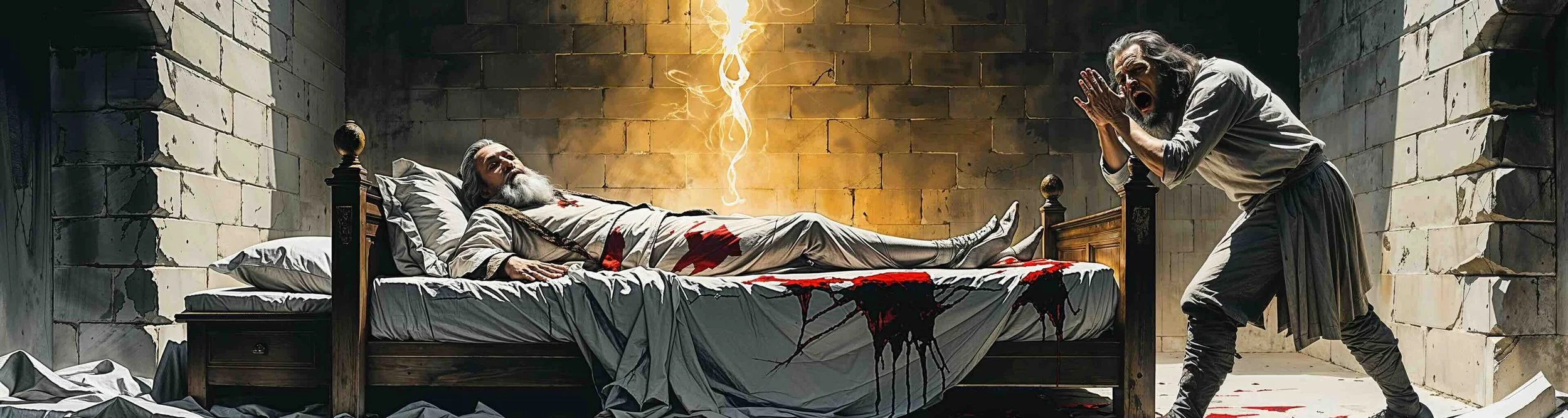
Key Event: Macduff discovers King Duncan’s body; Macbeth murders the guards to silence them; Malcolm and Donalbain flee Scotland.
The Atmosphere: Darkly comic at first, then apocalyptic, frantic, and suspicious.
Key Quote: "O horror, horror, horror! Tongue nor heart / Cannot conceive nor name thee!"
Significance: The private crime becomes public knowledge. Macbeth is forced to improvise his first political murders (the guards), and the flight of the princes clears his path to the throne.
Scene Summary
The loud knocking from the previous scene continues. A drunken Porter stumbles to open the gates, amusing himself by pretending to be the porter of hell-gate, welcoming in various sinners. He finally lets in Macduff and Lennox, who have come to wake the King. Macbeth, playing the perfect host, greets them and directs Macduff to Duncan’s chamber. While they wait, Lennox describes a terrifying night of storms, earthquakes, and screaming owls.
Macduff returns in a state of absolute terror, screaming that the King has been murdered. The castle awakes to the ringing of the alarum bell. Lady Macbeth, Banquo, and the King's sons arrive. Macbeth and Lennox go to the chamber to investigate. Upon returning, Macbeth announces that in a fit of furious grief, he killed the two guards, whom he claims were smeared in blood and holding the daggers. Macduff questions this rash action ("Wherefore did you so?"). Seeing her husband struggling to justify his overacting, Lady Macbeth suddenly faints, distracting the men. Suspicious of the surrounding lords, Malcolm and Donalbain decide they are no longer safe. They agree to flee immediately: Malcolm to England, and Donalbain to Ireland.
Context
The Porter & Hell-Gate: The Porter’s comedic routine is deeply symbolic. By pretending to guard the gates of hell, he speaks a thematic truth: Inverness has literally become a hell on earth, housing a murdered saint and ruled by a demonic usurper.
Equivocation: The Porter jokes about an "equivocator" who committed treason. This is a direct historical reference to Father Henry Garnet, a Jesuit priest executed for his role in the 1605 Gunpowder Plot (an attempt to assassinate King James I). Equivocation—the act of using ambiguous language to conceal the truth—becomes a central theme of the play.
Character Focus
Macduff: The Righteous Avenger
This scene establishes Macduff as the moral counterweight to Macbeth. While Macbeth speaks in rehearsed, overly poetic verses about the murder, Macduff is genuinely rendered speechless by the horror ("Tongue nor heart / Cannot conceive nor name thee"). He is also the first to question Macbeth's hasty execution of the guards. From this moment on, Macduff acts as the agent of divine justice.
Language & Technique
Prose vs Verse: The Porter speaks entirely in prose, reflecting his lower-class status and the bawdy, comedic nature of his dialogue. The moment Macduff and Lennox enter and the serious business of the court resumes, the language snaps back into formal blank verse.
Apocalyptic Imagery: Macduff describes the murder as "The great doom's image" (a picture of the end of the world) and tells the sleepers to rise up "As from your graves." The assassination of the King is equated with Judgment Day.
Pathetic Fallacy: Lennox's description of the "unruly" night—with its howling winds, earthquakes, and screaming birds—shows nature reacting violently to the disruption of the Great Chain of Being. The physical world is vomiting out its disgust at the regicide.
Key Quotes
Original:
Knock, knock, knock! Who's there, i' the name of Beelzebub? (The Porter)
Shakespeare Retold (Modern Verse):
Knock, knock, knock! Who’s there, in the name of the devil?!
Analysis: The Porter unwittingly diagnoses the spiritual state of the castle. By invoking "Beelzebub" (the Devil) and pretending to be the gatekeeper of hell, he highlights that Macbeth’s home is no longer a place of safety or holy hospitality, but a stronghold of demonic evil.
Original:
The night has been unruly: where we lay,
Our chimneys were blown down; and, as they say,
Lamentings heard i' the air; strange screams of death... (Lennox)
Shakespeare Retold (Modern Verse):
It was a wild night: where we were sleeping
Our chimneys were blown down; and, people said
They heard sad crying in the air, like death screams…
Analysis: Lennox describes a night of terrifying supernatural and meteorological chaos. Because the King is God's representative on earth, his murder sends shockwaves through the natural world. Nature itself is mourning and rebelling against the horrific crime.
Original:
Most sacrilegious murder hath broke ope
The Lord's anointed temple, and stole thence
The life o' the building! (Macduff)
Shakespeare Retold (Modern Verse):
An awful, profane murderer has broke open
The king’s own sanctuary, and taken from it
All life within the room!
Analysis: Macduff uses religious metaphor to describe the crime. Duncan's body is compared to "The Lord's anointed temple," reinforcing the Divine Right of Kings. The murder is not just an act of political treason, but an act of profound sacrilege—a theft from God Himself.
Original:
Had I but died an hour before this chance,
I had lived a blessed time; for, from this instant,
There 's nothing serious in mortality:
All is but toys. (Macbeth)
Shakespeare Retold (Modern Verse):
If I had died an hour before this happened
I would have lived a charmed life; but from now on,
There’s nothing worthwhile living anymore.
Life is a joke;
Analysis: Macbeth delivers a highly poetic, rehearsed speech to feign his grief. However, it contains a tragic double meaning. While the court thinks he is expressing sorrow over Duncan, Macbeth is subconsciously expressing the truth: by committing murder, he has destroyed his own soul and rendered his life meaningless.
Original:
Where we are,
There's daggers in men's smiles: the near in blood,
The nearer bloody. (Donalbain)
Shakespeare Retold (Modern Verse):
And here, within the castle,
The smiling men have daggers. Nearer the dead king,
The nearer we are to death.
Analysis: Donalbain recognises the brutal reality of their situation. The "daggers in men's smiles" echoes Lady Macbeth's "serpent under 't" metaphor. He understands that the murderer is among them, pretending to be a friend, and that as the King's blood relatives, he and Malcolm are the next targets.
Study Prompts (with suggested answers)
-
Benchmark Points:
Comic relief.
Delaying the discovery (building tension).
Thematic resonance (Hell-gate and equivocation).
Suggested Answer: The Porter provides necessary comic relief after the unbearable tension of the murder in the previous scene. However, it also serves to delay the inevitable discovery of the body, heightening the audience's suspense. Thematically, his jokes about hell and equivocation perfectly mirror the reality of Macbeth’s castle, which has become a place of damnation built on lies.
-
Benchmark Points:
Pathetic fallacy.
Disruption of the Great Chain of Being.
Unnatural consequences of regicide.
Suggested Answer: Lennox’s description of the "unruly" night uses pathetic fallacy to show the physical world reacting to the murder. According to the Elizabethan worldview (the Great Chain of Being), the King is intrinsically linked to the health of the nation. Murdering Duncan has caused a cosmic imbalance, resulting in earthquakes and "strange screams of death" in the wind.
-
Benchmark Points:
To silence potential witnesses.
A panic reaction.
Feigning passionate loyalty.
Suggested Answer: Macbeth kills the guards to silence them before they can wake up and deny the murder. It is his first unplanned act of violence, driven by panic and a desperate need to cover his tracks. He justifies it to the court by claiming it was a momentary lapse of reason caused by his overwhelming "violent love" for King Duncan.
-
Benchmark Points:
To distract attention from Macbeth.
Macduff's suspicious questioning.
The reality of the bloodshed.
Suggested Answer: It is highly likely she faints deliberately. Macbeth is over-explaining his reasons for killing the guards, and Macduff is growing suspicious ("Wherefore did you so?"). By swooning, Lady Macbeth brilliantly shifts the focus of the men away from her husband's faltering story and onto her own supposed feminine frailty. Alternatively, the sheer horror of Macbeth improvising further murders may have caused a genuine collapse.
-
Benchmark Points:
Fear of assassination.
"Daggers in men's smiles."
The consequence of their flight.
Suggested Answer: The princes realise that whoever killed their father is likely targeting them next to clear the line of succession. Donalbain astutely notes there are "daggers in men's smiles," recognising that the murderer is a two-faced ally within the castle. Their flight saves their lives, but it disastrously plays into Macbeth's hands, as their sudden disappearance makes them look guilty of orchestrating the murder.