
Home → Plays → Macbeth → Act 2 Scene 4 → Scene Analysis
Macbeth: Act 2, Scene 4 – analysis
Nature rebels against the murder of the King, and Macduff makes his first quiet act of political rebellion against the newly crowned Macbeth.
Scene Profile – At a Glance
Location: Outside Macbeth's castle.
Characters: Ross, An Old Man, Macduff.
Key Event: Ross and the Old Man discuss supernatural omens; Macduff announces that Macbeth has been named King and chooses not to attend the coronation.
The Atmosphere: Ominous, unnatural, and steeped in political suspicion.
Key Quote: "Lest our old robes sit easier than our new!"
Significance: Serves as a bridge between the murder and Macbeth's reign. It establishes the cosmic disruption caused by the regicide and positions Macduff as the primary dissenting voice.
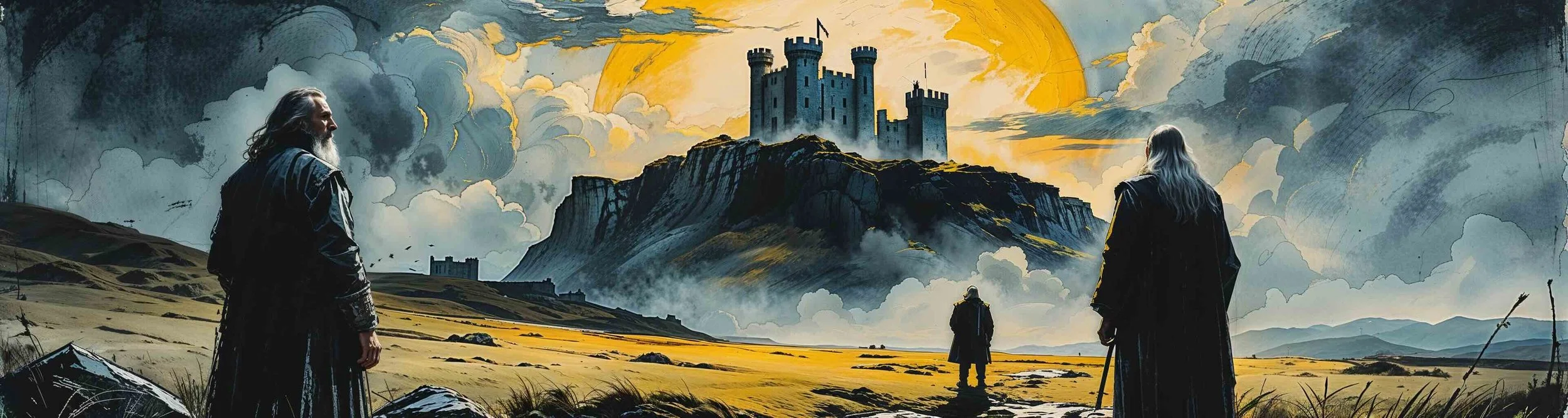
Scene Summary
An Old Man and the Thane of Ross stand outside the castle, discussing the bizarre and terrifying events of the past few days. The Old Man, who can remember seventy years of history, claims he has never seen anything as dreadful as this. Ross notes that although it is daytime, the sky is completely pitch black ("dark night strangles the travelling lamp"). The Old Man mentions another unnatural omen: a mighty falcon was hunted and killed by an ordinary mousing owl. Ross adds that King Duncan's beautiful, highly trained horses turned wild, broke out of their stalls, and ate each other.
Macduff enters. Ross asks him if the murderer is known. Macduff replies that the fleeing princes, Malcolm and Donalbain, are the prime suspects, as their sudden flight makes them look guilty. Because the heirs have fled, Macduff announces that Macbeth has been named King and has already left for Scone to be crowned. Ross states he will go to Scone for the coronation. Macduff, however, makes a pivotal choice: he will not attend. Instead, he is going home to his own castle in Fife. He parts with a warning, hoping that the new regime will not be worse than the old one.
Context
The Great Chain of Being: In the Elizabethan worldview, all creation was linked in a strict hierarchy with God at the top, then angels, then the King, followed by nobles, commoners, animals, and plants. Murdering the King broke the chain, causing chaos to spill over into the natural world (the macrocosm reflecting the microcosm). The darkness during the day and the horses eating each other are literal manifestations of this broken order.
Scone and Colmekill: Scone was the ancient, traditional crowning place of Scottish kings (home to the Stone of Destiny). Colmekill (Iona) was the sacred burial ground for Scottish monarchs. Macbeth goes to Scone for power, while Duncan goes to Colmekill for eternal rest.
Character Focus
Macduff: The Silent Rebel
Macduff's brief appearance here is monumental. While Ross follows the political tide to Scone to curry favour with the new King, Macduff actively chooses to go home to Fife. In a feudal society, failing to attend a new monarch's coronation is a dangerous, highly visible snub. It shows that Macduff is deeply suspicious of the rapid sequence of events and refuses to validate Macbeth's usurpation with his presence.
Language & Technique
Pathetic Fallacy: The entire first half of the scene relies heavily on pathetic fallacy. The eclipse ("dark night") and the violent storms represent the heavens showing their absolute disgust at human actions. The natural world is weeping and bleeding for Duncan.
Animal Symbolism: The falcon represents King Duncan (a creature of high status and noble flight). The "mousing owl" represents Macbeth (a creature of the night that usually hunts low-level prey, but has unnaturally struck above its station).
Clothing Metaphor: Macduff’s parting line ("Lest our old robes sit easier than our new!") revives the clothing motif from Act 1. The "new robes" are Macbeth's new laws and regime, which Macduff fears will be uncomfortable and ill-fitting compared to the "old robes" of Duncan's peaceful reign.
Key Quotes
Original:
By the clock 'tis day,
And yet dark night strangles the travelling lamp. (Ross)
Shakespeare Retold (Modern Verse):
Although it’s daytime,
It’s dark as night, as though the sun’s extinguished.
Analysis: The "travelling lamp" is the sun. The imagery of the night "strangling" the sun is violent and personified, perfectly mirroring how Macbeth (a creature of the night and darkness) just strangled the life out of the true, light-bringing King.
Original:
A falcon, towering in her pride of place,
Was by a mousing owl hawked at and killed. (Old Man)
Shakespeare Retold (Modern Verse):
A falcon, soaring high above the earth,
Was savaged by an owl that feeds on mice.
Analysis: A micro-allegory for the entire play. The natural hierarchy of the animal kingdom has been inverted. The lesser, nocturnal predator (the owl/Macbeth) has unnaturally slaughtered the majestic, high-flying ruler of the skies (the falcon/Duncan).
Original:
'Tis unnatural,
Even like the deed that's done. (Ross)
Shakespeare Retold (Modern Verse):
It is unnatural,
Like what has happened here.
Analysis: Ross makes the explicit connection for the audience. The chaos in the natural world (horses eating each other, eclipses) is a direct, physical consequence of the unnatural "deed" (regicide) committed by Macbeth.
Original:
He is already named, and gone to Scone
To be invested. (Macduff)
Shakespeare Retold (Modern Verse):
He’s named already; he has gone to Scone town
To be made king.
Analysis: The stark, factual delivery of this news highlights the terrifying speed of Macbeth's ascent. The Witches' third prophecy has come true. With the rightful heirs out of the way, the political machinery has moved swiftly to install the tyrant.
Original:
Well, may you see things well done there: adieu!
Lest our old robes sit easier than our new! (Macduff)
Shakespeare Retold (Modern Verse):
Well, may you see things well done there: adieu!
In case our old king’s better than the new!
Analysis: Macduff uses the recurring motif of clothing to express his political anxiety. He fears that the "new robes" (Macbeth's rule) will not fit as comfortably as the "old robes" (Duncan's rule). It is a veiled warning to Ross that life in Scotland is about to become deeply uncomfortable.
Study Prompts (with suggested answers)
-
Benchmark Points:
Chorus figure.
Historical perspective.
Emphasising the unprecedented horror.
Suggested Answer: The Old Man functions like a Chorus in a Greek tragedy. By stating that he can remember "threescore and ten" (seventy) years of history but has never seen a night as dreadful as this, he provides a long-term historical perspective. It emphasises to the audience that Duncan's murder is not just a standard political assassination, but an unprecedented cosmic horror.
-
Benchmark Points:
Unnatural behaviour.
Reflection of the human world.
Consuming one's own kind.
Suggested Answer: Duncan's horses were "the minions of their race" (the best of their breed), representing the noble Scottish Thanes. Just as these beautiful, tame animals suddenly turned wild and cannibalised each other, the once-loyal and noble Macbeth has turned feral, destroying his own King and kinsman. It symbolises the total collapse of loyalty and order.
-
Benchmark Points:
"Stolen away and fled."
Circumstantial evidence.
Macbeth's narrative control.
Suggested Answer: Macduff reports that "suspicion of the deed" has fallen on the King's two sons because they secretly fled the castle in the middle of the night. To the general public, this sudden flight looks exactly like guilt. This plays perfectly into Macbeth's hands, providing him with a convenient scapegoat and a clear path to the throne.
-
Benchmark Points:
Refusal to endorse Macbeth.
Political suspicion.
Protecting his own territory.
Suggested Answer: Macduff's decision to return to his own castle in Fife, rather than attend Macbeth's coronation at Scone, is a massive political statement. It indicates he does not trust Macbeth and refuses to publicly validate his new regime. It marks the beginning of the political resistance against the tyrant and places Macduff in grave danger.
-
Benchmark Points:
"Old robes" vs. "new robes."
Discomfort with the new regime.
Usurped power.
Suggested Answer: Macduff hopes that their "old robes sit easier than our new." This extends the metaphor started by Macbeth ("borrowed robes"). Macduff is comparing the reigns of the two kings to garments. He fears that Macbeth's "new" rule will be a poor, uncomfortable fit for Scotland compared to the familiar, comfortable "old" rule of King Duncan, subtly highlighting Macbeth's illegitimacy.