Macbeth: Act 3, Scene 1 – Analysis
Scene Profile – At a Glance
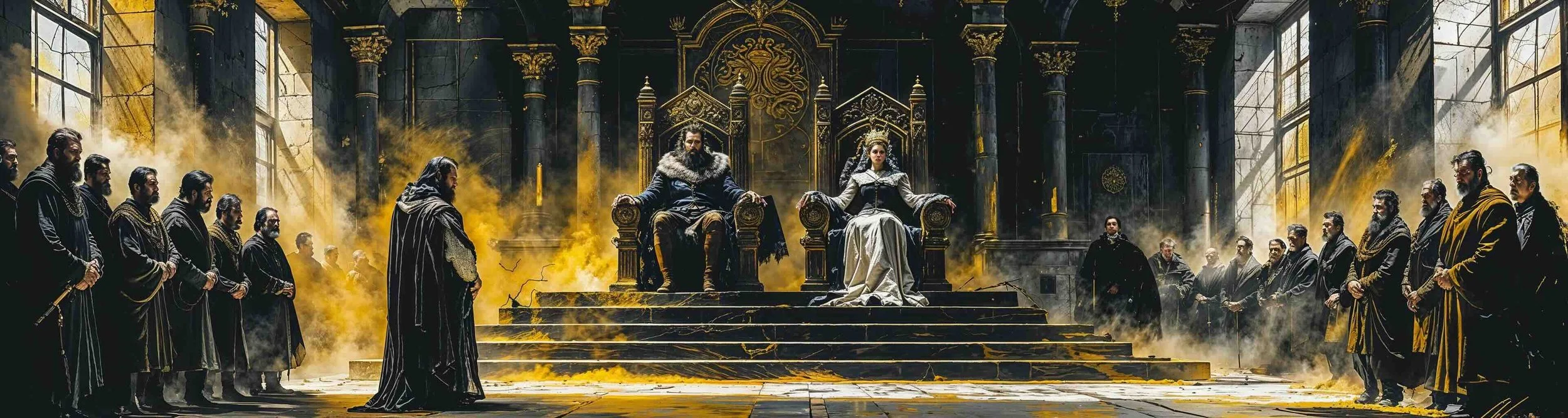
- Location: The royal palace at Forres.
- What Happens: Now crowned king, Macbeth learns Banquo will ride out before the evening feast. Fearing the witches' promise that Banquo will father kings, Macbeth hires two murderers to kill Banquo and his son Fleance that night.
- Key Characters: Macbeth, Banquo, and the two Murderers.
- Dramatic Function: Macbeth turns from haunted accomplice into active tyrant, ordering murder alone, without Lady Macbeth, to secure a crown he fears he holds in vain.
- Famous Quote:
To be thus is nothing;
But to be safely thus.
(Macbeth, Act 3, Scene 1) - Why It Matters: The murder of Banquo begins Macbeth's slide into serial killing. Here ambition curdles into paranoia, and the man who hesitated over Duncan now plots without a flicker of doubt.
Scene Summary
The scene opens with Banquo alone, brooding on how far the witches' words have come true. Macbeth now has everything the sisters promised – Glamis, Cawdor, the crown – and Banquo suspects he won it by foul means. But Banquo also remembers the second half of the prophecy: that he, not Macbeth, will father a line of kings, and he allows himself a private flicker of hope.
Macbeth enters in full royal state with Lady Macbeth and the court, and makes a great show of inviting Banquo to that night's "solemn supper". With studied casualness he questions Banquo about his afternoon ride – how far he is going, when he will return, and whether his son Fleance rides with him. Banquo answers freely, not realising he is handing his killer a timetable.
Left alone, Macbeth delivers a soliloquy that lays bare his fear. He envies and dreads Banquo's "royalty of nature", and rages that he has murdered Duncan and stained his soul only to put Banquo's children on the throne. He resolves to challenge fate itself.
Macbeth then meets the two murderers he has summoned. Reminding them that Banquo, not he, is the cause of their misfortunes, he goads them into accepting the job. He orders that Banquo and Fleance both die that night, well away from the palace, so suspicion will not fall on the king.
Banquo's Suspicion
Shakespeare opens the act not with the new king but with the one man who has guessed the truth. Banquo's first words show he sees exactly what Macbeth has done, and the language – "play'dst most foully" – is unambiguous. Yet Banquo does nothing. His silence is partly prudence and partly self-interest, because the same prophecy that damns Macbeth promises Banquo a royal dynasty.
Original
Thou hast it now: king, Cawdor, Glamis, all,
As the weird women promised, and, I fear,
Thou play'dst most foully for't...
(Banquo, Act 3, Scene 1)
Shakespeare Retold (Modern Verse)
You've got it now: king, Cawdor, Glamis, all things
Those weird women promised, but, I fear
You cheated awfully for it...
The irony is bitter. Banquo correctly diagnoses the murder but holds his tongue because the witches have given him a stake in keeping quiet. That compromise costs him his life. In dramatising Banquo's hope for his "posterity", Shakespeare also flatters his patron, King James, who claimed descent from the historical Banquo – the line of kings the witches foresaw was, in effect, the line that led to the throne of England.
The False Welcome
Macbeth's questioning of Banquo is a masterclass in two-faced courtesy. Every line is a warm host's enquiry, and every line gathers intelligence for the ambush. He asks whether Banquo rides far, when he will be back, and – the crucial detail – whether Fleance goes too. The audience, who do not yet know the murderers are waiting, may catch the menace only on a second hearing.
Original
Fail not our feast.
(Macbeth, Act 3, Scene 1)
Shakespeare Retold (Modern Verse)
Don't miss our feast.
The instruction is grimly double-edged. Macbeth means it as a host's parting word, but he already knows Banquo cannot keep the appointment, because Banquo will be dead. The phrase "fail not our feast" looks forward to the banquet of the next scene, where Banquo will indeed return – as a ghost. Macbeth's smooth public manner has become a weapon, exactly the "appearance versus reality" he and his wife have practised since Duncan's visit.
"To Be Thus Is Nothing"
Alone, Macbeth speaks the soliloquy that defines his new condition. The crown has brought him no peace; it has only given him something to lose. He fears Banquo not for what Banquo has done but for what Banquo is – brave, wise, and the father of future kings. The prophecy that raised Macbeth now torments him, because it promised the throne to another man's children.
Original
For Banquo's issue have I filed my mind;
For them the gracious Duncan have I murdered;
Put rancours in the vessel of my peace
Only for them...
(Macbeth, Act 3, Scene 1)
Shakespeare Retold (Modern Verse)
For Banquo's children, I've defiled my mind;
For them, I murdered kind and generous Duncan;
I poured a cup of poison in my conscience
Only for them...
This is ambition turned cannibal. Macbeth has destroyed his own "eternal jewel" – his soul – and the thought that the prize will pass to Banquo's heirs is unbearable. The logic is chilling: having already committed the worst crime, he reasons that one more murder costs him nothing. His decision to "come fate into the list" and fight destiny itself marks the moment he stops reacting to events and starts manufacturing them.
Language and Technique
- Soliloquy: Macbeth's "To be thus is nothing" speech lets the audience inside a mind that hides its true purpose from everyone on stage.
- Dramatic irony: Banquo's polite answers about his ride, and Macbeth's "Fail not our feast", mean far more to the audience than to Banquo.
- Extended metaphor: Macbeth's catalogue of dogs – "hounds and greyhounds, mongrels, spaniels, curs" – goads the murderers by ranking men like animals.
- Imagery of barrenness: The "fruitless crown" and "barren sceptre" capture Macbeth's dread that his kingship will die with him.
- Royal plural: Macbeth's new use of "we" and "our" shows him assuming the public voice of kingship even as he plots in private.
Key Quotes from Act 3, Scene 1
Quote 1To be thus is nothing;
But to be safely thus. – Our fears in Banquo
Stick deep...
(Macbeth, Act 3, Scene 1)
Shakespeare Retold (Modern Verse)
There's no point being king
Unless a safe king. All my fears of Banquo
Run deep...
Upon my head they placed a fruitless crown,
And put a barren sceptre in my gripe,
Thence to be wrenched with an unlineal hand,
No son of mine succeeding.
(Macbeth, Act 3, Scene 1)
Shakespeare Retold (Modern Verse)
They crowned me, but my children won't succeed me.
They handed me a useless royal sceptre
That will be snatched for one not in my lineage,
Because my son won't follow me.
It is concluded. Banquo, thy soul's flight,
If it find heaven, must find it out to-night.
(Macbeth, Act 3, Scene 1)
Shakespeare Retold (Modern Verse)
It's done. Banquo, your soul will soon take flight,
And if you're heaven-bound, you'll know tonight.
Key Takeaways
- Macbeth acts alone: For the first time he plots a murder without his wife, hiring killers in secret. Power has isolated him.
- Banquo is killed for the prophecy: The witches' promise that Banquo will father kings is the precise cause of his death.
- Ambition turns to paranoia: The crown brings no peace, only the fear of losing it, captured in "To be thus is nothing".
- Two-faced courtesy: Macbeth's warm welcome to Banquo masks an ambush, extending the play's theme of appearance versus reality.
- Fleance must die too: Macbeth orders the son killed as well, knowing the prophecy lives on through Banquo's line.
Study Questions and Analysis
Why does Macbeth want Banquo dead?
Macbeth fears Banquo for two reasons. The first is character: Banquo is brave and wise, the only man whose presence makes Macbeth feel diminished. The second, and decisive, reason is the prophecy. The witches told Banquo he would father a line of kings, which means Macbeth has murdered Duncan and damned himself only to hand the throne to Banquo's descendants.
There is none but he
Whose being I do fear...
(Macbeth, Act 3, Scene 1)
Shakespeare Retold (Modern Verse)
There is no one but him
That I'm afraid of...
The fear is both practical and existential. Banquo knows enough to suspect the murder, but more than that, he represents the future Macbeth cannot have. Killing him is an attempt to cancel the prophecy by force – to "come fate into the list" and fight destiny itself, even though the audience suspects that fate cannot be cheated so easily.
What does the soliloquy reveal about Macbeth's state of mind?
The "To be thus is nothing" soliloquy shows a man who has got everything he wanted and found it worthless. The crown is "nothing" because it is not "safely thus"; possession has bred only the terror of loss. Macbeth's mind is now governed by what he must do to feel secure, not by conscience.
The speech also reveals his bitterness about the cost. He dwells on having given his "eternal jewel" – his soul – "to the common enemy of man", the devil, all to make "the seed of Banquo kings". The arithmetic of damnation is unbearable to him: he has paid the highest possible price for a prize that will pass to someone else. A. C. Bradley, in Shakespearean Tragedy (1904), saw Macbeth as a man of powerful imagination tormented by what he does, and here that imagination turns wholly to fear and calculation, the conscience that paralysed him over Duncan now driving him forward.
How is dramatic irony used in the scene with Banquo?
The whole exchange between Macbeth and Banquo is built on irony. Macbeth plays the gracious host, inviting Banquo to the feast and wishing his horses "swift and sure of foot", while privately he has already decided Banquo will die before nightfall. Banquo answers every question honestly, not realising he is supplying the details of his own murder.
I wish your horses swift and sure of foot;
And so I do commend you to their backs. Farewell.
(Macbeth, Act 3, Scene 1)
Shakespeare Retold (Modern Verse)
I hope your horses canter fast and steady;
And so I wish you well in riding them. Goodbye.
The audience hears the menace under the courtesy, and the gap between what Macbeth says and what he intends is the essence of dramatic irony. It also continues the play's central concern with masks: the smiling king is the assassin, and the warmest words in the scene are spoken to a man already condemned.
How does Macbeth persuade the murderers?
Macbeth does not simply order the killing; he manipulates the murderers into wanting it. He tells them that Banquo, not the king, is the source of all their hardships – that Banquo "held you / So under fortune" – turning the men's grievances against the very victim he has chosen. He plays on their pride, challenging them to prove they are real men and not the lowest "rank of manhood".
His long catalogue of dogs, ranking "hounds and greyhounds, mongrels, spaniels, curs" by quality, is a calculated insult dressed as flattery: he dares them to show they are the best of their breed by accepting the job. It is the same technique Lady Macbeth once used on him, when she questioned his manhood to push him towards Duncan's murder. Macbeth has learned to weaponise masculinity against others, a sign of how far he has travelled into tyranny.
How has Macbeth changed since the murder of Duncan?
The contrast with the earlier murder is stark. Before killing Duncan, Macbeth agonised, hallucinated a dagger, and had to be driven to the deed by his wife. Here he plots Banquo's death calmly, alone, and with grim efficiency. He summons hired killers, supplies a timetable, and even thinks to have the murder done "something from the palace" so suspicion will not touch him.
Most strikingly, Lady Macbeth is absent from this decision. The partnership that planned Duncan's death has broken; Macbeth now keeps his own counsel and acts without her. L. C. Knights, in How Many Children Had Lady Macbeth? (1933), urged readers to attend to the poetry and its moral movement rather than to character alone, and the language here charts a clear descent – from a man horrified by murder to one who organises it like a piece of state business. The closing couplet, "It is concluded", shows a conscience that no longer resists.