
Home → Plays → Macbeth → Act 3 Scene 3 → Scene Analysis
Macbeth: Act 3, Scene 3 – analysis
The assassins strike in the dead of night, killing Banquo, but a fatal mistake allows Fleance to escape and keep the Witches' prophecy alive.
Scene Profile – At a Glance
Location: A park near the palace at Forres.
Characters: First Murderer, Second Murderer, Third Murderer, Banquo, Fleance.
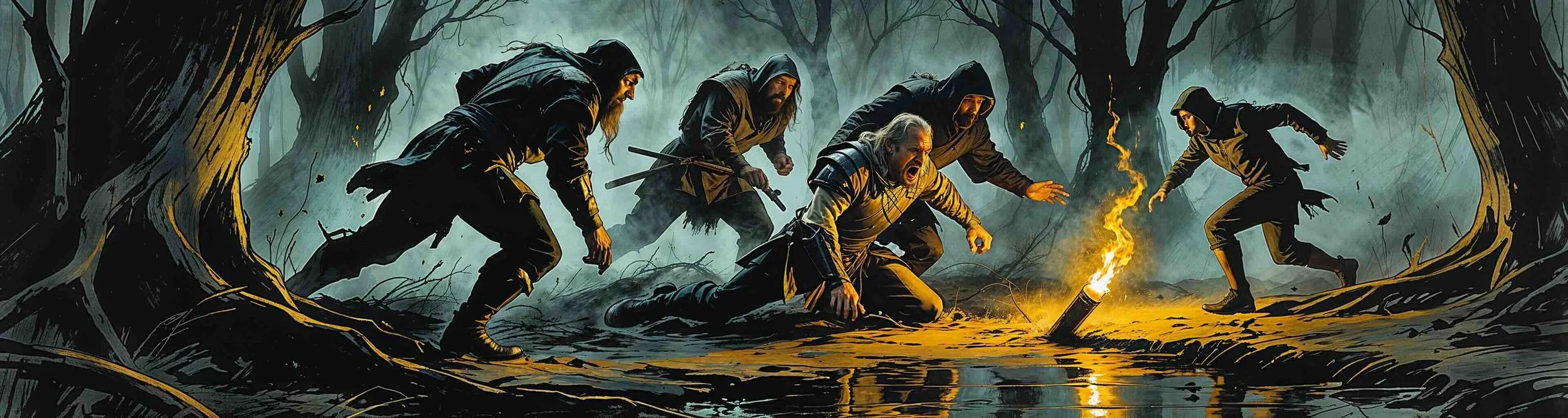
Key Event: The murderers ambush Banquo and Fleance; Banquo is killed, but Fleance escapes into the night.
The Atmosphere: Pitch black, tense, violent, and chaotic.
Key Quote: "O, treachery! Fly, good Fleance, fly, fly, fly!"
Significance: This is the structural turning point (peripeteia) of the play. It is the first time Macbeth's plans fail, marking the beginning of his inevitable downfall.
Scene Summary
Three murderers wait in a wooded park outside the royal palace. The First and Second Murderers are surprised by the arrival of a Third Murderer, who explains that Macbeth sent him to ensure the job is done correctly. Hearing horses approaching, they wait in the dark. Banquo and his son, Fleance, enter on foot, carrying a torch to light their way to the palace doors. Banquo casually remarks to the strangers that "It will be rain to-night." The First Murderer replies, "Let it come down," and the assassins attack. Banquo is overwhelmed and struck down. As he dies, he screams for Fleance to run away and avenge him. During the chaotic scuffle, the torch is knocked out ("Who did strike out the light?"). Under the cover of total darkness, Fleance manages to escape. Realising they have only completed half their mission ("We have lost / Best half of our affair"), the murderers head to the palace to report their failure to the King.
Context
The Third Murderer: The sudden appearance of the Third Murderer is a famous theatrical mystery. Some directors stage this character as Macbeth himself in disguise, or one of his trusted lords (like Ross or Seyton). Regardless of identity, his presence proves Macbeth's absolute paranoia—he does not even trust the assassins he hired to do the job.
The Turning Point: In classical tragedy, the peripeteia is the sudden reversal of fortune for the protagonist. Up until this exact moment, everything has gone perfectly for Macbeth. Fleance's escape is the fatal flaw in Macbeth's design; the prophecy survives, and Macbeth's doom is sealed.
Character Focus
Fleance: The Prophetic Survivor
Fleance has almost no dialogue in the play, yet he is one of its most crucial figures. He represents innocence, the future, and the inescapable truth of the Witches' prophecy. His survival proves that while Macbeth can temporarily violently disrupt the natural order (killing Duncan and Banquo), he cannot permanently destroy it or alter the grand design of fate. Fleance embodies the legacy that Macbeth is desperately and fruitlessly trying to stamp out.
Language & Technique
Metaphor (The Snake): Macbeth says, "We have scorched the snake, not killed it." The snake represents the threats to his throne. By only "scorching" (wounding) it by killing Duncan, the snake will heal and bite them again. It shows he views violence as an ongoing necessity, not a one-off event.
Animal Imagery (Scorpions & Bats): Macbeth's mind is filled with dark, venomous, and nocturnal creatures: scorpions, bats, and the "shard-borne beetle." These creatures perfectly symbolise his toxic, stinging thoughts and his complete immersion into the dark, unnatural world of the Witches.
Concealment Motif: The theme of appearance versus reality continues. Macbeth tells his wife they must make their faces "vizards" (masks) to hide their true hearts. The irony is that he is currently wearing a mask with his own wife, hiding the reality of the assassination plot from her.
Key Quotes
Original:
Nought's had, all's spent,
Where our desire is got without content:
'Tis safer to be that which we destroy
Than by destruction dwell in doubtful joy. (Lady Macbeth)
Shakespeare Retold (Modern Verse):
If nothing’s gained when time’s expired,
Unhappy, though you’ve got what you desired,
It’s better for the one whose blood’s been spilt
Than dwelling in your overwhelming guilt.
Analysis: A devastating private confession. The rhyming couplets give it the feel of a tragic proverb. She admits that achieving her ambition has left her entirely empty ("all's spent"). She envies the dead ("that which we destroy") because they are at peace, while she is trapped in a state of paranoid, "doubtful joy."
Original: We have scorched the snake, not killed it:
She'll close and be herself, whilst our poor malice
Remains in danger of her former tooth. (Macbeth)
Shakespeare Retold (Modern Verse):
We’ve slashed the snake, not killed it:
Its wounds will heal, recovering, whilst our spite
Remains in danger from its former poison.
Analysis: Macbeth uses the snake as a metaphor for the remaining threats to his crown (specifically Banquo and his heirs). He believes that stopping the violence now will only allow their enemies to regroup and strike back. It is his justification for continuing his bloody reign.
Original:
O, full of scorpions is my mind, dear wife!
Thou know'st that Banquo, and his Fleance, lives. (Macbeth)
Shakespeare Retold (Modern Verse):
My mind is full of scorpions, dear wife!
You know Banquo and his son Fleance live.
Analysis: One of the most vivid metaphors in the play. The "scorpions" represent his stinging paranoia, guilt, and dark ambitions. It is a physical manifestation of his psychological torture, making the audience acutely aware of his descent into madness.
Original:
Be innocent of the knowledge, dearest chuck,
Till thou applaud the deed. (Macbeth)
Shakespeare Retold (Modern Verse):
It’s better you don’t know of that, my darling,
Then you can clap the deed.
Analysis: Macbeth shuts his wife out of the plot. "Dearest chuck" is a term of endearment (like 'chick'), but its use here is patronising. He wants to impress her with his independent cruelty ("applaud the deed"), definitively reversing their roles from Act 1, where she was the mastermind.
Study Prompts (with suggested answers)
-
Benchmark Points:
Macbeth's intense paranoia.
Lack of trust in his own hired men.
The escalation of Macbeth's tyranny.
Suggested Answer: The sudden arrival of the Third Murderer visually demonstrates Macbeth's crippling paranoia. Even though he hired the first two assassins, he does not trust them to complete the task unsupervised. This shows that his rule is based entirely on suspicion and fear; he can no longer rely on anyone, forcing him to constantly double-cross and monitor his own agents.
-
Benchmark Points:
The peripeteia (reversal of fortune).
First time Macbeth's plans fail.
The survival of the prophecy.
Suggested Answer: Up to this point, Macbeth’s violent rise to power has been flawless. Fleance’s escape marks the first time Macbeth's plans have failed. Because Fleance survives, the Witches' prophecy (that Banquo's heirs will be kings) remains intact, meaning Macbeth's murders have ultimately been for nothing. This failure triggers the unravelling of his reign and his sanity.
-
Benchmark Points:
Practical cover for Fleance's escape.
Metaphorical extinguishing of goodness.
The motif of light vs. darkness.
Suggested Answer: Practically, striking out the torch plunges the park into total darkness, confusing the assassins and allowing Fleance to slip away. Metaphorically, the light represents Banquo's life, goodness, and truth. When the murderers extinguish the torch, they are plunging Scotland further into the unnatural, murderous darkness that Macbeth has created.
-
Benchmark Points:
Banquo's pathetic fallacy ("rain to-night").
The murderer's double entendre ("Let it come down").
The building of dramatic tension.
Suggested Answer: Banquo’s comment that "It will be rain to-night" uses pathetic fallacy to hint at the dark, weeping atmosphere of the impending tragedy. The First Murderer's brutal response, "Let it come down," is a chilling double entendre. He is using the natural weather as a cue for unnatural violence, initiating the attack so their weapons rain down upon Banquo.
-
Benchmark Points:
To fulfill the Witches' prophecy.
To contrast Macbeth's barrenness.
To provide hope for the future of Scotland.
Suggested Answer: Fleance must survive to ensure the Witches' prophecy—that Banquo will father a line of kings—remains a viable threat. His survival serves as a direct, living contrast to Macbeth's "fruitless crown" and lack of heirs. Theatrically and politically, his escape preserves the hope that the rightful, natural order can one day be restored to Scotland.