
Home → Plays → Macbeth → Act 3 Scene 4 → Scene Analysis
Macbeth: Act 3, Scene 4 – analysis
The newly crowned King attempts to host a unified feast, but his guilt physically manifests as Banquo's ghost, publicly shattering his facade of control.
Scene Profile – At a Glance
Location: A room of state in the palace at Forres.
Characters: Macbeth, Lady Macbeth, Ross, Lennox, Lords, Attendants, First Murderer, Ghost of Banquo.
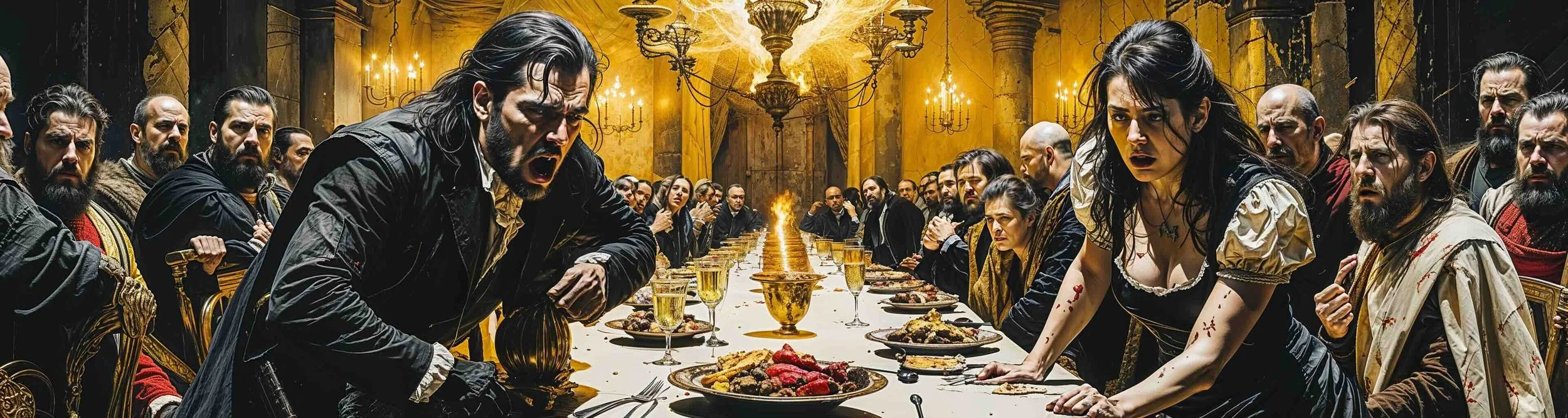
Key Event: The First Murderer reports Banquo's death and Fleance's escape; Macbeth hallucinates Banquo's ghost at the feast, terrifying his guests.
The Atmosphere: Outwardly festive but rapidly deteriorating into claustrophobic terror, chaos, and paranoia.
Key Quote: "I am in blood / Stepped in so far that, should I wade no more, / Returning were as tedious as go o'er."
Significance: This is the public turning point of the play. Macbeth’s private guilt bleeds into the public sphere, destroying his political authority and isolating him from his nobles.
Scene Summary
Macbeth and Lady Macbeth welcome the Scottish nobles to a grand banquet, attempting to project stability and royal grace. Just as the feast begins, the First Murderer appears at the door. He informs Macbeth that Banquo is dead, his throat cut, but that Fleance has escaped. Macbeth is seized by a sudden, suffocating panic, though he resolves to deal with the threat later.
Returning to the table, Macbeth is invited by Lennox to take his seat. However, Macbeth sees the seat is already occupied by the bloody Ghost of Banquo. Because only Macbeth can see the spirit, his terrified screams at an empty chair shock the nobles. Lady Macbeth desperately tries to save the situation, claiming her husband has suffered from these harmless fits since childhood. She privately scolds Macbeth, attacking his manhood ("Are you a man?"). The ghost vanishes, and Macbeth recovers, offering a toast to the "missing" Banquo. The ghost immediately reappears, driving Macbeth into a violent frenzy. Realising the situation is unsalvageable, Lady Macbeth abruptly dismisses the guests, ordering them to leave at once. Left alone in the dark, a paranoid Macbeth notes that Macduff refused to attend. He resolves to visit the Weird Sisters the next morning to demand more prophecies, accepting that he is now too deep in blood to ever turn back.
Context
The Sacred Banquet: In medieval and Renaissance culture, a royal banquet was a powerful symbol of political unity, order, and fellowship. By destroying the peace of the feast, Macbeth is symbolically destroying the health and order of Scotland itself.
The Ghost – Real or Psychological?: Directors must choose whether to put a physical actor playing the ghost on stage or leave the chair empty for the audience too. In Shakespeare's time, ghosts were often viewed as genuine supernatural entities, but the text strongly supports the idea that the ghost is a "painting of [Macbeth's] fear"—a psychological projection of his overwhelming guilt, much like the floating dagger in Act 2.
Character Focus
Macbeth: The Public Collapse
Macbeth's carefully constructed mask of tyranny completely shatters in this scene. Up to this point, he has managed to keep his "black and deep desires" hidden from the court. The appearance of the ghost represents his repressed conscience violently forcing its way out. His inability to control his own mind in front of his lords destroys his political credibility. He transitions from a calculating murderer into a frantic, paranoid tyrant who accepts that continuous, endless bloodshed is his only path forward.
Language & Technique
Alliteration and Metaphor: "But now I am cabined, cribbed, confined, bound in / To saucy doubts and fears." The harsh 'c' sounds and the repetition of restrictive words perfectly capture Macbeth's feeling of psychological claustrophobia upon hearing of Fleance's escape.
Dramatic Irony: Macbeth hypocritically toasts to Banquo, saying "would he were here!" The profound dramatic irony is that Banquo is there, in ghostly form, summoned by Macbeth's own false words.
Blood Imagery: The word "blood" is relentlessly repeated throughout the scene. It shifts from being a physical reality (the blood on the murderer's face) to a supernatural threat ("blood will have blood") and finally to a vast, uncrossable river ("stepped in so far").
Key Quotes
Original:
Then comes my fit again: I had else been perfect,
Whole as the marble, founded as the rock...
But now I am cabined, cribbed, confined, bound in
To saucy doubts and fears. (Macbeth)
Shakespeare Retold (Modern Verse):
I’m scared again, then. It would have been perfect.
Complete, like solid marble stood on bedrock…
But now I am confined within a cabin
Made up of doubts and fears.
Analysis: Upon learning of Fleance's escape, Macbeth's illusion of security crumbles. He compares the safety he could have had to solid, impenetrable stone (marble and rock). Instead, he feels physically trapped and imprisoned ("cabined, cribbed, confined") by his paranoia and the surviving prophecy.
Original:
Thou canst not say I did it: never shake
Thy gory locks at me. (Macbeth)
Shakespeare Retold (Modern Verse):
You cannot say I did this. Do not shake
Your bloodied head at me.
Analysis: Macbeth's first words to the ghost reveal a desperate, childlike attempt to evade responsibility. Because he used hired assassins, he tries to claim a technical innocence ("I didn't physically do it"). The "gory locks" (bloody hair) visualise the brutal reality of the violence he orchestrated.
Original:
O proper stuff!
This is the very painting of your fear:
This is the air-drawn dagger which, you said,
Led you to Duncan. (Lady Macbeth)
Shakespeare Retold (Modern Verse):
Nonsense!
It’s just a sight created out of fear,
Like the imaginary dagger you said
Led you to Duncan.
Analysis: Lady Macbeth dismisses the ghost as sheer nonsense ("proper stuff!"). She correctly diagnoses it as a hallucination born of guilt, comparing it directly to the floating dagger. She uses blistering sarcasm and logic to try and snap him out of his terror.
Original:
It will have blood; they say, blood will have blood. (Macbeth)
Shakespeare Retold (Modern Verse):
The ghost will want my blood; those killed want blood!
Analysis: A grim realisation of the mechanics of revenge. Macbeth understands that violence inherently breeds more violence. The shedding of blood demands retribution, trapping the murderer in an inescapable cycle of bloodshed to maintain their survival.
Original:
I am in blood
Stepped in so far that, should I wade no more,
Returning were as tedious as go o'er. (Macbeth)
Shakespeare Retold (Modern Verse):
I’ve so much blood
Upon my hands that, should I choose to backtrack,
It would be like repeating all I’ve done.
Analysis: One of the most defining quotes of Macbeth's character arc. He compares his murders to wading into a river of blood. He realises he is exactly halfway across; turning back to repentance and goodness would be just as difficult and exhausting as continuing to the other side. He consciously chooses to embrace the evil and keep killing.
Study Prompts (with suggested answers)
-
Benchmark Points:
The survival of the Witches' prophecy.
The feeling of being "confined."
The realisation that his crime is incomplete.
Suggested Answer: Fleance's escape is devastating because it means the Witches' prophecy—that Banquo's line will inherit the throne—is still active. Macbeth realises that he has damned his soul to murder Banquo, but failed to secure his own legacy. This causes his "fit" of paranoia to return, leaving him feeling trapped ("cabined, cribbed, confined") by fate and endless anxiety.
-
Benchmark Points:
Only Macbeth can see it.
Lady Macbeth compares it to the "air-drawn dagger."
A physical manifestation of guilt.
Suggested Answer: While staged physically, the text strongly implies the ghost is a psychological hallucination. Only Macbeth can see it, and it appears precisely when he hypocritically mentions Banquo's name. As Lady Macbeth notes, it is the "very painting of [his] fear," representing his suffocating guilt and the inescapable torment of his conscience manifesting before his eyes.
-
Benchmark Points:
Making excuses to the lords (a childhood illness).
Questioning Macbeth's manhood in private.
Eventually dismissing the guests to prevent a confession.
Suggested Answer: Lady Macbeth acts swiftly to manage the public relations disaster. She lies to the nobles, claiming Macbeth has suffered from these momentary, harmless fits since childhood, and begs them to ignore him. Privately, she viciously attacks his masculinity ("Are you a man?") to force him to recover. When he breaks down a second time, she Abruptly abandons protocol and orders the lords to leave immediately, terrified he will confess his crimes.
-
Benchmark Points:
The cyclical nature of violence.
Paranoia and the fear of revenge.
Karma or divine justice.
Suggested Answer: "Blood will have blood" expresses the universal truth that violence inevitably breeds more violence. Macbeth recognises that by murdering his way to the top, he has set a bloody precedent; the universe, or those he has wronged, will demand his blood in return. It marks his transition into total paranoia, where every shadow represents an act of vengeance.
-
Benchmark Points:
"Stepped in so far."
Turning to the Witches for guidance.
Acting without hesitation.
Suggested Answer: Macbeth resolves that he is "stepped in so far" into a river of blood that turning back is impossible. He decides to actively seek out the Weird Sisters to learn his fate, showing he is now entirely reliant on the forces of darkness. Furthermore, he declares that from now on, he will act on his violent impulses immediately, without overthinking them, sealing his transformation into a ruthless tyrant.