
Home → Plays → Macbeth → Act 3 Scene 6 → Scene Analysis
Macbeth: Act 3, Scene 6 – analysis
The Scottish nobility are no longer fooled by Macbeth’s lies. As the country suffers under a tyrant, Macduff heads to England to ignite a rebellion.
Scene Profile – At a Glance
Location: Somewhere in Scotland (usually staged as a room in the royal palace).
Characters: Lennox, A Lord.
Key Event: Lennox sarcastically summarises the recent murders; the Lord reveals Macduff has gone to England to ask King Edward for military aid.
The Atmosphere: Conspiratorial, cautious, sarcastic, and rebellious.
Key Quote: "...that a swift blessing / May soon return to this our suffering country / Under a hand accursed!"
Significance: A vital choric scene that provides exposition. It shows the definitive shift in public opinion against Macbeth and sets up the military conflict for the final acts.
Scene Summary
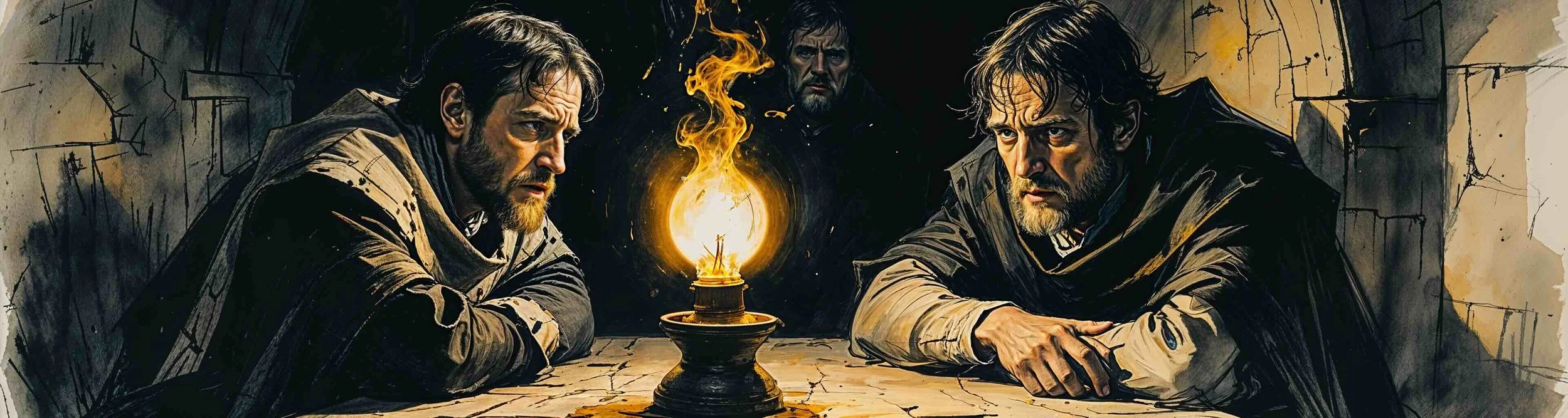
Lennox and an unnamed Scottish Lord are having a highly guarded, private conversation. Lennox delivers a heavily sarcastic speech summarising the recent events in Scotland. He notes how "strangely" things have worked out: Macbeth pitied Duncan, and Duncan ended up dead; Banquo walked too late and was killed, supposedly by Fleance since Fleance fled. Lennox sarcastically praises Macbeth for killing Duncan's guards out of "pious rage," noting it was a brilliant move since they surely would have denied the crime.
The Lord clearly understands Lennox's underlying meaning. He reveals the true state of affairs: Malcolm is living safely in the English court, treated with great respect by the holy King Edward the Confessor. Furthermore, Macduff has recently fled to England to ask King Edward and the skilled general, Siward, for an army to overthrow Macbeth and restore peace, food, and sleep to Scotland. Macbeth is already aware of Macduff's defiance and is furiously preparing for war. Lennox prays that a holy angel will guide Macduff and bring a swift blessing to their "suffering country."
Context
King Edward the Confessor: Edward was an actual historical King of England (ruled 1042–1066), famous for his extreme piety and alleged ability to heal the sick with his touch. Shakespeare includes him here to provide a stark, holy contrast to the demonic, diseased tyranny of Macbeth.
The Choric Scene: In classical theatre, a 'Chorus' is used to comment on the action, provide background information, and express the general public's viewpoint. This scene serves a choric function, stepping away from the main characters to show how the wider nation is reacting to the tragedy.
Character Focus
Lennox: The Voice of the Thanes
Lennox represents the shifting loyalty of the Scottish nobility. In earlier scenes, he was a loyal follower of the King, present at the discovery of Duncan's body and at Macbeth's banquet. Now, his eyes are open to the truth. However, because he lives under a brutal dictatorship, he cannot speak his treasonous thoughts plainly. He must use heavy sarcasm and veiled language to test the political waters with the other Lord, showing the terrifying, suffocating reality of living under a tyrant's rule.
Language & Technique
Verbal Irony (Sarcasm): Lennox’s opening speech is a masterpiece of verbal irony. When he says, "How it did grieve Macbeth!", he means exactly the opposite. This technique highlights the absurdity of Macbeth's official narrative and the fact that no one in Scotland actually believes it anymore.
Disease and Healing Imagery: The Lord describes Scotland as a "suffering country" groaning under an "accursed" hand. To cure this disease, they are looking to the "holy" English King. The imagery shifts the focus from individual ambition to the sickness and health of the entire nation.
The Motif of Sleep: The Lord hopes the rebellion will allow them to "sleep to our nights." This echoes the curse Macbeth brought upon himself in Act 2 ("Macbeth does murder sleep"). The insomnia and paranoia of the usurper have now infected the entire population.
Key Quotes
Original:
…and I do think
That had he Duncan's sons under his key—
As, an't please heaven, he shall not—they should find
What 'twere to kill a father; so should Fleance. (Lennox)
Shakespeare Retold (Modern Verse):
…and I do think
If he had Duncan’s sons locked up in jail—
As, God forbid, he doesn’t—they’d discover
The rap for father-killing; Fleance, too.
Analysis: Lennox's sarcasm reaches its peak. He is essentially saying: "If Macbeth got his hands on Malcolm, Donalbain, or Fleance, he would execute them immediately for 'killing their fathers'—but really, it would just be to secure his own throne." The aside ("an't please heaven, he shall not") reveals his true, rebellious prayer.
Original:
The son of Duncan,
From whom this tyrant holds the due of birth,
Lives in the English court, and is received
Of the most pious Edward with such grace... (Lord)
Shakespeare Retold (Modern Verse):
The son of Duncan,
From whom Macbeth-the-tyrant stole the crown,
Lives in the English court, and is well treated
By pious King Edward, and with so much grace…
Analysis: The Lord drops the veil of sarcasm and speaks plainly. By calling Macbeth a "tyrant" who steals the "due of birth" (rightful inheritance), he commits open treason. The contrast with the "pious" King Edward establishes England as a beacon of holy justice against Scotland's demonic corruption.
Original:
...we may again
Give to our tables meat, sleep to our nights,
Free from our feasts and banquets bloody knives... (Lord)
Shakespeare Retold (Modern Verse):
…we again may
Put food upon our tables, sleep at night,
Host feasts and banquets safe from threats of murder…
Analysis: The Lord lists the basic human necessities that Macbeth’s tyranny has destroyed: food, sleep, and safety. The reference to "bloody knives" at banquets is a direct callback to the disastrous feast in Scene 4. It shows that Macbeth's reign has turned daily life into a waking nightmare for his subjects.
Original:
Some holy angel
Fly to the court of England and unfold
His message ere he come, that a swift blessing
May soon return to this our suffering country
Under a hand accursed! (Lennox)
Shakespeare Retold (Modern Verse):
Perhaps some guardian angel
Will fly to England’s courts and give the message
Before he leaves, and thereby blessing us
With his return to this, our suffering country,
That’s now led by a tyrant!
Analysis: The scene concludes with a prayer for divine intervention. Lennox asks the angels to speed Macduff on his way. He explicitly defines Macbeth as an "accursed" force. This frames the upcoming war not just as a political rebellion, but as a holy crusade to purge evil from Scotland.
Study Prompts (with suggested answers)
-
Benchmark Points:
Heavy verbal irony and sarcasm.
Mocking Macbeth's official narrative.
Revealing the truth through opposites.
Suggested Answer: The tone of Lennox’s speech is heavily sarcastic and drenched in verbal irony. He repeats the official stories—that Fleance killed Banquo, and Malcolm killed Duncan—but his exaggerated praise of Macbeth's "pious" and "noble" actions makes it completely obvious that he believes Macbeth is the real murderer. He is mocking the absurdity of the tyrant's lies.
-
Benchmark Points:
Fled to the English court.
Seeking an audience with King Edward the Confessor.
Raising an army led by Siward.
Suggested Answer: Macduff has fled to England to join Malcolm at the court of King Edward the Confessor. His goal is to persuade the holy English King to provide an army, led by the renowned general Siward, to march on Scotland, overthrow Macbeth, and restore the rightful heir to the throne.
-
Benchmark Points:
A "suffering country."
Lack of basic necessities (meat, sleep).
Constant fear of violence ("bloody knives").
Suggested Answer: The Lord describes Scotland as an "accursed" and "suffering country." The natural order has been completely destroyed. The people are deprived of peaceful sleep, their feasts are ruined by the fear of assassination ("bloody knives"), and the traditional honours of court are meaningless. It is a nation held hostage by fear.
-
Benchmark Points:
A choric exposition scene.
Shifting the narrative focus to the rebellion.
Clarifying the political timeline.
Suggested Answer: Dramatically, this scene acts as a bridge between the murders of the first half of the play and the wars of the second half. It serves a choric function, efficiently providing the audience with crucial exposition about Macduff's movements and Malcolm's status, while confirming that the Scottish nobility are fully aware of Macbeth’s crimes and are secretly preparing to rebel.
-
Benchmark Points:
Edward: Pious, holy, legitimate, healing.
Macbeth: Accursed, tyrannical, usurper, diseased.
The battle between good and evil.
Suggested Answer: Shakespeare sets up a stark moral contrast between the two monarchs. King Edward is described as "pious" and full of "grace," representing holy, legitimate, and healing leadership. King Macbeth is described as a "tyrant" with an "accursed" hand, representing demonic, illegitimate, and diseased rule. This positions the impending war as a battle between divine justice and supernatural evil.