

A smiling villain, a stolen crown, a kingdom for a horse … retold in modern English verse.
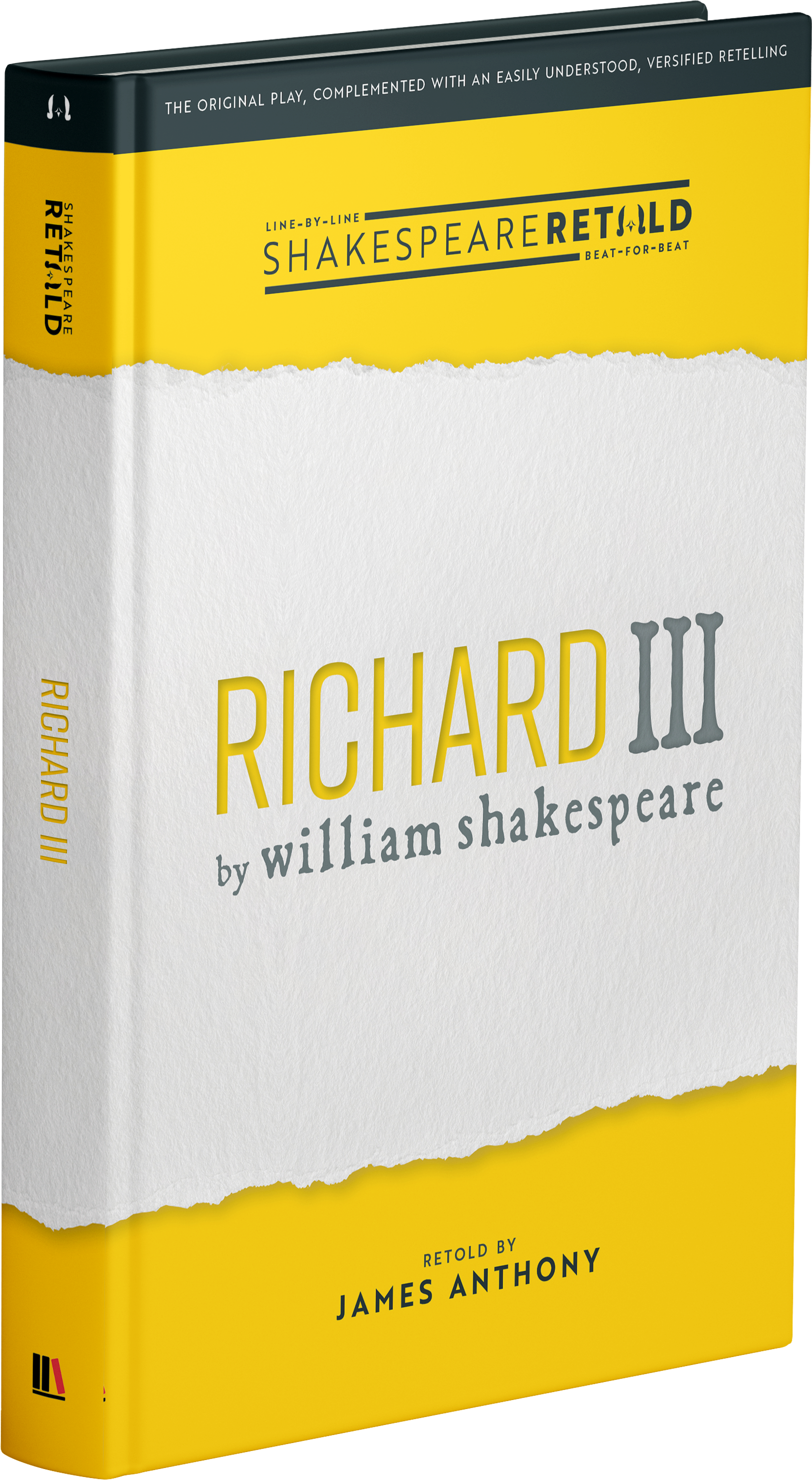
The complete Richard III study guide – every line translated; every rhythm kept; every scene, character and theme explored – free for students, teachers, actors, and theatregoers.
Richard III Overview
Richard III Deep Dive
-
ACT 1
-
Richard III – Act 1 Scene 1
"Now is the winter of our discontent"
Richard III Act 1, Scene 1 retold in modern English verse: Richard plots against Clarence and the dying King.
-
Richard III – Act 1 Scene 2
"Was ever woman in this humour wooed?"
Richard III Act 1, Scene 2 retold in modern English verse: Richard woos Lady Anne over the coffin of the king he killed.
-
Richard III – Act 1 Scene 3
The deposed queen curses the court
Richard III Act 1, Scene 3 retold in modern English verse: Old Queen Margaret curses the Yorkist court, Richard above all.
-
Richard III – Act 1 Scene 4
Clarence's dream, and the murderers
Richard III Act 1, Scene 4 retold in modern English verse: Clarence dreams of drowning, then two hired men come to kill him.
-
-
ACT 2
-
Richard III – Act 2 Scene 1
Peace at the deathbed, and news of Clarence
Richard III Act 2, Scene 1 retold in modern English verse: Edward's deathbed peace is broken by news of Clarence.
-
Richard III – Act 2 Scene 2
Three generations mourn, and a coup is agreed
Richard III Act 2, Scene 2 retold in modern English verse: The King is dead; Buckingham plans the Prince's escort.
-
Richard III – Act 2 Scene 3
Three citizens read the signs
Richard III Act 2, Scene 3 retold in modern English verse: Ordinary Londoners fear a child king and the Duke of Gloucester.
-
Richard III – Act 2 Scene 4
The Queen takes sanctuary
Richard III Act 2, Scene 4 retold in modern English verse: Rivers and Grey are arrested; Elizabeth takes sanctuary with her son.
-
-
ACT 3
-
Richard III – Act 3 Scene 1
The princes are sent to the Tower
Richard III Act 3, Scene 1 retold in modern English verse: Prince Edward reaches London and is lodged in the Tower.
-
Richard III – Act 3 Scene 2
Stanley's dream of the boar
Richard III Act 3, Scene 2 retold in modern English verse: Hastings laughs off Stanley's dream and walks towards his death.
-
Richard III – Act 3 Scene 3
Rivers, Grey and Vaughan at Pomfret
Richard III Act 3, Scene 3 retold in modern English verse: The Queen's kinsmen die at Pomfret, remembering Margaret's curse.
-
Richard III – Act 3 Scene 4
"Off with his head!"
Richard III Act 3, Scene 4 retold in modern English verse: Richard sends for strawberries, then sends Hastings to the block.
-
Richard III – Act 3 Scene 5
Rusty armour and a head in a bag
Richard III Act 3, Scene 5 retold in modern English verse: Richard and Buckingham sell Hastings' death to the Lord Mayor.
-
Richard III – Act 3 Scene 6
The Scrivener sees the trick
Richard III Act 3, Scene 6 retold in modern English verse: A scribe sees that Hastings' indictment was written before the crime.
-
Richard III – Act 3 Scene 7
Richard accepts the crown between two bishops
Richard III Act 3, Scene 7 retold in modern English verse: Buckingham begs Richard to take the crown; he accepts.
-
-
ACT 4
-
Richard III – Act 4 Scene 1
Turned away from the Tower
Richard III Act 4, Scene 1 retold in modern English verse: Three women are refused the Tower, and Anne is summoned to be crowned.
-
Richard III – Act 4 Scene 2
"I am not in the giving vein today"
Richard III Act 4, Scene 2 retold in modern English verse: Richard hires Tyrrel to kill the princes and turns on Buckingham.
-
Richard III – Act 4 Scene 3
The princes are dead
Richard III Act 4, Scene 3 retold in modern English verse: Tyrrel reports the murder of the princes in the Tower.
-
Richard III – Act 4 Scene 4
A mother's curse, a second wooing
Richard III Act 4, Scene 4 retold in modern English verse: Margaret teaches Elizabeth to curse; Richard woos for her daughter.
-
Richard III – Act 4 Scene 5
Stanley sends word to Richmond
Richard III Act 4, Scene 5 retold in modern English verse: Stanley's secret message to Richmond, and the Queen's consent.
-
-
ACT 5
-
Richard III – Act 5 Scene 1
Buckingham's doomsday
Richard III Act 5, Scene 1 retold in modern English verse: Buckingham goes to the block on All Souls' Day, remembering his oath.
-
Richard III – Act 5 Scene 2
Richmond marches on the boar
Richard III Act 5, Scene 2 retold in modern English verse: Richmond rallies his captains against the usurping boar.
-
Richard III – Act 5 Scene 3
"O coward conscience, how dost thou afflict me!"
Richard III Act 5, Scene 3 retold in modern English verse: The ghosts visit both tents before Bosworth.
-
Richard III – Act 5 Scene 4
"A horse, a horse! My kingdom for a horse!"
Richard III Act 5, Scene 4 retold in modern English verse: Richard, unhorsed, cries for a horse and hunts Richmond.
-
Richard III – Act 5 Scene 5
The bloody dog is dead
Richard III Act 5, Scene 5 retold in modern English verse: Richmond kills Richard, takes the crown, and unites the two houses.
-
Frequently asked questions about Richard III
What is Richard III about?
Richard III follows Richard, Duke of Gloucester – deformed, brilliant and openly determined to prove a villain – as he murders his way to the English throne. He has his brother Clarence drowned, woos Lady Anne over the coffin of the king he killed, engineers the deaths of the Queen's kinsmen and of Hastings, has himself begged to accept the crown, and orders the murder of his two young nephews, the Princes in the Tower. Then the curses laid on him in Act 1 come home: his allies desert him, the ghosts of his victims visit him on the night before Bosworth, and Henry, Earl of Richmond, kills him in battle and unites the houses of York and Lancaster as Henry VII.
When was Richard III written?
Richard III was written around 1592–93, at the end of the sequence that began with the three parts of Henry VI; it is among Shakespeare's earliest plays and, after Hamlet, his longest. The theatres were closed by plague for much of 1592–94, which may explain its delayed printing: the first Quarto appeared in 1597, five more followed before 1623, and the First Folio printed a longer text that most modern editions combine with the Quarto. Its popularity in print and on stage was immediate, and Richard Burbage, the company's leading actor, was famous in the part.
Is Richard III a history play or a tragedy?
Both, and the early editions could not decide either: the Quarto called it a tragedy, the First Folio filed it among the histories, and both title it The Tragedy of Richard the Third. It is a history in that it dramatises real events – the last phase of the Wars of the Roses, from Edward IV's reign to the Battle of Bosworth in 1485 – and completes the story begun in the Henry VI plays. It is a tragedy in shape: one man's rise, a moment of self-knowledge on the eve of battle, and a fall. Most students meet it as a history play with a tragic hero-villain at its centre.
Did Richard III really kill the Princes in the Tower?
Nobody knows. Edward V and his brother Richard, Duke of York, were lodged in the Tower in 1483 and were never seen again after that summer; Richard III had the strongest motive and the opportunity, and most historians think he was responsible, but there was no trial, no confession and no body that can be securely identified. Shakespeare's version comes from Sir Thomas More's History of King Richard the Third, written a generation later under the Tudors, which names Sir James Tyrrel as the organiser and two hired men as the killers – exactly the account the play stages in Act 4. The 2012 discovery of Richard's skeleton under a Leicester car park settled how he died and what his spine looked like, but not what happened to the princes.
What level is Richard III studied at?
Richard III is studied at GCSE and A-Level in the UK, AP English Literature in the US, the IB Diploma, and on undergraduate Shakespeare courses worldwide. Its opening soliloquy, the wooing of Lady Anne and the ghost scene before Bosworth are also standard audition and drama-school pieces. This study guide is written to support all of these levels, with modern English translation, scene-by-scene analysis, character profiles, theme guides, and key quotes.
What are the most famous lines in Richard III?
Richard III opens with one of the most quoted lines in English, "Now is the winter of our discontent", and ends with another, "A horse, a horse! My kingdom for a horse!" In between come "I am determined to prove a villain", "Was ever woman in this humour wooed?", "Off with his head", "I am not in the giving vein today" and, on the night before Bosworth, "O coward conscience, how dost thou afflict me!" Each is analysed in depth on the key quotes page.