
Home → Plays → The Merchant of Venice → Characters
The Merchant of Venice: Characters
The Merchant of Venice character analysis for all 8 main characters — Shylock, Portia, Antonio, Bassanio, Jessica, Lorenzo, Gratiano, and Nerissa. Each profile explores the character's psychology, motivation, and structural role within the play, supported throughout by a modern verse translation and key quotes.
A complete character study guide and revision resource for GCSE, A-Level, AP English, IB, and undergraduate Shakespeare — equally useful to teachers and actors. Select a character below to begin.


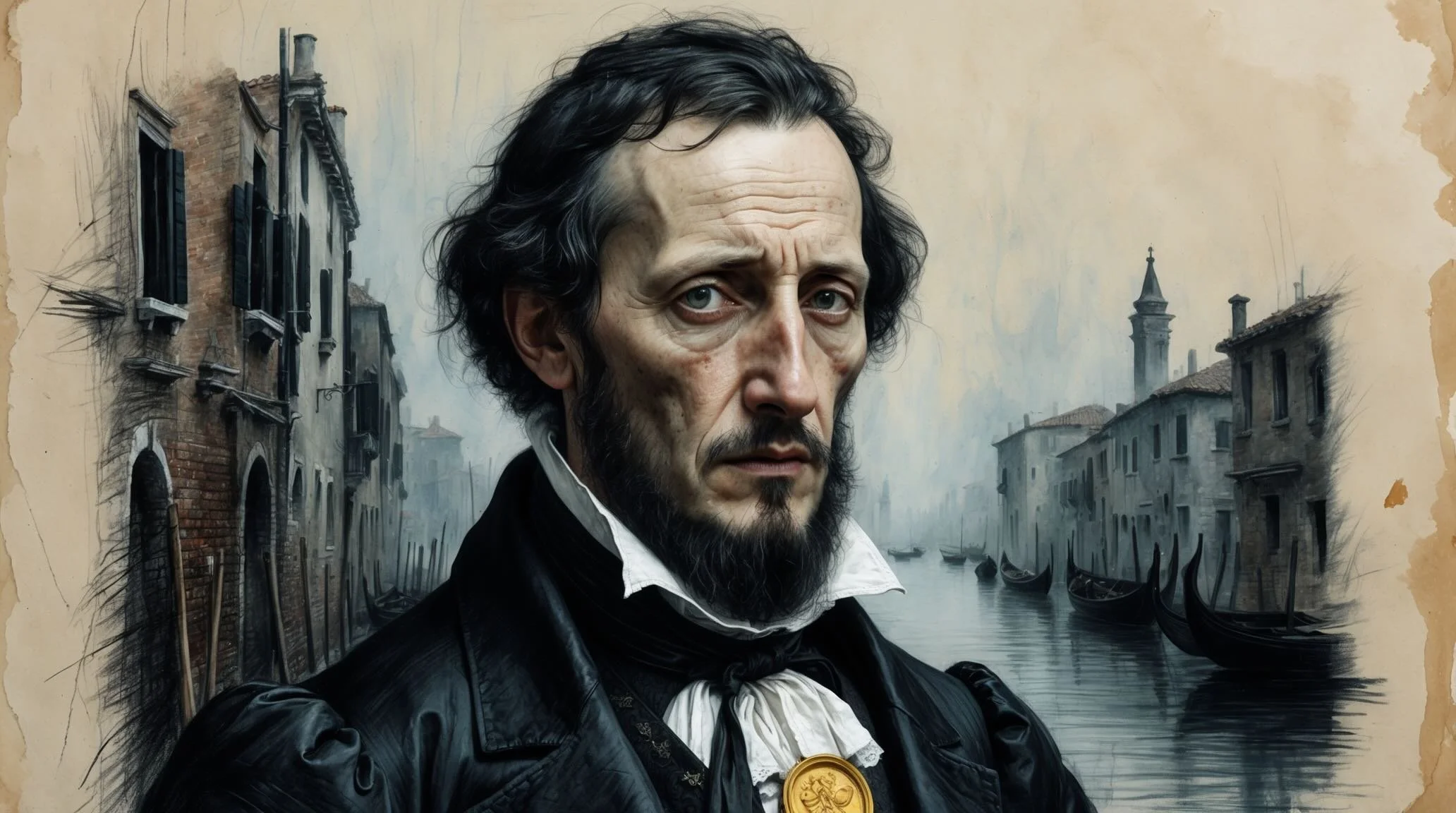

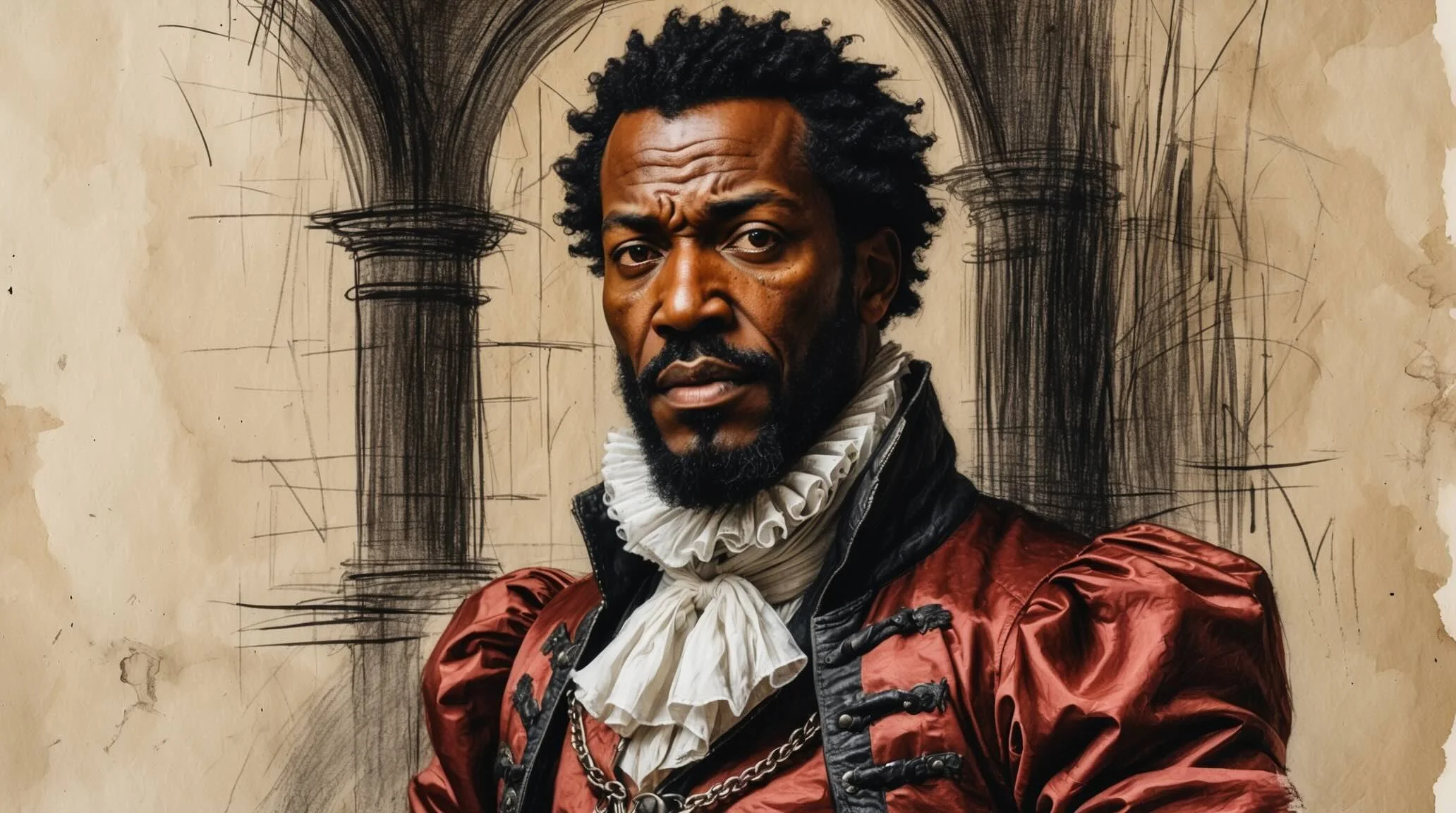



Supporting Cast
Beyond the eight figures who carry the main action, The Merchant of Venice divides its supporting cast across the play's two cities — the commercial, contentious Venice of the merchant streets and the courts, and the pastoral, harmonious Belmont of Portia's estate. The wider cast is grouped below by household and location.
Antonio's Friends
Solanio
One of the Venetian gentlemen attending Antonio and Bassanio. He appears throughout the play's Venice scenes alongside Salarino, gossiping about Antonio's argosies and Shylock's pursuit. Together they function as the play's chorus — narrating the streets, the wrecks, and Shylock's rage at Jessica's flight, all of which the audience cannot see.
Salarino
Solanio's near-constant companion in the choric Venice scenes. The textual confusion between Salarino, Solanio, and Salerio in the First Quarto is one of the most famous editorial puzzles in the Shakespearean canon — many modern editions conflate the three into two, but the Folger Library treats them as distinct figures.
Salerio
The Venetian messenger who in 3.2 carries the news of Antonio's wrecks to Belmont, and who attends Antonio at the trial in 4.1. His role is largely informational — the figure who brings Venice's bad news into Belmont's happiness, the play's structural bridge between its two worlds.
The Venetian Court
The Duke of Venice
The Doge who presides over the trial in 4.1. His helpless appeals to Shylock's mercy — "We all expect a gentle answer, Jew" — and his eventual acceptance of Portia's legal manoeuvre make him the play's most direct portrait of how Venetian commercial law constrains even Venetian civic authority. He cannot override a contract.
The Jailer
The court officer who in 3.3 escorts Antonio between his arrest and the trial. His brief, silent presence as witness to Antonio's "I'll follow him no more with bootless prayers" establishes the legal machinery of Venice as an impersonal procedural fact — the bond enforced by men without faces.
The Gobbos
Launcelot Gobbo
The clown of the play, servant first to Shylock and then to Bassanio. His extended 2.2 soliloquy weighing whether to leave Shylock's service — the conscience-versus-fiend debate — is one of Shakespeare's most-studied pieces of comic moral reasoning. His malapropisms and puns provide the play's primary comic register.
Old Gobbo
Launcelot's near-blind father, who in 2.2 fails to recognise his own son in one of Shakespeare's most direct nods to the biblical Jacob-and-Isaac scene of mistaken paternity (Genesis 27). The biblical parallel is structurally pointed: a play about a Jewish father and the Christian world borrows its comic father-son scene from the Hebrew Bible itself.
Belmont
The Prince of Morocco
One of Portia's failed casket-suitors, who in 2.7 chooses the gold casket and discovers it contains a skull with the warning "All that glisters is not gold." His opening line — "Mislike me not for my complexion" — opens the play's most direct dialogue with the question of race and judgement, and his careful arguments deserve more sympathetic reading than Portia's dismissive farewell allows.
The Prince of Arragon
Portia's second failed casket-suitor, who in 2.9 chooses the silver casket and discovers "the portrait of a blinking idiot." His aristocratic confidence in deserving Portia by birth-right is rebuked by the casket's mocking inscription — the play's most direct piece of writing on the difference between assuming you deserve something and actually winning it.
Balthasar
Portia's servant, sent in 3.4 to deliver Portia's letter to Doctor Bellario in Padua and to return with the legal papers and disguise that allow Portia's intervention at the trial. Notably, Portia then adopts his name as her own disguise — the question of whether the borrowing is coincidence or pointed is one of the play's quiet editorial puzzles. (Unrelated to the Balthasar in Romeo and Juliet.)
Stephano
A second servant of Portia, who in 5.1 announces her imminent return to Belmont. The brief night-time exchange that opens Act 5 — Lorenzo and Jessica's "in such a night as this" duet — pivots on his arrival as a structural marker that the comic resolution is approaching.
Others
Tubal
Shylock's friend and the only other Jewish character in the play. His 3.1 exchange with Shylock — alternating the news of Antonio's losses with the news of Jessica's extravagance — is one of Shakespeare's most economical pieces of writing on the way private grief and public revenge intersect. The "she traded a turquoise ring for a monkey" beat is the play's most quietly devastating moment about what Shylock has actually lost.
Leonardo
Bassanio's servant, briefly tasked in 2.2 with provisioning for the journey to Belmont. Functional rather than developed; included for exhaustive coverage.
Musicians and Attendants
The various unnamed figures who perform the night-scene music in 5.1 ("how sweet the moonlight sleeps upon this bank"), attend Portia and Nerissa at the casket scenes, and provide the silent magnificoes of the trial scene. Each fulfils function rather than character.
Frequently asked questions about The Merchant of Venice
What is The Merchant of Venice about?
The play runs on two interleaved plots — a Venetian commercial-legal plot and a Belmont marriage-comedy plot — and the relationship between them is the work's principal achievement.
The Venetian plot turns on the bond that the merchant Antonio signs with the Jewish moneylender Shylock: three thousand ducats, lent for three months, with a pound of Antonio's flesh as the forfeit if the loan is not repaid. Antonio agrees to the bond to fund his friend Bassanio's courtship of the wealthy heiress Portia at Belmont.
The Belmont plot turns on the casket-test devised by Portia's dead father. Suitors must choose between three caskets — gold, silver, lead — and the one who chooses correctly wins both Portia and the fortune she has inherited.
When Antonio's ships are reported lost and the bond becomes forfeit, Shylock demands the literal pound of flesh. Portia, disguised as a young male lawyer called Balthazar, intervenes in the Venetian court and defeats Shylock with the legal move that the bond specifies flesh but not blood.
The play concludes with three marriages: Bassanio and Portia, Gratiano and Nerissa, and Lorenzo and Jessica (Shylock's daughter, who has eloped with Lorenzo earlier in the play). Shylock is required to forfeit half his estate and convert to Christianity.
The play's principal achievement is the way the comic Belmont ending holds against the moral weight of the Venetian crisis it has, by its own arithmetic, produced.
When was The Merchant of Venice written and first performed?
The play was written between 1596 and 1598, based on the textual and contextual evidence we have.
It was entered into the Stationers' Register in July 1598 under the title The Merchant of Venyce, or otherwise called the Jewe of Venyce. The alternative title is useful evidence about how the play's earliest readers identified its principal figure.
The first quarto edition was published in 1600. The earliest documented performance was at the court of King James I in February 1605, followed by a second court performance days later. There is no surviving record of public theatre performances in the seventeenth century, though the play was almost certainly performed at the Globe and other public venues earlier than the court records suggest.
The play sits within Shakespeare's most productive mid-career period — between A Midsummer Night's Dream (c. 1595) and Much Ado About Nothing (c. 1598-99), with Romeo and Juliet, Richard II, and Henry IV Part 1 preceding it within five years. The dating places it in the same general period as Shakespeare's other "mature comedies" of the late 1590s.
Its commercial-legal subject matter has been linked by some scholars to the contemporary trial and execution of the Portuguese Jewish converso Roderigo Lopez (1594), Queen Elizabeth's personal physician. Lopez may have been an immediate context for the play's interest in the figure of the Jewish moneylender — though the connection is speculative rather than documentary.
Is The Merchant of Venice a comedy or a tragedy?
The First Folio of 1623 classified the play as a comedy. The formal markers support the classification — the play ends with three marriages, the restoration of Antonio's fortune, and a closing scene of pastoral lyricism at Belmont. By Shakespeare's working categories, this is the shape of comedy.
The complication is that the play's most-discussed figure — Shylock — operates within a register that exceeds what comedy is conventionally able to hold.
His grievances are real. His eloquence on common humanity is genuinely moving. His defeat in the courtroom is morally uncomfortable rather than satisfying. His forced conversion to Christianity is one of the most exposed pieces of legal violence in any of Shakespeare's plays. The closing scene at Belmont proceeds without him, and the absence is one of the play's most-discussed decisions.
The genre question has therefore been one of the central organising puzzles of the play's critical reception.
Auden, in his 1963 essay "Brothers and Others," classed the play among Shakespeare's "unpleasant plays" — comedies whose comic surface is constantly undercut by the historical reality of the world they depict.
Modern productions have, since at least the mid-twentieth century, increasingly treated the play as tragicomedy rather than comedy. Shylock is played as a substantive tragic figure rather than a comic antagonist.
The play's text supports both readings. The marriage-resolution structure is unambiguously comic. The moral cost of that resolution is unambiguously serious.
What are the play's principal themes?
The play is organised around several interlocking themes that operate across both the Venetian and Belmont plots.
Prejudice and intolerance is the play's most exposed concern — the Christian community's treatment of Shylock, the antisemitism built into the Venetian commercial system, the gentile/Gentile pun that runs through Jessica's conversion, and the religious-ethnic vocabulary that the play's Christian principals use throughout.
Mercy versus justice organises the courtroom scene of 4.1. Portia's "quality of mercy is not strained" speech is the play's most rigorous statement of the Christian-Platonist position on mercy. The verdict that follows it has been read for two centuries as the play's quiet acknowledgement of the gap between professed mercy and legal practice.
Wealth and greed runs through every plot — Bassanio's need for the loan, Portia's inheritance, Shylock's moneylending, Antonio's commercial empire, and Jessica's theft from her father.
Love and friendship organises the Antonio-Bassanio-Portia triangle that Auden's 1963 essay made the centre of modern reading.
Appearance versus reality is the philosophical heart of the casket-test, expressed in Bassanio's 3.2 "outward shows be least themselves" speech.
Risk and commerce is the background of the entire Venetian plot — Antonio's ships at sea, Shylock's moneylending, the bond as a piece of commercial speculation.
And gender and disguise is the mechanism by which Portia and Nerissa enter the Venetian court and produce the legal resolution.
What are Shakespeare's sources for The Merchant of Venice?
The play draws on at least three identifiable sources, which Shakespeare combined with characteristic editorial care.
The principal source for the bond-and-flesh plot is the medieval Italian collection Il Pecorone (The Big Sheep) by Giovanni Fiorentino, written in the 1370s and published in Milan in 1558. The fourth novella of the first day tells the story of a young Venetian gentleman who borrows money from a Jewish moneylender against a pound of flesh, courts a wealthy widow at Belmont, defaults on the bond, and is saved by the widow disguised as a lawyer. The shape of Merchant is unmistakably drawn from this source.
The casket-test plot comes from a different source — the medieval Gesta Romanorum, a Latin collection of moral tales translated into English in 1577. The casket-test as it appears in Gesta is a piece of moral allegory about choosing virtue over appearance. Shakespeare kept the structure but moved it into a romantic-comic setting.
The Jessica-Lorenzo plot has no direct single source. But elements of it are drawn from Christopher Marlowe's The Jew of Malta (c. 1589) — particularly the figure of the Jewish father's daughter who converts to Christianity (Marlowe's Abigail is the closest type) — and from broader early modern dramatic conventions of the "Jewish daughter who escapes."
Shakespeare's principal achievement in working with these sources is the moral complication of the Jewish principal.
Where Il Pecorone presents the moneylender as a piece of straightforward villainy, and where Marlowe presents Barabas as a piece of theatrical Vice in the older medieval tradition, Shakespeare's Shylock is given a substantive inner life, the "Hath not a Jew eyes?" speech, the turquoise ring scene, and the absence from the closing comic resolution.
The source material gives him the plot. Shakespeare gives him the character.
What is the relationship between Venice and Belmont in the play?
The two locations work as the play's main opposition, and the contrast shapes the whole play's geometry.
Venice is the play's commercial-legal centre — the city of merchants, moneylenders, bonds, courts, and the public marketplace of the Rialto. The action set in Venice is characterised by commercial transactions (the bond), public arguments (the 1.3 exchange between Antonio and Shylock at the Rialto), legal procedure (the trial of 4.1), and the religious-ethnic frictions that the Venetian commercial system both produces and depends on.
Belmont is the play's romantic-pastoral centre — the country estate of Portia, the site of the casket-test, the location of the lyric closing scene of 5.1. The action set in Belmont is characterised by romance (the courtship plots), philosophy (the casket-speeches, the music of the spheres), poetry (the moonlit "in such a night" exchange), and the marriage-resolution that produces the comic conclusion.
The opposition is not merely scenic but moral. Venice is the world of money, contract, and law. Belmont is the world of music, marriage, and philosophy.
The play's principal characters move between the two locations — Bassanio from Venice to Belmont to win Portia, Portia and Nerissa from Belmont to Venice in disguise to save Antonio, the whole company returning to Belmont for the closing scene.
The movement between locations carries the play's argument. What Venice cannot resolve — the bond, the religious-ethnic conflict, the moral cost of the commercial system — is, by the play's decision, displaced to Belmont. There, the comedy's marriage-resolution can absorb the displacement without acknowledging what has been lost.
Shylock, by the same decision, is never present at Belmont. The pastoral closing of 5.1 operates on terms his absence has made available.
Why does The Merchant of Venice remain controversial today?
The play's continuing controversy operates at several levels, and the question has been one of the most-debated in modern Shakespeare reception.
The first level is the play's textual presentation of Shylock. By any modern measure, the surface of the play is antisemitic.
It uses the religious-ethnic vocabulary of the period throughout ("the Jew," "infidel," "cur"). It presents the Jewish character as the antagonist of the comic action. It requires his forced conversion as the price of his life. It gives the Christian characters the triumph of the verdict.
After the Holocaust, productions of the play became substantially more difficult. Performing it has required productions to engage with what the surface presentation has been used for historically.
The second level is the complication the play itself introduces. Shylock's "Hath not a Jew eyes?" speech is, on its own terms, the most rigorous argument for common humanity in any of Shakespeare's plays. His grievances are presented with real depth. His treatment by the Christian community is, in Hazlitt's 1817 word, "hardly" what their professed ethics would require.
The play's surface is antisemitic. Its underlying structure exposes the antisemitism.
Modern productions and modern criticism have, since the late twentieth century, increasingly read the play as a critique of the antisemitism it portrays — though the question of whether this critique outweighs the surface presentation remains contested.
The third level is the broader question of how to teach or perform a play whose source conventions are no longer culturally available. Schools and theatres have, in different ways, developed approaches that frame the play within its critical reception history rather than presenting it as if its conventions were neutral.
The play is therefore not a closed historical artefact but a continuing site of cultural argument. The controversy is itself part of why the play remains in active repertoire four centuries after it was written.