Mercy vs Justice
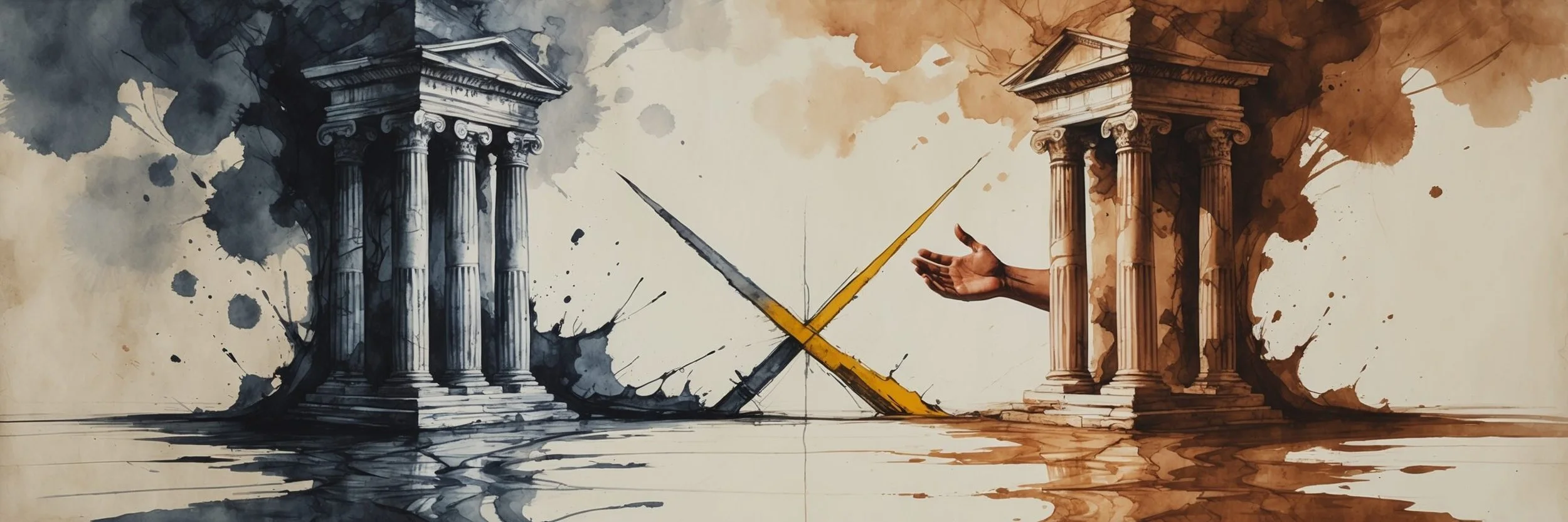
Theme Profile – At a Glance
- Focus: One courtroom, one bond, and the collision of two absolutes: the law that must be kept, and the mercy that cannot be compelled.
- Key Characters: Portia, Shylock, Antonio, the Duke, Gratiano.
- The Core Tension: Shylock demands the letter of the law; Portia preaches mercy above it – then defeats him with a letter smaller than his own.
- Key Manifestations: "I stand for judgment" (Act 4, Scene 1); the mercy speech (Act 4, Scene 1); "no jot of blood" (Act 4, Scene 1); the victors' terms (Act 4, Scene 1).
- Famous Quote:
"The quality of mercy is not strained..."
(Act 4, Scene 1) - The Outcome: Mercy wins the argument, the law wins the case, and the loser receives both – in a form four centuries have struggled to call either.
I Stand for Judgment
The trial scene's terrible clarity begins with Shylock's refusal of every exit. The Duke pleads, Bassanio offers double, then treble the principal – and the answer is procedural.
Original
I stand for judgment: answer; shall I have it?
(Act 4, Scene 1)
Shakespeare Retold (Modern Verse)
I seek your judgment. Tell me, can I have it?
The phrasing is the theme's first move: Shylock does not ask for revenge – he stands for judgment, positioning himself not as the court's petitioner but as the law's embodiment. His logic is unanswerable on Venice's own terms: the bond is lawful, sealed and forfeit, and a commercial city that voids contracts when it dislikes the creditor has no contracts at all – "There is no force in the decrees of Venice." The play grants the argument full force. Shylock's case is never refuted as law; the Duke cannot dismiss it, and Antonio himself concedes it. The man Venice spat on has discovered the one place its rules protect him – inside the letter of its own law – and he has barricaded himself there with a knife. Justice, the scene insists, is on the monster's side. That is precisely what makes the scene monstrous.
The Quality of Mercy
Against the law's perfect machine, the disguised Portia sets the play's most famous music.
Original
The quality of mercy is not strained,
It droppeth as the gentle rain from heaven
Upon the place beneath: it is twice blest;
It blesseth him that gives and him that takes...
(Act 4, Scene 1)
Shakespeare Retold (Modern Verse)
It’s effortless performing acts of mercy,
And being merciful is like the rain
That falls upon the ground: it has two merits;
It benefits the giver and receiver.
The speech's argument is as precise as its poetry. Mercy is "not strained" – not constrained, not compellable – which concedes Shylock's legal position entirely: no court can order him to be merciful. It can only be given, like rain, blessing giver and receiver alike; it sits above sceptres and crowns; and it is the only ground on which any soul dares face its own judgment – for "in the course of justice, none of us should see salvation." The theology is impeccable and the rhetoric is gentle, and the play immediately registers its limit: Shylock answers in four words – "My deeds upon my head!" – accepting damnation's terms rather than Venice's. The speech converts no one. Its function in the theme is to be true and insufficient: the play's loveliest idea, delivered perfectly, to a man whom Venice has given no reason to believe a word of it.
No Jot of Blood
Mercy having failed, Portia turns to the only language Shylock has agreed to speak – and reads his bond more literally than he does.
Original
Tarry a little; there is something else.
This bond doth give thee here no jot of blood;
The words expressly are 'a pound of flesh:'
Take then thy bond, take thou thy pound of flesh;
But, in the cutting it, if thou dost shed
One drop of Christian blood, thy lands and goods
Are, by the laws of Venice, confiscate...
(Act 4, Scene 1)
Shakespeare Retold (Modern Verse)
Hang on a moment; there is something else.
This bond does not award a drop of blood.
The words expressly state, ‘a pound of flesh.’
Then take your bond and take your pound of flesh.
But if, when cutting it, you cause to shed
One drop of Christian blood, your land and goods
Are, by the laws of Venice, confiscated...
"Tarry a little" is the most theatrical pause in Shakespeare, and what follows is not mercy's victory but literalism's: the bond says flesh, the bond does not say blood, and the man who demanded the letter dies by it. The reversal is flawless as drama and deliberately uneasy as justice. Portia has not answered Shylock's principle – that lawful bonds bind – she has out-lawyered it with a quibble that no commercial court could actually live by. The play knows this: the same speech that frees Antonio springs a second trap, the alien statute, which converts Shylock from creditor to criminal in one breath. The law that was his fortress becomes his scaffold without a single statute changing – only the reader. The theme's coldest lesson sits here: the letter of the law serves whoever construes it last.
The Justice of the Victors
With Shylock disarmed, the court distributes what it calls mercy – and the play invites a careful audit of the package.
Original
The Jew shall have all justice; soft! No haste:
He shall have nothing but the penalty.
(Act 4, Scene 1)
Shakespeare Retold (Modern Verse)
The Jew must have his justice; wait! Don’t rush:
He only is allowed the penalty.
"All justice" now means: nothing but the penalty – the phrase Shylock made his banner is handed back to him as a sentence. The Duke pardons his life "before thou ask it"; half the estate goes to Antonio, half to the state; Antonio's clemency converts his half into a trust for the daughter who robbed him and adds the baptism. Every element can be defended as period mercy, and the scene's choreography undercuts each defence: Gratiano heckles ("a halter gratis") at every act of clemency, the court's "mercy" arrives only after total victory, and the man receiving it is permitted six words and an exit. The theme closes its circle with deliberate discomfort: the quality of mercy was not strained – but this, the play lets us see, was; squeezed from victors at no cost, onto a man stripped of everything, in the precise shape of their convenience. Whether that is mercy seasoning justice, or power wearing mercy's robes, is the question the play hands to every age that stages it.
"Shylock is a good hater; 'a man no less sinned against than sinning.' If he carries his revenge too far, yet he has strong grounds for 'the lodged hate he bears Anthonio,' which he explains with equal force of eloquence and reason."
— William Hazlitt, Characters of Shakespeare's Plays, 1817
Key Quotes on Mercy vs Justice
Quote 1
That, in the course of justice, none of us
Should see salvation: we do pray for mercy;
And that same prayer doth teach us all to render
The deeds of mercy.
(Act 4, Scene 1)
Shakespeare Retold (Modern Verse)
That, in the course of justice, none of us
Would get to heaven lest we prayed for mercy;
And that same prayer of mercy teaches us
To act with mercy.
Quote Analysis: The mercy speech's theological core, and its sharpest edge. If strict justice were the universe's rule, no soul would be saved – everyone in the courtroom is a debtor whose bond is forfeit. The Lord's Prayer ("forgive us... as we forgive") is invoked as a daily self-sentencing: every petitioner for mercy contracts to render it. The argument should disturb the Christians more than Shylock – they are the ones who pray it – and the rest of the scene tests exactly that: within a hundred lines, the petitioners hold total power over a beaten enemy, and the audience watches what their prayer taught them.
My deeds upon my head! I crave the law,
The penalty and forfeit of my bond.
(Act 4, Scene 1)
Shakespeare Retold (Modern Verse)
I choose how I will act! I want the law,
The penalty and forfeit of my bond.
Quote Analysis: Shylock's answer to the most beautiful speech in the play is two lines of granite. "My deeds upon my head" deliberately echoes the crowd's cry at the Crucifixion – the play's first audiences would have heard a Jew accepting that blood-curse anew – and "I crave the law" completes the theme's symmetry: he does not want favour, latitude or even victory; he wants the system that never once protected him to keep its word at last. The tragedy inside the demand is audible: a man whose only citizenship is the letter of the law, craving the letter – which is about to be turned against him by a better reader.
'Tis mightiest in the mightiest: it becomes
The throned monarch better than his crown...
(Act 4, Scene 1)
Shakespeare Retold (Modern Verse)
It’s strongest in the strongest folk: it’s flattering
To royal monarchs more than is their crown...
Quote Analysis: Mercy, Portia argues, is power's best ornament – mightiest in the mightiest, more royal than the crown. The formulation quietly defines who mercy is for: it is the virtue of those in a position to grant it. That makes the speech, beneath its beauty, a mirror held to the courtroom's power map. Shylock, asked to be merciful, has held power for exactly one scene of his life; the Duke, Antonio and Venice have held it always. The line's truth lands twice: once as exhortation to the man with the knife, and again – two hundred lines later – as measurement of the men with the verdict.
Nay, take my life and all; pardon not that:
You take my house when you do take the prop
That doth sustain my house; you take my life
When you do take the means whereby I live.
(Act 4, Scene 1)
Shakespeare Retold (Modern Verse)
No, take my life and all; I don’t want pity.
You take my house removing what I use
To pay the upkeep of my house; you kill me
When you remove my means to make a living.
Quote Analysis: Shylock's reply to the court's clemency is the theme's last argument, and it is jurisprudence: a "pardon" that strips a man's livelihood pardons nothing – property, for the propertyless alien, is life, and the distinction between capital and capital punishment is a comfort of the comfortable. The speech reframes the verdict the victors call mercy as a slower execution, and no one in the courtroom answers it; the proceedings simply continue to the baptism clause. It is the play's final word on the difference between mercy granted and mercy received – measured, as always in Venice, in means.
Key Takeaways
- The Law Is on the Monster's Side: Shylock's case is never refuted, only outflanked. Venice's own rules arm him – which is why the scene terrifies.
- Mercy Cannot Be Compelled – or Refused Safely: The great speech concedes that no court can order mercy. Shylock's refusal is his right, and his ruin.
- The Letter Cuts Its Owner: "No jot of blood" defeats literalism with literalism. The law serves whoever construes it last – a victory, not a vindication.
- Audit the Victors' Mercy: Pardons, trusts and baptism arrive only after total power is secured. The play prices the package and lets the audience pay or protest.
Study Questions and Analysis
Is Portia's mercy speech sincere, strategic, or both?
Both – and the play needs the doubleness. As theology and poetry the speech is flawless: mercy as unforced rain, twice-blessed, above the sceptre, the soul's only plea – nothing in it is cynical, and nothing in the play mocks it. But it is also, precisely, an advocate's move. Portia enters the courtroom already knowing the bond's fatal flaw – she has the "no jot of blood" reading prepared – yet she opens not with the trap but with an offer: be merciful, and the trap need never spring. Read strategically, the speech is the law's last exit ramp, presented in the most persuasive language the defence can buy.
The strategy deepens the sincerity rather than cancelling it. Because Portia could win without the speech, the speech is gratuitous – which is exactly what it says mercy is. She gives Shylock the unconstrained chance to be what the law cannot make him, and only when he refuses three times ("My deeds upon my head", "I crave the law", the knife whetted on his sole) does she close the legal door. Harold C. Goddard, in his 1951 The Meaning of Shakespeare, pressed the darker question that has shadowed the scene since: whether the speech's preacher practises it – Portia proceeds, after all, to enforce not just acquittal but annihilation, and "the quality of mercy" is followed by the alien statute. On Goddard's reading the speech indicts the courtroom that applauds it. The generous reading and the ironic one share a premise: the speech states the play's highest standard – and the rest of the scene measures everyone, speaker included, against it. That measurement, not the verdict, is the theme.
Why does Shylock refuse three times the money?
Because by the trial the bond has stopped being a financial instrument and become the only court in which his injuries can be heard. The play documents the conversion. The pound of flesh begins as a "merry sport"; it hardens through Jessica's flight, the street mockery, and the news of Antonio's losses, until Shylock states its new denomination plainly.
The pound of flesh, which I demand of him,
Is dearly bought; 'tis mine and I will have it.
(Act 4, Scene 1)
Shakespeare Retold (Modern Verse)
The pound of flesh, which I insist I have,
Is fairly bought; it’s mine and I will have it.
"Dearly bought" is the theme's bleakest accounting: the flesh's price was not three thousand ducats but the gaberdine years – the spittle, the kicks, the stolen daughter, the daily contempt. Money cannot buy it back because money was never its currency; Bassanio's trebled ducats insult the arithmetic. William Hazlitt (1817) read the refusal as the conduct of "a good hater" with "strong grounds" – revenge as the one purchase Venice cannot refund. The play adds a structural reason: acceptance would return Shylock to the status quo ante, a tolerated alien awaiting the next spit; the bond, uniquely, makes Venice's law his instrument, and surrendering it surrenders the only power he has ever held over a Christian. The refusal is monstrous, comprehensible and self-destroying at once – the theme's whole argument in a single "no".
Is the "no jot of blood" judgment good law or a trick?
As law it is a quibble; as drama it is justice's mirror held up to literalism; and the play is honest enough to let both be visible. No real commercial code could survive Portia's canon of construction – a contract for flesh that excludes the blood necessarily incident to it voids every bond ever written, since all performance has incidents. The scene's legal scholars have noted as much for centuries; Harley Granville-Barker, in his Prefaces to Shakespeare (1930), genially dissolved the problem by reclassifying the genre: "The Merchant of Venice is a fairy tale. There is no more reality in Shylock's bond and the Lord of Belmont's will than in Jack and the Beanstalk." The bond is a folk-tale riddle, and Portia defeats it as folk heroines defeat ogres – by the riddle's own rules.
But the trick is doing serious thematic work. Shylock's position was that the letter is everything and the spirit nothing; Portia defeats him on that position – reading the letter with a literalism more pitiless than his own. The judgment is thus a demonstration, not a precedent: live by the letter, die by the letter; a law severed from equity can be turned against any of its worshippers by the next, sharper reader. The follow-up matters more than the quibble – the alien statute, produced from nowhere, criminalising the very suit the court had been entertaining all afternoon. That second blade reveals what the first concealed: Venice's law was never neutral; it contained, all along, a provision that defined Shylock as alien rather than citizen. The "trick" frees Antonio. The statute tells the truth about the system – and the theme lets each audience decide which disturbs it more.
Does anyone in the courtroom actually practise mercy?
Run the audit the scene invites. The Duke pardons Shylock's life unasked – genuine clemency, immediately qualified by his opening speech, which had already branded Shylock "an inhuman wretch" before evidence was heard; the court was never neutral. Antonio declines his half of the forfeiture – real renunciation of real money – then attaches the baptism and the deed to Lorenzo: mercy with a confiscating codicil, generosity that completes his lifelong project of correcting Shylock's existence. Portia preaches mercy supremely and administers the law's last turn of the screw, advising Shylock to beg the Duke's pardon "down therefore" – on his knees. Gratiano, the control specimen, heckles every clemency and proposes hanging at each pause: mercy's vocabulary entirely absent, saying aloud what the courtroom's decorum conceals.
Bassanio comes nearest the standard: his offers of double and treble payment, and his (rhetorical) willingness to sacrifice himself, are the scene's only attempts to purchase a merciful outcome at personal cost before victory. And one candidate is always forgotten: the mercy Shylock was never shown before the play began – the absence that manufactured the case. Harold C. Goddard (1951) made the disquieting summary: the Christians of the play possess mercy's language and Shylock its grievances, and the trial distributes each accordingly. The scene's design supports him – Shakespeare stages the most famous mercy-sermon in literature and then, deliberately, shows no character meeting its terms unconditionally. The quality of mercy is not strained; the quantity, in this courtroom, is the question.
What finally breaks Shylock – and what do his last words mean?
Not the loss of the case – he absorbs "no jot of blood" with a merchant's reflex, instantly accepting the thrice-offered principal instead. What breaks him is the discovery that there is no floor: each retreat opens a deeper penalty. The principal is refused ("He hath refused it in the open court"); then the alien statute takes the estate and puts his life at the Duke's mercy; then "mercy" itself arrives bearing the baptism and the deed to the son-in-law. The law he stood for turns out to have a trapdoor under every flagstone, and the man who said "I stand for judgment" ends the scene with nothing to stand on.
His capitulation is three words.
I am content.
(Act 4, Scene 1)
Shakespeare Retold (Modern Verse)
I am OK with that.
No speech in Shakespeare has less content than this "content". The word is forced into his mouth by the structure – Portia asks "Art thou contented, Jew?" and the alternatives are death – and every performance must decide what passes through it: surrender, irony, shock, a man already absent. His exit line completes the hollowing: "I am not well", a plea to send the deed after him – the great voice of the play reduced to paperwork and illness. Heinrich Heine (1838) heard in the trial the "madly agonised" cry of the oppressed; the stage tradition since Kean and Irving has staged the exit as the play's true catastrophe. The theme's verdict is in the dramaturgy: justice and mercy have both been served, the court is satisfied – and the play sends its audience to Belmont with the sound of a broken man's shuffle under all the moonlight that follows.
How would Elizabethan and modern audiences judge the trial differently?
The scene was built for one audience and inherited by another, and the theme reads differently under each light. For the play's first spectators, the trial's shape was providential comedy: the bond-villain of folk tale, armed with the devil's literalism, defeated by wit in the service of grace; the conversion a mercy in earnest (a soul, in their cosmology, actually saved); the alien statute unremarkable in a Europe whose every city had such laws. The Lord's Prayer argument of the mercy speech was their daily liturgy; Gratiano's jeers were licensed festivity; and the fifth act's harmony confirmed that the universe had been put right. Period evidence – including the play's long popularity and the gusto of its early stage-Jews – suggests the first audiences largely cheered.
The modern audience arrives with two intervening accumulations: the sympathetic Shylock built by Hazlitt (1817), Heine (1838) and the great nineteenth-century performances, and the twentieth century's history, after which a courtroom stripping a Jew of property, livelihood and faith cannot be received as comic restoration. The same scene now plays as the theme inverted: the mercy speech sounds like the prosecution's self-indictment, the quibble like power's sleight of hand, "I am content" like the play's moral price tag. Neither audience is simply wrong; the text feeds both – which is the deepest fact about it. Shakespeare wrote the trial his age wanted and salted it with everything the future would need to reverse it: the gaberdine receipts, the "Hath not a Jew eyes?" evidence, the victors' itemised terms. The theme's history is the play's meaning in motion: mercy and justice, weighed afresh by every generation, in a scale the dramatist deliberately left swinging.
Does the ring plot replay the trial in another key?
Exactly – Act 5 is the trial scene translated from blood to love, and the translation is the play's quiet verdict on its own theme. The structure repeats point for point. A solemn bond is sworn (Bassanio's oath never to part with Portia's ring); the bond is broken under pressure that seemed irresistible (the "doctor" who saved Antonio's life asks the ring as fee – and Antonio himself urges surrender); the wronged party then prosecutes with full theatrical severity – Portia arraigns Bassanio at Belmont, refuses excuse, threatens proportionate revenge, and produces evidence (the ring on her own finger) with the same "tarry a little" timing that turned the courtroom.
The differences are the point. This judge is the injured party, and chooses mercy at the moment of maximum advantage – the exposure dissolves into laughter and restored vows rather than confiscation. The "forfeit" – Bassanio's shame – is collected in full and then remitted entirely. And the security for the new bond is telling: Antonio, who once bound his flesh for Bassanio's venture, now binds his soul that Bassanio will keep faith – the body's surety replaced by the spirit's, the play's whole movement in one image.
Granville-Barker (1930) read the fifth act as the fairy tale completing itself after the trial's storm; later critics have heard the harder note inside the harmony – Portia's mock-trial works because she holds all the cards, exactly as Venice did, and mercy is once again the prerogative of total power, exercised this time with love. Both readings agree on the structure: Shakespeare would not end the play in the courtroom. He restaged the courtroom where mercy could win – among people who love each other – as if to say: this is the only jurisdiction where the quality of mercy is not strained. The rest is Venice.