The Merchant of Venice: Act 3, Scene 3 – Analysis
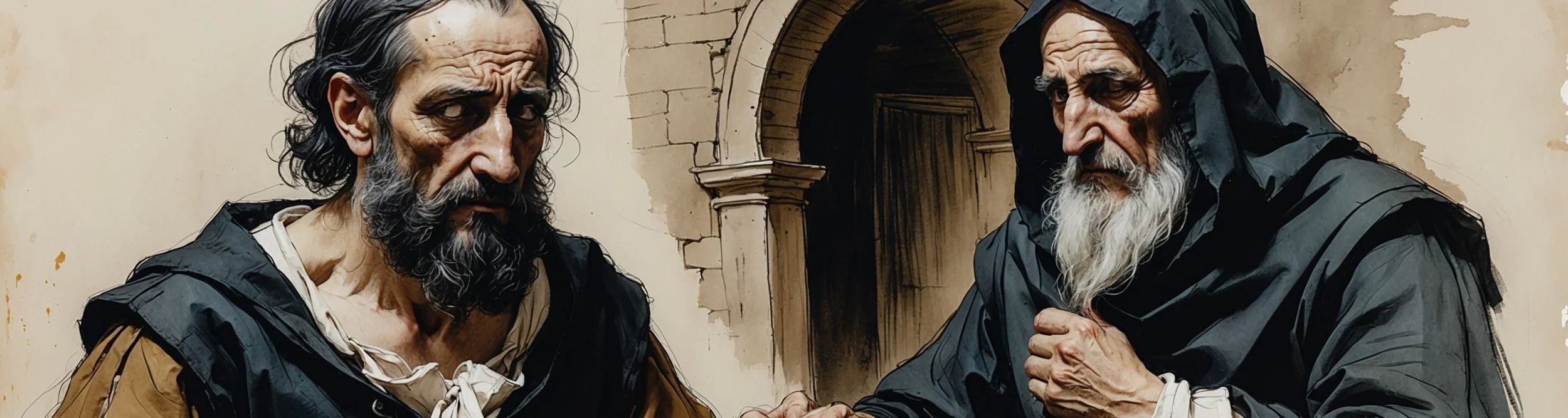
Scene Profile – At a Glance
- Location: A street in Venice, where the bankrupt Antonio is being led under guard.
- What Happens: Shylock has Antonio arrested and brought before him, and refuses even to listen to a plea for mercy. He insists, again and again, that he will have his bond. After Shylock storms off, Antonio admits the law cannot save him and pins his last hope on seeing Bassanio before he dies.
- Key Characters: Shylock, Antonio, Salarino, and a Gaoler.
- Dramatic Function: A short, grim scene that hardens the bond into a death sentence and sets up the trial, showing Shylock immovable and Antonio resigned.
- Famous Quote:
"I'll have my bond; speak not against my bond:
I have sworn an oath that I will have my bond."
(Shylock, Act 3, Scene 3) - Why It Matters: It shows that mercy is now beyond reach. Shylock will not even hear Antonio speak, and the play locks onto its central question of justice against mercy.
Scene Summary
On a Venice street, Shylock has the bankrupt Antonio brought out under guard. Antonio has forfeited his bond, and Shylock means to claim the pound of flesh it allows him. When Antonio tries to speak, Shylock cuts him off, telling the Gaoler not to talk to him of mercy and reminding everyone that Antonio once called him a dog. He repeats over and over that he will have his bond, that he has sworn an oath to have it, and that he will not be talked round by Christian pleaders. Then he leaves.
Alone with Salarino and the Gaoler, Antonio accepts his situation. He will waste no more breath begging a man who wants him dead. He understands Shylock's hatred – he has often stepped in to pay off debts owed to the moneylender, costing Shylock his profits. He explains, too, why the Duke cannot simply overrule the bond: Venice depends on foreign trade, and to deny a contract would shake the law that protects every merchant in the city. Worn down by grief, Antonio asks only that Bassanio come in time to see him pay the debt.
Mercy Refused
The scene's whole force lies in Shylock's refusal to listen. He does not argue, negotiate, or explain himself at length; he simply blocks every attempt at speech with the same flat assertion. His opening words set the tone, ordering the Gaoler to guard Antonio closely and forbidding any talk of mercy before Antonio has said a word.
Original
Gaoler, look to him: tell not me of mercy;
This is the fool that lent out money gratis:
Gaoler, look to him.
(Shylock, Act 3, Scene 3)
Shakespeare Retold (Modern Verse)
Jailer, watch out for him. Don't speak of mercy;
This is the fool that lent out money free.
So, watch him, jailer.
The repetition of "look to him" frames Antonio as a thing to be guarded rather than a man to be heard, and "tell not me of mercy" slams the door on the play's central virtue before anyone has even asked for it. Shylock's contempt is bound up with money: Antonio is "the fool that lent out money gratis", lending without interest and so, in Shylock's eyes, undercutting his trade and despising his livelihood. The grievance is real, but the scene lets us feel how that grievance has curdled into a refusal to recognise Antonio's humanity at all. This is mercy denied not by accident but on principle – Shylock has decided in advance that no plea will move him.
Antonio's Resignation
Once Shylock has gone, the scene shifts into a quieter register as Antonio takes the measure of his position. He is clear-eyed rather than despairing: he knows why Shylock hates him, and he knows the law will not bend to save him. His explanation of Venice's predicament is shrewd, showing that the city's wealth is also its trap – the rule of law that makes trade possible is the same rule that now binds him to the knife.
Original
The duke cannot deny the course of law:
For the commodity that strangers have
With us in Venice, if it be denied,
Will much impeach the justice of his state;
(Antonio, Act 3, Scene 3)
Shakespeare Retold (Modern Verse)
The duke cannot deny the rule of law.
For trust that has been earned from foreigners
With us in Venice , if it is revoked,
Will compromise our law's integrity,
Antonio sees that Venice cannot pick and choose which contracts to honour. The city trades with all nations, and foreign merchants like Shylock will only deal there if the law treats them exactly as it treats citizens. To void the bond now, however monstrous, would be to "impeach the justice" of the state and frighten away the trade the whole city lives on. It is a bleak, realistic assessment, and it explains why no easy rescue is coming. The only hope Antonio allows himself is personal rather than legal: that Bassanio will arrive to witness his death, repaying his love with presence if nothing else.
Language and Technique
- Repetition: Shylock hammers the word "bond" again and again, so that the contract itself becomes a refrain that drowns out every plea for mercy.
- Refusal to hear: Shylock literally will not let Antonio finish a sentence, cutting off speech to dramatise a mind that has closed.
- Animal imagery: The "dog" insult is turned back as a threat – "since I am a dog, beware my fangs" – so the abuse Antonio once gave becomes a warning of the harm to come.
- Legal language: Antonio's "course of law" and "justice of his state" set the scene in the cool vocabulary of contract, the very ground on which the trial will be fought.
Key Quotes from Act 3, Scene 3
Quote 1Thou call'dst me dog before thou hadst a cause;
But, since I am a dog, beware my fangs:
(Shylock, Act 3, Scene 3)
Shakespeare Retold (Modern Verse)
You called me dog before you needed me;
But, since I am a dog, beware my fangs.
I'll not be made a soft and dull-eyed fool,
To shake the head, relent, and sigh, and yield
To Christian intercessors. Follow not;
(Shylock, Act 3, Scene 3)
Shakespeare Retold (Modern Verse)
I'll not be taken for an idiot,
And shake my head, relenting, giving in
To Christian mediators. Do not follow;
Well, gaoler, on. Pray God, Bassanio come
To see me pay his debt, and then I care not!
(Antonio, Act 3, Scene 3)
Shakespeare Retold (Modern Verse)
Well, jailer, go. Pray God, Bassanio comes
To see me pay his debt, then I won't care!
Key Takeaways
- Mercy is refused outright: Shylock will not even let Antonio speak, blocking every plea with the same insistence on his bond.
- The bond becomes a death sentence: The contract that once seemed a grim joke is now a real threat to Antonio's life.
- The law cannot save Antonio: Venice depends on honouring contracts, so the Duke cannot simply void the bond without damaging the city's trade.
- Antonio is resigned, not desperate: He accepts his fate calmly, wanting only to see Bassanio before he dies.
Study Questions and Analysis
Why does Shylock refuse to listen to Antonio in this scene?
Shylock's refusal to listen is the whole point of the scene. He does not want to be argued out of his bond, and he knows that if he lets Antonio or the Christians speak, they will try to soften him with appeals to pity. So he simply will not hear them. He cuts off every attempt at speech with the same flat insistence, telling them not to talk to him of mercy and repeating that he will have his bond.
His reasons run deep. Shylock has been humiliated for years – spat on, called a dog, his trade undercut by a man who lends without interest. Now he has the law on his side, and he is determined not to throw that advantage away by giving in to feeling. There is real pain underneath the hardness: this is a man who has decided that mercy, in his experience, is a one-way street the Christians have never offered him. Whether we read his deafness to pleading as monstrous cruelty or as the bitter product of how he has been treated is a question the scene deliberately leaves open.
What does this scene reveal about justice and mercy in Venice?
The scene sets the play's two great forces in direct collision. Shylock stands for strict justice – the letter of the law, the contract honoured to the word – while Antonio and the Christians appeal, in vain, to mercy. What makes the scene so bleak is that justice here is on Shylock's side. The bond is legal, Antonio signed it freely, and Venice cannot simply tear it up.
Antonio understands this better than anyone. As he explains, the Duke "cannot deny the course of law", because Venice's wealth depends on foreign merchants trusting that their contracts will be enforced exactly like everyone else's. To make an exception for Antonio would be to "impeach the justice" of the whole state and scare away the trade the city lives on. Walter Cohen, in his essay "The Merchant of Venice and the Possibilities of Historical Criticism" (1982), reads exactly this bind as the play's economic core: Venice is a trading state whose survival rests on the sanctity of contract, so the bond cannot simply be set aside without unravelling the commercial law that makes the city function. Set against that hard logic, Barbara Lewalski, in "Biblical Allusion and Allegory in The Merchant of Venice" (1962), frames the same collision in religious terms: Shylock stands for the Old Law of strict justice, while the mercy the Christians invoke belongs to the New – though she notes the Christians themselves often live by the Old Law they preach against. The scene therefore poses an uncomfortable question that the trial will wrestle with: what happens when the law is perfectly just and utterly merciless at the same time? It is precisely because Shylock's claim is lawful that mercy becomes so urgent – and so hard to find.
Why does Antonio give up so easily?
Antonio's calm is one of the most striking things about the scene. Faced with death, he does not rage or scheme; he accepts it. Partly this is realism: he can see that Shylock will not relent and that the law will not save him, so further pleading is, as he puts it, "bootless" – useless. He refuses to waste his dignity begging a man who wants him dead.
But there is something deeper too. Antonio has been a melancholy figure from the play's very first line, where he confesses to a sadness he cannot explain. Here that melancholy hardens into something close to resignation, even a willingness to die. The one thing he still wants is not rescue but the sight of Bassanio – to have his friend present when he pays the debt taken on for Bassanio's sake. His acceptance is bound up with his love: if he must die, he would rather die for Bassanio than live without having proved his devotion. It makes Antonio a quietly tragic figure, ready to be sacrificed and almost at peace with it.