Hamlet: Act 4, Scene 4 – Analysis
Scene Profile – At a Glance
- Location: A plain in Denmark, on the way to the coast.
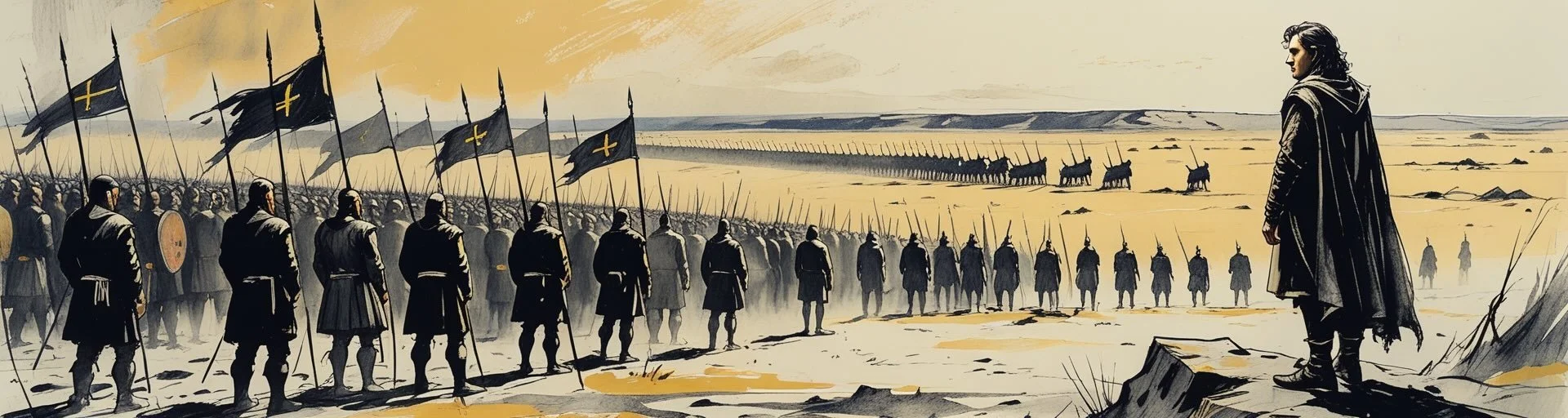
- What Happens: On his way to England, Hamlet meets a captain from Fortinbras's army, marching to fight Poland over a worthless scrap of land. Left alone, Hamlet delivers his last great soliloquy, shamed by the soldiers' readiness to die for nothing while he, with every reason, has still not acted.
- Key Characters: Hamlet, Fortinbras (through his army).
- Dramatic Function: The scene gives Hamlet's final soliloquy, sharpening the theme of action versus inaction just before he leaves Denmark, and uses Fortinbras as a foil.
- Famous Quote:
"My thoughts be bloody, or be nothing worth!"
(Hamlet, Act 4, Scene 4) - Why It Matters: It is Hamlet's most direct confrontation with his own failure to act, ending in a fierce vow to think only of "bloody" revenge.
Scene Summary
On his way to the ship that will carry him to England, Hamlet meets a captain from the army of Fortinbras, the Norwegian prince. The captain explains that the army is marching to fight Poland over a tiny, worthless piece of land – a patch hardly worth the lives it will cost. Hamlet is struck by the pointlessness of it.
Once the others have gone ahead, Hamlet is left alone for his final soliloquy. He reflects bitterly that everything he sees seems to accuse him of his own inaction. He asks what a man is worth if he does nothing but eat and sleep, and concludes that the god-given gift of reason is wasted if it never leads to action.
He then contrasts himself with Fortinbras's soldiers. They are willing to die for "an egg-shell", for honour and a meaningless plot of ground, while he, with a murdered father and a dishonoured mother, has failed to act at all. Ashamed, Hamlet resolves that from now on his thoughts must be "bloody" – wholly given to revenge – or worth nothing.
How All Occasions Do Inform Against Me
Alone, Hamlet turns the sight of the marching army into yet another reproach against himself. Everything he encounters seems to point out his failure and demand that he finally act.
Original
How all occasions do inform against me,
And spur my dull revenge!
(Hamlet, Act 4, Scene 4)
Shakespeare Retold (Modern Verse)
All these events denounce my own inaction
And spur me to revenge!
"Inform against me" is a legal phrase – to give evidence against someone – so Hamlet imagines the world itself accusing him in court. He calls his own revenge "dull", blunted, slow. This is the most clear-eyed Hamlet has been about his failure: he names it directly and is tormented by it. The soliloquy is his attempt to shame himself into the action he keeps avoiding, and its position in the play – just before he is carried off to England – makes it feel like a last reckoning with his own paralysis.
What Is a Man?
Hamlet broadens his self-reproach into a question about human worth. If a person does nothing but feed and sleep, he asks, what separates them from an animal?
Original
If his chief good and market of his time
Be but to sleep and feed? A beast, no more.
(Hamlet, Act 4, Scene 4)
Shakespeare Retold (Modern Verse)
If all he ever did throughout his life
Was sleep and eat? For then, he's just a beast.
"What is a man," Hamlet begins, if his whole life amounts to nothing more than eating and sleeping? He answers himself: "A beast, no more." He argues that God gave human beings reason and the power to look "before and after" precisely so that we would use it, not let it grow mouldy and unused. The irony is sharp and self-aware: Hamlet, the great thinker, is accusing himself of letting his thought rot without ever turning it into action. His gift has become his curse.
My Thoughts Be Bloody
The soliloquy builds to a fierce vow. Shamed by soldiers who will die for nothing, Hamlet resolves to give himself entirely to revenge from this moment on.
Original
O, from this time forth,
My thoughts be bloody, or be nothing worth!
(Hamlet, Act 4, Scene 4)
Shakespeare Retold (Modern Verse)
Now, from this moment on
My thoughts will all be violent, or be gone!
It is a ringing, decisive ending – from now on, only bloody thoughts will count. Yet there is a deep irony in it. Hamlet makes this vow as he is being shipped out of the country, away from Claudius, so he cannot act on it at all. And, tellingly, he resolves only that his thoughts will be bloody, not his deeds. The whole play turns on the gap between thinking and doing, and even his most determined vow stays, for now, in the realm of thought. The next time we see him, in Act 5, he will be strangely calmer, his fury cooled into acceptance.
Language and Technique
- Foil: Fortinbras and his soldiers are set against Hamlet – men of action risking everything for nothing, sharpening Hamlet's failure to act for everything.
- Legal imagery: "All occasions do inform against me" pictures the world as a court giving evidence of Hamlet's guilt of inaction.
- Rhetorical questions: "What is a man...?" and "How stand I then...?" turn the soliloquy into a fierce self-interrogation.
- Antithesis of thought and action: Hamlet contrasts reasoning and doing, "sleep and feed" against great deeds, dramatising his central conflict.
- The closing couplet: The final rhyme snaps the speech shut on a vow, giving his resolve a hard, memorable edge.
Key Quotes from Act 4, Scene 4
Quote 1Sith I have cause and will and strength and means
To do't.
(Hamlet, Act 4, Scene 4)
Shakespeare Retold (Modern Verse)
Because I have the will, the strength and means
To do it.
Is not to stir without great argument,
But greatly to find quarrel in a straw
When honour's at the stake.
(Hamlet, Act 4, Scene 4)
Shakespeare Retold (Modern Verse)
Does not require a monumental reason
To fight, but finding nothing much to fight for
When honour is at stake.
Go to their graves like beds, fight for a plot
Whereon the numbers cannot try the cause...
(Hamlet, Act 4, Scene 4)
Shakespeare Retold (Modern Verse)
Go to their graves like beds, fighting for land
Not big enough to house all of the troops...
Key Takeaways
- Fortinbras's army inspires the soliloquy: Soldiers marching to die for worthless land shame Hamlet by comparison.
- Reason demands action: Hamlet argues that a man who only eats and sleeps is "a beast, no more".
- He admits he has no excuse: He has "cause and will and strength and means" and still has not acted.
- Honour over a straw: True greatness, he says, fights even for a trifle when honour is at stake.
- A bloody vow: Hamlet resolves that his thoughts must be "bloody, or be nothing worth" – though only his thoughts.
Study Questions and Analysis
What prompts Hamlet's "How all occasions" soliloquy?
The trigger is the sight of Fortinbras's army marching to war. A captain tells Hamlet that the Norwegian prince is leading thousands of men to fight Poland over a tiny, worthless strip of land – ground so small and barren it is not worth the cost. The sheer pointlessness of the venture, and the soldiers' willingness to die for it, lodges in Hamlet's mind.
The contrast is unbearable to him. Here are men ready to throw away their lives for "an egg-shell", for honour and reputation, while he, with the strongest possible reason – a murdered father and a stolen throne – has done nothing. Fortinbras works throughout the play as Hamlet's foil: a decisive prince who acts where Hamlet broods. By placing this army in Hamlet's path just as he is being exiled, Shakespeare turns an external event into the spark for Hamlet's deepest self-examination, and gives him his final great speech.
What does Hamlet mean by "What is a man... a beast, no more"?
Hamlet asks what a human being is really worth if the whole purpose of their life is just to eat and sleep. His answer is blunt: such a person is no better than a "beast", an animal. The point is that what raises humans above animals is reason – the ability to think, to remember the past and plan the future, to act on purpose.
He goes on to argue that God gave us this "large discourse" of reason not to let it "fust", or grow mouldy, through disuse, but to use it. The irony, of course, is that Hamlet is accusing himself. He is the most thoughtful man imaginable, yet his thought has not produced action, so by his own definition he risks being the "beast" who only sleeps and feeds. The speech is a painful piece of self-criticism: Hamlet uses his great powers of reasoning to prove that he has been failing to use them properly.
How does Fortinbras's example shame Hamlet?
Fortinbras embodies a code of honour that Hamlet both admires and cannot live up to. To Fortinbras and his men, greatness means acting boldly whenever honour is at stake, even over something as trivial as a "straw". They will "find quarrel in a straw" and die for it without hesitation. Hamlet, by contrast, has the greatest of all causes and yet cannot bring himself to move.
The shame is sharpened because the soldiers' cause is so worthless and his is so just. If thousands will die calmly for a meaningless patch of ground, how can he do nothing for a murdered father? Fortinbras is one of three sons in the play avenging or fighting for a father – alongside Hamlet and Laertes – and he is the man of pure action against Hamlet's man of pure thought. Their final meeting matters: it is Fortinbras who inherits Denmark at the end, the decisive prince stepping into the space the hesitant one leaves behind. This scene plants that contrast at its sharpest.
What does "My thoughts be bloody, or be nothing worth" reveal?
The closing couplet is Hamlet's fiercest vow of revenge: from this moment, he says, his thoughts must be wholly given to bloody action, or they are worthless. It sounds like a turning point, the moment he finally commits. But the line is shot through with irony that is easy to miss.
First, Hamlet makes this vow just as he is being shipped to England, away from Claudius, so he is in no position to act on it. Second, and more tellingly, he swears that his thoughts – not his deeds – will be bloody. Even at his most resolved, the revenge stays in his head. The German writer Goethe, in his novel Wilhelm Meister's Apprenticeship (1795), famously described Hamlet as a sensitive, noble soul crushed by a task too heavy for it, "a lovely, pure" nature asked to do something it cannot. The couplet captures that exactly: a man straining to be the bloody avenger he is not, making in words the commitment his nature keeps failing to carry into action.
How does this soliloquy fit the theme of action versus inaction?
This is the play's most explicit treatment of its central theme. Where the earlier soliloquies circle around grief, suicide and doubt, this one is squarely about Hamlet's failure to act and his bafflement at it. He lays out the problem with total clarity: he has the cause, the will, the strength and the means, and still he delays. He cannot find an external reason, so the cause must be internal.
The scene refuses to give a simple answer. Hamlet himself offers two: that he thinks too "precisely" on the event, breaking it down until resolve dissolves, or that he is a coward. Critics have added many more, from A. C. Bradley's melancholy to Goethe's gentle, overburdened nature. By staging the soliloquy against Fortinbras's reckless army, Shakespeare frames Hamlet's inaction as a deeply human problem – the gap between knowing what we should do and actually doing it. The vow that ends the speech, so fierce and yet so unfulfilled, is the perfect emblem of that gap, and it sends Hamlet off to England with his great task still undone.