
Hamlet: Act 4, Scene 3 – Analysis
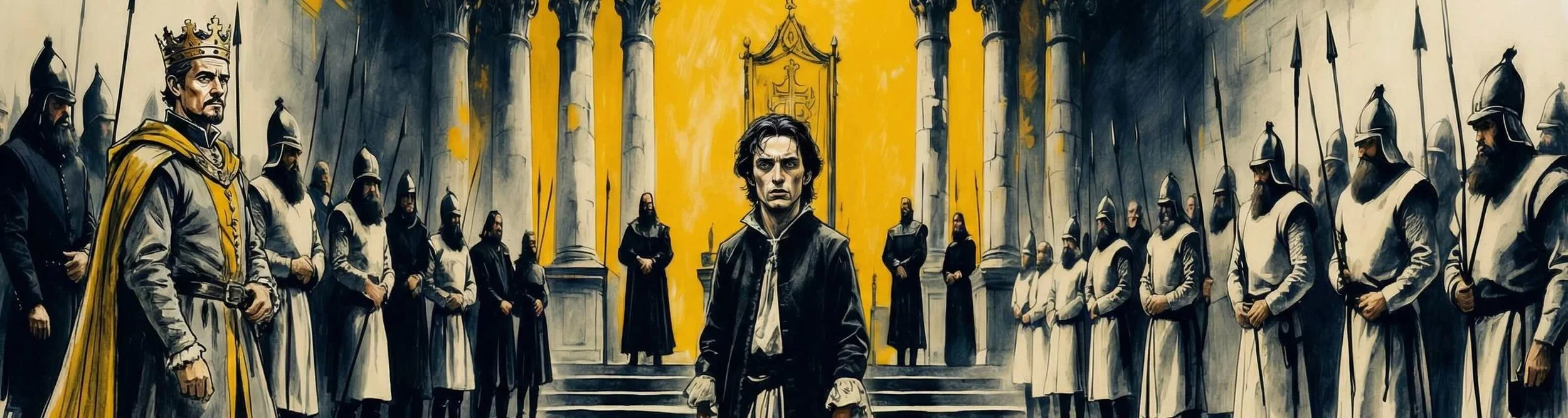
Scene Profile – At a Glance
- Location: A room in Elsinore Castle.
- What Happens: Claudius questions Hamlet about Polonius's body. Hamlet answers with grim jokes about worms and death, then reveals the body is near the lobby. Claudius sends Hamlet to England under guard, and, alone, confesses that he has sent secret letters ordering Hamlet's execution.
- Key Characters: Hamlet, Claudius.
- Dramatic Function: The scene sends Hamlet into exile and openly reveals Claudius's plan to have him murdered, raising the stakes of their conflict.
- Famous Quote:
"Your worm is your only emperor for diet..."
(Hamlet, Act 4, Scene 3) - Why It Matters: It shows Hamlet's bleak wit about death the great leveller, and exposes Claudius as a would-be murderer for the second time.
Scene Summary
Claudius presses Hamlet to say where he has hidden Polonius's body. Hamlet replies in riddles, saying Polonius is "at supper" – not eating, but being eaten by worms – and using the moment to lecture the king on how death reduces everyone, kings and beggars alike, to food for maggots. Eventually he reveals the body is near the lobby stairs.
Claudius, keeping his patience, tells Hamlet that for his own safety he must sail to England immediately. Hamlet, seeing through him but apparently content to go, leaves under guard with Rosencrantz and Guildenstern.
Left alone, Claudius drops his calm mask. He reveals that he has sent sealed letters to the King of England demanding that Hamlet be put to death the moment he arrives. He says Hamlet rages in his blood like a fever, and that he will know no peace until the prince is dead.
A King's Progress Through a Beggar
Hamlet uses the question about the body to deliver a black comic sermon on death. His point is serious beneath the joking: death makes a mockery of all rank and power, turning the greatest king into food for worms, just like the poorest beggar.
Original
A man may fish with the worm that hath eat of a king, and eat of the fish that hath fed of that worm.
(Hamlet, Act 4, Scene 3)
Shakespeare Retold (Modern Verse)
A man might fish with worms that ate a king and eat the fish that earlier ate the worm.
The logic is gruesome but exact: a worm eats a dead king, a fisherman uses that worm as bait, a beggar eats the fish – so a king can "go a progress through the guts of a beggar". Behind the joke lies the play's obsession with death as the great equaliser. To Hamlet, all the pomp of kingship ends in rot, and pointing this out to Claudius's face is a quiet act of defiance: the king's crown means nothing to the worms. The same idea returns, more famously, when Hamlet contemplates Yorick's skull in Act 5.
Do It, England
Hamlet leaves for England, and the moment he is gone Claudius shows his true intent. The journey is no act of mercy but a death sentence in disguise.
Original
The present death of Hamlet. Do it, England;
For like the hectic in my blood he rages,
And thou must cure me...
(Claudius, Act 4, Scene 3)
Shakespeare Retold (Modern Verse)
The timely death of Hamlet. Do it, King,
For he is coursing through my veins like fever,
And you must cure me...
The soliloquy removes any doubt about Claudius. He has written secret letters ordering the King of England to execute Hamlet on arrival. The image he chooses is telling: Hamlet is a "hectic" – a fever – burning in his blood, and only the prince's death will "cure" him. It is the same language of disease that runs through the whole play, but here the supposedly diseased thing is the threat to Claudius's stolen crown. The scene confirms that the king is now a deliberate, cold-blooded murderer for the second time, and that Hamlet is sailing into a trap.
Language and Technique
- Macabre wit: Hamlet's jokes about worms and supper make death the punchline, his way of facing horror through dark comedy.
- Levelling imagery: The chain from king to worm to fish to beggar pictures death erasing all difference of rank.
- Disease imagery: Claudius calls Hamlet a "hectic" or fever in his blood, casting murder as a cure – the play's sickness imagery turned on its head.
- Soliloquy as confession: Claudius's private speech lets the audience hear the death sentence the court does not, deepening the dramatic irony.
Key Quotes from Act 4, Scene 3
Quote 1At supper.
(Hamlet, Act 4, Scene 3)
Shakespeare Retold (Modern Verse)
At supper.
In heaven; send hither to see: if your messenger find him not there, seek him i' the other place yourself.
(Hamlet, Act 4, Scene 3)
Shakespeare Retold (Modern Verse)
In heaven: send somebody up to check; if he's not there, go look in hell yourself.
Now, Hamlet, where's Polonius?
(Claudius, Act 4, Scene 3)
Shakespeare Retold (Modern Verse)
Now, Hamlet: where's Polonius?
Key Takeaways
- Hamlet jokes about death: Polonius is "at supper" for the worms; even a king ends up as food for maggots.
- Death the leveller: The worm speech says kings and beggars come to the same end – a key idea of the play.
- Hamlet is sent to England: Claudius removes him from Denmark under the cover of concern for his safety.
- Claudius reveals his plot: Alone, he confesses he has ordered Hamlet's execution in England.
- The king is a murderer again: Disease imagery casts Hamlet as a "fever" only death can cure.
Study Questions and Analysis
Why does Hamlet talk so much about worms and dead bodies?
On the surface, Hamlet's worm-talk is part of his mad-seeming wit, a way of dodging Claudius's questions and needling the king. But it is also a genuine meditation on death, one of the play's deepest themes. Hamlet insists that worms are the true "emperors" of the dinner table, because they eat everyone in the end, and that a dead king can pass "through the guts of a beggar".
The obsession reflects where Hamlet's mind has gone. Surrounded by death – his father's, Polonius's, and the threat of his own – he keeps stripping away the dignity people give to rank and the body. G. Wilson Knight, in The Wheel of Fire (1930), described Hamlet as a figure saturated in death, an "ambassador of death" whose vision drains the value from life around him. The worm speech is part of that vision: it refuses to let kingship, or even the human body, mean anything grander than meat returning to the earth. It looks ahead directly to the graveyard scene, where the same idea is given its most famous form.
What does "a king may go a progress through the guts of a beggar" mean?
A "progress" was a grand royal journey, when a monarch travelled through the country in state. Hamlet twists the phrase savagely: a dead king can make a "progress" not through his realm but through a beggar's intestines – if a worm eats the king, a fish eats the worm, and a beggar eats the fish. The most exalted person on earth ends up passing through the body of the lowest.
The line is the heart of the scene's idea that death levels everything. In life, the gulf between a king and a beggar is enormous; in death, it vanishes entirely, because both become food for the same worms. Hamlet is partly mocking Claudius, reminding the usurper that his stolen crown will not save him from the common fate of all flesh. The thought is grimly democratic, and it strips away the awe that surrounds royalty – a daring thing to say to a king's face, even disguised as madness.
What is Claudius's secret plan for Hamlet in England?
Claudius pretends that sending Hamlet to England is for the prince's own safety, a way to calm the situation after the killing of Polonius. But in his closing soliloquy he reveals the truth: he has sent sealed letters to the King of England ordering that Hamlet be put to death as soon as he lands.
This is the second time we see Claudius plot a murder, and it shows his ruthlessness clearly. He will not risk killing Hamlet openly in Denmark, where the prince is loved by the people, so he arranges to have it done quietly and far away, with England's hand on the knife. He describes Hamlet as a fever in his blood that only death can cure, language that betrays both his fear and his cold determination. The plan also sets up one of the play's turning points: Hamlet will discover the letters at sea, rewrite them to condemn Rosencrantz and Guildenstern instead, and escape – a rare moment of decisive, successful action that returns him to Denmark for the final reckoning.
Why is Hamlet so insolent towards Claudius in this scene?
Hamlet treats the king with barely hidden contempt, mocking him with riddles and grim jokes and refusing to answer plainly. His insolence has several roots. He now knows, from "The Mousetrap", that Claudius is his father's murderer, so he feels no respect for the man wearing the crown. His "antic disposition" also gives him licence to be rude in ways that would otherwise be treason.
There is recklessness in it, too. Hamlet has just killed Polonius and is about to be shipped abroad, and he seems almost to enjoy provoking the king, daring him to react. The scene shows the strange confidence of a man who has stopped caring about his own safety and who despises his enemy too much to flatter him. Yet his contempt also makes him careless: he walks willingly into Claudius's trap, going off to England without suspecting – or without minding – the murderous plan waiting at the other end.
How does this scene develop the theme of death and mortality?
This scene gives the death theme one of its sharpest expressions before the graveyard. Through the worm speech, Hamlet argues that death erases every distinction human beings care about – wealth, rank, even the difference between a king and a beggar – reducing all bodies to the same decaying matter. It is a bleak, physical view of mortality, with no comfort of heaven attached.
The scene pairs this philosophical meditation with two very real death threats: the corpse of Polonius, treated as a joke, and the secret order for Hamlet's own execution. Death is everywhere – talked about, lying in the next room, and being plotted in letters. By placing Hamlet's witty contemplation of mortality next to Claudius's cold arrangement of a murder, the scene shows the two faces of death in the play: the universal fate that levels all, and the deliberate killing that drives the plot. Both will come together in the bloody final act, towards which this scene is now hurrying.
