Hamlet: Act 4, Scene 2 – Analysis
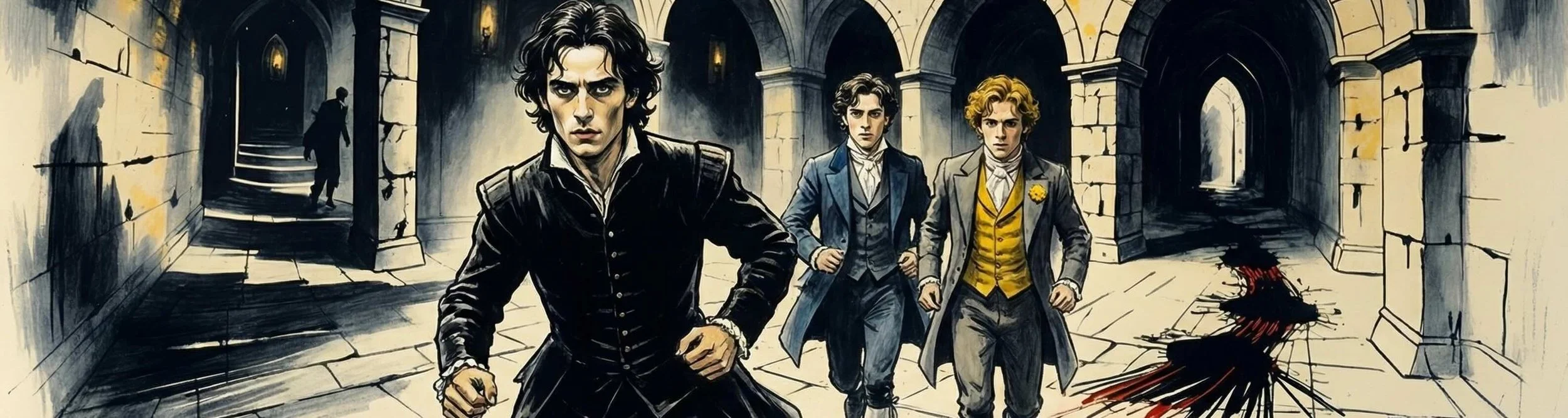
Scene Profile – At a Glance
- Location: A passage or room in Elsinore Castle.
- What Happens: Rosencrantz and Guildenstern catch up with Hamlet and demand to know where he has hidden Polonius's body. Hamlet answers in riddles, mocks them as the king's "sponges", refuses to tell them, and finally leads them off to the king.
- Key Characters: Hamlet, Rosencrantz and Guildenstern.
- Dramatic Function: The brief scene shows Hamlet's dark, mocking wit after the killing and his open contempt for the king's spies.
- Famous Quote:
"Hide fox, and all after."
(Hamlet, Act 4, Scene 2) - Why It Matters: It shows Hamlet treating the hunt for the body, and the king himself, as a children's game – mocking the authority that is closing in on him.
Scene Summary
Rosencrantz and Guildenstern find Hamlet and ask what he has done with Polonius's body. Hamlet refuses to give a straight answer, replying with grim jokes about dust and death. He turns on his old schoolfriends, accusing them of being the king's tools who soak up royal favour only to be squeezed dry and discarded.
When they press him again for the body and insist he come to the king, Hamlet plays word-games, declaring that "the king is a thing of nothing". At last he agrees to be taken to Claudius, but turns even this into a game of hide-and-seek, running off and daring them to chase him.
Compounded with Dust
Asked where the body is, Hamlet answers with bleak humour. He has, he says, mixed Polonius back into the dust he came from – a flippant joke that is also a grim truth about death.
Original
Compounded it with dust, whereto 'tis kin.
(Hamlet, Act 4, Scene 2)
Shakespeare Retold (Modern Verse)
I've mixed it up with dust, from whence it came!
The line is a joke, but it carries the play's deep preoccupation with death and decay. "Dust to dust" is the language of the burial service, and Hamlet treats Polonius's corpse as just so much matter returning to the earth. This grimly comic view of the body anticipates the graveyard scene in Act 5, where Hamlet holds Yorick's skull and meditates on how even kings end up as dust. His wit here is a kind of armour, letting him face death by laughing at it.
The King Is a Thing
Hamlet refuses to respect either the body-hunt or the king behind it. His riddling answers turn into a barely veiled insult to Claudius's authority.
Original
The body is with the king, but the king is not with the body.
(Hamlet, Act 4, Scene 2)
Shakespeare Retold (Modern Verse)
The body's with the king, although the king is not there with the body.
The riddle plays on different meanings of "body" – Polonius's corpse, and the "body politic", the idea of the king as the head of the state. Hamlet goes on to call the king "a thing of nothing", which is close to treason. Under the cover of mad wordplay, he is expressing pure contempt for Claudius, denying his legitimacy and his worth. It shows how Hamlet uses his "antic disposition" as a licence to say what no one else dares: that the king is a hollow nothing.
Language and Technique
- Riddling prose: Hamlet answers in puzzles and quibbles, using the freedom of "madness" to insult the king and dodge his spies.
- The sponge metaphor: Rosencrantz and Guildenstern are "sponges" who soak up the king's favours and will be squeezed dry – a sharp image of disposable servants.
- Imagery of dust and decay: The body "compounded with dust" links this throwaway scene to the play's great meditations on death.
- Games and play: "Hide fox, and all after" turns a deadly manhunt into a child's game, mocking the seriousness of the court.
Key Quotes from Act 4, Scene 2
Quote 1Besides, to be demanded of a sponge!
(Hamlet, Act 4, Scene 2)
Shakespeare Retold (Modern Verse)
Besides, I'm being questioned by a sponge!
That I can keep your counsel and not mine own.
(Hamlet, Act 4, Scene 2)
Shakespeare Retold (Modern Verse)
That I'd believe in you but not myself.
Key Takeaways
- Hamlet hides the body: He refuses to say where Polonius is, joking that he has mixed the corpse back into dust.
- He mocks his old friends: Rosencrantz and Guildenstern are "sponges" who serve the king and will be thrown away.
- Contempt for Claudius: Hamlet calls the king "a thing of nothing", denying his authority.
- Wit as a weapon: Under cover of madness, Hamlet says dangerous, near-treasonous things freely.
- The net tightens: Hamlet is led off towards the king, and his exile to England draws closer.
Study Questions and Analysis
Why is Hamlet so flippant about Polonius's body?
Hamlet treats the body and the question of where it is as a chance for grim jokes, saying he has "compounded it with dust". This flippancy can be read in several ways. On one level it is part of his "antic disposition", a continuation of the mad behaviour he uses to confuse and provoke the court. On another, it reflects a genuine, deepening obsession with death and decay that runs through the whole play.
It can also seem callous, and it is meant to disturb us. Hamlet has just killed a man – an old man who was, whatever his faults, a father – and here he laughs about the corpse. The lightness sits uneasily against the seriousness of what he has done, and it shows how far the killing, and his own situation, have hardened him. The joking is a mask, but it is also a sign of a mind that has begun to treat death as a familiar, almost comic companion, exactly as he will in the graveyard scene.
What does Hamlet mean by calling Rosencrantz and Guildenstern "sponges"?
Hamlet compares his old schoolfriends to sponges to expose what they really are: the king's tools. A sponge soaks up water and is then squeezed dry; in the same way, Rosencrantz and Guildenstern soak up Claudius's rewards, favours and trust, and gather information for him – but the moment the king has what he needs, he will squeeze them empty and discard them.
The insult is both contemptuous and clever. It tells the pair, to their faces, that Hamlet knows they are spying on him and that he despises them for it. It also contains a warning they are too foolish to heed: servants who let themselves be used by a ruthless king will end up used up and thrown away. The image foreshadows their actual fate – sent to England carrying orders for Hamlet's death, they are killed instead, destroyed by the very plot they were carrying out for Claudius.
What does "the king is a thing of nothing" suggest?
This is one of the most daring things Hamlet says in the play. Through a riddle about the body being "with the king" but the king not being "with the body", he arrives at the declaration that the king is "a thing of nothing". Taken seriously, this is close to treason: he is denying Claudius any real worth or legitimacy, calling him an empty nothing dressed up as a king.
The line works on the old idea of the "king's two bodies" – the mortal man and the eternal office of kingship. Hamlet suggests that Claudius has the title but not the substance: he occupies the throne, but he is a hollow thing, not a true king. Only by hiding such statements inside mad-seeming wordplay can Hamlet say them at all. It is a vivid example of how his "antic disposition" gives him the freedom to voice his deepest contempt for the man he is sworn to destroy.
Is Hamlet mad in this scene, or only playing mad?
The scene keeps the question deliberately open, as the play does throughout. On the surface, Hamlet's behaviour looks mad: riddles, jokes about corpses, a sudden game of hide-and-seek. But underneath, every line has a sharp, sane purpose. He insults the king, exposes his spies, and refuses to give up the body, all while seeming to ramble.
This control points strongly to performance rather than genuine madness. Hamlet is using his "antic disposition" exactly as he planned: to say dangerous things safely and to keep his enemies off balance. Yet the wildness of his wit, and his strange glee in the face of a killing he has just committed, leave room for doubt. The most convincing reading is that Hamlet is largely acting, but that real grief, anger and instability are bleeding into the act, so that the line between the performance and the man grows ever harder to draw.