Hamlet: Act 4, Scene 1 – Analysis
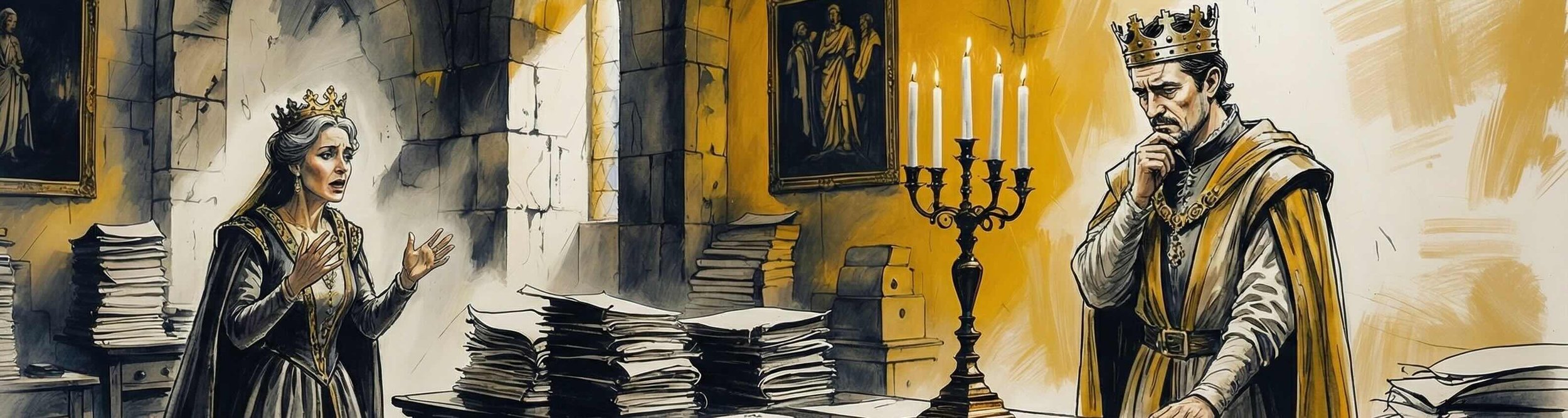
Scene Profile – At a Glance
- Location: A room in Elsinore Castle, immediately after the closet scene.
- What Happens: Gertrude tells Claudius that Hamlet has killed Polonius in a fit of madness. Claudius is alarmed, realising it could have been him, and resolves to ship Hamlet to England at once. He sends Rosencrantz and Guildenstern to find the body.
- Key Characters: Claudius, Gertrude.
- Dramatic Function: The short scene shows the immediate fallout of Polonius's death and Claudius turning the crisis to his advantage, speeding Hamlet towards exile.
- Famous Quote:
"Mad as the sea and wind, when both contend
Which is the mightier..."
(Gertrude, Act 4, Scene 1) - Why It Matters: It shows Gertrude shielding her son and Claudius coldly calculating his next move – the deadly contest is now fully out in the open.
Scene Summary
The scene picks up the moment after the closet scene. Gertrude, shaken, tells Claudius what has happened: Hamlet, in a fit of madness, has killed Polonius, who was hiding behind the curtain. She describes her son as utterly out of his senses.
Claudius reacts with alarm rather than grief. He sees at once that the sword could just as easily have struck him, and that Hamlet at large is a danger to everyone. He tells Gertrude that the king will be blamed for not controlling the prince, and that Hamlet must be sent away to England immediately for everyone's safety.
He sends Rosencrantz and Guildenstern to find Hamlet and recover Polonius's body. The scene ends with Claudius determined to manage the disaster, turning a murder in his own household into a reason to remove the prince he fears.
Mad as the Sea and Wind
Gertrude's account of the killing is striking for what it does and does not say. She describes Hamlet as completely mad, a man swept beyond reason, and emphasises his madness rather than any cold purpose.
Original
Mad as the sea and wind, when both contend
Which is the mightier...
(Gertrude, Act 4, Scene 1)
Shakespeare Retold (Modern Verse)
Mad as the sea and wind that fight each other
To prove who's stronger...
The image of the sea and wind fighting is powerful, but the key question is whether Gertrude believes it. After the closet scene, she has seen that Hamlet is dangerous but also that his "madness" has a piercing clarity. By stressing his madness to Claudius, she may be quietly protecting her son, framing the killing as a fit of insanity rather than an attempt on the king's life. Her loyalty seems to have shifted towards Hamlet, which is one sign that his harsh words have reached her.
His Liberty Is Full of Threats
Claudius does not mourn Polonius for a moment. His thoughts go straight to his own safety and his grip on power. A free, unpredictable Hamlet is now an unacceptable risk.
Original
His liberty is full of threats to all;
To you yourself, to us, to every one.
(Claudius, Act 4, Scene 1)
Shakespeare Retold (Modern Verse)
His freedom risks the safety of us all;
To you, to me, to everybody here.
The line shows Claudius the politician at work. Within seconds of hearing about a death in his own home, he is calculating how to use it. Hamlet's killing of Polonius gives the king the perfect excuse to do what he already wanted – remove Hamlet from Denmark. What looks like concern for everyone's safety is really self-preservation. From here, the journey to England is set in motion, carrying with it Claudius's secret plan to have Hamlet murdered abroad.
Language and Technique
- Storm imagery: Hamlet "mad as the sea and wind" pictures his mind as a raging storm, a violence of nature beyond control.
- Royal "we": Claudius slips between "us" and "me", the language of a king who treats his own survival as the survival of the state.
- Dramatic irony: Claudius frames Hamlet as the dangerous one, while the audience knows the real murderer in the room is the king himself.
- Euphemism: The plan to deal with Hamlet is wrapped in the calm language of necessity and care, hiding the deadly intent beneath.
Key Quotes from Act 4, Scene 1
Quote 1And, in this brainish apprehension, kills
The unseen good old man.
(Gertrude, Act 4, Scene 1)
Shakespeare Retold (Modern Verse)
And in his mad, misguided view, he killed
The unseen good old man.
O heavy deed!
(Claudius, Act 4, Scene 1)
Shakespeare Retold (Modern Verse)
Oh no, that's awful!
Key Takeaways
- Gertrude reports the killing: She tells Claudius that Hamlet, in a mad fit, has killed Polonius.
- She shields her son: By stressing his madness, Gertrude frames the death as insanity, not an attack on the king.
- Claudius thinks of himself first: His main fear is that the blow could have been meant for him.
- Exile is decided: Claudius uses the killing as his excuse to send Hamlet to England at once.
- The plot accelerates: A death in the household becomes the trigger for Claudius's deadly scheme abroad.
Study Questions and Analysis
How does Gertrude describe the killing of Polonius, and why?
Gertrude describes Hamlet as utterly mad – "mad as the sea and wind" – and presents the killing of Polonius as the act of a man out of his senses, who stabbed at a noise behind the curtain in a "brainish apprehension". She calls Polonius "the unseen good old man", emphasising his innocence and the accidental nature of his death.
Her choice of words is significant. After the closet scene, Gertrude has seen that Hamlet is not simply raving; his accusations struck home. Yet to Claudius she stresses madness above all. Many readers see this as Gertrude protecting her son: by insisting he was insane, she shields him from the charge of deliberately trying to murder the king. It is the first clear sign that Hamlet's words have shifted her loyalty, and that she is now, quietly, on his side against her husband.
How does Claudius react to Polonius's death?
Claudius reacts with alarm, not grief. His first real thought is that the sword could have struck him – "It had been so with us, had we been there." He sees instantly that a Hamlet capable of sudden killing is a threat to his own life, and he frames the prince's "liberty" as a danger to everyone in the kingdom.
The reaction is pure Claudius: swift, self-interested and politically shrewd. He spends no time mourning his loyal counsellor and every moment calculating how to protect himself and manage the fallout. Within the scene he turns the murder into a justification for sending Hamlet to England, which is exactly what he already wanted. It confirms that, beneath the smooth public manner, Claudius is a cold operator who treats even a death in his household as an opportunity.
What does this scene reveal about Claudius's priorities?
The scene strips Claudius down to his essentials: power and survival. Faced with the killing of Polonius, he worries about his own safety, about how the king will be blamed for not restraining Hamlet, and about how to be rid of the prince – in that order. Polonius, who served him faithfully, barely registers as a loss.
This single-mindedness is what makes Claudius dangerous. He is never distracted by feeling for long; he keeps his eye on the throne and on the threats to it. The scene also shows his talent for turning events to his advantage. A murder that might have ruined a weaker ruler becomes, in his hands, the lever that finally removes Hamlet from Denmark. Behind his measured words lies a man who will let nothing – not loyalty, not law, not death – stand between him and his hold on power.
Why is Polonius's death a turning point in the play?
The killing of Polonius changes everything. It gives Claudius the legitimate excuse he needed to send Hamlet away, setting up the voyage to England and the secret order for Hamlet's execution. It also makes Hamlet a killer and a fugitive, no longer simply a grieving prince but a man with blood on his hands.
Most importantly, it creates a new avenger. Polonius leaves behind a son, Laertes, and a daughter, Ophelia. Laertes will return from France burning to avenge his father – doing instantly and fiercely what Hamlet has spent the whole play failing to do – and Ophelia, robbed of both her father and Hamlet's love, will slide into madness and death. This brief scene is the quiet pivot on which the second half of the tragedy turns: from here, the consequences of Hamlet's rash thrust spread outward to engulf almost everyone.