Hamlet: Act 3, Scene 4 – Analysis
Scene Profile – At a Glance
- Location: The Queen's private chamber (her "closet") in Elsinore.
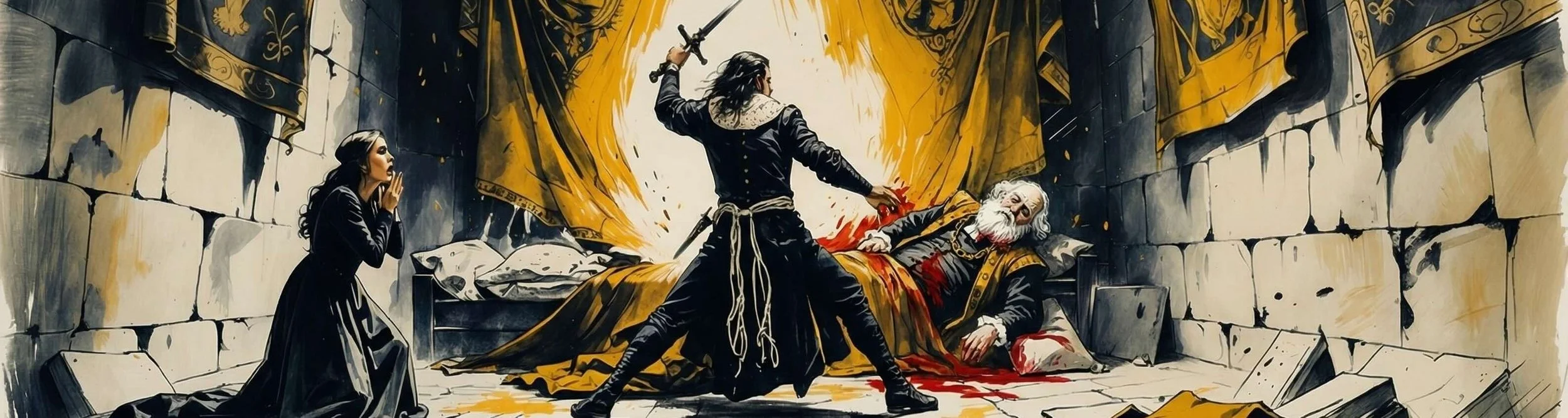
- What Happens: Hamlet confronts his mother. Hearing a noise behind a curtain, he stabs and kills the hidden Polonius, thinking it is the king. He forces Gertrude to face her guilt by comparing her two husbands. The Ghost appears to remind him of his revenge, then Hamlet urges his mother to repent and drags Polonius's body away.
- Key Characters: Hamlet, Gertrude, Polonius, the Ghost.
- Dramatic Function: The closet scene is the emotional climax of the middle of the play: Hamlet's first killing, his reckoning with his mother, and the Ghost's last appearance.
- Famous Quote:
"Assume a virtue, if you have it not."
(Hamlet, Act 3, Scene 4) - Why It Matters: Hamlet finally acts – and kills the wrong man, setting the rest of the tragedy in motion and turning Laertes into an avenger.
Scene Summary
Polonius hides behind a curtain (an "arras") in Gertrude's room to listen as she scolds her son. When Hamlet arrives, his sharp, accusing manner frightens the queen, who cries out for help. Polonius echoes her cry from behind the curtain, and Hamlet, thinking it is the king spying on him, stabs through the cloth and kills him. When he lifts the arras and sees Polonius, he shows little remorse.
Hamlet then turns the full force of his anger on his mother. He makes her look at portraits of her dead husband and of Claudius, demanding to know how she could leave so noble a man for so base a one. He attacks her marriage as lust and betrayal, until Gertrude begs him to stop, saying he has broken her heart.
At the height of his fury, the Ghost appears, visible only to Hamlet. It reminds him to keep his promise of revenge and to be gentle with his mother. Gertrude, who cannot see the Ghost, is convinced her son is truly mad. Hamlet insists he is not, and pleads with her to repent and to keep away from Claudius's bed.
The scene ends with a strange tenderness mixed with cruelty. Hamlet urges his mother to "assume a virtue" and reform, says he must be "cruel only to be kind", and reveals he knows he is being sent to England and suspects a plot. Then he drags Polonius's body out of the room.
Dead, for a Ducat
For all his hesitation elsewhere, Hamlet acts here without a second's thought – and kills the wrong man. Hearing a noise behind the curtain, he assumes it is Claudius and lunges.
Original
How now! A rat? Dead, for a ducat, dead!
(Hamlet, Act 3, Scene 4)
Shakespeare Retold (Modern Verse)
What's that? A rat? I bet you that he's dead!
The terrible irony is that the man who could not kill a kneeling, defenceless Claudius in the previous scene now kills instantly – but blindly, through a curtain, the wrong target. When Gertrude gasps at the deed, Hamlet's cold reply, "Is it the king?", shows he hoped it was Claudius. The killing of Polonius is the play's hinge: it makes Hamlet a murderer, gives Claudius an excuse to send him away, and turns Polonius's son Laertes into the very kind of avenger Hamlet has failed to be.
Look Here, Upon This Picture
With Polonius dead, Hamlet rounds on his mother. He produces two portraits – one of his father, one of Claudius – and forces her to compare the two men she has married.
Original
Look here, upon this picture, and on this,
The counterfeit presentment of two brothers.
(Hamlet, Act 3, Scene 4)
Shakespeare Retold (Modern Verse)
Look at this picture first, then look at this one:
A copy imitation of two brothers.
Hamlet paints his father as a god – "Hyperion's curls", the brow of Jove, the eye of Mars – and Claudius as a "mildewed ear" rotting beside him. The contrast is the same one from his first soliloquy, "Hyperion to a satyr", now thrust physically in his mother's face. He cannot understand how she could choose the lesser man, and his disgust spills into harsh attacks on her desire and her age. The scene shows Hamlet's obsession with his mother's sexuality, which many find the most troubling and intimate part of the play.
The Ghost Returns
As Hamlet's rage at his mother boils over, the Ghost appears for the last time. Crucially, only Hamlet can see it; to Gertrude, her son is raving at empty air.
Original
Do you not come your tardy son to chide,
That, lapsed in time and passion, lets go by
The important acting of your dread command?
(Hamlet, Act 3, Scene 4)
Shakespeare Retold (Modern Verse)
Have you returned to scold your tardy son,
Who, taking too much time and lacking passion,
Has failed to carry out your dire command? Tell me!
Hamlet assumes the Ghost has come to scold his "tardy" delay, and he is right: the Ghost reminds him to keep to his "almost blunted purpose" and to comfort, not torment, his mother. The fact that Gertrude cannot see the Ghost is one of the play's great puzzles. In Act 1 several men saw it; here only Hamlet does. Some take this as proof the Ghost is real but selective; others see it as a sign that Hamlet's "madness" may now be partly genuine. The scene keeps the question open.
Language and Technique
- The arras: The curtain Polonius hides behind is a perfect emblem of the play's spying, and stabbing through it is Hamlet striking blindly at a hidden watcher.
- Visual contrast: The two portraits stage the play's "Hyperion to a satyr" theme as a physical object, forcing Gertrude to see the difference.
- Imagery of disease: Claudius as a "mildewed ear", sin as an "ulcerous place" hiding "rank corruption" – the body of the queen, like the state, is pictured as infected.
- The unseen Ghost: A spirit visible to one character but not another creates eerie dramatic tension and raises doubts about Hamlet's sanity.
- Paradox: "I must be cruel, only to be kind" captures the scene's mixture of brutality and love in a single contradiction.
Key Quotes from Act 3, Scene 4
Quote 1Is it the king?
(Hamlet, Act 3, Scene 4)
Shakespeare Retold (Modern Verse)
Is it the king?
O, what a rash and bloody deed is this!
(Gertrude, Act 3, Scene 4)
Shakespeare Retold (Modern Verse)
Oh, what a hasty, awful thing to do!
O Hamlet, thou hast cleft my heart in twain.
(Gertrude, Act 3, Scene 4)
Shakespeare Retold (Modern Verse)
Oh Hamlet, you have broke my heart in two.
O, throw away the worser part of it,
And live the purer with the other half.
(Hamlet, Act 3, Scene 4)
Shakespeare Retold (Modern Verse)
Then throw away the evil half of it,
And live a decent life with what is left.
I must be cruel, only to be kind...
(Hamlet, Act 3, Scene 4)
Shakespeare Retold (Modern Verse)
Removing him is cruel yet must be done...
Key Takeaways
- Hamlet kills Polonius: He stabs blindly through the curtain, thinking it is the king – his first killing, and a fatal mistake.
- He confronts Gertrude: The two portraits force her to compare his noble father with the "mildewed" Claudius.
- The Ghost returns: It reminds Hamlet of his revenge and to spare his mother – but only he can see it.
- Gertrude shows remorse: Hamlet's words "cleave her heart", and she seems genuinely shamed.
- "Cruel only to be kind": Hamlet frames his harshness as love, and exits dragging Polonius's body.
Study Questions and Analysis
Why does Hamlet kill Polonius?
Polonius has hidden behind a curtain to spy on Hamlet's meeting with his mother. When Gertrude, frightened by Hamlet's intensity, cries for help, Polonius echoes her call from his hiding place. Hamlet, who has just been thinking about killing the king, assumes the hidden voice belongs to Claudius spying on him, and stabs through the curtain on impulse.
The killing is full of dark irony. The man famous for hesitating now acts instantly, and kills the wrong person. It shows that Hamlet is capable of sudden, violent action when his guard is down, which makes his earlier delays even more striking. The consequences are enormous: Hamlet has now committed murder himself, given Claudius a legitimate reason to remove him, and created a new avenger in Laertes, whose father he has killed. From this point the tragedy accelerates, and much of the bloodshed to come flows from this single rash thrust.
What is the significance of the two portraits?
Hamlet makes Gertrude look at images of her two husbands side by side. He describes his father in god-like terms – the curls of Hyperion the sun-god, the brow of Jove, the eye of Mars – and Claudius as a diseased, "mildewed ear" of corn blighting his healthy brother. The visual comparison forces Gertrude to confront the gulf between the man she lost and the man she chose.
The device dramatises the contrast Hamlet first drew in his opening soliloquy, "Hyperion to a satyr". By making it physical, with real pictures, he tries to shame his mother into seeing her remarriage as he sees it: not love but lust, not a fair exchange but a fall from the divine to the rotten. The portraits also feed the play's disease imagery, casting Claudius as an infection spreading through the royal family. The scene's force comes from Hamlet's desperate need to make his mother see the truth, and his disgust when she cannot fully share his loathing.
Why does the Ghost reappear, and why can't Gertrude see it?
The Ghost returns to redirect Hamlet. By its own words, it comes to "whet" his "almost blunted purpose" – to remind him that he has been delaying his revenge – and to stop him tormenting his mother, whom it told him in Act 1 to leave to heaven. It steps in just as Hamlet's attack on Gertrude is becoming unbearable.
The fact that Gertrude cannot see or hear the Ghost is one of the play's most debated moments. In the very first scenes, the Ghost was seen by several level-headed soldiers, which argued for its reality. Here it appears to Hamlet alone, which can suggest several things: that it is real but choosing to reveal itself only to its son; or that Hamlet, under enormous strain, is now partly hallucinating, his pretended madness shading into real disturbance. A. C. Bradley, in his 1904 Shakespearean Tragedy, took the Ghost to be genuinely present throughout, but acknowledged the scene's deliberate ambiguity. The play refuses to settle whether we are watching a true spirit or a mind beginning to crack.
Is Hamlet too cruel to his mother in this scene?
Hamlet's treatment of Gertrude is shockingly harsh. He shouts at her, dwells with disgust on her sex life, and reduces her to tears, telling her she has lived "in the rank sweat of an enseamed bed". Many readers and critics find his fixation on his mother's desire excessive and disturbing, more like jealousy than justice.
It will but skin and film the ulcerous place,
Whilst rank corruption, mining all within,
Infects unseen.
(Hamlet, Act 3, Scene 4)
Shakespeare Retold (Modern Verse)
For that will only hide the real infection,
Which, left unchecked, will spread throughout your soul,
Corrupting from within.
Yet there is another side. Hamlet tells Gertrude not to "skin and film" over her guilt with excuses, because hidden sin festers like an unseen ulcer; he wants her to face the truth and repent. By this reading, his cruelty is a kind of rough healing. Ernest Jones, in Hamlet and Oedipus (1949), read the scene through a Freudian lens, seeing Hamlet's obsession with his mother's bed as evidence of buried desire. Others see only a wounded son desperate to reclaim his mother from a corrupt marriage. The scene's power lies in holding both the tenderness and the cruelty together, so that we cannot quite separate love from violence.
What does "I must be cruel, only to be kind" mean?
Hamlet uses this paradox to justify his harsh treatment of his mother. He means that he is being cruel to her now – forcing her to face her guilt, refusing to spare her feelings – in order to do her good in the long run, by saving her soul and freeing her from Claudius. The pain, he argues, is a kind of love.
The phrase has become a common saying for any tough kindness, but in the play it is more troubling than comforting. Hamlet has, after all, just killed a man, and his "kindness" is delivered standing over a corpse. The line also echoes the logic of the whole revenge plot, which keeps justifying terrible acts as necessary or even virtuous. Shakespeare invites us to weigh whether Hamlet's cruelty really is kind, or whether "cruel to be kind" is the comforting story violent people tell themselves. The scene leaves the judgement to us.
Does Gertrude know about the murder of Hamlet's father?
The play never states it outright, but this scene is the strongest evidence that Gertrude is innocent of the murder. When Hamlet kills Polonius, she cries out at the "rash and bloody deed", and when Hamlet accuses her of a murder "almost as bad" as killing a king and marrying his brother, she responds with genuine bewilderment: "As kill a king!" Her shock seems too real to be acting.
If Gertrude did not know Claudius murdered her first husband, then her great fault is weakness and haste rather than guilt for blood – she remarried too quickly and unwisely, but she is not a murderer. This reading makes her a more sympathetic, tragic figure: a woman who chose comfort and a new husband without grasping the horror beneath. Her evident remorse in this scene, once Hamlet's words have "cleft her heart", supports it. The ambiguity is deliberate, and how an actor plays Gertrude's reactions here can tip the whole interpretation of her character.
How does the closet scene develop the theme of action versus inaction?
The scene is a study in the wrong kind of action. After three acts of hesitation, Hamlet finally strikes – and the result is a disaster. He kills not the guilty Claudius but the foolish, harmless Polonius, and he does it blindly, on impulse, through a curtain. The contrast with the prayer scene is pointed: there he had the right man and would not act; here he acts and gets the wrong man.
The Ghost's reappearance sharpens the theme. It comes specifically to remind Hamlet of his "almost blunted purpose", confirming that he has been failing to do the one thing required of him, while doing damage everywhere else. The scene suggests that Hamlet's problem is not simply that he cannot act, but that his thought and his action are badly out of joint – he broods when he should strike and strikes when he should think. The killing of Polonius is the cost of that imbalance, and it sets in motion the chain of revenge, with Laertes, that will eventually destroy Hamlet himself.