Hamlet: Act 3, Scene 3 – Analysis
Scene Profile – At a Glance
- Location: A room in Elsinore Castle.
- What Happens: Shaken by the play, Claudius arranges to send Hamlet to England, then kneels alone to pray and confesses his guilt. Hamlet comes upon him and could kill him, but holds back because killing him at prayer might send his soul to heaven. After Hamlet leaves, Claudius admits his prayer was empty.
- Key Characters: Claudius, Hamlet.
- Dramatic Function: The scene gives Hamlet his clearest chance to kill Claudius and shows him refuse it, while exposing the king's guilt and his inability to truly repent.
- Famous Quote:
"My words fly up, my thoughts remain below..."
(Claudius, Act 3, Scene 3) - Why It Matters: It is Hamlet's great missed opportunity, and the only scene where Claudius is alone with his conscience and admits the murder.
Scene Summary
Rattled by "The Mousetrap", Claudius tells Rosencrantz and Guildenstern to prepare to take Hamlet to England, fearing the danger the prince now poses. Polonius slips away to hide in the queen's room and overhear her coming conversation with Hamlet.
Left alone, Claudius tries to pray. For the first time we hear him admit, in private, that he murdered his brother. He longs for forgiveness, but realises he cannot truly repent because he is not willing to give up what the murder won him – his crown, his power and his queen. He kneels, struggling, his soul "limed" like a bird caught in a trap.
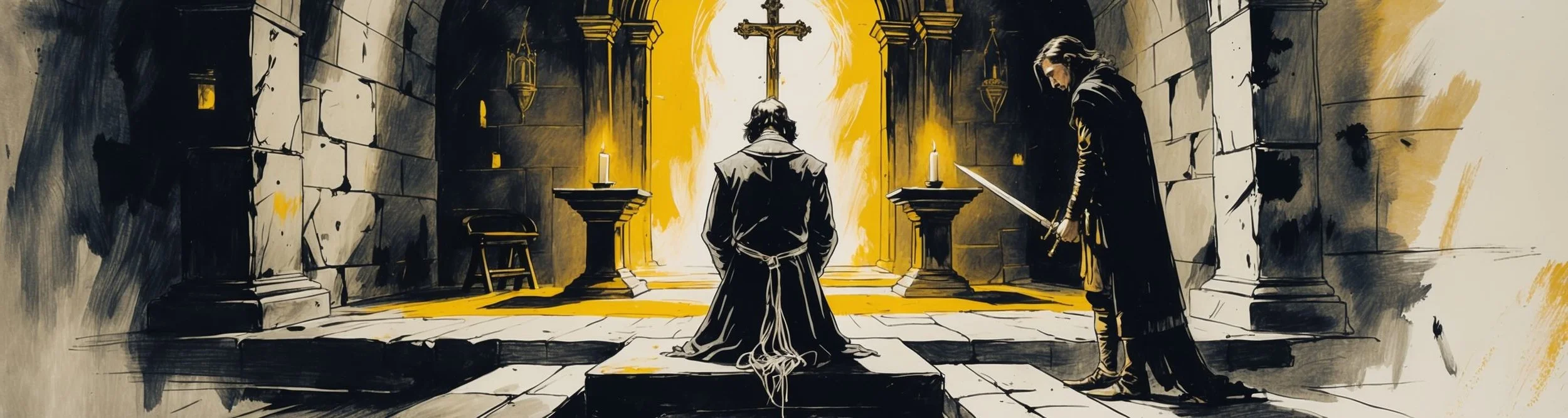
Hamlet enters and sees the king kneeling and defenceless. He draws his sword: here is the perfect chance to take his revenge. But he stops himself, reasoning that to kill Claudius while he is praying would send the king's soul to heaven, whereas his own father was murdered with all his sins upon him. Hamlet decides to wait for a moment when Claudius is sinning, so that his soul will be damned, and leaves.
Claudius rises, unaware how close he came to death. In a final couplet he confesses that his prayer was hollow: his words rose towards heaven, but his heart never followed them, so the prayer was worthless.
O, My Offence Is Rank
For the only time in the play, Claudius is alone with his conscience, and what pours out is genuine guilt. He knows exactly what he has done, and he reaches for the oldest crime in the Bible to describe it.
Original
O, my offence is rank it smells to heaven;
It hath the primal eldest curse upon't...
(Claudius, Act 3, Scene 3)
Shakespeare Retold (Modern Verse)
This crime of mine now stinks to highest heaven!
It's cursed like Cain who executed Abel...
The image of an offence so "rank" it "smells to heaven" ties Claudius to the play's running theme of disease and rot – his crime is a stench corrupting the whole kingdom. The "primal eldest curse" is the murder of Abel by his brother Cain, the first killing in the Bible. By naming it, Claudius admits his is exactly that sin: a brother's murder. The speech is important because it removes all doubt for the audience: the king is unmistakably guilty, and he knows it.
Now Might I Do It Pat
Hamlet arrives to find his enemy kneeling, helpless, with his back turned. It is the chance he has been waiting for, and for a moment he is ready to take it.
Original
Now might I do it pat, now he is praying;
And now I'll do't. And so he goes to heaven...
(Hamlet, Act 3, Scene 3)
Shakespeare Retold (Modern Verse)
So I could kill him now, but he is praying.
I'll do it now! And then he'll go to heaven...
"Pat" means neatly, conveniently – the perfect moment. But Hamlet talks himself out of it within a few lines. If he kills Claudius mid-prayer, with his sins confessed, the king's soul might go to heaven, while old King Hamlet was murdered unprepared and now suffers. To Hamlet, that would not be revenge but reward. So he sheathes his sword and waits. This is the play's most famous hesitation, and it has divided readers for centuries: is his reason sincere, or just one more excuse to avoid acting?
Words Without Thoughts
The scene's bitter irony is saved for the end. The whole reason Hamlet spares Claudius is that he believes the king is achieving a holy death through prayer. But Claudius reveals, the moment Hamlet has gone, that the prayer never worked at all.
Original
My words fly up, my thoughts remain below:
Words without thoughts never to heaven go.
(Claudius, Act 3, Scene 3)
Shakespeare Retold (Modern Verse)
I say my prayers, but thoughts still contravene them;
And God won't hear my words unless I mean them.
The dramatic irony is devastating. Claudius could not truly repent, so his soul was just as vulnerable as Hamlet wanted – had Hamlet struck, he would have got exactly the damning revenge he was waiting for. By hesitating to be sure of the king's damnation, Hamlet throws away his best chance and lets the tragedy roll on. The neat rhyming couplet seals the scene with a hard truth about prayer: words mean nothing without a sincere heart behind them.
Language and Technique
- Soliloquy and confession: Claudius's private prayer lets the audience hear his guilt directly, the only time he openly admits the murder.
- Biblical allusion: The "primal eldest curse" of Cain and Abel makes Claudius's crime the archetypal sin of brother killing brother.
- Imagery of rot: An offence that is "rank" and "smells to heaven" links the king's guilt to the play's disease imagery.
- Dramatic irony: Hamlet spares Claudius to ensure his damnation, just as Claudius reveals his prayer has failed – so the king is damned anyway.
- The rhyming couplet: The neat closing rhyme gives Claudius's confession the snap of a grim moral lesson about empty prayer.
Key Quotes from Act 3, Scene 3
Quote 1May one be pardoned and retain the offence?
(Claudius, Act 3, Scene 3)
Shakespeare Retold (Modern Verse)
Can I be pardoned and retain the bounty?
A villain kills my father; and for that,
I, his sole son, do this same villain send...
(Hamlet, Act 3, Scene 3)
Shakespeare Retold (Modern Verse)
A villain kills my father; in response,
Do I, his only son, then kill the villain...
Up, sword; and know thou a more horrid hent:
When he is drunk asleep, or in his rage...
(Hamlet, Act 3, Scene 3)
Shakespeare Retold (Modern Verse)
Stop, sword! Let's wait until a worse occasion,
Perhaps when he is drunk or full of rage...
Then trip him, that his heels may kick at heaven,
And that his soul may be as damned and black...
(Hamlet, Act 3, Scene 3)
Shakespeare Retold (Modern Verse)
I'll get him then, he'll kick and scream at heaven,
And that will curse him into vile damnation...
Key Takeaways
- Claudius confesses: Alone, the king admits he murdered his brother – the "primal eldest curse" of Cain.
- He cannot repent: Claudius will not give up his crown and queen, so his prayer is hollow.
- Hamlet's great missed chance: He could kill the kneeling king but refuses, fearing it would send him to heaven.
- A darker revenge: Hamlet wants to wait until Claudius is sinning so his soul will be damned.
- Bitter irony: The prayer never worked, so Hamlet sacrifices his best opportunity for nothing.
Study Questions and Analysis
What is Claudius praying for, and can he be forgiven?
Claudius is trying to pray for forgiveness for murdering his brother, and for the first time he openly admits the crime. But he runs into a wall. True repentance, in Christian belief, requires giving up the sin and its fruits, and Claudius is not willing to do that.
My crown, mine own ambition and my queen.
(Claudius, Act 3, Scene 3)
Shakespeare Retold (Modern Verse)
My crown, my own ambition and my queen.
He still holds the things the murder won him – the throne, the power he craved, and Gertrude – and he will not let them go. So, as he himself admits, he cannot be pardoned while he keeps the prize. The speech makes Claudius a genuinely tragic figure for a moment: he sees his own damnation clearly and is honest about it, but he is too attached to his rewards to save himself. It is a remarkably human portrait of a guilty conscience that wants forgiveness without sacrifice.
Why doesn't Hamlet kill Claudius when he has the chance?
Hamlet finds the king kneeling and undefended, and he draws his sword, ready to act. Then he reasons himself out of it. If he kills Claudius while he is praying, with his sins freshly confessed, the king might go to heaven. But his own father was murdered suddenly, without a chance to confess, and is now suffering for it. To send his father's murderer to heaven would, Hamlet decides, be a reward, not a revenge, so he resolves to wait for a moment when Claudius is sinning.
On the surface, this is a coherent reason. But it comes from a man who has already delayed for two acts, which is why so many readers suspect it is one more rationalisation. The scene is the strongest single piece of evidence in the "delay" debate, because here, uniquely, Hamlet has proof, opportunity and a clear path – and still does not strike. Whatever the true cause, the consequence is enormous: by sparing Claudius now, Hamlet allows everything that follows, including his own banishment and the deaths to come.
Is Hamlet's reason for sparing Claudius genuine or an excuse?
This is one of the most argued-over questions in the play. Taken at face value, Hamlet's reason is a serious one in his world: to send a soul to heaven by killing it at prayer would deny the dead father his proper revenge and even reward the killer. A man who believes deeply in the afterlife might genuinely hold back for this reason.
Yet many critics have doubted him. Samuel Johnson, in his 1765 edition of Shakespeare, found Hamlet's stated motive – the wish to damn Claudius's soul – "too horrible to be read or to be uttered", and suspected it masked something else. A. C. Bradley, in his 1904 Shakespearean Tragedy, argued that the real cause of Hamlet's failure to act is his melancholy and habit of overthinking, and that the religious reasoning is partly an unconscious excuse. The play deliberately leaves the matter open. What is certain is the irony: whatever Hamlet's true motive, the prayer he fears would save Claudius has in fact failed, so the reasoning is built on a false premise.
What is the dramatic irony at the end of the scene?
The irony is one of the cruellest in Shakespeare. Hamlet spares Claudius precisely because he believes the king is in a state of grace, praying his way towards heaven. But the moment Hamlet leaves, Claudius stands and admits that his prayer was empty – his words rose up but his heart, unwilling to give up his crimes, stayed below, so heaven heard nothing.
This means that if Hamlet had struck, he would have killed Claudius with an unrepented murder on his soul – exactly the damning revenge he was waiting for. By pausing to make sure of the king's damnation, Hamlet throws away the one chance that would have achieved it. The audience knows this; Hamlet never does. The scene is a masterpiece of construction: two soliloquies, two private confessions, and a tragic misunderstanding sitting between them, with the hero making the wrong choice for what seems like the right reason.
What does this scene reveal about Claudius?
This is the scene that makes Claudius more than a stock villain. Alone, with nothing to gain by pretending, he reveals a real and tormented conscience. He knows the enormity of what he has done, compares it to the first murder in history, and genuinely longs to be forgiven. He is not a man who feels nothing; he is a man who feels guilt and chooses his crimes anyway.
That choice is what damns him. Claudius understands the path to forgiveness exactly – confess, repent, give up the gains – and deliberately refuses the last step because he loves his crown and his queen too much. This makes him a genuinely tragic and human figure, closer to Macbeth than to a cartoon villain. It also raises the stakes of Hamlet's revenge: Claudius is intelligent, self-aware and dangerous, a worthy and frightening opponent rather than an easy target, which makes Hamlet's failure to kill him here all the more costly.
How does this scene develop the theme of revenge and justice?
The scene pushes the play's idea of revenge to a disturbing extreme. The Ghost asked Hamlet to avenge a murder; here Hamlet decides that simply killing Claudius is not enough – he wants to damn his soul for eternity, timing the murder to catch the king in sin. Revenge has expanded from punishing a crime to controlling an enemy's afterlife, which goes far beyond any earthly idea of justice.
This is where the play's revenge plot collides with Christian morality. Christianity teaches that vengeance and judgement belong to God, not to men, yet Hamlet is trying to play God with Claudius's soul. The scene quietly suggests that revenge of this kind is not justice at all but a kind of damnation in itself – for the avenger as much as his victim. It deepens the tragedy: in trying to make his revenge perfect and total, Hamlet loses the only clean chance he will ever have, and the cycle of killing rolls on towards the ruin of almost everyone in the play.