Hamlet: Act 3, Scene 2 – Analysis
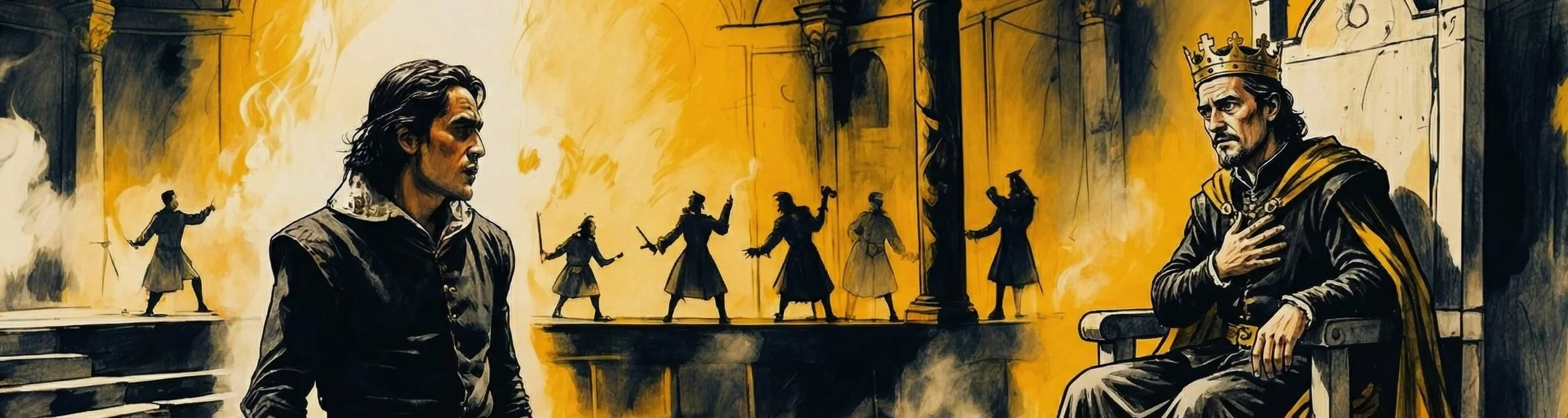
Scene Profile – At a Glance
- Location: A hall in Elsinore Castle, set up for a play.
- What Happens: Hamlet coaches the actors and asks Horatio to watch the king's face. The players perform "The Mousetrap", a murder like old King Hamlet's. Claudius leaps up in guilt and stops the play. Triumphant, Hamlet takes this as proof, mocks Rosencrantz and Guildenstern, and steels himself to confront his mother.
- Key Characters: Hamlet, Claudius, Gertrude, Horatio.
- Dramatic Function: The play-within-the-play is the turning point: it gives Hamlet proof of Claudius's guilt and openly pits the two against each other for the rest of the tragedy.
- Famous Quote:
"The lady doth protest too much, methinks."
(Gertrude, Act 3, Scene 2) - Why It Matters: Hamlet's "Mousetrap" catches the king's conscience and proves the Ghost told the truth, turning suspicion into certainty.
Scene Summary
Hamlet gives the visiting actors careful advice on how to perform, urging natural, controlled acting rather than ranting. He then takes Horatio aside and asks him to watch Claudius closely during the play, so that between them they can judge whether the king's face betrays guilt.
The court gathers. Hamlet, restless and barbed, jokes with Ophelia and the others. The actors perform "The Mousetrap", a play in which a man pours poison into a sleeping king's ear and woos his widow – exactly the crime the Ghost described. Hamlet provides a running commentary, growing more pointed as the murder approaches.
When the poisoner pours the poison, Claudius rises in a fury, calls for light, and rushes out, stopping the play. To Hamlet and Horatio this is the proof they wanted: the king's guilt is real, and the Ghost was honest. Hamlet is wildly elated.
Rosencrantz and Guildenstern arrive with a message that the king is furious and the queen wants to see Hamlet. Hamlet toys with them, using a recorder to show that they are trying to "play" him like an instrument. Alone at last, he braces himself, in dark and violent language, to go and speak harshly to his mother – but to wound her only with words.
Hold the Mirror Up to Nature
The scene opens with Hamlet, the play's great lover of theatre, instructing the actors. His advice is a small manifesto on acting: be natural, be controlled, do not overdo it. The aim of acting, he says, is to "hold the mirror up to nature" – to show life truly.
Original
Speak the speech, I pray you, as I pronounced it to you, trippingly on the tongue...
(Hamlet, Act 3, Scene 2)
Shakespeare Retold (Modern Verse)
Now, please, perform the speech just like I did, quite naturally...
The advice matters because it describes what Hamlet is about to do. He believes a play can mirror reality so accurately that it forces the truth out of those watching. His whole plan rests on theatre's power to reflect life back at people and pierce their consciences. There is irony, too, in this man who lectures actors on sincerity while himself wearing the mask of madness – in this court, even the truth must be staged.
The Mousetrap
The play Hamlet has chosen mirrors the murder of his father. As the on-stage poisoner kills a sleeping king and courts his widow, Hamlet watches Claudius, and needles the court with sharp commentary. When his mother remarks on the Player Queen's loud vows of eternal love, the line cuts close to home.
Original
The lady doth protest too much, methinks.
(Gertrude, Act 3, Scene 2)
Shakespeare Retold (Modern Verse)
I think the lady witters on too much.
Gertrude means that the Player Queen overdoes her promises never to remarry, and the line has become a famous everyday phrase for protesting so loudly that you seem to be hiding the opposite. It is also pointed: Hamlet is using the play to confront his mother with her own hasty remarriage, and her comment shows she does not yet see herself in the mirror he is holding up. The whole "Mousetrap" works by making the watchers see their own crimes acted out before them.
"Give Me Some Light"
The trap snaps shut at the moment of the on-stage poisoning. Claudius can bear no more. He springs up, demands light, and storms out, breaking up the performance in front of the whole court.
Original
Give me some light: away!
(Claudius, Act 3, Scene 2)
Shakespeare Retold (Modern Verse)
Turn up the lights: I'm leaving!
The cry for "light" is loaded with meaning. A guilty man who has lived in darkness suddenly cannot bear to watch his own crime re-enacted and flees towards the light. For Hamlet, this is everything: the king's reaction is the proof he needed that the Ghost spoke the truth and that Claudius is the murderer. The careful, doubting prince finally has his evidence. From this moment the secret war between Hamlet and Claudius becomes open and deadly.
The Witching Time of Night
Left alone after his triumph, Hamlet's mood darkens into something frightening. Summoned to his mother, he feels capable of terrible things, and has to remind himself of the Ghost's order not to harm her.
Original
Tis now the very witching time of night,
When churchyards yawn and hell itself breathes out...
(Hamlet, Act 3, Scene 2)
Shakespeare Retold (Modern Verse)
It's now the time of night when witches rise,
And graveyards open with the breath of hell...
Proof of the murder has not calmed Hamlet; it has unleashed a darker self. He imagines he could "drink hot blood", and pictures himself capable of monstrous cruelty. The danger is that, in this state, he might kill his mother, so he deliberately reins himself in, resolving to "speak daggers to her, but use none". The speech shows revenge curdling into something violent and almost demonic, and Hamlet's fight to keep it within the limits the Ghost set.
Language and Technique
- Play-within-a-play: The staged murder mirrors the real one, so theatre itself becomes a weapon for forcing out hidden truth.
- Dramatic irony: The audience knows the "Mousetrap" is a trap; we watch Claudius walk into it while the court does not understand what is happening.
- Imagery of light and dark: Claudius's panicked cry for "light" exposes the guilt he has kept in the dark, linking truth with illumination.
- Extended metaphor of music: Hamlet uses a recorder to show Rosencrantz and Guildenstern that they cannot "play upon" him as if he were an instrument.
- Gothic imagery: "Churchyards yawn", "hell breathes out" and "drink hot blood" give Hamlet's resolve a dark, supernatural charge.
Key Quotes from Act 3, Scene 2
Quote 1Observe mine uncle: if his occulted guilt
Do not itself unkennel in one speech...
(Hamlet, Act 3, Scene 2)
Shakespeare Retold (Modern Verse)
To watch my uncle. If his hidden guilt
Does not reveal itself within that speech...
O good Horatio, I'll take the ghost's word for a thousand pound.
(Hamlet, Act 3, Scene 2)
Shakespeare Retold (Modern Verse)
My dear Horatio, the ghost was right – I'll bet a thousand pounds!
Let me be cruel, not unnatural:
I will speak daggers to her, but use none...
(Hamlet, Act 3, Scene 2)
Shakespeare Retold (Modern Verse)
Let me be cruel, but not be inhumane:
I'll talk with daggers to her, but won't use one...
The lady doth protest too much, methinks.
(Gertrude, Act 3, Scene 2)
Shakespeare Retold (Modern Verse)
I think the lady witters on too much.
Key Takeaways
- The trap works: The play-within-a-play makes Claudius betray his guilt by rising and fleeing.
- Hamlet gets his proof: The king's reaction convinces Hamlet and Horatio that the Ghost told the truth.
- Theatre reveals truth: Hamlet uses acting – "the mirror up to nature" – to expose a real crime.
- The conflict turns open: After this, Hamlet and Claudius are openly dangerous to each other.
- A darker Hamlet: Elated and violent, he steels himself to confront his mother with words, not weapons.
Study Questions and Analysis
What is "The Mousetrap" and why does Hamlet stage it?
"The Mousetrap" is Hamlet's nickname for the play he has the actors perform, "The Murder of Gonzago", reshaped to mirror his father's murder: a man pours poison into a sleeping king's ear and then woos the widow. Hamlet stages it to test the Ghost's story. If Claudius really is the murderer, watching his own crime acted out should startle his conscience into some visible sign of guilt.
The plan reveals Hamlet's caution and his cleverness. Rather than kill the king on the word of a ghost that might be a devil, he insists on independent proof. It also shows his faith in the power of theatre. The strategy works perfectly: Claudius cracks and flees. The "Mousetrap" is the hinge of the whole play, the moment suspicion becomes certainty, and it is fitting that the most famously indecisive hero in literature acts decisively here through a play rather than a sword.
What does Hamlet's advice to the players reveal?
Hamlet tells the actors to perform naturally and with control, to "suit the action to the word, the word to the action", and never to "tear a passion to tatters" with ranting. Most famously, he says the purpose of acting is to "hold the mirror up to nature" – to reflect real life truthfully. The speech reads almost like Shakespeare's own thoughts on his craft, slipped into the play.
It also reveals Hamlet's whole strategy. He believes a play, done right, can reflect reality so exactly that it forces the watcher to confront the truth, which is precisely what he is about to do to Claudius. There is rich irony here as well: Hamlet praises honesty and naturalness in performance while he himself is constantly performing – pretending to be mad, playing the careless joker. In a court built on false shows, theatre becomes, paradoxically, the one place where the truth can be told.
How does Claudius react to the play, and what does it prove?
As the on-stage poisoner kills the sleeping king, Claudius can no longer contain himself. He rises, calls for light, and rushes from the room, breaking up the performance in front of the entire court. It is a dramatic, public collapse of his composure, and it is exactly the reaction Hamlet hoped for.
To Hamlet and Horatio, this proves two things: that Claudius is guilty of the murder, and that the Ghost was telling the truth rather than tempting Hamlet with a lie. The careful test has paid off. Yet the proof is, strictly, ambiguous – a king might be disturbed by watching a kinsman murdered on stage even if innocent – which is why Hamlet wanted a second witness in Horatio. The pair are convinced, and the play treats Claudius's guilt as settled from this point. His flight is the public turning point after which the conflict can no longer stay hidden.
What does "The lady doth protest too much" mean?
Gertrude says this about the Player Queen, who vows again and again that she would never remarry if her husband died. "Protest" in Shakespeare's English means to declare or promise, so Gertrude is observing that the Player Queen promises so insistently that the promise seems hollow – she "doth protest too much". Over time the phrase has come to mean that someone who denies something too strongly may be hiding the truth.
The line is layered with irony. Hamlet has crafted the play partly to confront his mother with her own quick remarriage, yet Gertrude criticises the fictional widow without recognising herself. She judges the Player Queen for exactly the fault Hamlet sees in her. It is a quiet but devastating moment: the "mirror" of the play is held up to Gertrude, and she looks straight past her own reflection, which is part of why Hamlet feels he must confront her directly in the scene that follows.
Why does Hamlet admire Horatio so much?
Just before the play, Hamlet pays Horatio a heartfelt tribute, praising him as a man who is "not passion's slave" – someone who keeps a steady mind whether fortune treats him well or badly. In a court ruled by ambition, flattery and fear, Horatio's calm balance and honesty make him precious to Hamlet, and he says he would wear such a man in his "heart's core".
The admiration is revealing because Horatio is everything Hamlet is not. Where Hamlet is swept by violent feeling, doubt and self-disgust, Horatio is level and reliable. That is exactly why Hamlet trusts him to watch the king impartially during the play, and why, at the very end, he begs Horatio to live and tell his story. The tribute also highlights Hamlet's own torment: he can see and love the steadiness he lacks, but he cannot achieve it. Horatio is the still point around which Hamlet's storm turns.
What is the point of the recorders scene?
After the play, Rosencrantz and Guildenstern come to question Hamlet on the king's behalf. Hamlet picks up a recorder (a simple flute) and invites Guildenstern to play it. When Guildenstern protests that he cannot, Hamlet pounces: how dare they think they can "play upon" him – sound out his secrets and manipulate his moods – when they cannot even play a simple pipe?
It is one of Hamlet's sharpest moments. He has fully seen through his old friends and tells them, in effect, that he knows they are the king's tools. The metaphor of a person as a musical instrument captures the play's obsession with people being used and manipulated. Hamlet insists he has depths they cannot reach: "you cannot play upon me." The scene shows his quick intelligence and his growing isolation – he can no longer trust anyone but Horatio – and it hardens his contempt for Rosencrantz and Guildenstern, which makes his later cold treatment of them easier to understand.
Why doesn't Hamlet kill Claudius now that he has proof?
This is one of the play's central puzzles. Hamlet has exactly what he wanted – clear evidence that Claudius is guilty – yet instead of seizing the moment to strike, he goes off to confront his mother and lets the chance pass. The very next scene gives him a perfect opportunity to kill the king at prayer, and he hesitates again.
Critics have offered many explanations. A. C. Bradley, in his 1904 Shakespearean Tragedy, saw a deep melancholy paralysing Hamlet's will even when the path is clear. G. Wilson Knight, in The Wheel of Fire (1930), read Hamlet as a man so possessed by death and disgust that he spreads destruction rather than clean justice. Others note that Hamlet, having proved the truth, becomes caught up in his fury at his mother instead. Whatever the cause, the gap between proof and action here is the heart of the "Hamlet problem": certainty, in this play, does not produce a deed, and the delay drives the tragedy onward to its bloody end.
How does this scene explore appearance versus reality?
The scene turns the theme inside out. Throughout the play, false appearances hide the truth – a smiling king is a murderer, friends are spies. Here, for once, a deliberate piece of pretence is used to expose reality. Hamlet stages a fiction, a play with actors, precisely in order to drag the real, hidden crime into the open. Theatre, the home of make-believe, becomes the instrument of truth.
At the same time, the scene is thick with performance. Hamlet performs madness and careless wit; Claudius performs the calm host until he cracks; the court watches a play while being, themselves, watched by Hamlet and Horatio. Everyone is acting and observing at once. The genius of the "Mousetrap" is that it uses the very thing the court is built on – show, performance, watching – against the man at its centre. In a world where nothing can be taken at face value, Hamlet finds the truth not by stripping away the show but by staging a better one.