Hamlet: Act 3, Scene 1 – Analysis
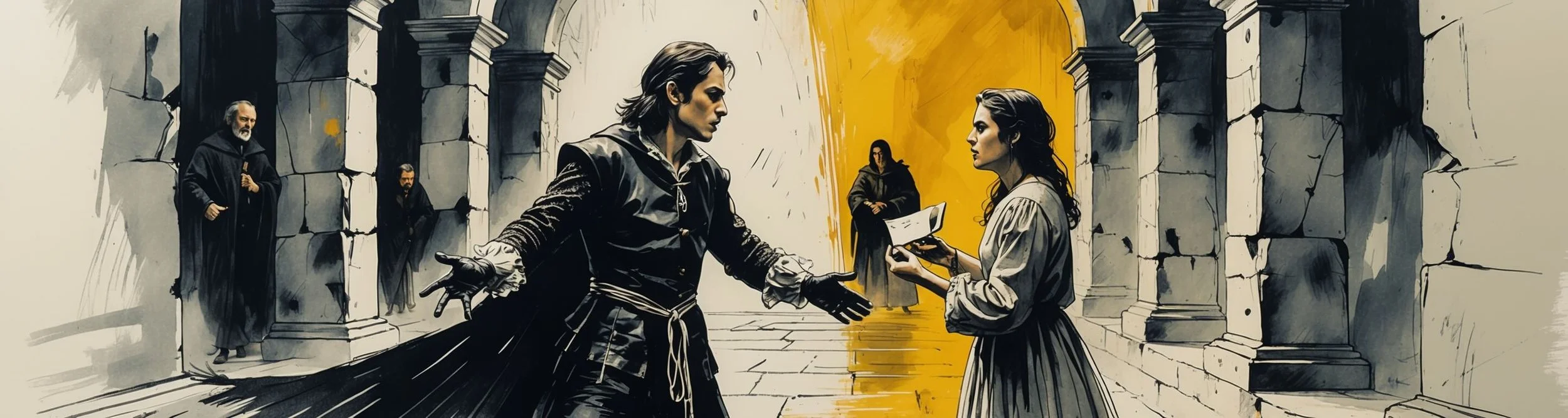
Scene Profile – At a Glance
- Location: A hall in Elsinore Castle, where the king and Polonius set their trap.
- What Happens: Claudius and Polonius hide to watch Hamlet meet Ophelia. Alone first, Hamlet delivers the "To be, or not to be" soliloquy. He then turns on Ophelia, denies he ever loved her, and tells her to "get thee to a nunnery". Claudius, unconvinced it is love, decides to send Hamlet to England.
- Key Characters: Hamlet, Ophelia, Claudius, Polonius.
- Dramatic Function: The scene holds the play's most famous soliloquy and the cruel "nunnery" confrontation, deepening Hamlet's despair and pushing Ophelia towards her breakdown.
- Famous Quote:
"To be, or not to be, that is the question."
(Hamlet, Act 3, Scene 1) - Why It Matters: "To be, or not to be" is the most famous speech in English drama, and the nunnery scene shows Hamlet's despair spilling cruelly onto Ophelia.
Scene Summary
Rosencrantz and Guildenstern report that they have learned nothing useful from Hamlet, though he is interested in the visiting players. Claudius and Polonius then put their plan into action: they place Ophelia where Hamlet will meet her, with a prayer book in her hands, and hide to watch.
Hamlet enters, alone as he thinks, and speaks the "To be, or not to be" soliloquy, weighing life against death and wondering whether it is better to endure suffering or to end it. He concludes that the fear of what may come after death – the "undiscovered country" – is what makes people put up with the pains of life, and that too much thinking robs us of the will to act.
Ophelia approaches to return his old love-letters. Hamlet, who may sense he is being watched, turns on her with sudden cruelty. He denies ever loving her, attacks women and marriage, and repeatedly orders her to "get thee to a nunnery", before storming off. Ophelia, devastated, mourns the noble mind she believes has been destroyed.
Claudius and Polonius come out of hiding. The king is not convinced that love is the cause of Hamlet's behaviour; he senses something more dangerous brewing, and decides to send Hamlet away to England. Polonius still clings to his love theory and proposes one more test: let the queen try to draw Hamlet out after the play.
To Be, or Not to Be
Believing himself alone, Hamlet opens the most famous speech in all of drama. It is not really about his revenge at all; it is a wider, almost philosophical meditation on whether life is worth living, and on why human beings go on suffering rather than ending it.
Original
To be, or not to be, that is the question.
Whether 'tis nobler in the mind to suffer
The slings and arrows of outrageous fortune...
(Hamlet, Act 3, Scene 1)
Shakespeare Retold (Modern Verse)
Shall I live on, or take my life? I wonder.
Would I find greater honour if I suffered
The stinging pain wrought by my wretched luck...
The question "to be, or not to be" is whether to go on living or to die. Hamlet weighs simply enduring life's pains against taking "arms" to end them, perhaps by suicide. What makes the speech so powerful is its calm, reasoning tone: this is not a wild outburst but a man quietly, carefully thinking about whether existence is worth the trouble. It speaks to anyone who has ever felt crushed by life, which is why it has lasted for four centuries.
The Dread of Something After Death
Hamlet decides that the reason people endure suffering instead of ending it is fear of the unknown that lies beyond death. Death might be sleep – but it might bring dreams, or something worse, and no one has ever come back to tell us.
Original
But that the dread of something after death,
The undiscovered country from whose bourn
No traveller returns...
(Hamlet, Act 3, Scene 1)
Shakespeare Retold (Modern Verse)
Unless it was in fear of worse in death,
An undiscovered country from whose border
No traveller returns...
The "undiscovered country" is one of literature's great images of death: a land no one has explored and from which no traveller comes home. This fear of the afterlife is also deeply tied to the play's earlier scenes, because Hamlet has just seen a traveller seemingly return – the Ghost. The mystery of what waits after death haunts the whole tragedy, and here it becomes the reason human beings cling to a life that hurts them.
Conscience Does Make Cowards
The soliloquy ends with a thought that reaches to the very heart of the play. Hamlet concludes that thinking too much about consequences drains away the courage to act, turning bold plans into nothing.
Original
Thus conscience does make cowards of us all;
And thus the native hue of resolution
Is sicklied o'er with the pale cast of thought...
(Hamlet, Act 3, Scene 1)
Shakespeare Retold (Modern Verse)
And so, awareness turns us into cowards;
And thus our natural drive to solve a problem
Recedes and fades through over-contemplation...
This is almost a self-diagnosis. The "native hue of resolution" – the natural colour of a firm decision – is made pale and sickly by too much thought. Here Hamlet describes exactly his own problem: a mind so busy weighing every angle that it cannot move to action. The image of healthy resolve being made "sick" by thinking also fits the play's web of disease imagery. Thought, Hamlet's greatest gift, is also the thing that paralyses him.
"Get Thee to a Nunnery"
When Ophelia appears to return his letters, Hamlet's mood turns savage. He denies ever loving her, mocks women and marriage, and drives her away with a phrase he repeats again and again.
Original
Get thee to a nunnery: why wouldst thou be a breeder of sinners?
(Hamlet, Act 3, Scene 1)
Shakespeare Retold (Modern Verse)
Resettle in a convent! Why become a mother of more sinners?
Hamlet tells Ophelia to enter a convent so she will never marry or have children, sparing the world more "sinners". The cruelty is shocking, and its causes are tangled: his disgust at his mother, his sense that all women are false, and perhaps a suspicion that Ophelia is part of the trap being set for him. "Nunnery" may also carry a coarse slang meaning of "brothel", making the insult sharper still. Whatever drives it, the scene is a turning point for Ophelia: the man she loved publicly rejects and humiliates her, and her slide towards madness begins here.
Language and Technique
- Soliloquy as argument: "To be, or not to be" is structured like a calm debate, weighing one side against the other, which makes its subject – suicide and suffering – feel reasoned rather than wild.
- Extended metaphor of death: Death as sleep, as a dream, and as an "undiscovered country" gives the unknown a series of vivid, fearful shapes.
- Imagery of sickness: Resolution "sicklied o'er with the pale cast of thought" pictures thinking itself as a disease that drains the colour from action.
- Repetition: Hamlet's drum-beat "Get thee to a nunnery" hammers his rejection of Ophelia and of marriage into her, and into the audience.
- Dramatic irony: Hamlet and Ophelia speak while the king and her father secretly listen, so every word is performed for hidden watchers.
Key Quotes from Act 3, Scene 1
Quote 1And makes us rather bear those ills we have
Than fly to others that we know not of?
(Hamlet, Act 3, Scene 1)
Shakespeare Retold (Modern Verse)
Concluding that we'd rather bear the pain
We know of than of that that we do not?
O, what a noble mind is here o'erthrown!
The courtier's, soldier's, scholar's, eye, tongue, sword...
(Ophelia, Act 3, Scene 1)
Shakespeare Retold (Modern Verse)
Oh no, his gracious mind is now bewitched,
Confusing strengths of prince, soldier and scholar!
I did love you once.
(Hamlet, Act 3, Scene 1)
Shakespeare Retold (Modern Verse)
I loved you once.
We are arrant knaves, all; believe none of us.
(Hamlet, Act 3, Scene 1)
Shakespeare Retold (Modern Verse)
Utter scoundrels, discredited.
Madness in great ones must not unwatched go.
(Claudius, Act 3, Scene 1)
Shakespeare Retold (Modern Verse)
Great folk, when mad, must not be left alone.
Key Takeaways
- The play's most famous speech: "To be, or not to be" weighs life against death and asks whether existence is worth its suffering.
- Thought versus action: Hamlet concludes that "conscience" – too much thinking – makes cowards of us and kills our resolve.
- Cruelty to Ophelia: Hamlet denies his love and drives her away with "get thee to a nunnery", beginning her tragedy.
- A trap is sprung: Claudius and Polonius spy on the meeting, and Hamlet may sense he is being watched.
- Claudius grows wary: Unconvinced it is love, the king decides Hamlet is dangerous and must be sent to England.
Study Questions and Analysis
What is "To be, or not to be" actually about?
The speech is a meditation on whether life is worth living. "To be, or not to be" means, at its simplest, "to live or to die". Hamlet weighs two options: passively suffering "the slings and arrows of outrageous fortune", or actively ending that suffering – which, for a single person, means suicide. He then asks what death really is, and fears it may be not peaceful sleep but troubled dreams, or something worse.
Importantly, the soliloquy is general rather than personal. Hamlet speaks of "us" and "we", not "I", turning his private despair into a question about all human existence. He never mentions his revenge or Claudius directly. This is part of what makes the speech so universal: it is less the cry of one prince than a clear-eyed examination of why anyone goes on living in the face of pain. That universality is exactly why it has become the most quoted passage in English literature.
What does "conscience does make cowards of us all" mean?
Here "conscience" means something close to consciousness or awareness – the habit of thinking ahead and weighing consequences. Hamlet's point is that this very thoughtfulness is what stops people acting boldly. We imagine all the things that could go wrong, especially after death, and the fear this breeds drains away our courage. Firm resolve is "sicklied o'er with the pale cast of thought".
The line is often read as Hamlet's diagnosis of his own delay. He is the great thinker of literature, and his endless reflection is exactly what keeps him from killing Claudius. The idea links directly to the play's theme of action versus inaction. Where a simple revenger like Laertes or Fortinbras would strike at once, Hamlet thinks, and thinking unmans him. Whether this is a flaw or a kind of wisdom is one of the play's deepest questions, and the soliloquy leaves it open.
How does this soliloquy connect to the theme of action versus inaction?
The soliloquy is the clearest statement of the play's central tension. Hamlet has been charged with a decisive act – killing the king – yet here, at the play's midpoint, he is found not plotting revenge but contemplating death and the paralysis caused by thought. The speech essentially explains why he keeps failing to act: the more he thinks, the weaker his resolve becomes.
Critics have debated this delay for centuries. A. C. Bradley, in his 1904 Shakespearean Tragedy, traced it to a profound melancholy that saps Hamlet's will, while Coleridge, in his 1818 lectures, saw Hamlet as a man with "an overbalance of the imaginative" – so absorbed in thought that he loses the power to act. Both readings find their proof here. The genius of the speech is that it makes inaction itself dramatic: nothing happens on stage, yet we watch a mind talk itself out of every decisive move, which is the engine of the whole tragedy.
Why is Hamlet so cruel to Ophelia in this scene?
Hamlet's cruelty has several possible sources, and the play deliberately leaves them tangled. His disgust at his mother's hasty remarriage has soured his view of all women, so Ophelia suffers for Gertrude's perceived sins. He may also suspect, or sense, that Ophelia is being used as bait by her father and the king – and if he knows he is being watched, his attack is partly aimed at the listeners. There may even be a twisted attempt at protection: by making Ophelia hate him, he frees her from a doomed and dangerous love.
Whatever the cause, the effect on Ophelia is devastating. She has obeyed her father, returned Hamlet's gifts, and now finds the man she loves denying he ever cared and publicly shaming her. Elaine Showalter, in her 1985 essay Representing Ophelia, argued that Ophelia is given almost no power to shape her own fate; she is acted upon by the men around her until she breaks. This scene is the cruellest of those blows, and her grieving speech afterwards shows a loving heart wounded past healing. The nunnery scene is where Ophelia's tragedy truly begins.
Does Hamlet know he is being watched?
The play never settles this, and productions choose differently. There is no stage direction telling us Hamlet spots the hidden king and Polonius, but his behaviour gives strong hints. In the middle of attacking Ophelia he suddenly demands to know where her father is, and when she lies – "At home, my lord" – his cruelty seems to sharpen.
Where's your father?
(Hamlet, Act 3, Scene 1)
Shakespeare Retold (Modern Verse)
Where's your father?
Many readers take this sudden question as the moment Hamlet realises he is being spied on and that Ophelia is part of the trap. If so, his rage is partly performance for the eavesdroppers and partly genuine hurt that Ophelia would deceive him. Other productions play it as a wild outburst of paranoia. Either way, the uncertainty deepens the scene's power: we can never be sure how much of Hamlet's cruelty is calculated and how much is real, which is true of his "madness" throughout the play.
What does "Get thee to a nunnery" mean?
On the surface, Hamlet is telling Ophelia to enter a convent so that she will never marry or have children, and so will not bring more "sinners" into a corrupt world. It fits his bleak mood: he has decided that humanity is rotten and that breeding only multiplies the rottenness. Sending Ophelia to a nunnery would keep her "pure" and remove her from the dirty business of marriage and sex that now disgusts him.
There is also a harsher reading. "Nunnery" was sometimes used as slang for a brothel, so the command can carry a sneering double meaning, accusing Ophelia of falseness. Most likely Shakespeare wants both senses to hover: the idealistic wish to protect her and the cruel insult, side by side. The repetition of the phrase – Hamlet says it five times – turns it into a kind of weapon, beating Ophelia back and shutting down any possibility of love between them. It is the formal end of their relationship and a key step in her destruction.
How does this scene develop the theme of appearance versus reality?
The whole scene is built on spying and pretence. Claudius and Polonius hide to watch a meeting they have staged, using Ophelia and a prayer book as props. Ophelia pretends she has simply come to return Hamlet's letters, when in fact she is bait. Hamlet, in turn, may be performing his madness and cruelty for the hidden audience he suspects is there. Almost no one in the scene is being straightforward.
This layering of watchers and performers is the play's appearance-versus-reality theme at its most intense. Even the great soliloquy is, unknown to Hamlet, being overheard. Claudius's response to the eavesdropping is telling: where Polonius still believes the comforting "appearance" of lovesickness, the king sees a dangerous "reality" beneath it. The scene shows how, in Elsinore, every private moment is liable to be a staged one, and how the constant watching corrodes trust until honest feeling – like the love between Hamlet and Ophelia – cannot survive.