Hamlet: Act 2, Scene 2 – Analysis
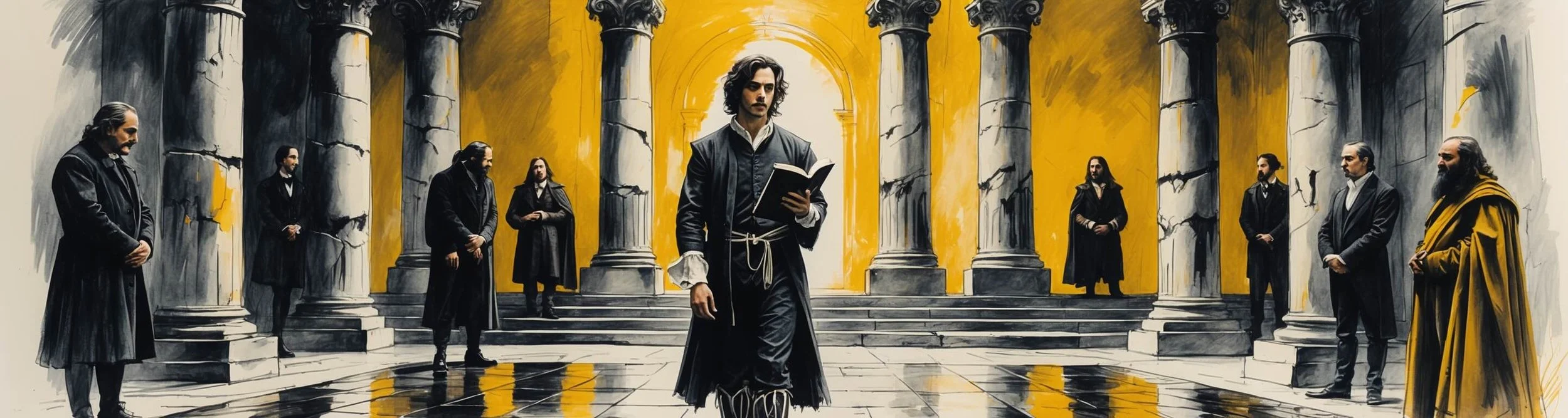
Scene Profile – At a Glance
- Location: A state room in Elsinore Castle.
- What Happens: Claudius sets Rosencrantz and Guildenstern to spy on Hamlet. Polonius announces that love has made Hamlet mad and plans to test the theory. Hamlet mocks Polonius and his old friends, welcomes a troupe of actors, and, alone, resolves to use a play to trap Claudius into revealing his guilt.
- Key Characters: Hamlet, Claudius, Polonius, Rosencrantz and Guildenstern.
- Dramatic Function: The play's longest scene gathers the spies around Hamlet, shows his wit and his despair, and ends with the plan that will drive Act 3 – the play-within-a-play.
- Famous Quote:
"What a piece of work is a man! How noble in reason!"
(Hamlet, Act 2, Scene 2) - Why It Matters: It contains some of Hamlet's most famous speeches and the turning point of the plot: his decision to catch "the conscience of the king".
Scene Summary
Claudius and Gertrude welcome Rosencrantz and Guildenstern, two of Hamlet's old school friends, and ask them to spend time with the prince and find out what is troubling him. The two agree at once to spy on their friend for the king. Meanwhile the ambassadors return from Norway with news that young Fortinbras has been redirected against Poland and asks only for safe passage through Denmark.
Polonius then arrives, sure he has found the cause of Hamlet's madness: love for Ophelia. After a long-winded speech, he reads out a love letter from Hamlet and proposes a test: he will set Ophelia in Hamlet's path and let the king eavesdrop. When Hamlet enters, Polonius tries to talk to him and is mocked and baffled, though he notices a strange sense behind the prince's nonsense.
Rosencrantz and Guildenstern try their luck next, but Hamlet quickly works out that they were sent for. He speaks to them of his black mood, calling Denmark a prison and the world a sterile place, and delivers his great meditation on the glory and emptiness of mankind. A troupe of travelling actors arrives, and Hamlet, delighted, asks one of them to perform a passionate speech about the fall of Troy and the grief of Queen Hecuba.
Left alone, Hamlet is ashamed: an actor can weep real tears for a made-up queen, while he, with real cause, does nothing. He curses himself for his inaction, then seizes on an idea. The actors will perform a play that mirrors his father's murder, and Hamlet will watch Claudius's face. If the king flinches, the Ghost's story is true. "The play's the thing," he concludes, "wherein I'll catch the conscience of the king."
Spies and Schemers
The scene is full of plots against Hamlet. The king turns his school friends into informers, and Polonius bustles in with his own theory, delivered in his usual roundabout style until even the queen loses patience. His verdict is delivered with comic self-importance.
Original
Therefore, since brevity is the soul of wit,
And tediousness the limbs and outward flourishes,
I will be brief: your noble son is mad...
(Polonius, Act 2, Scene 2)
Shakespeare Retold (Modern Verse)
And so – since briefness is the root of wisdom,
And grand flamboyant gestures rather dull –
I will be brief: your noble son is mad.
The joke is that Polonius praises "brevity" in the middle of an endlessly wordy speech. He is the opposite of brief, and the gap between his advice and his behaviour is pure comedy – the same hypocrisy we saw when he preached "to thine ownself be true". But the scheming is serious: between the king's spies and Polonius's eavesdropping plan, Hamlet is now surrounded by watchers, and the rest of the play tightens this net around him.
Method in His Madness
When Hamlet appears, he runs rings around Polonius, pretending not to recognise him and answering every question with mad-sounding riddles. Yet Polonius, for all his foolishness, senses that the nonsense is not quite nonsense.
Original
Though this be madness, yet there is method in 't.
(Polonius, Act 2, Scene 2)
Shakespeare Retold (Modern Verse)
It seems as though there's method in his madness.
This is the source of the everyday phrase "method in his madness". It captures the whole puzzle of Hamlet's behaviour: his wild talk has a hidden logic and purpose. Hamlet uses the licence of the "madman" to insult Polonius to his face and speak dangerous truths without being held to account. Polonius half-grasps this, which makes him both a fool and, occasionally, a shrewd observer – and it keeps alive the play's question of how much of Hamlet's madness is performance.
"What a Piece of Work Is a Man"
With Rosencrantz and Guildenstern, Hamlet drops the riddles and speaks something closer to his heart, describing how joyless the world has become for him. The speech rises to a glorious description of humanity, then collapses into disgust.
Original
What a piece of work is a man! How noble in reason! how infinite in faculty! In form and moving how express and admirable! In action how like an angel!
(Hamlet, Act 2, Scene 2)
Shakespeare Retold (Modern Verse)
A man is so miraculous, and noble, intelligent, and graceful as he moves! His actions make him look just like an angel!
Hamlet praises mankind as the height of creation – god-like in mind, angelic in action – and then, in the same breath, dismisses it all: man is no more to him than "this quintessence of dust". The speech is the play in miniature. Hamlet can still see how wonderful life and humanity ought to be, but his grief and disgust have drained the joy from all of it. It is depression described with painful clarity: knowing the world is beautiful and feeling nothing for it.
O, What a Rogue and Peasant Slave
The actor's passionate speech about Hecuba leaves Hamlet alone and ashamed. The player wept real tears over an imaginary grief; Hamlet, with a murdered father to avenge, has done nothing but talk. He turns on himself with savage contempt.
Original
O, what a rogue and peasant slave am I!
(Hamlet, Act 2, Scene 2)
Shakespeare Retold (Modern Verse)
Oh, what a vagrant waste of space I am.
This is the first of Hamlet's great self-accusing soliloquies, and it puts his delay at the centre of the play. He cannot understand why an actor can summon storms of feeling for a fiction while he, who has every reason to act, stays frozen. He lashes himself as a coward and a "muddy-mettled rascal". The speech is important because it shows Hamlet himself does not know why he hesitates – the mystery of his inaction is felt as keenly by him as by us.
The Play's the Thing
Out of this storm of self-disgust, Hamlet pulls a plan. He has been struck by how powerfully a play can move people, and he decides to turn that power into a trap. He will have the actors stage a murder like his father's and watch the king closely.
Original
the play 's the thing
Wherein I'll catch the conscience of the king.
(Hamlet, Act 2, Scene 2)
Shakespeare Retold (Modern Verse)
the play's the thing
Wherein I'll catch the conscience of the king.
This is the turning point of the scene and the engine of Act 3. Crucially, the plan also shows Hamlet's caution and intelligence: he does not simply trust the Ghost and strike, but seeks hard proof, because the Ghost might be a devil. The rhyming couplet gives his decision a ringing, theatrical confidence. He will use art – a performance – to expose a truth, fighting the false "show" of Claudius's court with a show of his own.
Language and Technique
- Prose for madness and wit: Hamlet's clever, mocking exchanges with Polonius and his friends are in prose, while his private soliloquy returns to verse, marking the shift from performance to true feeling.
- Bathos: "What a piece of work is a man" soars in praise of humanity and then crashes to "this quintessence of dust", mirroring Hamlet's swing from wonder to despair.
- Dramatic irony: The audience knows Rosencrantz and Guildenstern are spies before Hamlet says so, so we watch him work it out and admire his sharpness.
- The play-within-a-play: Hamlet plans to use theatre to reveal reality, turning "acting" into a tool for exposing the truth in a court built on pretence.
- Self-questioning: The soliloquy's rush of furious questions – "Am I a coward?" – dramatises a mind turning violently against itself.
Key Quotes from Act 2, Scene 2
Quote 1More matter, with less art.
(Gertrude, Act 2, Scene 2)
Shakespeare Retold (Modern Verse)
Quit using flowery language.
Excellent well; you are a fishmonger.
(Hamlet, Act 2, Scene 2)
Shakespeare Retold (Modern Verse)
Yes, very well: you are a fishmonger.
Ay, sir; to be honest, as this world goes, is to be one man picked out of ten thousand.
(Hamlet, Act 2, Scene 2)
Shakespeare Retold (Modern Verse)
Yes, sir! For being decent in this world means you're the only one in ten thousand.
Denmark's a prison.
(Hamlet, Act 2, Scene 2)
Shakespeare Retold (Modern Verse)
Denmark's a prison.
A dull and muddy-mettled rascal, peak,
Like John-a-dreams, unpregnant of my cause,
And can say nothing...
(Hamlet, Act 2, Scene 2)
Shakespeare Retold (Modern Verse)
A pitiful, weak-minded knucklehead,
Head-in-the-clouds; toothless, despite my motives,
Remaining mute; not even for a king...
Key Takeaways
- The net tightens: Claudius sets Rosencrantz and Guildenstern to spy, and Polonius plans to eavesdrop using Ophelia.
- "Method in his madness": Hamlet's mad talk has a hidden purpose, letting him insult Polonius and hide his real thoughts.
- Hamlet's deep despair: "What a piece of work is a man" shows him able to see the world's beauty but unable to feel it.
- He blames himself for inaction: Shamed by an actor's tears, Hamlet curses his own delay in the "rogue and peasant slave" soliloquy.
- The plan is born: Hamlet decides to use a play to test Claudius's guilt – "the play's the thing".
Study Questions and Analysis
Why does Claudius summon Rosencrantz and Guildenstern?
Claudius is worried by Hamlet's strange behaviour and wants to find out what lies behind it. He summons Rosencrantz and Guildenstern, two of Hamlet's old schoolfellows, because they can get close to the prince in a way the king and queen cannot. Under the cover of friendship, they are to watch Hamlet and report back. It is an act of surveillance dressed up as kindness.
Their easy agreement to spy on a friend tells us a great deal about the moral world of the play. Loyalty is cheap at Elsinore, and ambition or fear of the king outweighs old friendship. Hamlet's later contempt for the pair – and his cold disposal of them on the voyage to England – is rooted in this betrayal. The scene also deepens the theme of watching: the king now has eyes on Hamlet from two directions, Polonius's and the two students', and Hamlet must navigate a court where even friendship is a trap.
What is Polonius's theory about Hamlet's madness?
Polonius is convinced that Hamlet has been driven mad by frustrated love for Ophelia. He arrives full of self-importance, announces that he has found the cause, and reads aloud a love letter Hamlet wrote her as "proof". To test his idea, he proposes to "loose" Ophelia to Hamlet in a public place while he and the king hide and watch how the prince behaves.
The theory is wrong, and the audience knows it, but it is also useful to the plot in two ways. It gives the king a plausible, harmless explanation for Hamlet's state, which keeps suspicion away from the real cause. And it sets up the "nunnery scene" in the next act, where Hamlet, sensing he is being watched, turns cruelly on Ophelia. Polonius's confident misreading is characteristic of him – he is forever sure he understands people he has completely misjudged – and it draws Ophelia deeper into a scheme that will help destroy her.
What does "there is method in't" mean, and is Hamlet really mad here?
The phrase means that there is a hidden logic or purpose beneath Hamlet's apparently mad talk. Polonius says it, half-admiringly, after Hamlet has baffled him with riddling replies that nonetheless seem to keep circling back to pointed truths. It has passed into everyday English as "method in his madness".
In this scene, Hamlet's madness looks largely like a performance – the "antic disposition" he promised. He is sharp, funny and in control, using the mask of madness to insult Polonius, expose his old friends, and say dangerous things safely. Yet the play never lets us be entirely sure. A. C. Bradley, in his 1904 Shakespearean Tragedy, argued that Hamlet's pretended madness overlies a genuine melancholy, so that the act and a real disturbance shade into each other. Here the "method" is plainly on display, but the despair of the soliloquy that ends the scene shows that the feeling underneath is no act.
What does Hamlet mean when he says "Denmark's a prison"?
Hamlet tells Rosencrantz and Guildenstern that Denmark, and indeed the whole world, feels like a prison to him. On one level this is literal: he is watched everywhere, forbidden to return to university, and surrounded by people reporting on him. He is trapped in a court that has become hostile and false.
On another level, the prison is in his mind. He adds that "there is nothing either good or bad, but thinking makes it so", suggesting that his own dark thoughts are what make Denmark unbearable. The line captures both his real situation and his depression: even if the bars were removed, his grief and disgust would still confine him. It is a strikingly modern image of a mind imprisoned by its own state, and it shows how Hamlet's philosophical habit turns every fact into a question about perception and reality.
What is the significance of "What a piece of work is a man"?
The speech is one of the most famous passages in the play because it holds two opposite feelings at once. Hamlet describes humanity in soaring terms – noble in reason, infinite in ability, god-like in understanding, the "beauty of the world" and the "paragon of animals". It is a glowing statement of Renaissance confidence in human greatness.
Then it falls off a cliff. To Hamlet, all that glory now amounts to nothing but "this quintessence of dust"; man delights him not, nor woman either. The speech matters because it shows exactly what depression has done to him. He has not forgotten how wonderful life can be; he can still describe it perfectly. He simply cannot feel it any more. That split – clear sight of beauty, total absence of joy – is one of the truest pictures of melancholy in all of literature, and it explains the deadness that lies behind Hamlet's wit.
Why do the Players and the speech about Hecuba matter?
The arrival of the actors does several things. It cheers Hamlet, who clearly loves the theatre and talks knowledgeably about acting and plays. It introduces the troupe he will use to trap the king. And it gives him a passionate speech – an actor's lament for Queen Hecuba weeping over the fall of Troy and the death of her husband Priam – that strikes painfully close to home.
What's Hecuba to him, or he to Hecuba,
That he should weep for her?
(Hamlet, Act 2, Scene 2)
Shakespeare Retold (Modern Verse)
Who's Hecuba to him, or he to her,
That he should cry for her?
The actor weeps real tears for a queen who never existed, a woman who is "nothing" to him. The contrast crushes Hamlet: he has a murdered father and a sacred duty of revenge, yet feels and does less than a player performing a fiction. The Hecuba speech is therefore the trigger for his self-disgust and, out of that, for his plan. It also raises one of the play's deep questions – about the strange power of art to make us feel for the unreal – which Hamlet will exploit to make Claudius betray himself.
What does the "rogue and peasant slave" soliloquy reveal about Hamlet?
The soliloquy is a furious act of self-examination. Hamlet contrasts the actor's storm of feeling for an imaginary grief with his own strange paralysis. He calls himself a coward and a "muddy-mettled rascal" who "can say nothing", and he works himself into a rage of self-contempt before suddenly checking himself for raving like a melodramatic fool.
What it reveals, above all, is that Hamlet does not understand his own delay. He has the motive, the means and the certainty of the Ghost's word, yet he has not acted, and he cannot say why. Critics have offered many explanations – A. C. Bradley pointed to a crippling melancholy, while T. S. Eliot, in his 1919 essay Hamlet and His Problems, argued that Hamlet's feelings are simply too large for any action to discharge. The soliloquy shows the problem from the inside: a thoughtful man, appalled at his own inaction, lashing himself for a failure he cannot fully explain. It is here, too, that thinking finally produces a deed – the plan for the play.
What is Hamlet's plan with "The play's the thing"?
Hamlet decides to have the visiting actors perform a play, "The Murder of Gonzago", that closely resembles the way the Ghost says his father was killed. He will slip in a few lines of his own and, during the performance, watch Claudius's face for any sign of guilt. If the king reacts, it will prove the Ghost told the truth.
The plan is revealing in two ways. First, it shows Hamlet's caution and intelligence: rather than kill the king on the Ghost's word alone, he seeks independent proof, partly because he fears the Ghost might be a devil sent to damn him. This is not simple cowardice but a scholar's demand for evidence. Second, it shows the play's faith in the power of theatre. Hamlet believes a performance can pierce a guilty conscience where direct accusation cannot, fighting the lies of Claudius's court with a fiction that tells the truth. The decision ends the act on a surge of purpose and sets up the climactic "Mousetrap" scene in Act 3.