Hamlet: Act 2, Scene 1 – Analysis
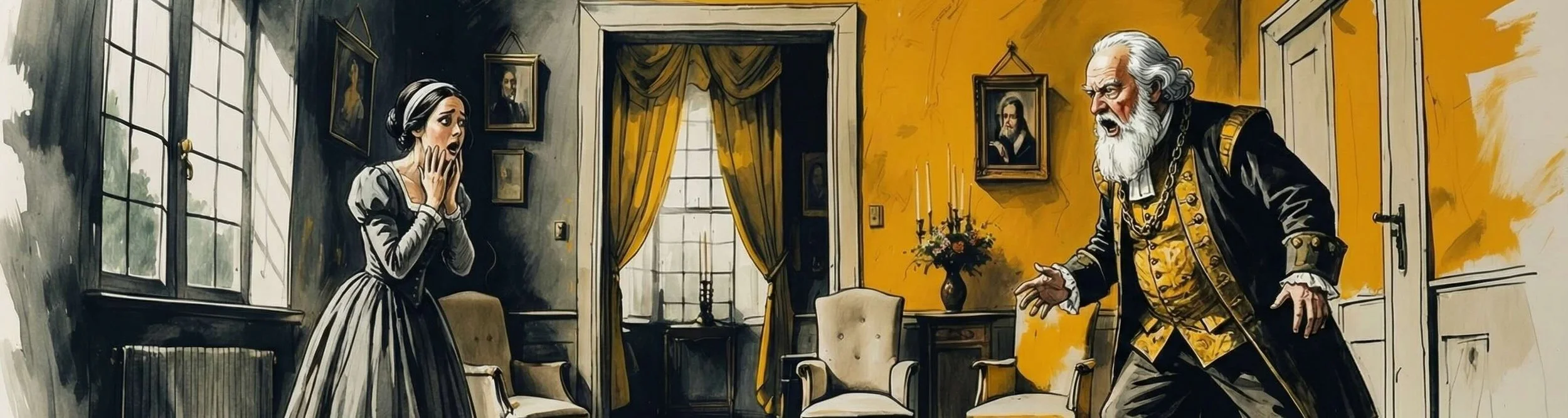
Scene Profile – At a Glance
- Location: A room in Polonius's house in Elsinore.
- What Happens: Polonius sends his servant Reynaldo to France to spy on Laertes by spreading small lies and watching the reaction. Then Ophelia rushes in, frightened, to report that Hamlet has visited her looking wild and distracted. Polonius decides this is madness caused by love and hurries to tell the king.
- Key Characters: Polonius, Ophelia, with the servant Reynaldo.
- Dramatic Function: The scene establishes the court's culture of spying and gives the first report of Hamlet's "madness", which Polonius wrongly blames on love.
- Famous Quote:
"As if he had been loosed out of hell
To speak of horrors..."
(Ophelia, Act 2, Scene 1) - Why It Matters: It shows surveillance as a way of life at Elsinore and launches the central question of whether Hamlet's madness is real or pretended.
Scene Summary
Polonius gives detailed instructions to his servant Reynaldo, whom he is sending to France to keep an eye on Laertes. He tells Reynaldo to ask around about Laertes by hinting at small faults – gambling, drinking, visiting brothels – and watching how people react, so that a little falsehood will draw out the truth about his son's behaviour.
After Reynaldo leaves, Ophelia enters in distress. She describes a frightening visit from Hamlet: he came to her room with his clothing in disarray, pale and trembling, took her by the wrist, stared long into her face, and finally left with a deep sigh, never taking his eyes off her.
Polonius immediately concludes that Hamlet is mad with love for Ophelia, made desperate because she has obeyed her father and rejected him. He regrets having ordered her to repel Hamlet, and decides they must tell Claudius at once, since this lovesickness in the prince is too important to keep secret.
Spying by Indirection
The scene opens with Polonius teaching the fine art of spying. He instructs Reynaldo not to ask about Laertes directly but to drop little lies about him and watch how people respond, fishing for the truth through deceit. It is a small, almost comic scene, but it tells us a great deal about how Elsinore works.
Original
And thus do we of wisdom and of reach,
With windlasses and with assays of bias,
By indirections find directions out...
(Polonius, Act 2, Scene 1)
Shakespeare Retold (Modern Verse)
So we can know precisely what's occurring
By testing roundabout hypotheses,
And indirectly know the direct truth...
"By indirections find directions out" is Polonius's whole method in a single line: reach the truth crookedly, never straight. The same instinct will lead him to hide behind a curtain to eavesdrop on Hamlet and his mother – a decision that gets him killed. The scene quietly establishes that spying is normal here, and that almost everyone in this court watches everyone else. It is the world Hamlet must survive, and it explains why he too learns to deceive.
Hamlet in Ophelia's Closet
Ophelia's account of Hamlet's visit is one of the strangest moments in the play, and it happens offstage, so we only ever hear it described. Hamlet says nothing; he simply appears, dishevelled and shaking, and studies her face.
Original
My lord, as I was sewing in my closet,
Lord Hamlet, with his doublet all unbraced...
(Ophelia, Act 2, Scene 1)
Shakespeare Retold (Modern Verse)
My lord, as I was sewing in my closet,
Lord Hamlet, with his jacket all unbuttoned...
The picture is deliberately ambiguous. Is this the start of Hamlet's promised "antic disposition", an act of madness staged for an audience he knows will report it to the king? Is it genuine heartbreak at losing Ophelia? Or real distress after the Ghost? The play never tells us, and that uncertainty is the point. From here on, no one – not Ophelia, not Polonius, not even the audience – can be sure where Hamlet's performance ends and his true feeling begins.
The Very Ecstasy of Love
Polonius has no doubt at all. He leaps to a confident diagnosis: Hamlet is driven out of his wits by frustrated love, and Ophelia's rejection is the cause.
Original
This is the very ecstasy of love,
Whose violent property fordoes itself...
(Polonius, Act 2, Scene 1)
Shakespeare Retold (Modern Verse)
This is the madness of besotted love
That self-destructs through violent behaviour...
Polonius is sure he has solved the mystery, and he is completely wrong. Hamlet's trouble is not lovesickness but the Ghost's terrible command, which Polonius knows nothing about. This is the play's pattern with Polonius: he is confident, busy and observant, yet he consistently misreads people. His wrong diagnosis here sends the king and queen off on a false trail, and it shows how easily the watchers of Elsinore mistake the surface for the truth.
Language and Technique
- Imagery of fishing and hunting: Polonius speaks of "bait", "carp" and "windlasses", picturing the search for truth as a sly hunt, which fits the play's world of traps and spies.
- Reported action: Hamlet's visit is described, not shown, so we only see it through Ophelia's frightened eyes – keeping his true state of mind hidden from us.
- Visual detail: The "doublet all unbraced", filthy stockings and knocking knees paint a precise image of disorder, the outward signs of a mind in turmoil.
- Dramatic irony: Polonius confidently names love as the cause, while the audience knows the real cause is the Ghost, so his certainty rings false.
Key Quotes from Act 2, Scene 1
Quote 1He took me by the wrist and held me hard;
Then goes he to the length of all his arm...
(Ophelia, Act 2, Scene 1)
Shakespeare Retold (Modern Verse)
He grabbed me by the wrist and held me tight,
And then withdrew a full arm's length from me...
And, with his other hand thus o'er his brow,
He falls to such perusal of my face
As he would draw it.
(Ophelia, Act 2, Scene 1)
Shakespeare Retold (Modern Verse)
And, with his other hand held to his forehead,
He stared with eyes fixated on my face
Like he would draw me.
That hath made him mad.
(Polonius, Act 2, Scene 1)
Shakespeare Retold (Modern Verse)
That's what's made him mad.
Key Takeaways
- Spying is a way of life: Polonius teaches Reynaldo to find the truth by "indirections", setting the tone of a watchful, distrustful court.
- Hamlet's "madness" begins: Ophelia reports his wild, silent visit – possibly the start of his antic disposition, possibly real distress.
- The visit is reported, not shown: We only hear about it, so Hamlet's true state of mind stays hidden from us.
- Polonius misreads everything: He confidently blames love, when the real cause is the Ghost's command he knows nothing about.
- Ophelia is caught in the middle: Obeying her father has cost her Hamlet, and now she is blamed for the result.
Study Questions and Analysis
Why does Polonius send Reynaldo to spy on Laertes?
On the surface, Polonius is an anxious father checking up on his son in a faraway city. But the way he does it is revealing. He does not simply ask Reynaldo to see that Laertes is well; he coaches him in an elaborate technique of dropping false hints about Laertes's vices and watching how others react, so as to draw out the truth by deceit.
The scene matters because it establishes the play's atmosphere of surveillance. Almost everyone in Elsinore spies on someone: Polonius on Laertes and then on Hamlet, the king on Hamlet through Rosencrantz and Guildenstern, Hamlet on the king through the play. Polonius's little lesson in "indirections" is a miniature of the whole court's way of operating. It also gently mocks him: he is so addicted to scheming that he plots even against his own son, and his love of cunning will eventually get him killed behind a curtain.
What does Ophelia report about Hamlet's visit?
Ophelia describes a deeply unsettling encounter. Hamlet came to her room with his clothes undone, no hat, his stockings dirty and falling down, pale as his shirt and with his knees knocking, looking as if he had escaped from hell to tell of its horrors. He said nothing. He took her by the wrist, held her at arm's length, stared long and hard into her face, sighed deeply, and left with his eyes fixed on her to the last.
Crucially, we never see this scene; we only hear Ophelia's account of it. That choice keeps Hamlet's behaviour mysterious. We cannot watch his expression or hear his thoughts, so we cannot tell whether he is acting, breaking down, or saying a silent farewell. The episode also shows the effect Hamlet's transformation is already having on those around him: Ophelia is genuinely frightened, and the visit ripples straight to Polonius and then to the king.
Is Hamlet's behaviour in this scene real madness or an act?
This is one of the play's great unanswerable questions, and this scene is where it begins in earnest. Hamlet has already warned Horatio that he may "put an antic disposition on", so his wild appearance may be a calculated performance, staged for Ophelia precisely because he knows she will report it to her father and the king. Seen this way, it is the first move in his strategy of pretended madness.
But the visit can also be read as genuine anguish. Hamlet has lost his father, been ordered to commit murder, and now lost Ophelia, who has rejected his letters on Polonius's command; real distress would be no surprise. Critics have argued both sides for centuries. A. C. Bradley, in his 1904 Shakespearean Tragedy, saw Hamlet as suffering a real, profound melancholy that his pretended madness only partly masks, so that the act and the affliction blur together. The scene is built to keep both readings alive at once, and that doubt about Hamlet's true state is itself central to the play.
Why does Polonius decide Hamlet is mad with love?
Polonius reaches his conclusion quickly and confidently. Hearing that Hamlet appeared distracted and lovelorn, and learning that Ophelia has been rejecting his advances on Polonius's own orders, he decides that thwarted love has driven the prince to madness – the "very ecstasy of love". It fits neatly with what Polonius already believes about Hamlet and Ophelia.
The diagnosis is wrong, and the audience knows it. Hamlet's torment comes from the Ghost, not from Ophelia, but Polonius has no way of knowing that, and his eagerness to have an answer leads him to the wrong one. The mistake is characteristic: Polonius is a confident reader of other people who is almost always mistaken. His error here is also useful to Hamlet, because as long as the court thinks the prince is simply lovesick, no one suspects that he knows the truth about the murder.
How does this scene develop the theme of spying and surveillance?
The scene is built around watching and being watched. It opens with Polonius arranging to have Laertes secretly observed, and it closes with him rushing to report Hamlet's private behaviour to the king. In between, Ophelia's account turns Hamlet's intimate visit into a piece of intelligence to be passed up the chain. Nothing in this household stays private for long.
This matters because surveillance is one of the play's defining conditions. Elsinore is a place where conversations are overheard, loved ones are used as bait, and trust is constantly betrayed. The habit of spying that Polonius models here will recur again and again – in the "nunnery" scene, where he and the king hide to watch Hamlet and Ophelia, and in the closet scene, where his eavesdropping kills him. By making Polonius such a keen, comic spy at the start of Act 2, Shakespeare prepares us for a court in which everyone is performing for hidden watchers, and honesty has almost nowhere left to live.
What does this scene reveal about Ophelia's position?
Ophelia is once again caught between the men in her life, with no good choices. She obeyed her father's order in Act 1 to reject Hamlet, and now she is the frightened bearer of news about the very distress that obedience may have caused. Her own feelings – her fear, her possible love for Hamlet – are barely considered; what matters to Polonius is what the visit means for his standing with the king.
The scene also reduces Ophelia to a kind of instrument. Her account of Hamlet becomes evidence in Polonius's scheme, and she is swept along to the king as part of his plan. Elaine Showalter, in her 1985 essay Representing Ophelia, argued that Ophelia is consistently spoken about and acted upon by the men around her rather than allowed to speak and act for herself. This scene shows that process in action: even her terror is turned into useful information. It is another step in the slow erosion of a young woman who began the play with wit and spirit, and who will end it destroyed.