Death and Mortality
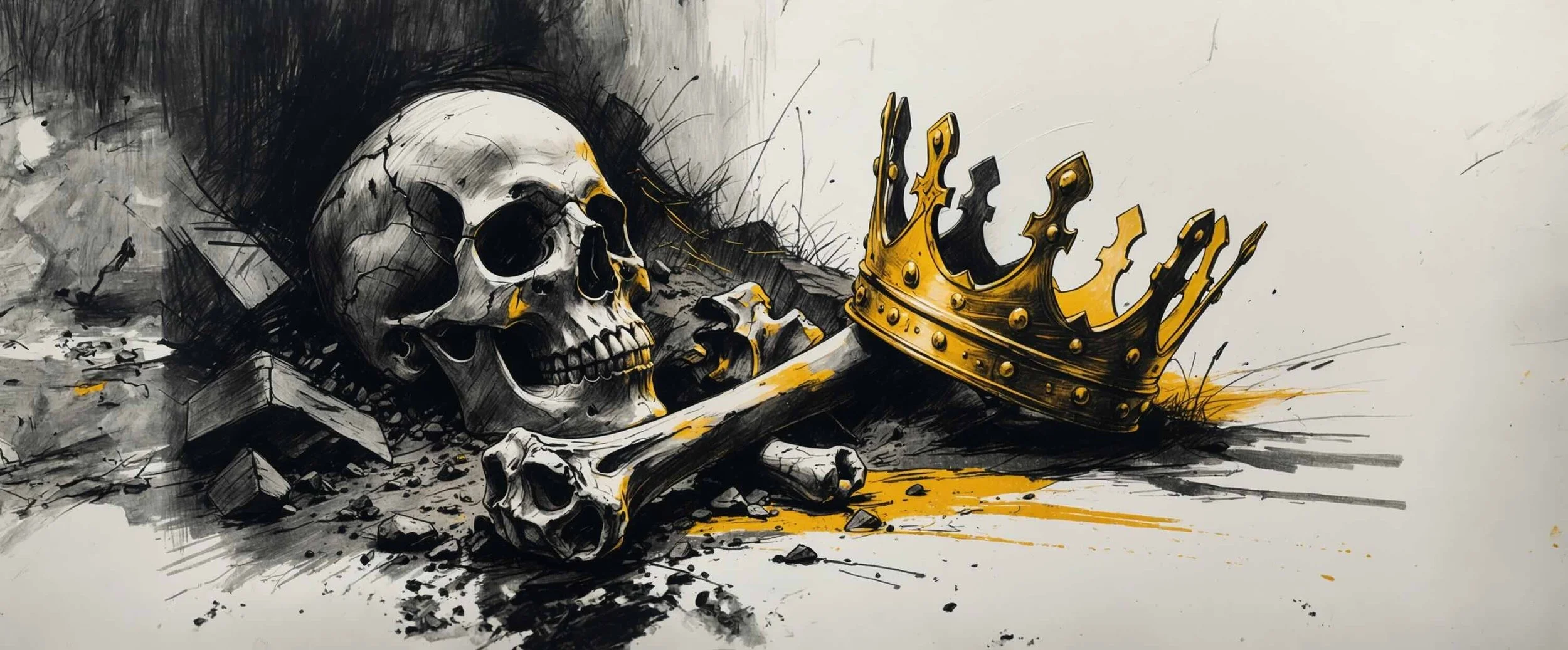
Theme Profile – At a Glance
- Focus: The inevitability of death, the physical decay of the body, the spiritual terror of the afterlife, and the contemplation of suicide.
- Key Characters: Prince Hamlet, The Ghost, Ophelia, and the Gravediggers.
- The Core Conflict: The tension between life as a state of unbearable suffering and death as a terrifying, unpredictable "undiscover'd country" from which no one returns.
- Key Manifestations: Hamlet's obsession with skulls and rotting corpses; his suicidal ideation; the Ghost's torment in Purgatory; the philosophical graveyard scene.
- Famous Quote:
"Alas, poor Yorick! I knew him, Horatio: a fellow
of infinite jest, of most excellent fancy: he hath
borne me on his back a thousand times; and now, how
abhorred in my imagination it is!"
(Act 5, Scene 1) - The Outcome: After struggling with the spiritual and physical horror of death for four acts, Hamlet achieves a state of fatalistic acceptance just before the poisoned duel, resigning himself to divine providence.
The Spiritual Dread of the Afterlife
In Hamlet, death is never simply the end of life; it is the terrifying beginning of something unknown. This theological anxiety is the primary engine of Hamlet's hesitation. When The Ghost returns to Elsinore, it brings with it the horrific reality of Purgatory—a place of burning and purging that traumatises Hamlet.
Original
To die, to sleep;
To sleep: perchance to dream: ay, there's the rub;
For in that sleep of death what dreams may come
When we have shuffled off this mortal coil,
Must give us pause...
(Act 3, Scene 1)
Shakespeare Retold (Modern Verse)
Endless sleep!
But sleeping, I might dream, and there’s the catch:
For in that sleep of death, what dreams may come
When we have left this turmoil of existence?
It’s worth a thought, for sure.
Hamlet is deeply suicidal, longing to escape the corruption of the court. However, his intellect prevents him from finding peace in the idea of death. He realises that if death is merely a "sleep," then it must be subject to "dreams" (nightmares and spiritual punishments). It is this paralysing fear of the afterlife that traps him in a miserable, living limbo.
The Physical Reality of Decay
While Hamlet fears the spiritual consequences of death, he is equally obsessed with the grotesque physical realities of biological decay. He constantly strips away the finery of the royal court to remind its inhabitants that they are merely walking corpses waiting to rot.
Original
Not where he eats, but where he is eaten: a certain
convocation of politic worms are e'en at him. Your
worm is your only emperor for diet...
(Act 4, Scene 3)
Shakespeare Retold (Modern Verse)
Oh, he’s not eating; he is being eaten.
A bunch of civic worms are eating him.
For worms possess a mastery of eating:
After killing Polonius, Hamlet refuses to treat the body with royal dignity. Instead, he uses the hidden corpse to taunt King Claudius about the food chain. He violently equalises humanity, pointing out that both a fat king and a lean beggar are ultimately nothing more than two different dishes served at the same table for maggots.
The Graveyard as the Ultimate Equaliser
The theme of mortality reaches its philosophical peak in Act 5, Scene 1. Surrounded by the bones of lawyers, courtiers, and jesters, Hamlet is forced to confront the physical remnants of a man he loved: Yorick.
Original
Alexander died, Alexander was buried,
Alexander returneth into dust; the dust is earth; of
earth we make loam; and why of that loam, whereto he
was converted, might they not stop a beer-barrel?
(Act 5, Scene 1)
Shakespeare Retold (Modern Verse)
Alexander died; he’s buried,
returning into dust; the dust of earth;
this earth we make to clay; and from that clay,
that’s made from him, why can’t we make a bung?
In the graveyard, all worldly ambition, deception, and gender expectations are rendered meaningless. Hamlet traces the dust of Alexander the Great stopping a beer barrel, highlighting the absurd, farcical nature of human pride. It is here, staring into the empty eye sockets of a skull, that Hamlet finally exhausts his dread of death, preparing him to face his own fate with newfound stoicism.
"Hamlet is a play about death... the hero is a man who has been given a glimpse of the skull beneath the skin."
— C.S. Lewis, Hamlet: The Prince or the Poem?, 1942
Key Quotes on Mortality
Quote 1
Alas, poor Yorick! I knew him, Horatio: a fellow
of infinite jest, of most excellent fancy: he hath
borne me on his back a thousand times; and now, how
abhorred in my imagination it is!
(Act 5, Scene 1)
Shakespeare Retold (Modern Verse)
Oh no, poor Yorick! I knew him, Horatio.
He was so funny, always making jokes.
He gave me piggybacks a thousand times,
and now it makes me sick to think of it.
Quote Analysis: This is the visual and thematic climax of Hamlet’s obsession with death. Confronted with the physical reality of a rotting skull belonging to someone he loved, the abstract philosophy of death becomes abruptly personal, visceral, and nauseating.
O, that this too too solid flesh would melt
Thaw and resolve itself into a dew!
Or that the Everlasting had not fix'd
His canon 'gainst self-slaughter!
(Act 1, Scene 2)
Shakespeare Retold (Modern Verse)
I wish my tarnished body would dissolve
Into a liquid, like a morning dew!
Or if our God had not so stipulated
That suicide is banned!
Quote Analysis: In his very first soliloquy, Hamlet expresses a profound desire to cease existing. He views his own physical body as burdensome ("solid flesh") and wishes he could simply evaporate. The only thing keeping him alive is the religious law forbidding suicide, establishing his trap between a miserable life and a terrifying God.
But that the dread of something after death,
The undiscover'd country from whose bourn
No traveller returns, puzzles the will
And makes us rather bear those ills we have
Than fly to others that we know not of?
(Act 3, Scene 1)
Shakespeare Retold (Modern Verse)
Unless it was in fear of worse in death,
An undiscovered country from whose border
No traveller returns, and makes us ponder,
Concluding that we’d rather bear the pain
We know of than of that that we do not?
Quote Analysis: This quote defines the universal human predicament. Hamlet argues that cowardice regarding the afterlife is what keeps humanity alive. We endure the political corruption, heartbreak, and physical pain of the world solely because we are too terrified of what eternal punishments might await us if we end our own lives.
If it be now, 'tis not to come; if it be not to
come, it will be now; if it be not now, yet it will
come: the readiness is all: since no man has aught
of what he leaves, what is't to leave betimes?
(Act 5, Scene 2)
Shakespeare Retold (Modern Verse)
If it is now, it won’t be later;
if not later, now;
if not now, it will happen later on.
The preparation’s key. Since no one knows
what’s left behind, what’s wrong with dying early?
Quote Analysis: This marks the resolution of Hamlet's internal conflict. He abandons his dread and intellectual panic, accepting that death is inevitable and divinely ordained. By embracing "the readiness," he achieves a spiritual peace that finally allows him to act without fear.
Key Takeaways
- The Existential Trap: The characters are trapped between the unbearable suffering of the living world and the terrifying, punitive reality of the afterlife.
- The Great Equaliser: Shakespeare continually uses the physical reality of death to mock the pride, ambition, and political plotting of the court; kings and beggars all end up as dust.
- The Weight of Grief: The play explores how proximity to death (the loss of fathers) psychologically destroys the youth of Elsinore, driving Hamlet to melancholy, Ophelia to madness, and Laertes to murderous rage.
- Acceptance: The tragedy can only conclude when the protagonist stops fighting his own mortality. Hamlet's ultimate victory is not killing Claudius, but conquering his own fear of death.
Study Questions and Analysis
Why does Hamlet say "No traveller returns" when he has seen a Ghost?
This is a famous paradox. It suggests that Hamlet still harbours deep theological doubts about the Ghost. He may believe the apparition was not his father at all, but a demon from Hell masquerading as a spirit. Therefore, the true nature of the afterlife (the "undiscover'd country") remains a terrifying, unconfirmed mystery to him.
How does Horatio's view of death contrast with Hamlet's?
Horatio represents the Stoic ideal. He accepts death as a natural occurrence, noting that "custom hath made it in him a property of easiness." While Hamlet agonises over the theological and physical horrors of dying, Horatio remains emotionally grounded, serving as an anchor of sanity amidst Hamlet's existential panic.
What is the significance of Ophelia's death in relation to the theme of mortality?
Ophelia's drowning introduces the controversy of suicide into the public sphere of the court. The gravediggers debate whether she deserves Christian burial rights, highlighting how the church's strict rules regarding mortality clash with the realities of human suffering and madness.
Why is the graveyard scene written in prose instead of blank verse?
Prose is typically used by lower-class characters in Shakespeare, or when high-class characters are dealing with base, unrefined matters. By shifting to prose in the graveyard, Shakespeare verbally strips away the poetic, aristocratic illusions of Elsinore, bringing everyone down to the gritty, common reality of dirt and bone.
How does Claudius view mortality?
Claudius weaponises mortality. He casually uses death to solve his political problems (murdering his brother, plotting against Hamlet). However, when he tries to pray, his fear of eternal damnation proves that he, too, is terrified of the divine consequences that wait beyond the grave.
How does Hamlet's attitude towards death change throughout the play?
In Act 1, he desires death but fears God's laws. In Act 3, he intensely overthinks the mechanics of the afterlife. In Act 5, Scene 1, he is disgusted by the physical reality of decay. Finally, in Act 5, Scene 2, he transcends his fear entirely, accepting that "there's a special providence in the fall of a sparrow," submitting peacefully to God's will.
Why is the skull of Yorick specifically chosen to highlight decay?
Yorick was a jester — a figure associated with laughter, vitality, and human connection. Seeing the physical remains of someone so vibrant makes the reality of death overwhelmingly poignant for Hamlet. It proves that no amount of joy, wit, or life force can overcome the finality of the grave.