

A young king, a band of brothers, an impossible victory … retold in modern English verse.
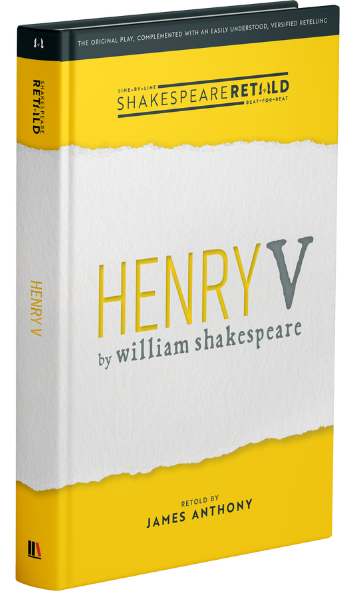
The complete Henry V study guide – every line translated; every rhythm kept; every scene, character and theme explored – free for students, teachers, actors, and theatregoers.
Henry V Overview
Henry V Deep Dive
-
ACT 1
-
Henry V – Act 1 Prologue
"O for a Muse of fire"
Henry V Act 1, Prologue retold in modern English verse: the Chorus begs imagination to supply armies the stage cannot hold.
-
Henry V – Act 1 Scene 1
Two bishops, a bill, and a reformed king
Henry V Act 1, Scene 1 retold in modern English verse: two bishops plot to save Church wealth from a new bill.
-
Henry V – Act 1 Scene 2
The Salic law and a gift of tennis balls
Henry V Act 1, Scene 2 retold in modern English verse: Canterbury proves Henry's claim; tennis balls answer it.
-
-
ACT 2
-
Henry V – Act 2 Prologue
England arms while treason takes French gold
Henry V Act 2, Prologue retold in modern English verse: the Chorus shows England arming and three traitors bought.
-
Henry V – Act 2 Scene 1
Pistol, Nym, and news of Falstaff's sickness
Henry V Act 2, Scene 1 retold in modern English verse: Pistol and Nym quarrel as Falstaff lies dying.
-
Henry V – Act 2 Scene 2
Three traitors unmasked at Southampton
Henry V Act 2, Scene 2 retold in modern English verse: Henry unmasks Cambridge, Scroop and Grey and sails for France.
-
Henry V – Act 2 Scene3
The Hostess tells of Falstaff's death
Henry V Act 2, Scene 3 retold in modern English verse: the Hostess tells of Falstaff's death; his friends leave for war.
-
Henry V – Act 2 Scene 4
France debates the coming storm
Henry V Act 2, Scene 4 retold in modern English verse: the Dauphin scorns Henry; Exeter demands the French crown.
-
-
ACT 3
-
Henry V – Act 3 Prologue
The fleet sails for Harfleur
Henry V Act 3, Prologue retold in modern English verse: the fleet sails to Harfleur and the siege cannon begin.
-
Henry V – Act 3 Scene 1
"Once more unto the breach, dear friends"
Henry V Act 3, Scene 1 retold in modern English verse: Henry rallies his soldiers to storm the breach at Harfleur.
-
Henry V – Act 3 Scene 2
Four captains and a reluctant crew
Henry V Act 3, Scene 2 retold in modern English verse: Pistol's crew hangs back while four captains argue tactics.
-
Henry V – Act 3 Scene 3
Harfleur surrenders at the gates
Henry V Act 3, Scene 3 retold in modern English verse: Henry's terrible ultimatum opens the gates of Harfleur.
-
Henry V – Act 3 Scene 4
Katharine's English lesson
Henry V Act 3, Scene 4 retold in modern English verse: Katharine learns English from Alice, word by mangled word.
-
Henry V – Act 3 Scene 5
The French nobles vow to crush the English
Henry V Act 3, Scene 5 retold in modern English verse: the French king orders his nobles to crush Henry's army.
-
Henry V – Act 3 Scene 6
Bardolph must hang, and Montjoy brings defiance
Henry V Act 3, Scene 6 retold in modern English verse: Henry approves a hanging and answers France's herald.
-
Henry V – Act 3 Scene 7
The French count their winnings before the battle
Henry V Act 3, Scene 7 retold in modern English verse: the French boast away the night before Agincourt.
-
-
ACT 4
-
Henry V – Act 4 Prologue
"A little touch of Harry in the night"
Henry V Act 4, Prologue retold in modern English verse: campfires, dicing Frenchmen, and a king among his soldiers.
-
Henry V – Act 4 Scene 1
A borrowed cloak and a king's burden
Henry V Act 4, Scene 1 retold in modern English verse: the disguised king debates his cause with his own soldiers.
-
Henry V – Act 4 Scene 2
The French mount up at sunrise
Henry V Act 4, Scene 2 retold in modern English verse: the French mount at sunrise, sure the battle is already won.
-
Henry V – Act 4 Scene3
"We few, we happy few, we band of brothers"
Henry V Act 4, Scene 3 retold in modern English verse: the Crispin's Day speech turns a few into a band of brothers.
-
Henry V – Act 4 Scene 4
Pistol takes a prisoner
Henry V Act 4, Scene 4 retold in modern English verse: Pistol ransoms a French soldier through the Boy's translation.
-
Henry V – Act 4 Scene 5
The French chivalry broken and shamed
Henry V Act 4, Scene 5 retold in modern English verse: the French ranks break in shame at Agincourt.
-
Henry V – Act 4 Scene 6
York's death and a terrible order
Henry V Act 4, Scene 6 retold in modern English verse: York dies beside Suffolk; Henry orders the prisoners killed.
-
Henry V – Act 4 Scene 7
Fluellen compares Harry to Alexander
Henry V Act 4, Scene 7 retold in modern English verse: the boys are slain, the day is won, and a glove changes hands.
-
Henry V – Act 4 Scene 8
The glove revealed and the dead are counted
Henry V Act 4, Scene 8 retold in modern English verse: Williams's glove is repaid and the dead of Agincourt counted.
-
-
ACT 5
-
Henry V – Act 5 Prologue
A borrowed cloak and a king's burden
Henry V Act 4, Scene 1 retold in modern English verse: the disguised king debates his cause with his own soldiers.
-
Henry V – Act 5 Scene 1
Fluellen makes Pistol eat the leek
Henry V Act 5, Scene 1 retold in modern English verse: Fluellen avenges his leek and Pistol plans a swindler's life.
-
Henry V – Act 5 Scene 2
The wooing of Katharine and the peace of Troyes
Henry V Act 5, Scene 2 retold in modern English verse: Henry wins Kate, and two kingdoms are joined in peace.
-
Henry V – Act 5 Epilogue
A borrowed cloak and a king's burden
Henry V Act 4, Scene 1 retold in modern English verse: the disguised king debates his cause with his own soldiers.
-
Frequently asked questions about Henry V
What is Henry V about?
Henry V follows the young king – the wild Prince Hal of the Henry IV plays – as he claims the crown of France and leads England to war. He crushes a conspiracy at Southampton, besieges Harfleur, and at Agincourt defeats what the play presents as an overwhelmingly larger French army, before wooing Princess Katharine and sealing the peace that names him heir of France. A Chorus frames every act, begging the audience to piece out the stage's imperfections with their thoughts – making this Shakespeare's most self-aware play about theatre itself.
When was Henry V written?
Henry V was written in 1599, and it is one of the most precisely datable plays in the canon: the Act 5 Chorus is generally read by scholars as an allusion to the Earl of Essex's Irish expedition, which would place composition between March and September of that year. It was likely among the first plays staged at the newly built Globe – many hear the theatre itself in the Chorus's 'wooden O'. A shortened Quarto text appeared in 1600, without the Chorus speeches; the full text was first printed in the First Folio of 1623.
Is Henry V a history play?
Yes – Henry V is the final play of Shakespeare's second tetralogy of English histories, completing the arc begun in Richard II and continued through both parts of Henry IV. It can be read on its own, but it gains enormously from that hinterland: Henry's reformation from tavern prince to warrior king is the tetralogy's long-promised payoff, and the offstage death of Falstaff in Act 2 lands hardest for those who knew him. Audiences and critics have argued for centuries over whether the play celebrates its hero-king or quietly questions the cost of his glory – it sustains both readings, which is much of why it endures.
Did the Battle of Agincourt really happen?
Yes. Henry V's exhausted, outnumbered army defeated the French near Agincourt on 25 October 1415 – Saint Crispin's Day – one of the most celebrated English victories of the Hundred Years War. Shakespeare takes his casualty figures straight from his chronicle sources, and modern historians dispute both the numbers and the scale of the odds; but the substance is historical, from the siege of Harfleur to the Treaty of Troyes that made Henry heir of France. The play compresses five years of campaigning into a single sweeping arc.
What level is Henry V studied at?
Henry V is studied at GCSE and A-Level in the UK, AP English Literature in the US, the IB Diploma, and on undergraduate Shakespeare courses worldwide. Its great set-piece speeches – the Muse of fire prologue, the breach, Saint Crispin's Day – are also staples of drama training and public speaking far beyond the classroom. This study guide is written to support all of these levels, with modern English translation, scene-by-scene analysis, character profiles, theme guides, and key quotes.
What are the most famous lines in Henry V?
Henry V contains some of the most stirring lines Shakespeare ever wrote: "O for a Muse of fire", "Once more unto the breach, dear friends", "We few, we happy few, we band of brothers", "A little touch of Harry in the night", and "The game's afoot". Each is analysed in depth on the key quotes page.