
Henry V: Characters
Henry V character analysis for all 8 main characters — King Henry V, the Chorus, Pistol, Fluellen, Princess Katharine, the Dauphin, Exeter, and the Archbishop of Canterbury. Each profile explores the character's psychology, motivation, and structural role within the play, supported throughout by a modern verse translation and key quotes.
A complete character study guide and revision resource for GCSE, A-Level, AP English, IB, and undergraduate Shakespeare — equally useful to teachers and actors. Select a character below to begin.
The Chorus
The play's narrator, who opens every act and asks the audience to imagine the war.
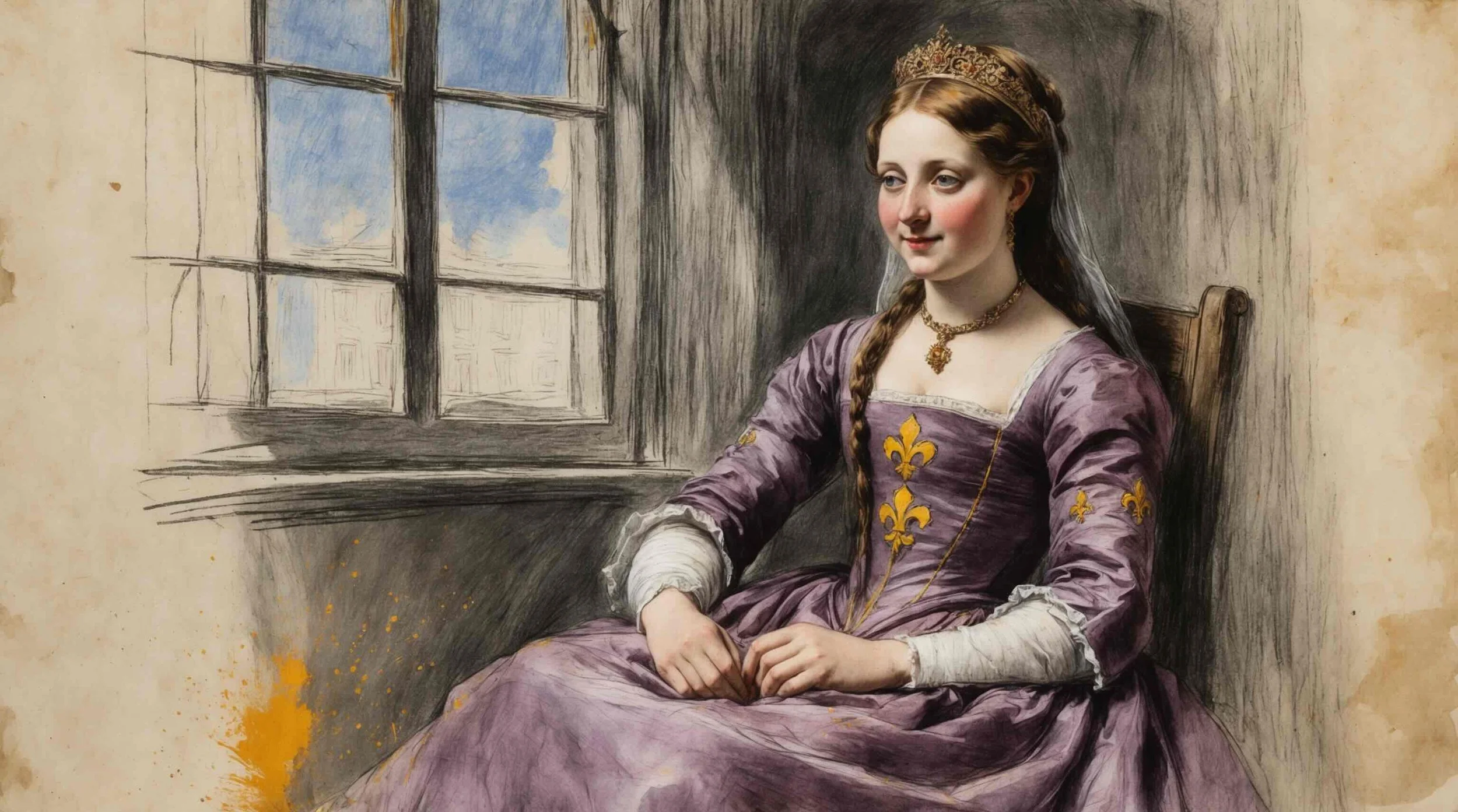
Princess Katharine
The French princess whose marriage to Henry is a clause in the peace treaty.
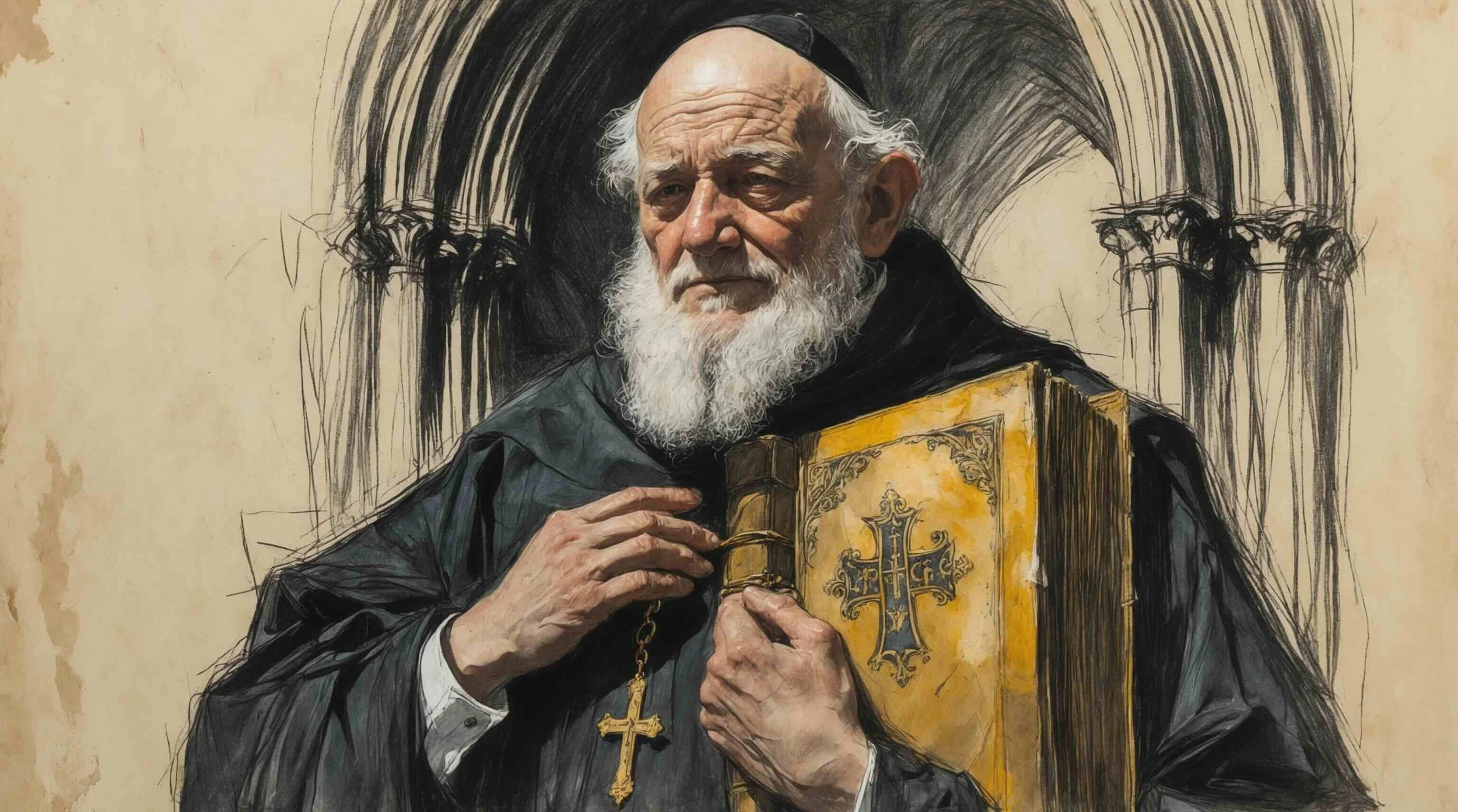
Archbishop of Canterbury
The churchman who supplies Henry with a legal claim to France, and a reason to want one.
Supporting Cast
Beyond the eight figures who carry the main action, Henry V deploys the widest social range of any Shakespeare history — an English court and army drawn from four nations and every rank, and a French court watching the invasion arrive. The wider cast is grouped below by allegiance and function.
The English Court and Command
The Bishop of Ely
Canterbury's fellow churchman and second voice in A1S1 and A1S2. He prompts and seconds the Archbishop's case for war, supplying the famous image of the strawberry growing beneath the nettle to explain the King's hidden growth. His presence turns Canterbury's argument into an institutional position rather than one man's opinion.
Westmoreland
The earl whose wish for reinforcements — "But one ten thousand of those men in England" — provokes the Saint Crispin's Day speech in A4S3. Henry's whole argument about honour shared among a happy few is built as a direct answer to him. He also opens the war council of A1S2, urging the King to claim France.
Gloucester and Bedford
Henry's younger brothers, present from Southampton to the treaty scene. They are given little individual character — deliberately, since this king shares power with no rival personality — but their quiet presence marks the difference between this united royal family and the fractured one of the Henry IV plays.
The Duke of York
The cousin who kneels in A4S3 to beg command of the vanguard at Agincourt, and who dies winning it. Exeter's account in A4S6 of York dying beside Suffolk, kissing his dead comrade's face, is the play's most tender image of battlefield brotherhood — and it moves the King himself to the edge of tears.
Sir Thomas Erpingham
The white-haired old officer whose cloak Henry borrows for his night walk through the camp in A4S1. His cheerful refusal of a softer billet — an old man choosing to lodge like a king because he lies like a king should — gives Henry the disguise, and the standard of uncomplaining service the scene then tests.
Salisbury and Warwick
Earls of the English command. Salisbury's brief blessing before Agincourt in A4S3 — commending his comrades to God before what he calls a fearful odds — supplies the battle's sense of scale from a professional soldier's mouth. Warwick appears in the aftermath, summoned to untangle the glove quarrel.
The Southampton Traitors
The Earl of Cambridge
Richard, Earl of Cambridge, the highest-ranking of the three conspirators paid in French gold to kill the King at Southampton in A2S2. His hint that money was not his only motive gestures at the dynastic claim — his son will become the Yorkist line of the Wars of the Roses — that the play chooses not to explore.
Lord Scroop
Henry Scroop of Masham, the King's trusted friend and bedfellow, and the traitor whose betrayal genuinely wounds. Henry's fifty-line address to him in A2S2 treats the treason as a second fall of man: if Scroop could seem so perfectly loyal, no appearance of virtue can ever be fully trusted again.
Sir Thomas Grey
The Northumberland knight who completes the trio. Like the others, he assures the King that mercy to traitors would be dangerous — advice Henry then turns on all three of them, using their own severity to shut off their appeal for mercy. All three are led to execution assuring the King of their repentance.
The Captains
Gower
The English captain and the army's voice of plain good sense. He is Fluellen's patient friend, the man who sees through Pistol's counterfeit soldiering in A3S6 and delivers the play's warning about men who learn the phrase of war by rote, and the observer who draws the moral of the leek scene in A5S1.
Macmorris
The Irish captain, met in A3S2 supervising the mines at Harfleur. Testy, brave and touchy about his country, he explodes at Fluellen's mention of his nation — "What ish my nation?" — a question about who counts as British that the play raises and conspicuously declines to answer.
Jamy
The Scots captain, present in the same A3S2 exchange. Fluellen rates him a marvellous good soldier, and his broad phonetic Scots completes the play's four-nations line-up of English, Welsh, Irish and Scottish officers serving in one army — a picture with sharp political point in 1599.
The Soldiers
Michael Williams
The private soldier who, not knowing his midnight interlocutor is the King, argues in A4S1 that the King bears a heavy reckoning for the men who die in his war. He wins the argument, strikes Fluellen over the exchanged gloves, defends himself to the King's face without grovelling, and is paid a glove full of crowns rather than answered.
John Bates
Williams's comrade in the night-time debate. Weary and unillusioned, he assumes the King wishes himself in the Thames and says he would obey anyway, since obedience wipes the crime of an unjust war out of the soldier. He speaks for every man who fights without believing the speeches.
Alexander Court
The third soldier at the campfire, with a single line — asking his brother soldiers whether that is not the morning breaking yonder. One line is enough: dawn on Saint Crispin's Day arrives through the voice of the army's most ordinary man.
Eastcheap
Sir John Falstaff (unseen)
The great comic companion of the Henry IV plays never appears, but his death hangs over Act 2. The Hostess's account in A2S3 of how he died — his nose sharp as a pen, babbling of green fields — is one of the most celebrated death reports in drama, and her verdict that the King has killed his heart is the old world's charge against the new king.
Bardolph
The red-faced veteran of Eastcheap, marched to France as a thief and hanged in A3S6 for stealing a pax from a church. His old drinking companion the King, informed of the sentence, endorses it without pausing on the name — the play's coldest measure of what Henry has left behind.
Nym
The laconic corporal who quarrels with Pistol over the Hostess, punctuating everything with his catchphrase about humours. The Boy reports in A4S4 that he has been hanged for theft like Bardolph — a death the play delivers in a subordinate clause.
The Boy
Falstaff's former page, and the underplot's clearest pair of eyes. His A3S2 soliloquy sizes up his three masters exactly — men whose few bad words are matched with as few good deeds — and resolves to leave them. He is murdered with the luggage-guards in A4S7, the play's most quietly devastating offstage death.
The Hostess (Nell Quickly)
Mistress Quickly of the Eastcheap tavern, now married to Pistol. She narrates Falstaff's death in A2S3 with accidental poetry and sends her husband to war; in A5S1 Pistol learns she has died. With her goes the last of the tavern world of Henry IV.
The French Court
The King of France (Charles VI)
The Dauphin's father, and the only Frenchman who takes the English threat seriously from the start. Haunted by the memory of Crécy, he orders his nobles to prepare in A2S4 while his son jokes. He ends the play conceding everything — his towns, his daughter, and the succession itself.
Queen Isabel
The French Queen, who appears only in the treaty scene of A5S2 and speaks the blessing over the marriage that ends the play. Her prayer that English and French may live in kindly union carries a weight of irony the Epilogue promptly delivers on.
The Duke of Burgundy
The peacemaker of A5S2, whose long lament for the ruined garden of France — vines unpruned, meadows run wild, children growing up like savages — is the fullest account of the war's cost anywhere in the play. It is a French voice, not an English one, that counts what the victory destroyed.
Montjoy
The French herald who carries defiance, demands for ransom, and finally the concession of defeat between the two armies. His growing respect for the ragged English king — and Henry's unfailing courtesy to him — make their exchanges one of the play's most dignified threads. It is Montjoy who tells Henry the day is his, and gives the battle its name.
Alice
Katharine's gentlewoman, who has been in England and teaches her mistress English body-parts in the A3S4 language lesson. In A5S2 she stands interpreter between the princess and the wooing King — the play's gentlest reminder that this courtship needs a translator.
The French Command
The Constable of France
Charles Delabreth, commander of the French army and the sharpest tongue in the A3S7 camp scene, where he punctures the Dauphin's boasting all night. His confidence about the battle is total, his assessment of everything except the outcome shrewd. He dies at Agincourt, high on the roll of the French dead.
Bourbon and Orleans
French dukes of the pre-battle scenes. Orleans trades wagers and insults with the Constable in A3S7 and defends the Dauphin's gallantry to faint praise; Bourbon, raging at the rout in A4S5, proposes the shamed charge back into the field in which most of the named French dead are made.
Rambures and Grandpré
French lords who fill out the command. Rambures asks about the English mastiff spirit in A3S7 and wants to wager on prisoners; Grandpré's A4S2 set-piece describes the starving English army as carrion ready for the crows — minutes before it destroys them. Both die in the battle.
The Governor of Harfleur
The town's commander, who answers Henry's terrible ultimatum in A3S3. Told the Dauphin cannot relieve him, he opens the gates and throws the town on the King's mercy — the decision that makes Harfleur's threatened horrors a might-have-been rather than a massacre.
Monsieur le Fer
The French soldier captured by Pistol in A4S4, in the play's blackest comic scene. With the Boy interpreting, terror and mistranslation see him ransom himself for two hundred crowns to the least dangerous man in the English army — the war reduced to extortion in one exchange.
Frequently asked questions about the characters in Henry V
Who are the main characters in Henry V?
The play has eight featured figures. King Henry V is the young King of England, the play's protagonist, who claims the French crown and wins it at Agincourt. The Chorus is the narrator who opens every act, asking the audience to imagine the armies the stage cannot show. Pistol is the swaggering Eastcheap braggart who follows the war to steal, and ends it beaten and alone. Fluellen is the Welsh captain — comic in his accent, completely serious in his soldiering, and winner of the play's last fight.
Princess Katharine is the French King's daughter, who learns English in one famous scene and is wooed by Henry in another. The Dauphin is the French heir whose tennis-ball insult gives Henry his excuse for war. Exeter is the King's uncle — his ambassador, enforcer and steadiest commander. The Archbishop of Canterbury is the churchman whose legal argument launches the invasion, for reasons of his own.
Around them stands one of Shakespeare's widest supporting casts — captains from four nations, common soldiers, the Eastcheap survivors and the French court — grouped in the Supporting Cast section above.
Who is the protagonist of Henry V?
King Henry V dominates the play more completely than almost any Shakespearean protagonist. He speaks roughly a third of its lines, delivers its three great set-piece speeches — the breach at Harfleur in A3S1, Saint Crispin's Day in A4S3, and the wooing of Katharine in A5S2 — and every other character is defined by their relation to him. The Chorus calls him "the mirror of all Christian kings", and the play spends five acts testing what that mirror actually shows.
The interesting question is not whether he is the protagonist but what kind. He is a brilliant leader, personally brave, and sincerely religious. He is also a calculating performer who threatens Harfleur with horrors, hangs an old friend, orders prisoners killed, and moves responsibility for the war onto everyone but himself. William Hazlitt, in 1817, caught the doubleness in a single sentence — "a very amiable monster, a very splendid pageant" — and the play supports both halves at once, never choosing between them.
See King Henry V for the full analysis.
Does Henry V have a villain?
No — and that is unusual for Shakespeare. The nearest thing to an antagonist is the Dauphin, the French heir who sends Henry tennis balls as an insult in A1S2. But the play systematically undercuts him as a threat: his own commanders mock him through the night before Agincourt in A3S7, and he is beaten offstage rather than confronted — there is no duel, no meeting, no reckoning between him and Henry.
The real opposition is spread wider. France itself is the obstacle; the traitors of A2S2 supply a brief conspiracy; and the soldier Williams, arguing with the disguised King in the A4S1 night scene, lands the heaviest blow anyone strikes — that the King has "a heavy reckoning to make" for the men who die in his war. Henry wins the battle but never quite wins that argument, and much of the play's conflict is internal: between the King's public performance and the private doubts of the ceremony soliloquy.
See The Dauphin for the full analysis.
What is the role of the Chorus in Henry V?
The Chorus opens all five acts and closes the play — a scale of use found nowhere else in Shakespeare. Its job is to apologise for the theatre's limits and ask the audience to imagine what the stage cannot show: the fleet at Southampton, the night camp before Agincourt, London welcoming the victor home.
The twist is that the scenes which follow keep failing to match its descriptions. The Chorus announces all the youth of England on fire; the next scene shows Eastcheap packing to steal. It promises the battle of Agincourt; the stage gives us four frightened men in the dark. The gap is too consistent to be an accident — it is the play's method.
Norman Rabkin's famous account of the play (1977) is that it "points in two opposite directions, virtually daring us to choose one of the two opposed interpretations it requires of us" — and the Chorus is the principal instrument of that doubleness. Whether it is the play's proud official voice or its most unreliable narrator is one of the best essay questions the play offers.
See The Chorus for the full analysis.
Is Falstaff in Henry V?
No. Shakespeare's most famous comic character — Henry's tavern companion through both Henry IV plays — never appears on stage. Instead the Hostess describes his offstage death in A2S3, in one of the most celebrated death reports in drama: he fumbled with the sheets, played with flowers, and "a' babbled of green fields". Her verdict on the cause is the old world's charge against the new king: "The king has killed his heart."
That charge has a long critical history — A. C. Bradley observed in 1909 that at Falstaff's rejection "our hearts go with Falstaff to the Fleet" — and this play quietly finishes the story. Falstaff's world survives him only briefly. Pistol, Bardolph, Nym, the Boy and the Hostess carry Eastcheap to France, and the play is unsparing with them. Bardolph and Nym are hanged, the Boy is murdered with the luggage, the Hostess dies at home, and only Pistol limps back to England, beaten by Fluellen and planning a life of theft. The comic underworld of the earlier plays is systematically closed down.
See Pistol for the full analysis.
Who are the four captains in Henry V?
In A3S2, at the siege of Harfleur, the play brings together four officers of Henry's army: Fluellen the Welshman, Gower the Englishman, Macmorris the Irishman and Jamy the Scot. It is the first scene in English drama to put all four nations of the British Isles on stage in one army — a pointed image in 1599, when Essex's army was campaigning in Ireland — and their conversation collapses into a quarrel within minutes. Macmorris's furious "What ish my nation?" is the scene's unanswered question, and one of the play's most quoted lines.
Fluellen is the one developed at length: pedantic about the disciplines of war, phonetically Welsh, easily mocked and completely vindicated. He polices the army's honesty, exposes Pistol, and wins the play's final fight in defence of his leek. The captains together are the play's picture of a united Britain — comic, quarrelsome, and holding.
See Fluellen for the full analysis.
What role do women play in Henry V?
Only four women speak, and their scenes are brief — this is the most male of Shakespeare's histories. But the play gives them pointed work to do. Princess Katharine has the largest female role: her English lesson in A3S4 and the wooing scene of A5S2 frame the conquest of France as, finally, the acquisition of a bride whose consent is a formality. Her protest to Henry — "I cannot speak your England" — mistakes the word and tells the truth: in this play the language and the country are the same possession.
Alice, her gentlewoman, teaches and translates. The Hostess narrates Falstaff's death — the play's greatest speech given to a common woman — before dying offstage herself. And Queen Isabel of France appears once, to bless the treaty marriage with a prayer for lasting union that the Epilogue overturns within fourteen lines. Between them, the women mark what the men's war costs and what it trades.
See Princess Katharine for the full analysis.
How does the Henry V character set compare to Shakespeare's other histories?
Three things make this cast unusual. First, its social range: no other history gives common soldiers so much argued speech. Williams and Bates debate the ethics of the war with the disguised King in A4S1 and are never made ridiculous — the men at the bottom of the army state the play's hardest moral question. And when Henry promises "We few, we happy few, we band of brothers" in A4S3, the play has already shown us, by name, the ordinary men the promise is made to — and lets us judge whether it is kept.
Second, its breadth of nation and voice: Welsh, Irish and Scots captains, French princesses and heralds, phonetic accents and whole scenes in French. The English court itself is comparatively thin — this king has loyal brothers and no rivals, which is exactly the point after the civil wars of the Henry IV plays.
Third, its frame: no other Shakespeare play is narrated throughout by a Chorus. Among the nobles, Exeter serves as the reliable arm of the crown — ambassador, judge and soldier — while the Archbishop of Canterbury opens the play with the Church's own reasons for war. The result reads less like a family chronicle than a portrait of a whole nation at war, from throne to tavern.