The Chorus
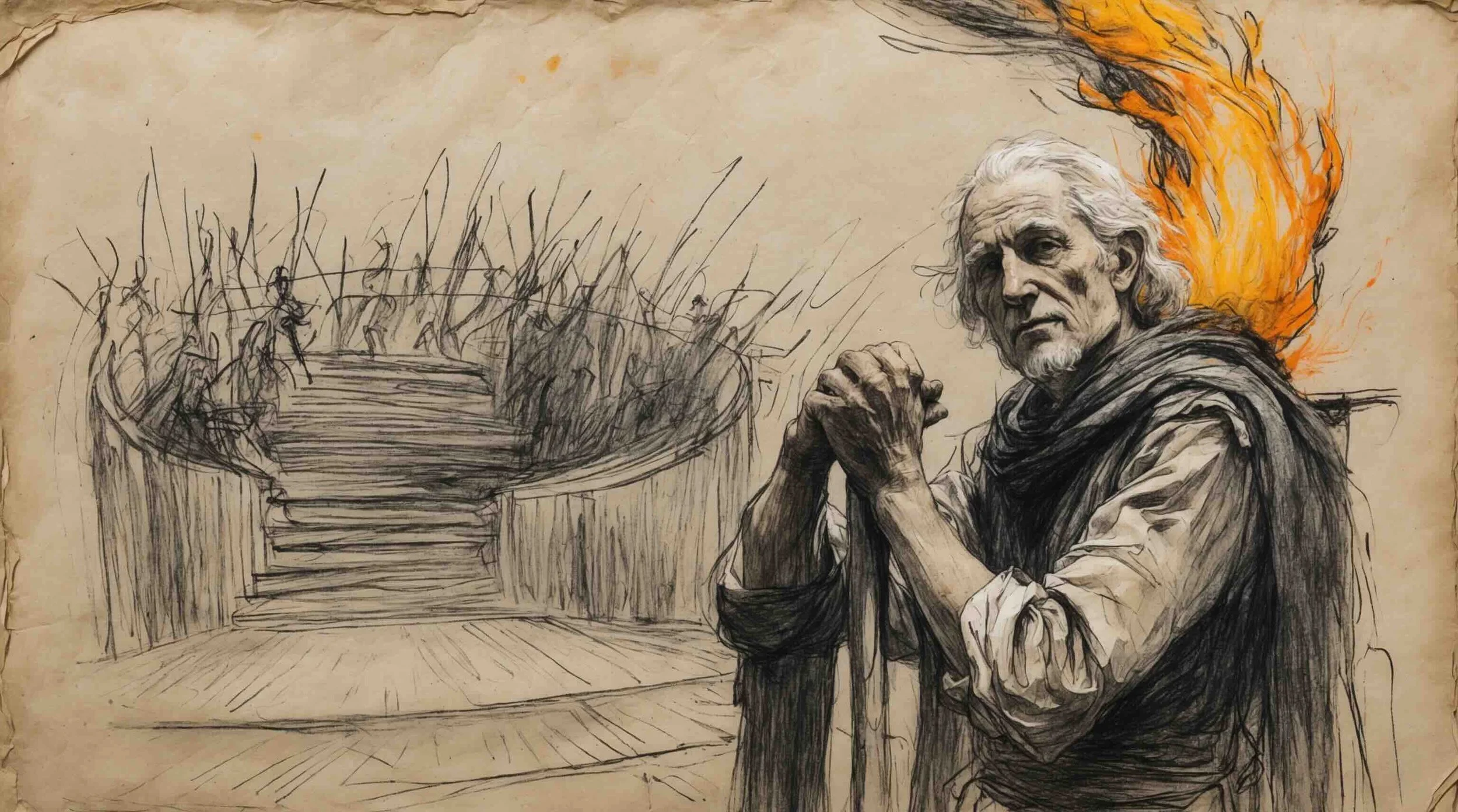
Character Profile – At a Glance
- Role: The play’s narrator. A single unnamed figure who opens each of the five acts and closes the play, telling the audience where the scene has moved to, what to picture, and what to think of the King.
- Key Traits: Apologetic about the theatre’s limits, openly dazzled by Henry, and patriotic to the edge of propaganda. Every speech is in tightly controlled verse, and each act’s prologue ends on a rhyming couplet.
- The Core Conflict: The Chorus keeps promising a play the stage cannot deliver, and keeps praising a king the following scenes do not quite match. The gap between what we are told and what we then see is one of the play’s main effects.
- Key Actions: Apologises for the "wooden O" and asks the audience to supply what the stage cannot (Act 1). Reports the Southampton conspiracy (Act 2). Carries the fleet across the Channel to Harfleur (Act 3). Paints the night before Agincourt and Henry’s walk among his soldiers (Act 4). Skips the return to London and compares Henry to the Earl of Essex in Ireland (Act 5). Closes the play by naming what Henry’s son lost (Epilogue).
- Famous Quote:
"A little touch of Harry in the night."
(Act 4, Prologue) - The Outcome: The Chorus gets the last word, and uses it to undo the triumph. Fourteen lines of Epilogue tell the audience that Henry’s infant son lost France and left England bleeding.
O for a Muse of Fire
Almost no other Shakespeare play opens like this. Most begin in the middle of something – guards on a battlement, servants brawling, witches on a heath. Henry V begins with a man walking out alone and wishing aloud that he had better resources.
Original
O for a Muse of fire, that would ascend
The brightest heaven of invention,
A kingdom for a stage, princes to act
And monarchs to behold the swelling scene!
(Act 1, Prologue)
Shakespeare Retold (Modern Verse)
If we can conjure burning inspiration
To fire up our creativity,
This stage will seem a country, full of princes
And royalty observing the commotion!
The wish is impossible on purpose. A "Muse of fire" belongs to epic poetry rather than the playhouse; a kingdom for a stage and real princes to act in it would not be theatre at all. The Chorus opens by asking for the one thing the company cannot have, and the effect is not despair but appetite. Before a single character has spoken, the audience has been told that the story about to be attempted is bigger than the building it is happening in.
There is also a claim being smuggled in. By reaching for epic before the play has begun, the Chorus has already classified Henry as epic material – a subject that would ordinarily need a Muse, a kingdom and monarchs. The scale is asserted before any of it has been shown.
This Wooden O
The apology sharpens into something more specific: a set of questions about whether this actual building can hold this actual story.
Original
On this unworthy scaffold to bring forth
So great an object: can this cockpit hold
The vasty fields of France? Or may we cram
Within this wooden O the very casques
That did affright the air at Agincourt?
(Act 1, Prologue)
Shakespeare Retold (Modern Verse)
Upon this insufficient stage, to act
So great a story. Can this theatre seem
To be the sprawling fields of France? Can we fit
Within this wood rotunda, all the helmets
That filled the air of Agincourt with terror?
"This wooden O" has become the most quoted description of an Elizabethan playhouse ever written, and it is worth remembering that it is a piece of self-criticism. The round timber theatre is being compared, unfavourably, with a battlefield. So is the cast: a "cockpit" was a pit for cockfighting, which makes the actors birds in a ring.
What follows is the move that makes the whole play work. Having admitted that the theatre cannot show France, the Chorus hands the job to the audience – asking them to divide one man into a thousand, to see horses that are not there, to piece out the company’s imperfections with their own thoughts. It is an unusually explicit statement of how theatre actually functions, and it also quietly changes the audience’s position. Anyone who agrees to imagine the army has agreed to help build it. By the time Agincourt arrives, the spectators have been co-opted into the war effort, and they agreed to it in the first three minutes.
O England!
The Act 2 prologue shows the Chorus in its most nakedly patriotic register. England is arming; young men are selling land to buy horses; the country is described as a small body with an enormous heart. And then, mid-flight, the speech turns.
Original
O England! Model to thy inward greatness,
Like little body with a mighty heart,
What mightst thou do, that honour would thee do,
Were all thy children kind and natural!
(Act 2, Prologue)
Shakespeare Retold (Modern Verse)
Oh England! You are small, but great inside,
A little body with a massive heart,
What things could you achieve, given the chance,
If every Englishman was true and loyal!
The word doing the work is Were. England’s greatness is stated as a conditional that has not been met: this is what the country could do if its children were loyal, and the next twenty lines explain that three of them are not. The Chorus then names Cambridge, Scroop and Grey, tells us they have taken French gold, and announces that they mean to kill the King before he sails.
This is a strange thing for a narrator to do, and it is worth noticing how much it gives away. The Chorus spoils its own plot – the audience now knows about the conspiracy before Henry appears to expose it – and it does so in order to keep the patriotic frame intact. Treachery has to be introduced and labelled as an aberration before it can be shown on stage. Then, having promised Southampton, the Chorus withdraws and the play cuts instead to Pistol, Nym and Bardolph quarrelling in a London street. The first thing the Chorus tells us to expect is the first thing it fails to deliver.
A Little Touch of Harry in the Night
The Act 4 prologue is the finest thing the Chorus is given and one of the great set-pieces of English dramatic verse. It builds the night before Agincourt out of sound – the hum of two armies, horses answering horses, armourers hammering rivets – and then walks the King through it.
Original
That every wretch, pining and pale before,
Beholding him, plucks comfort from his looks:
A largess universal like the sun
His liberal eye doth give to every one,
Thawing cold fear, that mean and gentle all,
Behold, as may unworthiness define,
A little touch of Harry in the night.
(Act 4, Prologue)
Shakespeare Retold (Modern Verse)
So every wretched soldier, tired before,
When seeing him, draws comfort from his looks.
A generous warmth, like daylight from the sun,
His gaze bestows on each and every soldier,
Dissolving fear, if they are high or low ranked,
As they observe, though they may not be noble,
A little piece of Harry in the night.
The picture is of a king who cures fear by being looked at. He is compared to the sun; his glance is a gift distributed to everyone equally; every soldier who sees him is warmed. It is the most affectionate description of Henry in the play and probably the single most persuasive piece of writing in his favour.
Then the scene begins, and Henry does not do this. He puts on a borrowed cloak so that nobody will know who he is, gets into an argument with three soldiers who tell him to his face that the King’s cause may be rotten, storms off, and delivers a bitter soliloquy about how unfair it is to be blamed. There is no largess, no thawing, and nobody is comforted. The gap is too wide and too immediate to be an accident. The Chorus has given the official account of the night, and the play then shows the night.
This Star of England
The Epilogue is fourteen lines long and rhymed like a sonnet, and it performs one of the most deliberate acts of deflation in Shakespeare. The war has been won, the treaty signed, the marriage agreed. The Chorus comes out to close the play, praises Henry once more, and then keeps talking.
Original
Small time, but in that small most greatly lived
This star of England: Fortune made his sword;
By which the world's best garden be achieved,
And of it left his son imperial lord.
(Epilogue)
Shakespeare Retold (Modern Verse)
The time was short, but greatness lived within it,
An English star, where Fortune made his sword,
And conquered fields of France and all things in it,
Then left it to his son, imperial lord.
"Small time" is the first cold note. Henry died at thirty-five, two years after the treaty, and the Chorus says so before saying anything else. "Fortune made his sword" is the second: after four acts in which victory has been credited to God, the Epilogue hands it to luck. And the final quatrain finishes the job, naming Henry VI, the infant king, and the councillors who between them lost France and left England bleeding.
The last line is almost a shrug – the audience has seen those plays already, so let them accept this one kindly. Shakespeare had written the three Henry VI plays years earlier, and his first audiences would have known exactly what was being referred to. The effect is to place the triumph inside a longer story in which it does not last. Whatever the Chorus has spent five acts building, it dismantles in the last thing it says.
"…it points in two opposite directions, virtually daring us to choose one of the two opposed interpretations it requires of us."
— Norman Rabkin, Rabbits, Ducks, and Henry V, 1977
Key Quotes
Quote 1
Now all the youth of England are on fire,
And silken dalliance in the wardrobe lies:
Now thrive the armourers, and honour's thought
Reigns solely in the breast of every man...
(Act 2, Prologue)
Shakespeare Retold (Modern Verse)
The youth of England now all burn with passion;
They’ve packed away their courting leisure clothes.
Those making armour thrive, and thoughts of honour
Preoccupy the mind of every man.
Quote Analysis: A whole country converting itself to war in four lines. The detail that carries it is the wardrobe: fine clothes for courting have been folded away, which dates the change and makes it domestic. The claim is total – all the youth, every man – and it is contradicted almost at once by the next scene, where Pistol, Nym and Bardolph go to France for what they can steal. The Chorus describes a nation of volunteers; the play shows an army that also contains thieves.
They sell the pasture now to buy the horse,
Following the mirror of all Christian kings,
With winged heels, as English Mercuries.
(Act 2, Prologue)
Shakespeare Retold (Modern Verse)
They sell their field so they can buy a horse
To follow model Christian king, King Henry,
Like Mercury, who flew on shoes with wings.
Quote Analysis: "The mirror of all Christian kings" is the Chorus’s central claim about Henry, and a mirror in this period meant a model or pattern rather than a reflecting surface: Henry is the standard other Christian kings should copy. The line is quoted constantly, and it is never spoken by anyone inside the action. It belongs to the play’s official voice, not to a character who has to live with the consequences. The first image, meanwhile, is quietly troubling – men selling the land that feeds them to buy the means of going to war.
Work, work your thoughts, and therein see a siege;
Behold the ordnance on their carriages,
With fatal mouths gaping on girded Harfleur.
(Act 3, Prologue)
Shakespeare Retold (Modern Verse)
Embellish all your thoughts and see a siege;
Observe the cannons resting on their carts,
Their muzzles aiming at the walls of Harfleur.
Quote Analysis: The repeated imperative – "Work, work" – is the Chorus at its most demanding. This is not scene-setting; it is an instruction to the audience to do the staging themselves. The reward is the image of the guns, where "fatal mouths gaping" turns the cannon into something alive and hungry. Throughout the play the Chorus supplies exactly the spectacle the Elizabethan stage could not: fleets, sieges, artillery, thousands of men. The most expensive effects in Henry V cost nothing, because they happen in the audience’s head.
And so our scene must to the battle fly;
Where – O for pity! – we shall much disgrace
With four or five most vile and ragged foils,
Right ill-disposed in brawl ridiculous,
The name of Agincourt. Yet sit and see,
Minding true things by what their mockeries be.
(Act 4, Prologue)
Shakespeare Retold (Modern Verse)
And so it’s time we start the battle scene;
Where – shame on us! – our acting will belittle –
By using four or five weak fencing foils
Used poorly in an unconvincing brawl –
The real fights of Agincourt. Now stare,
Imagining what really happened there.
Quote Analysis: The Chorus warns the audience, seconds before it happens, that the battle they are about to watch will be four or five men waving blunt swords. It is an astonishing thing to say in a war play, and it is also a defence: having named the inadequacy first, the Chorus makes it impossible for anyone to be disappointed by it. The closing line is the play’s clearest statement of its own method. "Minding true things by what their mockeries be" means finding the real thing through the poor imitation – which is either a description of how theatre works, or a warning that everything in this play is a version of something it cannot actually show.
Key Takeaways
- A Narrator No Other History Play Has: The Chorus appears before every act and at the end. No other Shakespeare history is framed this way, and the framing is the play’s most distinctive feature.
- The Audience Is Given a Job: The Act 1 prologue asks spectators to supply the armies, the horses and the fields of France. Agreeing to imagine the war means taking part in it.
- Praise That the Scenes Do Not Match: The Chorus calls Henry "the mirror of all Christian kings" and describes his comfort spreading through the camp. What follows repeatedly shows something more complicated.
- The Epilogue Undoes the Triumph: Fourteen rhymed lines credit the victory to Fortune, note how briefly Henry lived, and record that his son lost France.
Study Questions and Analysis
What is the function of the Chorus in Henry V?
The Chorus does at least four separable jobs, and confusing them is the commonest weakness in essays on the play.
The first is practical. The Chorus covers ground the stage cannot: a fleet crossing the Channel, a siege train, a night camp, a royal entry into London. Each prologue moves the audience geographically and asks them to accept the move. The second is temporal. Five acts cannot hold a campaign of years, and the Chorus repeatedly asks pardon for compressing "time, of numbers and due course of things".
The third is interpretative, and it is the contested one. The Chorus does not merely locate the action; it evaluates it, telling us that Henry is the pattern of Christian kingship and that his soldiers draw comfort from his face. The fourth is participatory: the audience is enlisted as co-author of the spectacle.
Admit me Chorus to this history;
Who prologue-like your humble patience pray,
Gently to hear, kindly to judge, our play.
(Act 1, Prologue)
Shakespeare Retold (Modern Verse)
Permit me – I’m called Chorus – to narrate it;
And, like a prologue in a book, I pray
You’ll listen up and kindly judge our play.
Andrew Gurr’s New Cambridge edition (1992, updated 2005) is unusually strong on this material and treats the Chorus as central rather than decorative – the device through which the edition’s account of the play’s divided vision of Henry is organised. Sharon Tyler’s essay "Minding true things: the Chorus, the audience, and Henry V" (1987) is the dedicated study, taking its title from the Act 4 prologue. Joel B. Altman’s "‘Vile Participation’" (Shakespeare Quarterly, 1991) is the most searching account of the fourth function, arguing that the play is engineered to make its audience "admire the King and nurture hostile feelings toward him" simultaneously – and that the Chorus is the main instrument for producing the first half of that response.
A fifth function is worth adding for students: the Chorus is the play’s only figure who knows the whole story in advance. It reports the Southampton conspiracy before it happens and names Henry VI’s losses long after. That knowledge sits outside the action and gives everything the Chorus says the tone of history already written.
Why does the Chorus keep apologising for the theatre?
The apologies are so insistent – "unworthy scaffold", "flat unraised spirits", "four or five most vile and ragged foils" – that they cannot be read simply as modesty. Three explanations are usually offered, and they are not mutually exclusive.
The first is that the apology is a technique for raising expectations rather than lowering them. A speaker who insists the show will be inadequate to its subject has just told the audience that the subject is enormous.
The second is that the apology recruits the audience. Having declared the company’s inability, the Chorus asks the spectators to make up the difference, and the arithmetic image it chooses is precise:
O, pardon! Since a crooked figure may
Attest in little place a million;
And let us, ciphers to this great accompt,
On your imaginary forces work.
(Act 1, Prologue)
Shakespeare Retold (Modern Verse)
Forgive me! For though I can scribble down
Small zeros that can represent one million,
Let all us zeros acting this great story
Have huge effect on your imagination.
A "cipher" is a zero, worth nothing alone but multiplying whatever stands beside it. The actors are the zeros; the audience’s imagination is the digit that gives them value. It is a genuinely beautiful account of theatrical illusion and a piece of flattery aimed straight at the paying customers.
The third explanation is thematic, and it is James L. Calderwood’s in Metadrama in Shakespeare’s Henriad (1979). Calderwood reads the second tetralogy as moving from confidence in language towards scepticism about it, with the order Henry’s rhetoric creates carrying a "built-in obsolescence". On that reading, a play whose subject is a king who governs by persuasion opens with a narrator worrying aloud about whether words and gestures can be trusted to conjure a reality. The Chorus’s anxiety about representation and the play’s anxiety about royal performance are the same anxiety in different clothes.
Does the Chorus tell the truth about Henry?
This is the most productive question a student can ask about the play, because the answer is demonstrably "not entirely", and the discrepancies are specific enough to quote.
Three stand out. The Act 2 prologue promises Southampton and the play cuts to a squabble in Eastcheap. The Act 4 prologue describes a king moving among his men and thawing their fear, and the scene shows a king in disguise losing an argument with a private soldier. The Act 5 prologue is the most striking of all:
Before him through the city: he forbids it,
Being free from vainness and self-glorious pride;
Giving full trophy, signal and ostent
Quite from himself to God. But now behold...
(Act 5, Prologue)
Shakespeare Retold (Modern Verse)
With him towards the city: he forbids it,
For he’s devoid of vanity and pride,
Declaring that the victory and emblems
Aren’t his but come from God. And now observe...
Henry is praised for refusing a triumphal procession, and the refusal is then described in twenty-five lines of triumphal procession – London pouring out its citizens, the mayor and aldermen like Roman senators, the crowd fetching in their "conquering Caesar". The humility is celebrated by staging exactly the pageant it declined.
Critics divide on what to make of this. E. M. W. Tillyard’s Shakespeare’s History Plays (1944), reading the tetralogy as an expression of orthodox Tudor political thought, takes the Chorus more or less at its word. Harold C. Goddard’s The Meaning of Shakespeare (1951) treats the discrepancies as the engine of a sustained ironic design. Norman Rabkin’s "Rabbits, Ducks, and Henry V" (1977) declines to arbitrate, arguing that the play "points in two opposite directions, virtually daring us to choose one of the two opposed interpretations it requires of us" – and the Chorus is the clearest place to watch that happen, since it supplies one of the two directions in pure form.
One caution. The Chorus is never caught in a factual lie. Henry did refuse the procession; the soldiers were comforted in the morning; the youth of England did arm. What the Chorus does is select, and the play repeatedly shows the material that the selection left out.
What is the Earl of Essex reference in the Act 5 Prologue?
It is the most precisely datable passage in Shakespeare, and it is spoken by the Chorus. Describing the London crowd welcoming Henry home, the speech reaches for a comparison from the audience’s own year:
Were now the general of our gracious empress,
As in good time he may, from Ireland coming,
Bringing rebellion broached on his sword,
How many would the peaceful city quit,
To welcome him! Much more, and much more cause...
(Act 5, Prologue)
Shakespeare Retold (Modern Verse)
If the commanding general of our queen –
One day he might – come back from Ireland
Announcing he’s defeated their rebellion,
How many city people would emerge
To welcome him! Far more, with far more reason...
The "gracious empress" is Elizabeth I, and the general in Ireland is almost certainly Robert Devereux, second Earl of Essex, who left London in March 1599 to put down Tyrone’s rebellion and returned in disgrace that September, having made an unauthorised truce. The lines therefore place the play’s composition between those two dates, and they are usually cited as the firmest evidence for dating Henry V to 1599.
The content is as interesting as the dating. The Chorus is comparing a living English commander to Henry V while his campaign is still unresolved – a public expression of hope with a visible hedge in it ("as in good time he may"). Within two years Essex would be executed for leading a rebellion against the Queen, which gives the passage a retrospective irony Shakespeare cannot have intended.
Christopher Highley’s Shakespeare, Spenser, and the Crisis in Ireland (1997) devotes a chapter to Henry V and the Essex expedition, arguing that the confrontation between English power and a Gaelic other runs through the play and shapes how it imagines English identity – a reading that connects this passage directly to Captain Macmorris and the four-captains scene in A3S2. Gary Taylor’s Oxford edition (1982) and Andrew Gurr’s New Cambridge edition (1992) both treat the passage as the anchor for the play’s date. It is worth noting that the Chorus does not appear at all in the 1600 Quarto, so a reader of that text would meet neither the Essex allusion nor the "wooden O".
Why is the Chorus missing from the 1600 Quarto?
Henry V survives in two substantially different early texts: a short Quarto printed in 1600 and reprinted in 1602 and 1619, and the much longer Folio text of 1623. The Quarto is roughly half the length of the Folio. It has no Chorus at all, no Act 1 prologue, no Epilogue, and it also loses the opening scene between Canterbury and Ely, most of the Salic Law argument, and the character of Macmorris.
Two broad explanations compete. The older view treats the Quarto as a "bad" text – a memorial reconstruction assembled by actors and therefore corrupt. The more recent view, developed at length in Gary Taylor’s Oxford edition (1982), treats it as a legitimate abridgement reflecting how the play was actually cut for performance, possibly by a touring company with a smaller cast.
What matters for reading the play is how much the omissions have in common. Remove the Chorus, the bishops’ private conversation and the Salic Law exposition, and you remove a great deal of the material that invites scepticism about the war – and simultaneously most of the material that inflates Henry into an epic figure. The Quarto is a leaner, more straightforwardly martial play. Whether that is a corruption or a company’s judgement about what worked on stage is still argued, but it demonstrates something useful: the Chorus is detachable, and the play changes decisively when it is detached.
Andrew Gurr, who edited both the New Cambridge Henry V (1992) and a separate edition of the Quarto text, has done more than anyone to make the shorter version available as something other than an error. Students quoting "this wooden O" should simply be aware that they are quoting the Folio.
How does the Chorus shape the audience's experience of Agincourt?
Very deliberately, and the effect is achieved mostly before the battle starts. The Act 4 prologue spends its first thirty lines making the English army pitiable rather than heroic.
The poor condemned English,
Like sacrifices, by their watchful fires
Sit patiently and inly ruminate
The morning's danger, and their gesture sad
Investing lank-lean cheeks and war-worn coats
Presenteth them unto the gazing moon
So many horrid ghosts.
(Act 4, Prologue)
Shakespeare Retold (Modern Verse)
The ravaged English,
Appearing sacrificial, sit by watch-fires
And meditate and patiently mull over
The morning’s danger, seeming sorrowful,
Their gaunt cheeks and their battered, war-torn coats
Suggesting to the moon that gazes on
That they’re a haunt of ghosts.
"Condemned" is the decisive word: these men are already sentenced. Against them the Chorus sets the French, "confident and over-lusty", gambling on how many Englishmen they will kill and complaining that the night is passing too slowly. The moral arrangement is complete before a blow is struck – starving ghosts against arrogant gamblers – and the audience has been positioned to want one side to win.
The technique has a name in classical rhetoric, enargeia: making an absent thing vividly present to the mind. Joel B. Altman’s "‘Vile Participation’" (Shakespeare Quarterly, 1991) argues that this is how the play generates its emotional charge and then redirects it, moving the audience’s aggression outward onto the enemy. Michael Neill makes a related point about the play’s historical work in "Broken English and Broken Irish" (Shakespeare Quarterly, 1994) and in his Folger essay on the play: "the play’s own reconstruction of history consciously intervened in the historical process". The Agincourt an English audience carries in its head is largely the Chorus’s Agincourt rather than the chroniclers’.
It is worth noticing what the Chorus does not describe. There is no account of the archers, the mud, the narrow field or the French cavalry – the things that actually decided the battle. The prologue supplies atmosphere and moral framing, and leaves the military explanation to Henry, who attributes it to God.
What does the Epilogue do to the play's ending?
It reverses it. The final scene has just delivered everything a triumphal history could want: the treaty settled, Katharine won, France and England joined, Queen Isabel wishing the marriage well. The Chorus then walks out and spends its last quatrain on the collapse.
Henry the Sixth, in infant bands crowned King
Of France and England, did this king succeed;
Whose state so many had the managing,
That they lost France and made his England bleed...
(Epilogue)
Shakespeare Retold (Modern Verse)
Henry the Sixth, in swaddling clothes, was crowned
The King of France and England, this king’s heir;
But, running both, so many ran around
That they lost France, and England did despair.
The theatrical history matters here. Shakespeare had written the three Henry VI plays around 1591, several years before Henry V, so the Epilogue is not foreshadowing a story the audience has yet to see – it is reminding them of plays they already know. The line "Which oft our stage hath shown" says so directly. Henry V is the last-written play of the second tetralogy and, in the chronology of the reigns, the one that hands straight over to the earlier-written first tetralogy. The Epilogue is the join.
Critically, this is the strongest single piece of evidence against a purely celebratory reading. Norman Rabkin (1977) treated the ending as the point at which the play’s two directions become impossible to reconcile: nothing forced Shakespeare to end a victory play by naming the defeat. Jonathan Dollimore and Alan Sinfield, in Alternative Shakespeares (1985), argued that "even in this play, which is often assumed to be the one where Shakespeare is closest to state propaganda, the construction of ideology is complex" – and an epilogue that announces the loss of everything just won is a fair illustration.
The counter-reading should be given its weight too. An Elizabethan audience believed the loss of France was caused by faction and a weak minority government, not by any flaw in Henry’s achievement. On that view the Epilogue does not diminish Henry; it measures how much depended on him personally, and how quickly it went once he was gone. Either way, the sonnet form is doing quiet work: fourteen lines that praise for eight and then turn.