Pistol
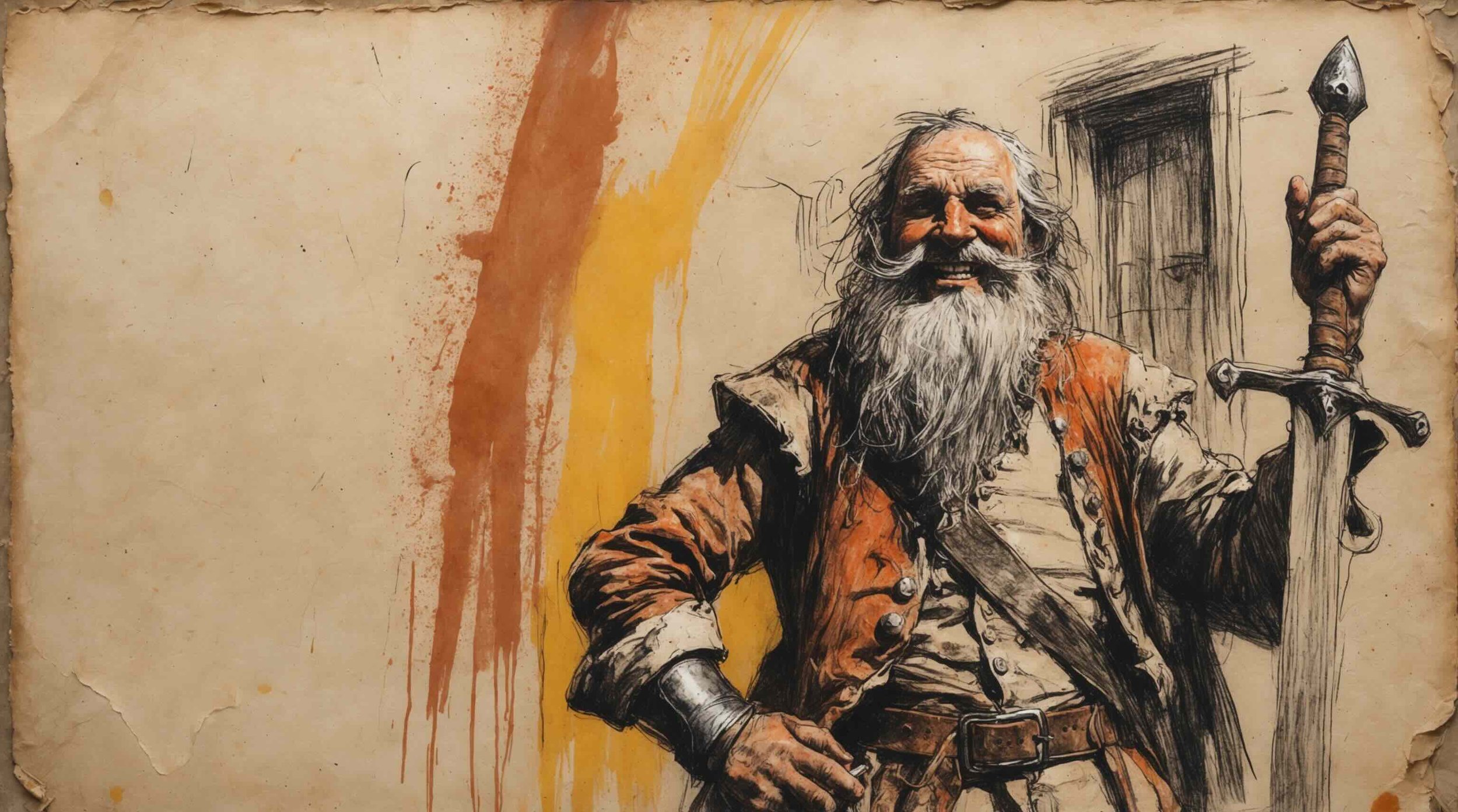
Character Profile – At a Glance
- Role: An ancient (ensign) in the English army and the last survivor of Falstaff’s Eastcheap circle. He is the play’s chief comic figure and its running commentary on what the war looks like from the bottom.
- Key Traits: Loud, cowardly, greedy and magnificently unstoppable. He speaks a swollen mock-heroic verse stolen from old plays, quarrels constantly, and is beaten by everyone he provokes.
- The Core Conflict: Pistol talks like an epic hero and behaves like a thief. The gap between his language and his conduct is the play’s most sustained comic joke – and the one place where it can be aimed at more elevated speakers too.
- Key Actions: Quarrels with Nym over the Hostess in A2S1 and is talked down by Bardolph. Leaves for France in A2S3 after news of Falstaff’s death. Hides from the fighting at Harfleur in A3S2. Begs Fluellen to save Bardolph from hanging in A3S6 and curses him when he refuses. Meets the disguised King in A4S1. Captures and ransoms a French soldier in A4S4. Is made to eat a leek by Fluellen in A5S1, and leaves the play alone.
- Famous Quote:
"Base is the slave that pays."
(Act 2, Scene 1) - The Outcome: His wife dies of disease in a London hospital, his friends are dead or hanged, and he is beaten and given fourpence. He announces that he will go home, become a pimp and a pickpocket, and pass his beating-scars off as war wounds.
The Roaring Ancient of Eastcheap
Pistol arrives in A2S1 in the middle of a quarrel, and the quarrel establishes everything about him in about forty lines. He has married the Hostess, whom Nym believes was promised to him; both men draw; neither fights. What Pistol actually does when threatened is talk.
Original
NYM: Will you shog off? I would have you solus.
PISTOL: 'Solus,' egregious dog? O viper vile!
The 'solus' in thy most mervailous face;
The 'solus' in thy teeth, and in thy throat,
And in thy hateful lungs, yea, in thy maw, perdy,
And, which is worse, within thy nasty mouth!
I do retort the 'solus' in thy bowels...
(Act 2, Scene 1)
Shakespeare Retold (Modern Verse)
NYM: Will you shove off? I want to fight you solo.
PISTOL: ‘Solo’, disgusting dog? Oh, vulgar snake!
I’ll shove your ‘solo’ in your fancy face;
The ‘solo’ in your teeth, and in your throat,
And in your hate-filled lungs and stomach, damn you,
And, even worse, within your nasty mouth!
And I will shove your ‘solo’ in your bowels...
Nym has used an ordinary word – solus, alone, meaning "let’s step outside" – and Pistol treats it as an obscenity, then spends six lines pushing it into every orifice of Nym’s body. The comedy is entirely verbal, and it depends on the audience noticing that nobody has been touched. Pistol’s method is to bury an opponent in language until the situation has passed.
The verse is doing something specific. Pistol speaks in a swollen, obsolete style borrowed from the popular tragedies of the 1580s – the theatre of Marlowe’s imitators, all thunder and Latin tags. To Shakespeare’s audience he would have sounded like a man quoting plays that were already twenty years out of date. He is, in effect, a bad actor who has escaped into real life, and the war he is about to join will keep offering him situations he can only meet with a speech.
Like Horse-Leeches, My Boys
By A2S3 Falstaff is dead and the company is leaving for France. Pistol’s farewell to his wife is a string of proverbs about trusting nobody, and it finishes with the clearest statement in the play of what the war is for, as far as Eastcheap is concerned.
Original
Go, clear thy crystals. Yoke-fellows in arms,
Let us to France; like horse-leeches, my boys,
To suck, to suck, the very blood to suck!
(Act 2, Scene 3)
Shakespeare Retold (Modern Verse)
So, dry your eyes. My comrades, joined together,
Let’s go to France, like parasitic leeches
To suck their blood, to suck and suck their blood!
Two scenes earlier the Chorus has told the audience that all the youth of England are on fire with thoughts of honour. Here is the same expedition described by the men actually going on it: a chance to feed. The repetition – suck, suck, suck – makes the appetite physical, and the image Pistol chooses for himself is a parasite that lives on other people’s blood.
It would be easy to treat this as simple comic villainy, but the play has placed it too carefully. Pistol is not being contrasted with the war; he is describing it. The English are in France to take something that belongs to somebody else, and the difference between Pistol’s account and Henry’s is largely a difference of vocabulary. Pistol also announces, in the same scene, that he intends to be a sutler – an army supplier – which is the least heroic and most profitable job available.
Bardolph Must Hang
A3S6 is the scene that turns Pistol from a joke into something harder to laugh at. Bardolph has stolen a small brass plate from a French church – a pax, kissed during Mass – and has been sentenced to hang for it. Pistol comes to Fluellen to beg for his friend’s life, and for once his rhetoric has a real object.
Original
Fortune is Bardolph's foe, and frowns on him;
For he hath stolen a pax, and hanged must a' be:
A damned death!
Let gallows gape for dog; let man go free
And let not hemp his wind-pipe suffocate:
But Exeter hath given the doom of death
For pax of little price.
(Act 3, Scene 6)
Shakespeare Retold (Modern Verse)
Fortune is an enemy of Bardolph,
He stole a church plate; now he will be hanged,
And that’s an awful death!
It’s fine to hang a dog; let him go free
Preventing rope from suffocating him.
But Exeter has ordered him to hang
For stealing a cheap plate.
The argument is that the punishment does not fit the theft, and it is a good argument. Bardolph is being killed for an object Pistol twice calls cheap. The plea is also the only time in the play that Pistol asks for something that is not money, and it is the only time his inflated manner comes close to genuine feeling.
Fluellen refuses on principle – discipline must be kept, and he would want his own brother executed for the same offence. Pistol’s response is instant and total: "Die and be damned! And figo for thy friendship!" The friendship is dropped the moment it fails to deliver. And when Henry is told of the hanging a few lines later, he approves it in one flat sentence and moves on to a general order about not stealing from French villages. Bardolph drank with Henry for two plays. The King does not remark on it.
Yield, Cur!
Pistol’s Agincourt is A4S4, and it is a small masterpiece of comic construction. While the battle rages elsewhere, Pistol captures a terrified French gentleman and tries to negotiate a ransom. Neither man speaks the other’s language, and the Boy has to interpret.
Original
Peasant, unless thou give me crowns, brave crowns;
Or mangled shalt thou be by this my sword.
(Act 4, Scene 4)
Shakespeare Retold (Modern Verse)
Peasant, unless you give me proper gold coins,
You will be chopped up by this sword of mine.
Pistol has finally got what he came to France for. The scene is funny because he is bullying a man who is already on his knees, because he cannot understand a word of the reply, and because the Frenchman ends up thanking him as the bravest and most distinguished lord in England – a description Pistol is delighted to accept and has done nothing to earn.
But the scene is placed with some cruelty. It sits immediately after the Boy has told the audience that Bardolph and Nym are both dead – hanged – and immediately before the French kill the boys guarding the baggage. The Boy who translates here is murdered within two scenes. The one commercial success of Pistol’s campaign happens in the gap between two deaths, and the play makes sure we can see both of them from where we are standing.
Bawd I’ll Turn
Pistol’s last appearance is in A5S1, and the play gives him a beating before it gives him an exit. He has mocked Fluellen’s Welsh leek; Fluellen finds him afterwards, cudgels him, and makes him eat it raw. Gower then tells him plainly what everyone has known for four acts: that he is a counterfeit. Left alone, Pistol drops the mock-heroic entirely and speaks the only plain lines he has in the play.
Original
Old I do wax; and from my weary limbs
Honour is cudgelled. Well, bawd I'll turn,
And something lean to cutpurse of quick hand.
To England will I steal, and there I'll steal:
And patches will I get unto these cudgelled scars,
And swear I got them in the Gallia wars.
(Act 5, Scene 1)
Shakespeare Retold (Modern Verse)
I’m growing old, and from my aching limbs
My reputation’s battered. I’ll run brothels,
And I’ll start picking pockets stealthily.
I’ll steal away to England and start stealing:
I’ll plaster clobbered scars, so I’ll enhance
My claim I got them in the wars in France.
"Honour is cudgelled" is the whole play in three words, delivered by the person least entitled to say it. The pun in the fourth line does the rest: Pistol will steal to England and then steal in it, the same verb doing both jobs. And the final couplet is the sharpest thing in the speech. He will fake the wounds. Somewhere in England there will be a veteran of Agincourt showing scars he got from a Welshman with a stick, and the story will be believed.
The placing is what gives it force. This speech comes immediately before the last scene, in which kings and dukes settle the peace of Europe and Henry woos Katharine. Everyone Pistol came to France with is dead. He goes home widowed, beaten, broke and dishonest, and the play does not pause over it. He is the war’s account rendered from below, and it does not balance.
"…we wish Henry a glorious reign and much joy of his crew of hypocritical politicians, lay and clerical; but our hearts go with Falstaff to the Fleet."
— A. C. Bradley, Oxford Lectures on Poetry, 1909
Key Quotes
Quote 1
Bardolph, be blithe: Nym, rouse thy vaunting veins:
Boy, bristle thy courage up; for Falstaff he is dead,
And we must earn therefore.
(Act 2, Scene 3)
Shakespeare Retold (Modern Verse)
Bardolph, be happy. Nym, arouse your blood.
Boy, fire up your courage, for Falstaff now is dead,
And we must earn our keep without his help.
Quote Analysis: The hinge of the whole Eastcheap plot, and colder than it first appears. Falstaff has just died offstage of a broken heart, and Pistol’s response is a rallying cry followed by a piece of arithmetic: the man who kept them is gone, so they will have to make their own living. "Earn" is doing a great deal of work – what Pistol means by earning is the looting he describes minutes later. The line marks the point at which the comic world of the Henry IV plays stops being funded by anybody and has to go to France to feed itself.
The plain-song is most just: for humours do abound:
Knocks go and come; God's vassals drop and die;
And sword and shield,
In bloody field,
Doth win immortal fame.
(Act 3, Scene 2)
Shakespeare Retold (Modern Verse)
That statement of truth is right, for fear is everywhere:
Hits come and go; God’s people fall and die;
A sword and shield,
In a battlefield
Does win immortal fame.
Quote Analysis: Spoken at the walls of Harfleur, seconds after Henry has finished "Once more unto the breach", and while Pistol is conspicuously not going through it. He agrees that the fighting is glorious, sings a snatch of ballad about immortal fame, and stays exactly where he is. The short jingling lines are the giveaway: the metre collapses into doggerel at the precise moment the sentiment becomes heroic. Shakespeare places Pistol’s version of the war twenty lines after the King’s, and lets the audience hear both.
The king's a bawcock, and a heart of gold,
A lad of life, an imp of fame;
Of parents good, of fist most valiant.
I kiss his dirty shoe, and from heart-string
I love the lovely bully. What is thy name?
(Act 4, Scene 1)
Shakespeare Retold (Modern Verse)
The king’s a fine man with a heart of gold,
A lively chap, a famous child;
Well raised, and brave when fighting with his fists.
I’d kiss his dirty shoes; with all my heart
I love that decent man. What is your name?
Quote Analysis: Pistol is praising the King to a stranger in the dark, and the stranger is the King. It is the warmest tribute Henry receives all night, and it is worth nothing, because Pistol does not know who he is talking to and because "bully" and "lad of life" are the vocabulary of a tavern rather than a court. Two things follow. Henry has just been told he is loved by a man he watched Bardolph hang beside. And when Pistol asks his name, Henry lies. The one unguarded compliment in A4S1 is repaid with a false identity.
As I suck blood, I will some mercy show.
Follow me!
(Act 4, Scene 4)
Shakespeare Retold (Modern Verse)
Although I am a leech, I will show mercy.
Follow me!
Quote Analysis: Pistol accepts the ransom and lets his prisoner live, and the sentence he uses to do it is one of the strangest in the play. He calls himself a bloodsucker in the same breath as he offers mercy, and appears to see no contradiction – the mercy is a business decision, and he says so. The line also closes the loop with A2S3, where he promised his friends they would go to France as horse-leeches. He has done exactly what he said he would do. Alone among the characters in this play, Pistol never dresses up his motives, and the effect is to make everyone else’s dressing-up visible.
Key Takeaways
- All Voice, No Heart: Pistol’s swollen mock-heroic verse is the play’s running joke about the distance between what people say and what they do.
- The War From Below: He states plainly what the campaign offers ordinary soldiers – plunder, ransom and the chance to feed – while the Chorus describes honour.
- Bardolph’s Hanging: Pistol’s plea for his friend is his one moment of real feeling, and the King’s flat approval of the execution is the coldest line in the play.
- The Bill for the Victory: He goes home widowed, beaten and broke, and plans to fake his war wounds. His exit is placed right before the royal peace-making.
Study Questions and Analysis
Who is Pistol and what is his function in the play?
Pistol is an ancient – a corruption of "ensign", the junior officer who carried the company colours – and he arrives in Henry V carrying a history. He first appears in Henry IV, Part 2 as one of Falstaff’s hangers-on, and by the time this play opens he has married Mistress Quickly, the Hostess, and inherited what is left of the Eastcheap crowd.
His function is structural rather than plot-driven: he does almost nothing that affects the outcome of the war, and the play would lose no events if he were cut. What it would lose is its second opinion. Every stage of the campaign is shown twice – once in the high style, once in Eastcheap. The Boy, who has watched him for three acts, delivers the flattest assessment:
I did never know so full a voice issue from so empty a heart: but the saying is true: 'The empty vessel makes the greatest sound.'
(the Boy, Act 4, Scene 4)
Shakespeare Retold (Modern Verse)
I’ve never heard a voice so loud from such a hollow heart. But the proverb is true: ‘When empty, vessels make the loudest noise.’
That verdict is aimed at Pistol, but the play arranges for it to travel. A drama whose central figure governs by speaking has just been handed a proverb about loud voices and empty hearts, and it is spoken by the most reliable witness in the cast. Harold C. Goddard’s The Meaning of Shakespeare (1951) built much of its reading on exactly this pattern, treating the Eastcheap underplot as a sustained ironic commentary on the main action rather than as light relief between battles.
There is a practical dimension too. Pistol is a substantial comic part, and the 1600 Quarto – which cuts the Chorus and most of the material inviting scepticism about the war – keeps him. Whatever else he is, he was popular.
What is the effect of Pistol's inflated language?
Pistol speaks a language nobody else in the play speaks, and identifying it precisely is worth doing. It is not simply "bad verse". It is a pastiche of the heroic drama of the 1580s: end-stopped blank verse, exclamatory openings, classical name-dropping, mangled foreign phrases, and a general air of having been shouted from a scaffold twenty years ago. To an audience in 1599 it would have sounded like a man who had learned to speak from watching old plays.
The joke works because his situation never matches his register. Here he is threatening a man who has already surrendered:
O, Signieur Dew should be a gentleman:
Perpend my words, O Signieur Dew, and mark;
O Signieur Dew, thou diest on point of fox,
Except, O signieur, thou do give to me
Egregious ransom.
(Act 4, Scene 4)
Shakespeare Retold (Modern Verse)
Oh, Signior Dew thinks he’s a gentleman:
Reflect upon my words, oh Signior Dew:
Oh Signior Dew, you’ll die upon this sword
Unless, oh Signior, you will give to me
A massive ransom payment.
"Signieur Dew" is Pistol mishearing the Frenchman’s "Dieu" – God – as a surname, and then addressing him by it four times with mounting grandeur. The rhetoric is immaculate and the comprehension is zero.
The larger point is comparative. Henry V is a play in which the leading character wins a war by talking, and it takes care to include a man whose talk is worthless. James L. Calderwood’s Metadrama in Shakespeare’s Henriad (1979) reads the tetralogy as moving from confidence in language to scepticism about it, with even Henry’s rhetoric carrying a "built-in obsolescence"; Pistol is that scepticism given a body and a costume. Michael Neill’s "Broken English and Broken Irish" (Shakespeare Quarterly, 1994) places him alongside the play’s Welsh, Irish and Scots captains and its French princess as one of many characters whose relationship to English is a problem the play keeps staging.
Why does Shakespeare kill Falstaff offstage instead of putting him in the play?
The epilogue to Henry IV, Part 2 had promised the audience that the story would continue "with Sir John in it". It does not. Falstaff dies in A2S3, offstage, reported by the Hostess in the most famous piece of prose in the play.
I saw him fumble with the sheets and play with flowers and smile upon his fingers' ends, I knew there was but one way; for his nose was as sharp as a pen, and a' babbled of green fields.
(the Hostess, Act 2, Scene 3)
Shakespeare Retold (Modern Verse)
I saw him fumbling with the sheets, pretending he was playing with flowers, smiling as he looked at his fingertips, I knew that he was dying; for his face was gaunt, his nose drawn out like a pen, and he mumbled about green fields.
Three explanations circulate, and all three have something in them. The first is theatrical: Will Kemp, the company’s great comic actor, left the Lord Chamberlain’s Men around 1599, and the part may simply have had nobody to play it. The second is political: the Falstaff character had already caused trouble with the Cobham family over his original name, Oldcastle, and further trouble was avoidable. The third is dramatic, and it is the one worth arguing in an essay.
Samuel Johnson, annotating the play in 1765, thought Shakespeare had exhausted the character – that he could "contrive no train of adventures suitable to his character" once Hal became king. A. C. Bradley’s "The Rejection of Falstaff" (Oxford Lectures on Poetry, 1909) made the more influential case: Shakespeare had made Falstaff too attractive for the rejection at the end of Part 2 to land as intended, so that "our hearts go with Falstaff to the Fleet" rather than transferring to the new king. On Bradley’s reading, Falstaff could not appear in Henry V because he would win the audience away from its hero.
What the play does instead is keep the ghost. Falstaff dies of a broken heart – the Hostess says the King has killed it – and the remnant of his circle goes to France, where Bardolph is hanged, Nym is hanged, the Boy is murdered, and Pistol comes home to nothing. The comic world is not so much removed as slowly liquidated.
What does Bardolph's hanging show about Henry's army?
It shows the discipline working exactly as advertised, and it shows what that costs. Bardolph steals a pax – a small brass or wooden tablet, kissed by the congregation during Mass – from a French church, and is hanged for it. The theft is petty; the object is sacred; the sentence is death.
Henry hears of it from Fluellen and responds without hesitation:
We would have all such offenders so cut off: and we give express charge, that in our marches through the country, there be nothing compelled from the villages, nothing taken but paid for, none of the French upbraided or abused in disdainful language...
(King Henry, Act 3, Scene 6)
Shakespeare Retold (Modern Verse)
We’ll have all offenders like that executed. And I give an express order that as we march through the country, nothing is pilfered from the villages, nothing is taken unless it’s paid for, none of the French people insulted or abused with disrespectful words...
The policy is genuinely admirable, and Henry gives the reason: when lenity and cruelty compete for a kingdom, the gentler player wins soonest. An army that does not rob the country it is crossing keeps that country’s roads open. This is competent generalship as well as decency.
What the scene does not contain is any sign that Henry recognises the name. Bardolph appears in three plays with him; they drank together, robbed together, and Bardolph’s red nose was a running joke between them. The King says "such offenders" and moves on. Whether Shakespeare intends coldness, self-discipline, or simply a man with a battle to fight is left entirely open – and productions have played all three.
Theodor Meron, writing on Henry V and the law of war in the American Journal of International Law (1992) and in Henry’s Wars and Shakespeare’s Laws (1993), notes that the historical Henry’s ordinances of war were unusually strict about church property and that the play is accurate here. Stephen Greenblatt’s "Invisible Bullets" (1988) reads the episode differently, as one of the moments where the play "deftly registers every nuance of royal hypocrisy, ruthlessness, and bad faith" and then absorbs it into the celebration.
Why is Pistol's scene with the French soldier important?
A4S4 is the only view the play gives of Agincourt from inside the fighting, and what it shows is not fighting. It is a transaction.
BOY: He prays you to save his life: he is a gentleman of a good house; and for his ransom he will give you two hundred crowns.
PISTOL: Tell him my fury shall abate, and I the crowns will take.
(Act 4, Scene 4)
Shakespeare Retold (Modern Verse)
BOY: He begs that you save his life: he is a gentleman from a good house, and for his ransom payment he will give you two hundred gold coins.
PISTOL: Tell him my anger will subside and I will take his gold coins.
Ransom was the ordinary economics of medieval warfare: a captured gentleman was worth money alive and nothing dead, which is why armies took prisoners. Pistol is not behaving abnormally. He is behaving exactly as the system expects, and the scene lets the audience watch the system operate without any of the language that usually covers it.
Its placement does the rest of the work. It comes immediately after Henry has refused ransom for himself in the grandest possible terms, and immediately before he orders every prisoner in the English camp killed. Set the three moments side by side and the play has shown ransom refused on principle, ransom accepted for profit, and ransom cancelled by slaughter, inside about two hundred lines.
Jonathan Dollimore and Alan Sinfield, in Alternative Shakespeares (1985), argued that "even in this play, which is often assumed to be the one where Shakespeare is closest to state propaganda, the construction of ideology is complex"; sequences like this one are what they had in mind. The scene also gives the Boy his last speech. He stays behind with the luggage, tells the audience that Bardolph and Nym are hanged and that Pistol is an empty vessel, and is killed offstage before the act is over.
What is the point of the leek scene in Act 5?
The leek scene is often cut in performance and is worth defending. Pistol has insulted Fluellen’s Welshness by mocking the leek he wears on Saint David’s Day; Fluellen waits until the war is over, then beats him with a cudgel and makes him eat one raw.
PISTOL: By this leek, I will most horribly revenge: I eat and eat, I swear –
FLUELLEN: Eat, I pray you: will you have some more sauce to your leek? There is not enough leek to swear by.
(Act 5, Scene 1)
Shakespeare Retold (Modern Verse)
PISTOL: By this leek, I swear I will get revenge. I’m eating it, I am, I promise…
FLUELLEN: Eat, I tell you: do you want some more sauce on your leek? There’s not enough leek left for you to swear on.
The comedy is precise: Pistol swears revenge on the very object he is being forced to swallow, and Fluellen points out that he is eating his own oath. It is the exact reversal of the A2S1 quarrel, where Pistol’s words were enough to keep him safe. Here they are worth nothing, and he is paid fourpence for his trouble.
Gower then explains the moral in the plainest terms in the play – that Pistol mocked Fluellen because he could not speak English without an accent, and assumed that a man who spoke oddly could not hit hard. That makes the scene part of the play’s larger argument about nation and language rather than a detachable piece of knockabout. Michael Neill’s "Broken English and Broken Irish" (Shakespeare Quarterly, 1994) and Christopher Highley’s Shakespeare, Spenser, and the Crisis in Ireland (1997) both read the play’s treatment of Welsh, Irish and Scots speech as bound up with how Englishness was being constructed in 1599 – and the leek scene is where the play insists that the man with the accent is the one with the authority.
Structurally, it also clears the stage. Every one of Pistol’s companions is gone; the beating strips him of the last thing he had, which was his mouth; and what follows is the soliloquy that sends him home to a criminal career.
What does Pistol's ending tell us about the cost of the war?
It supplies the audit that the royal ending does not. A5S2 gives us the treaty, the marriage and the union of two crowns. A5S1 gives us this:
Doth Fortune play the huswife with me now?
News have I, that my Nell is dead i' the spital
Of malady of France;
And there my rendezvous is quite cut off.
(Act 5, Scene 1)
Shakespeare Retold (Modern Verse)
Is Lady Luck my cheating floozy now?
I’ve heard my wife Nell died in hospital
Of syphilis;
And so I can’t return to stay with her.
The phrase "malady of France" is a period name for syphilis, and the pun is doing hard work in a play about a French campaign: the disease and the war carry the same name, and both of them have emptied Eastcheap. Nell’s death removes the last thing Pistol had to return to. Of the five characters who left London in A2S3, one is dead of disease, two are hanged, one is murdered, and one comes home to become a pimp.
The critical stakes here are the same as for the Epilogue. Norman Rabkin’s "Rabbits, Ducks, and Henry V" (Shakespeare Quarterly, 1977) argued that the play "points in two opposite directions, virtually daring us to choose one of the two opposed interpretations it requires of us"; a triumphal history that immediately precedes its wedding scene with a widowed thief planning to fake his war wounds is a fair example of what he meant. Harold C. Goddard (1951) read the Eastcheap material as consistently ironic in this way, tracking the distance between what the play announces and what it shows.
The counter-case is that Pistol is a coward and a criminal who has ended roughly where he deserves, and that the play is not asking us to grieve for him. That is fair as far as it goes. But the play chose to give him a soliloquy, chose to place it here, and chose to end it on the image of counterfeit scars – and none of those choices were forced.