ACT 4
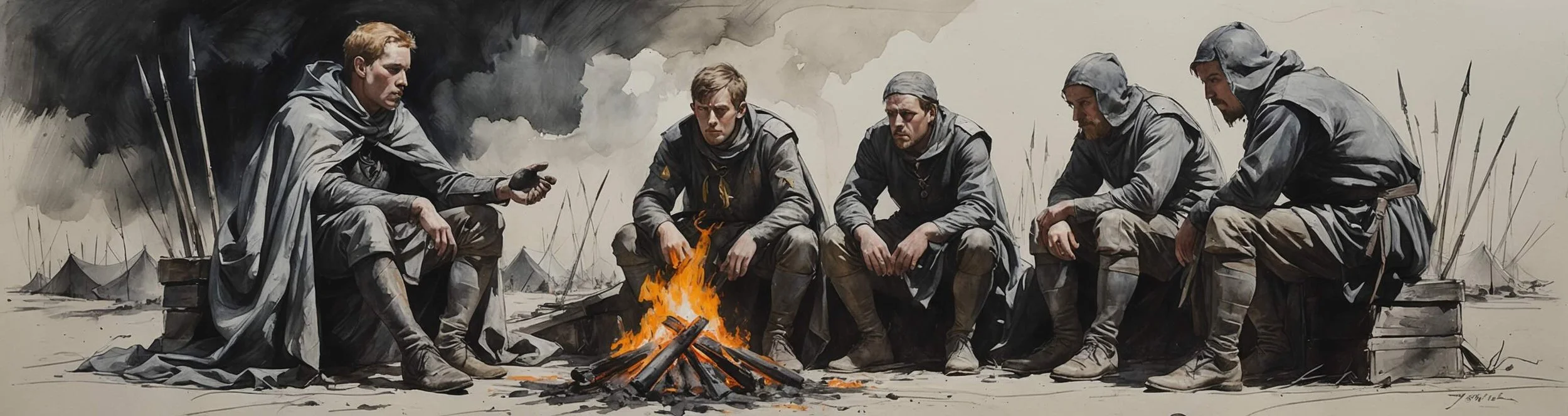
Henry V Act 4, Scene 1: Retold in Modern English Verse
A borrowed cloak and a king’s burden
Before dawn, Henry borrows Sir Thomas Erpingham’s cloak and walks unknown among his men. He trades words with Pistol, overhears Fluellen lecturing Gower, and falls into hard argument with the soldiers Bates and Williams over whether the king’s cause can answer for the men who die in it; he and Williams exchange gloves as pledges of a quarrel to be settled after the battle. Alone, Henry weighs the emptiness of ceremony against the sound sleep of a slave, and prays God not to think upon the fault his father made in compassing the crown.
Characters appearing: King Henry V | Bedford | Gloucester | Erpingham | Pistol | Fluellen | Gower | Bates | Court | Williams
Key themes: Kingship and Leadership | Religion and Morality | Class and Brotherhood
THE ENGLISH CAMP AT AGINCOURT.
[ENTER KING HENRY, BEDFORD, AND GLOUCESTER]
KING HENRY V
Gloucester, 'tis true that we are in great danger;
Gloucester, it’s true that we are in great danger;
The greater therefore should our courage be.
And so our courage must be greater still.
Good morrow, brother Bedford. God Almighty!
Good morning, brother Bedford. God Almighty!
There is some soul of goodness in things evil,
There’s something good in everything that’s evil,
Would men observingly distil it out.
If only we would take the time to look.
For our bad neighbour makes us early stirrers,
Such as our foe that makes us get up early,
Which is both healthful and good husbandry:
Which is a healthy thing to do, and prudent.
Besides, they are our outward consciences,
Besides, they’re like our conscience staring at us,
And preachers to us all, admonishing
And, like a preacher issuing a warning,
That we should dress us fairly for our end.
Advising we prepare ourselves for death.
Thus may we gather honey from the weed,
Thus, we will benefit from something bad,
And make a moral of the devil himself.
And learn a moral lesson from the devil.
[ENTER ERPINGHAM]
Good morrow, old Sir Thomas Erpingham:
Good morning, old Sir Thomas Erpingham:
A good soft pillow for that good white head
Your grey hair should be resting on a pillow
Were better than a churlish turf of France.
Instead of on this hostile grass of France.
ERPINGHAM
Not so, my liege: this lodging likes me better,
Not true, my lord: I much prefer to sleep here,
Since I may say 'Now lie I like a king.'
So I can say, ‘I’m sleeping like a king.’
KING HENRY V
'Tis good for men to love their present pains
It’s good that men can tolerate discomfort
Upon example; so the spirit is eased:
Through leading by example; it is soothing.
And when the mind is quickened, out of doubt,
And with our spirits stirred, without a doubt,
The organs, though defunct and dead before,
Our body parts, though broken earlier,
Break up their drowsy grave and newly move,
Snap out of lethargy and move again,
With casted slough and fresh legerity.
As snakes stay fresh by shedding tired skin.
Lend me thy cloak, Sir Thomas. Brothers both,
Lend me your cloak, Sir Thomas. Both of you,
Commend me to the princes in our camp;
Give my regards to nobles in our camp;
Do my good morrow to them, and anon
Wish them good day from me, and after that
Desire them all to my pavilion.
Request they all come to my army tent.
GLOUCESTER
We shall, my liege.
We will, my lord.
ERPINGHAM
Shall I attend your grace?
Shall I come with your grace?
KING HENRY V
No, my good knight;
No, sir;
Go with my brothers to my lords of England:
Go with my brothers to the noblemen.
I and my bosom must debate awhile,
I need to spend some time in contemplation,
And then I would no other company.
And therefore I would like to be alone.
ERPINGHAM
The Lord in heaven bless thee, noble Harry!
The Lord in heaven bless you, noble Harry!
[EXEUNT ALL BUT KING HENRY]
KING HENRY V
God-a-mercy, old heart! Thou speak'st cheerfully.
My thanks to you, old friend – you’ve cheered me up.
[ENTER PISTOL]
PISTOL
Qui va la?
Who goes there?
KING HENRY V
A friend.
A friend.
PISTOL
Discuss unto me; art thou officer?
Reveal to me: are you an officer?
Or art thou base, common and popular?
Or are you a plebeian commoner?
KING HENRY V
I am a gentleman of a company.
I am a ranking soldier in a squadron.
PISTOL
Trail'st thou the puissant pike?
Do you carry a powerful battle spear?
KING HENRY V
Even so. What are you?
I do. And who are you?
PISTOL
As good a gentleman as the emperor.
As noble as the emperor himself.
KING HENRY V
Then you are a better than the king.
So you’re superior then to the king.
PISTOL
The king's a bawcock, and a heart of gold,
The king’s a fine man with a heart of gold,
A lad of life, an imp of fame;
A lively chap, a famous child;
Of parents good, of fist most valiant.
Well raised, and brave when fighting with his fists.
I kiss his dirty shoe, and from heart-string
I’d kiss his dirty shoes; with all my heart
I love the lovely bully. What is thy name?
I love that decent man. What is your name?
KING HENRY V
Harry le Roy.
Harry le Roy.
PISTOL
Le Roy! A Cornish name: art thou of Cornish crew?
Le Roy! A Cornish name: are you from Cornwall?
KING HENRY V
No, I am a Welshman.
No, I am a Welshman.
PISTOL
Know'st thou Fluellen?
Do you know Fluellen?
KING HENRY V
Yes.
Yes.
PISTOL
Tell him, I'll knock his leek about his pate
Tell him, I’ll knock his leek badge off his head
Upon Saint Davy's day.
When it’s St David’s day.
KING HENRY V
Do not you wear your dagger in your cap that day,
You better not wear your dagger in your cap that day,
lest he knock that about yours.
in case he hits you around your head.
PISTOL
Art thou his friend?
Are you his friend?
KING HENRY V
And his kinsman too.
And his kinsman as well.
PISTOL
The figo for thee, then!
I’ll flip you the bird, then!
KING HENRY V
I thank you: God be with you!
Well, thank you: God be with you!
PISTOL
My name is Pistol called.
My name is Pistol.
[EXIT]
KING HENRY V
It sorts well with your fierceness.
Your name matches your fierceness.
[ENTER FLUELLEN AND GOWER]
GOWER
Captain Fluellen!
Captain Fluellen!
FLUELLEN
So! In the name of Jesu Christ, speak lower. It is
Oi! For Christ’s sake, speak quieter. It is
the greatest admiration of the universal world, when
the most astonishing thing in the world when
the true and aunchient prerogatifes and laws of the
the real ancient prerogatives and laws of
wars is not kept: if you would take the pains but to
war are not observed. If you could be bothered to
examine the wars of Pompey the Great, you shall
study the wars of Pompey the Great, you will
find, I warrant you, that there is no tiddle toddle
find, I assure you, that there is no chitter-chatter
nor pibble pabble in Pompey's camp; I warrant you,
nor jibber-jabber in Pompey’s camp. I assure you,
you shall find the ceremonies of the wars, and the
you will find military ceremonies, and the
cares of it, and the forms of it, and the sobriety
discipline, and the structure, and the sober
of it, and the modesty of it, to be otherwise.
execution, and the humility, unlike what we’ve got here.
GOWER
Why, the enemy is loud; you hear him all night.
Well, our enemy is noisy; you can hear them all night.
FLUELLEN
If the enemy is an ass and a fool and a prating
If the enemy is an idiot and a fool and waffling
coxcomb, is it meet, think you, that we should also,
twerp, is it appropriate, do you think, that we should also,
look you, be an ass and a fool and a prating
you see, act like an idiot and a fool and a waffling
coxcomb? In your own conscience, now?
twerp? What do you reckon now?
GOWER
I will speak lower.
I will speak quieter.
FLUELLEN
I pray you and beseech you that you will.
I beg and implore you do that.
[EXEUNT GOWER AND FLUELLEN]
KING HENRY V
Though it appear a little out of fashion,
Although he is a rather quirky chap,
There is much care and valour in this Welshman.
This Welshman is both careful and he’s brave.
[ENTER THREE SOLDIERS, JOHN BATES, ALEXANDER COURT, AND MICHAEL WILLIAMS]
COURT
Brother John Bates, is not that the morning which
Brother John Bates, isn’t that the sign of morning
breaks yonder?
breaking over the horizon?
BATES
I think it be: but we have no great cause to desire
I think it is: but we don’t have any reason to wish for
the approach of day.
the day to arrive.
WILLIAMS
We see yonder the beginning of the day, but I think
Over there we see the beginning of the day, but I don’t
we shall never see the end of it. Who goes there?
think we’ll ever see the end of it. Who goes there?
KING HENRY V
A friend.
A friend.
WILLIAMS
Under what captain serve you?
Under what captain do you serve?
KING HENRY V
Under Sir Thomas Erpingham.
Under Sir Thomas Erpingham.
WILLIAMS
A good old commander and a most kind gentleman: I
He’s a good old commander and a decent gentleman.
pray you, what thinks he of our estate?
Tell me, what does he think of the current situation?
KING HENRY V
Even as men wrecked upon a sand, that look to be
He thinks we’re like shipwrecked men on a sandbank,
washed off the next tide.
waiting to be washed away on the next high tide.
BATES
He hath not told his thought to the king?
Has he not shared these thoughts with the king?
KING HENRY V
No; nor it is not meet he should. For, though I
No, nor would it be appropriate for him to do so. Because,
speak it to you, I think the king is but a man, as I
although it might not be appropriate to say so, the king is just
am: the violet smells to him as it doth to me: the
a man like me: a violet smells the same to him as it does me;
element shows to him as it doth to me; all his
air and water appear the same to him as to me; all
senses have but human conditions: his ceremonies
his senses are merely human conditions; without his royal
laid by, in his nakedness he appears but a man; and
pageantry, he’s just a man when seen naked;
though his affections are higher mounted than ours,
though his aspirations are higher than ours,
yet, when they stoop, they stoop with the like
when he falls – like a falcon swoops for prey – he falls the
wing. Therefore when he sees reason of fears, as we
same way we do. So when he sees a reason to be fearful, like
do, his fears, out of doubt, be of the same relish
we do, without a doubt his fears will be just the same
as ours are: yet, in reason, no man should possess
as ours. But, it makes sense that no one should fill him
him with any appearance of fear, lest he, by showing
with fear by appearing scared, in case he shows that
it, should dishearten his army.
fear and disheartens his army.
BATES
He may show what outward courage he will; but I
He can demonstrate whatever courage he likes; but I
believe, as cold a night as 'tis, he could wish
think, however cold it is tonight, he is wishing
himself in Thames up to the neck; and so I would he were,
he was up to his neck in the River Thames; and so do I,
and I by him, at all adventures, so we were quit here.
standing beside him, whatever the risk, to get out of here.
KING HENRY V
By my troth, I will speak my conscience of the king:
In honesty, I’ll tell you what I think about the king:
I think he would not wish himself any where but
I think he wouldn’t wish to be anywhere other than
where he is.
where he is now.
BATES
Then I would he were here alone; so should he be sure
Then I wish he was here alone, so he could be
to be ransomed, and a many poor men's lives saved.
held to ransom, and many a poor man’s life be saved.
KING HENRY V
I dare say you love him not so ill, to wish him here
I bet you don’t dislike him so much that you’d wish he were
alone, howsoever you speak this to feel other men's
here alone; you’re just saying that to figure out what the
minds: methinks I could not die any where so
other men think. Personally, I don’t think I could die anywhere
contented as in the king's company; his cause being
as contentedly as here with the king, because his rationale
just and his quarrel honourable.
is right and his argument is honourable.
WILLIAMS
That's more than we know.
Whether right and honourable is more than we actually know.
BATES
Ay, or more than we should seek after; for we know
Yes, or more than we should try to find out; for all we need to
enough, if we know we are the kings subjects: if
know is that we are under the rule of the king: if
his cause be wrong, our obedience to the king wipes
the king’s rationale is wrong, our obedience to the king rids
the crime of it out of us.
us of any guilt.
WILLIAMS
But if the cause be not good, the king himself hath
But if the king’s rationale isn’t good, the king himself has
a heavy reckoning to make, when all those legs and
a high price to pay, because all those legs and
arms and heads, chopped off in battle, shall join
arms and heads that get chopped off in battle will join
together at the latter day and cry all 'We died at
together on Judgement Day, shouting, ‘We died at
such a place;' some swearing, some crying for a
that place;’ some will be swearing, some crying for a
surgeon, some upon their wives left poor behind
surgeon, some will wail for their wives left poor when
them, some upon the debts they owe, some upon their
they died, some worried about debts they owe, some by
children rawly left. I am afeard there are few die
their children harshly left behind. I’m afraid that few people die
well that die in a battle; for how can they
well in a battle, for how can one die with
charitably dispose of any thing, when blood is their
dignity and grace when bloodshed is all they are
argument? Now, if these men do not die well, it
seeking? Now, if these men don’t die honourably,
will be a black matter for the king that led them to
it will be a grave charge against the king for causing their
it; whom to disobey were against all proportion of
deaths; for they had no choice but to obey his
subjection.
orders.
KING HENRY V
So, if a son that is by his father sent about
So, if a son – sent by his father on a
merchandise do sinfully miscarry upon the sea, the
business trip – commits a sin, and is then shipwrecked, then,
imputation of his wickedness by your rule, should be
by your logic, the son’s sins should be paid for by
imposed upon his father that sent him: or if a
his father who sent him on the trip. Or, if a
servant, under his master's command transporting a
servant – fulfilling the orders of his master – is delivering
sum of money, be assailed by robbers and die in
a sum of money but is then robbed and dies without
many irreconciled iniquities, you may call the
praying for his sins to be forgiven, you are saying that
business of the master the author of the servant's
his master is responsible for the servant’s
damnation: but this is not so: the king is not
damnation. But this isn’t the case: the king is not
bound to answer the particular endings of his soldiers,
responsible for how each of his soldiers dies, just as the
the father of his son, nor the master of his
father is not responsible for his son, nor the master for his
servant; for they purpose not their death, when
servant; for they don’t intend them to die when
they purpose their services. Besides, there is no
they commanded them into their service. Besides, there is no
king, be his cause never so spotless, if it come to
king, even if his rationale were spotless, who can
the arbitrement of swords, can try it out with all
put together a fighting army where all the soldiers
unspotted soldiers: some peradventure have on them
have spotless characters as well. Some soldiers will carry
the guilt of premeditated and contrived murder;
the guilt of planning a premeditated murder;
some, of beguiling virgins with the broken seals of
some will have seduced virgins by lying to
perjury; some, making the wars their bulwark, that
them; some will use the war as defence against the
have before gored the gentle bosom of peace with
fact they violently broke the peace before through
pillage and robbery. Now, if these men have
pillage and robbery. Now, if these men have
defeated the law and outrun native punishment,
escaped justice and not been punished for it,
though they can outstrip men, they have no wings to
they might be able to outrun men, but they won’t escape
fly from God: war is his beadle, war is vengeance;
the justice of God. War is God’s constable and avenger:
so that here men are punished for before-breach of
in war, men are punished for crimes committed before
the king's laws in now the king's quarrel:
the king gave his orders in a battle the king has now ordered.
where they feared the death, they have borne life away;
Where they feared death before, they escaped with their lives,
and where they would be safe, they perish: then if
and where they thought they were safe, they died. So if
they die unprovided, no more is the king guilty of
they die without repenting their sins, the king is no more guilty
their damnation than he was before guilty of those
of their damnation than he was guilty of those
impieties for the which they are now visited. Every
sins for which God is now holding them to account. Every
subject's duty is the king's; but every subject's
person’s duty is to obey the king; but every person’s
soul is his own. Therefore should every soldier in
soul is their own. And so every soldier in
the wars do as every sick man in his bed, wash every
a war should do what a sick man in bed does, namely
mote out of his conscience: and dying so, death
pray to purge his conscience of sin. Then if he dies, his death
is to him advantage; or not dying, the time was
will be advantageous, taking him to heaven; or if he lives, the
blessedly lost wherein such preparation was gained:
time was blessed when he made his preparations for death.
and in him that escapes, it were not sin to think
And for those that survive, it’s fair to think
that, making God so free an offer, He let him
that, after offering God an easy chance to kill him, God let him
outlive that day to see His greatness and to teach
survive that day to bear witness to God’s greatness and teach
others how they should prepare.
others how to prepare for their deaths.
WILLIAMS
'Tis certain, every man that dies ill, the ill upon
It’s true that every man that dies without repenting is
his own head, the king is not to answer it.
responsible for it themselves, and the king is not to blame.
BATES
But I do not desire he should answer for me; and
But I don’t want him to shoulder my guilt, and
yet I determine to fight lustily for him.
yet I am determined to fight fiercely for him.
KING HENRY V
I myself heard the king say he would not be ransomed.
I heard the king say he will not pay a ransom if captured.
WILLIAMS
Ay, he said so, to make us fight cheerfully: but
Yes, he said that to make us fight enthusiastically. But
when our throats are cut, he may be ransomed, and we
when our throats are cut, he might pay the ransom and we
ne'er the wiser.
will never know.
KING HENRY V
If I live to see it, I will never trust his word after.
If I live to see him do that, I will never trust him again.
WILLIAMS
You pay him then. That's a perilous shot out of an
So you’ll make him pay for it? That’s as dangerous as firing
elder-gun, that a poor and private displeasure can
a wooden toy pop-gun, thinking that a poor man can have any
do against a monarch! You may as well go about to
influence on the monarch! You may as well try to
turn the sun to ice with fanning in his face with a
turn the sun to ice by fanning it with a
peacock's feather. You'll never trust his word
peacock’s feather. You’ll never trust his word
after! Come, 'tis a foolish saying.
again! Come on, that’s a ridiculous thing to say.
KING HENRY V
Your reproof is something too round: I should be
Your rebuttal is too blunt: I would be
angry with you, if the time were convenient.
angry with you if the time allowed.
WILLIAMS
Let it be a quarrel between us, if you live.
Then let’s continue the quarrel if you survive.
KING HENRY V
I embrace it.
I’ll do that.
WILLIAMS
How shall I know thee again?
How will I recognise you again?
KING HENRY V
Give me any gage of thine, and I will wear it in my
Give me something of yours, and I will wear it in my
bonnet: then, if ever thou darest acknowledge it, I
hat. Then, if you ever dare to acknowledge that it’s yours, I
will make it my quarrel.
will continue the argument with you.
WILLIAMS
Here's my glove: give me another of thine.
Here’s my glove: give me something of yours.
KING HENRY V
There.
There.
WILLIAMS
This will I also wear in my cap: if ever thou come
I will also wear this in my hat: if you ever come
to me and say, after to-morrow, 'This is my glove,'
to me and say, after tomorrow, ‘This is my glove,’
by this hand, I will take thee a box on the ear.
I swear I will clip you round the ear.
KING HENRY V
If ever I live to see it, I will challenge it.
If I ever live to see it again, I’ll ask you for it.
WILLIAMS
Thou darest as well be hanged.
You might as well dare to be hanged.
KING HENRY V
Well. I will do it, though I take thee in the
Well. I will do it, even if I meet you in the
king's company.
company of the king.
WILLIAMS
Keep thy word: fare thee well.
Keep your word. I wish you well.
BATES
Be friends, you English fools, be friends: we have
Be friends, you English fools, be friends: we have
French quarrels enow, if you could tell how to reckon.
Frenchmen to quarrel with now, in case you hadn’t noticed.
KING HENRY V
Indeed, the French may lay twenty French crowns to
Indeed, the French might gamble twenty French coins to one
one, they will beat us; for they bear them on their
that they will beat us. After all, they carry their
shoulders: but it is no English treason to cut
coins on their shoulders. But it’s not treasonous for English
French crowns, and to-morrow the king himself will
to chip away at the French coins, and tomorrow the king
be a clipper.
himself will be chipping away at coins.
[EXEUNT SOLDIERS]
Upon the king! Let us our lives, our souls,
Let’s blame the king! Let’s take our lives and souls,
Our debts, our careful wives,
Our debts, our careful wives,
Our children and our sins lay on the king!
Our children and our sins and blame the king!
We must bear all. O hard condition,
A king must bear it all. It’s difficult,
Twin-born with greatness, subject to the breath
It comes with leadership, exposed to views
Of every fool, whose sense no more can feel
Of fools insensitive to any views
But his own wringing! What infinite heart's-ease
Except their own! What endless peace of mind
Must kings neglect, that private men enjoy!
Can private men enjoy, yet kings can’t have!
And what have kings, that privates have not too,
And what do kings have that civilians don’t,
Save ceremony, save general ceremony?
Except, of course, for pomp and ceremony?
And what art thou, thou idle ceremony?
And what’s the point of you, then, ceremony?
What kind of god art thou, that suffer'st more
If ceremony is a god, why suffer
Of mortal griefs than do thy worshippers?
More than your citizens who worship you?
What are thy rents? What are thy comings in?
What do you earn from this, hey, ceremony?
O ceremony, show me but thy worth!
Oh ceremony, show me what you’re worth then!
What is thy soul of adoration?
What makes a ceremony so adored?
Art thou aught else but place, degree and form,
Well, is there more to you than place and style,
Creating awe and fear in other men?
Designed to instil fear in other men?
Wherein thou art less happy being feared
But, as you’re feared, you’re more unhappy than
Than they in fearing.
The citizens that fear you.
What drink'st thou oft, instead of homage sweet,
Instead of loyal homage, why do you drink
But poisoned flattery? O, be sick, great greatness,
Pure flattery that’s poisonous? You’re sick,
And bid thy ceremony give thee cure!
And seek to cure yourself with ceremony!
Think'st thou the fiery fever will go out
Do you think that your raging temperature
With titles blown from adulation?
Will dissipate with royal adulation?
Will it give place to flexure and low bending?
Will it be cured by people bowing to you?
Canst thou, when thou command'st the beggar's knee,
Can you, by ordering a man to kneel,
Command the health of it? No, thou proud dream,
Insist his knee gets healthy? No, dream on,
That play'st so subtly with a king's repose;
You merely make it hard for kings to rest;
I am a king that find thee, and I know
I am a king who’s found you out, and know
'Tis not the balm, the sceptre and the ball,
It’s not the ointment, sceptre nor the orb,
The sword, the mace, the crown imperial,
The sword nor club, and nor the royal crown,
The intertissued robe of gold and pearl,
And nor the robe that’s made with gold and pearls,
The farced title running 'fore the king,
And nor the fancy titles of the king,
The throne he sits on, nor the tide of pomp
The throne he sits on, nor pomposity
That beats upon the high shore of this world,
That crashes on the world like waves at high tide,
No, not all these, thrice-gorgeous ceremony,
No, none of these things, gorgeous ceremony,
Not all these, laid in bed majestical,
If they were laid out on a royal bed
Can sleep so soundly as the wretched slave,
Could help me sleep more soundly than a pauper,
Who with a body filled and vacant mind
Whose belly’s full and empty mind is free
Gets him to rest, crammed with distressful bread;
To let him sleep, full of the bread he worked for;
Never sees horrid night, the child of hell,
He never suffers hell-begotten nightmares,
But, like a lackey, from the rise to set
But working from the break of day to sunset,
Sweats in the eye of Phoebus and all night
He sweats under the sun and then all night
Sleeps in Elysium; next day after dawn,
He sleeps like he’s in heaven; then the next day
Doth rise and help Hyperion to his horse,
He’s up to help the sun rise in the sky,
And follows so the ever-running year,
And does this every day of every year
With profitable labour, to his grave:
With useful work until the day he dies;
And, but for ceremony, such a wretch,
And so, except for ceremony, this man
Winding up days with toil and nights with sleep,
Who spends his days at work and nights asleep,
Had the fore-hand and vantage of a king.
Is richer and more privileged than a king.
The slave, a member of the country's peace,
The poor man, who enjoys our peaceful country,
Enjoys it; but in gross brain little wots
Is rarely bothered in his simple mind
What watch the king keeps to maintain the peace,
That our king rarely rests to keep the peace,
Whose hours the peasant best advantages.
Whose efforts he has reaped the pleasures of.
[ENTER ERPINGHAM]
ERPINGHAM
My lord, your nobles, jealous of your absence,
My lord, your noblemen are missing you,
Seek through your camp to find you.
And looking for you in the camp.
KING HENRY V
Good old knight,
Dear knight,
Collect them all together at my tent:
Go round them up and bring them to my tent:
I'll be before thee.
I’ll go there now.
ERPINGHAM
I shall do't, my lord.
I will do that, my lord.
[EXIT]
KING HENRY V
O God of battles! Steel my soldiers' hearts;
Oh God of war! Give courage to my soldiers;
Possess them not with fear; take from them now
Don’t make them scared; remove their tendency
The sense of reckoning, if the opposed numbers
To calculate the odds if they’re outnumbered
Pluck their hearts from them. Not to-day, O Lord,
That plucks their courage from them. Not today,
O, not to-day, think not upon the fault
Oh, not today, don’t think about the crime
My father made in compassing the crown!
My father perpetrated for the crown!
I Richard's body have interred anew;
I had Richard’s remains reburied nobly;
And on it have bestowed more contrite tears
And I have cried more broken-hearted tears
Than from it issued forced drops of blood:
Than drops of blood that fell from Richard’s body.
Five hundred poor I have in yearly pay,
Each year, I pay five hundred lowly paupers
Who twice a-day their withered hands hold up
To put their hands together twice a day
Toward heaven, to pardon blood; and I have built
And pray to heaven for forgiveness; I’ve made
Two chantries, where the sad and solemn priests
Two funds that pay for sad and solemn priests
Sing still for Richard's soul. More will I do;
To sing for Richard’s soul. And I’ll do more;
Though all that I can do is nothing worth,
Though none of this has any real value,
Since that my penitence comes after all,
For I’m repenting once the crime’s committed
Imploring pardon.
And asking for forgiveness.
[ENTER GLOUCESTER]
GLOUCESTER
My liege!
My lord!
KING HENRY V
My brother Gloucester's voice? Ay;
Is that my brother Gloucester’s voice? Yes;
I know thy errand, I will go with thee:
I know why you are here; I’ll come with you:
The day, my friends and all things stay for me.
It’s time I told my army what to do.
[EXEUNT]