ACT 4
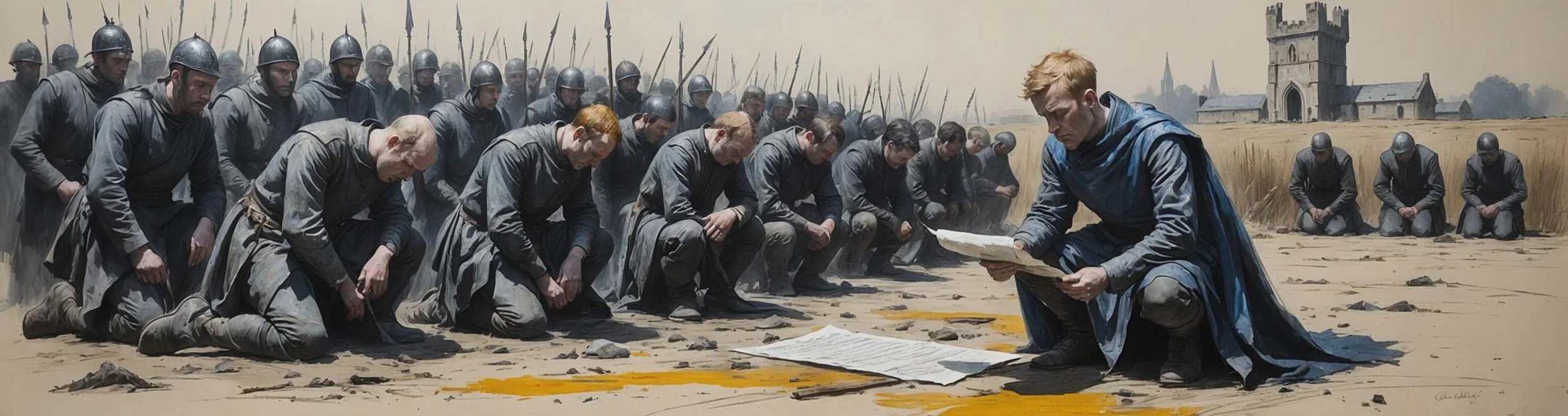
Henry V Act 4, Scene 8: Retold in Modern English Verse
The glove revealed and the dead are counted
Williams strikes Fluellen over the glove, and the quarrel boils until Henry reveals the trick: it was the king himself that Williams promised to strike. The soldier defends himself stoutly – the king came disguised, and the offence was of Henry’s own making – and his glove is filled with crowns. Then the herald brings the counts: ten thousand French dead, princes and nobility among them, against an English list so short that Henry gives the victory to God alone, orders the hymns of thanksgiving sung, and sets the army’s course for Calais and England.
Characters appearing: Gower | Williams | Fluellen | Warwick | Gloucester | King Henry V | Exeter | Herald
Key themes: Class and Brotherhood | Religion and Morality
BEFORE KING HENRY'S PAVILION.
[ENTER GOWER AND WILLIAMS]
WILLIAMS
I warrant it is to knight you, captain.
I’m sure it is to grant your knighthood, captain.
[ENTER FLUELLEN]
FLUELLEN
God's will and his pleasure, captain, I beseech you
At God’s will and pleasure, captain, I urge you
now, come apace to the king: there is more good toward
to come quickly to the king: there is more good fortune
you peradventure than is in your knowledge to dream of.
coming your way than you could ever dream of.
WILLIAMS
Sir, know you this glove?
Sir, do you recognise this glove?
FLUELLEN
Know the glove! I know the glove is glove.
Recognise the glove! I know this glove is a glove.
WILLIAMS
I know this; and thus I challenge it.
Well, I recognise it, hence I’m challenging you to a fight.
[STRIKES HIM]
FLUELLEN
'Sblood! An arrant traitor as any is in the
By God’s blood! This man’s a traitor more than anyone
universal world, or in France, or in England!
in the entire world, or in France, or in England!
GOWER
How now, sir! You villain!
What are you doing, you villain!
WILLIAMS
Do you think I'll be forsworn?
Do you think I’d break an oath?
FLUELLEN
Stand away, Captain Gower; I will give treason his
Stand aside, Captain Gower; I’ll respond to this treasonous
payment into ploughs, I warrant you.
action with blows in return, I promise you.
WILLIAMS
I am no traitor.
I’m not a traitor.
FLUELLEN
That's a lie in thy throat. I charge you in his
You are speaking a lie. I order you in the
majesty's name, apprehend him: he's a friend of the
name of the king, arrest him: he’s a friend of the
Duke Alencon's.
Duke of Alencon.
[ENTER WARWICK AND GLOUCESTER]
WARWICK
How now, how now! What's the matter?
Hang on, hang on! What’s going on here?
FLUELLEN
My Lord of Warwick, here is – praised be God for it! –
My Lord Warwick, here is – praise to God we’ve discovered it! –
a most contagious treason come to light, look
evidence of a most infectious treason, you
you, as you shall desire in a summer's day. Here is
see, as clear as a summer’s day. Here is
his majesty.
the king.
[ENTER KING HENRY AND EXETER]
KING HENRY V
How now! What's the matter?
Now then! What’s the matter?
FLUELLEN
My liege, here is a villain and a traitor, that,
My lord, here is a villain and traitor, who,
look your grace, has struck the glove which your
you see my lord, has reacted in anger at the glove which your
majesty is take out of the helmet of Alencon.
majesty has taken out of Alencon’s helmet.
WILLIAMS
My liege, this was my glove; here is the fellow of
My lord, this was my glove; and here’s the corresponding
it; and he that I gave it to in change promised to
glove I swapped with; and the man I gave it to promised to
wear it in his cap: I promised to strike him, if he
wear it in his cap. I promised to hit him, if he
did: I met this man with my glove in his cap, and I
did: I met this man with my glove in his cap, and I
have been as good as my word.
have been true to my word.
FLUELLEN
Your majesty hear now, saving your majesty's
Your majesty, let me tell you, in defence of your majesty’s
manhood, what an arrant, rascally, beggarly, lousy
integrity, what a blatant rascal, beggar and lousy
knave it is: I hope your majesty is pear me
rogue this man is. I hope your majesty will bear
testimony and witness, and will avouchment, that
testimony for me, and will agree, that
this is the glove of Alencon, that your majesty is
this is the glove of Alencon that your majesty
give me; in your conscience, now?
gave me. Do you agree?
KING HENRY V
Give me thy glove, soldier: look, here is the
Give me your glove, soldier: look, here is the
fellow of it.
other one of the pair.
'Twas I, indeed, thou promised'st to strike;
For it was me you promised you would hit;
And thou hast given me most bitter terms.
And you described me in appalling words.
FLUELLEN
An please your majesty, let his neck answer for it,
If it pleases your majesty, let’s hang him by the neck for this,
if there is any martial law in the world.
if there are any court-martial laws in the world.
KING HENRY V
How canst thou make me satisfaction?
What can you say to satisfy me, soldier?
WILLIAMS
All offences, my lord, come from the heart: never
My lord, all offences come from the heart, but
came any from mine that might offend your majesty.
my offences never meant to offend your majesty.
KING HENRY V
It was ourself thou didst abuse.
It was me you offended.
WILLIAMS
Your majesty came not like yourself: you appeared to
Your majesty wasn’t dressed like you are now: you seemed
me but as a common man; witness the night, your
to be a common man to me. Recall that night, what you
garments, your lowliness; and what your highness
were wearing, your common appearance; and
suffered under that shape, I beseech you take it for
the offence you suffered like that, I beg that you take it
your own fault and not mine: for had you been as I
as your fault, not mine. For had you been the person I
took you for, I made no offence; therefore, I
thought you were, I would have caused no offence; therefore, I
beseech your highness, pardon me.
beg your highness to forgive me.
KING HENRY V
Here, uncle Exeter, fill this glove with crowns,
Here, Exeter, fill up this glove with gold coins,
And give it to this fellow. Keep it, fellow;
And give it to this man. You keep it, mate;
And wear it for an honour in thy cap
And wear it as a token in your cap
Till I do challenge it. Give him the crowns:
Until I challenge you again. Give him coins:
And, captain, you must needs be friends with him.
And, captain, you must now be friends with him.
FLUELLEN
By this day and this light, the fellow has mettle
In the light of day, this brave man has
enough in his belly. Hold, there is twelve pence
fire in his belly. So, here is twelve pence
for you; and I pray you to serve Got, and keep you
for you; and I pray that you serve God, and keep out
out of prawls, and prabbles' and quarrels, and
of brawls and squabbles and quarrels and
dissensions, and, I warrant you, it is the better for you.
disagreements, and I assure you, you’ll be better for it.
WILLIAMS
I will none of your money.
I won’t take any of your money.
FLUELLEN
It is with a good will; I can tell you, it will
I offer it in good faith; I tell you it’s enough
serve you to mend your shoes: come, wherefore should
to mend your shoes. Come on, why are
you be so pashful? Your shoes is not so good: 'tis
you being so bashful? Your shoes aren’t in good shape. It’s
a good silling, I warrant you, or I will change it.
a real shilling, I assure you; if not, I will change it.
[ENTER AN ENGLISH HERALD]
KING HENRY V
Now, herald, are the dead numbered?
Now, herald, have you counted up the dead?
HERALD
Here is the number of the slaughtered French.
Here is how many Frenchmen have been killed.
KING HENRY V
What prisoners of good sort are taken, uncle?
What noble prisoners have we captured, uncle?
EXETER
Charles Duke of Orleans, nephew to the king;
Charles, Duke of Orleans, nephew to the king;
John Duke of Bourbon, and Lord Bouciqualt:
John Duke of Bourbon, and Lord Bouciqualt.
Of other lords and barons, knights and squires,
Of all the other noblemen and lords,
Full fifteen hundred, besides common men.
Some fifteen hundred, not including plebs.
KING HENRY V
This note doth tell me of ten thousand French
This note suggests ten thousand Frenchmen lay
That in the field lie slain: of princes, in this number,
Slain in the battlefield: of which, the princes
And nobles bearing banners, there lie dead
And standard-bearing noblemen who’ve died
One hundred twenty six: added to these,
Are one hundred and twenty-six. As well,
Of knights, esquires, and gallant gentlemen,
The knights, esquires, and gallant gentlemen
Eight thousand and four hundred; of the which,
Come to eight thousand, four hundred; of which,
Five hundred were but yesterday dubbed knights:
Five hundred only yesterday were knighted.
So that, in these ten thousand they have lost,
So, of ten thousand Frenchmen who have died,
There are but sixteen hundred mercenaries;
There are just sixteen hundred hired soldiers;
The rest are princes, barons, lords, knights, squires,
The rest are princes, barons, lords, knights, squires,
And gentlemen of blood and quality.
And well-respected men of noble blood.
The names of those their nobles that lie dead:
The names of all their noblemen who’ve died:
Charles Delabreth, high constable of France;
Charles Delabreth, high constable of France;
Jaques of Chatillon, admiral of France;
Jaques of Chatillon, admiral of France;
The master of the cross-bows, Lord Rambures;
The master of the crossbows, Lord Rambures;
Great Master of France, the brave Sir Guichard Dolphin,
Great Master of France, the brave Sir Guichard Dolphin,
John Duke of Alencon, Anthony Duke of Brabant,
John Duke of Alencon, Anthony Duke of Brabant,
The brother of the Duke of Burgundy,
The brother of the Duke of Burgundy,
And Edward Duke of Bar: of lusty earls,
And Edward Duke of Bar. Of valiant earls,
Grandpre and Roussi, Fauconberg and Foix,
Grandpre and Roussi, Fauconberg and Foix,
Beaumont and Marle, Vaudemont and Lestrale.
Beaumont and Marle, Vaudemont and Lestrale.
Here was a royal fellowship of death!
That makes a royal band-of-brothers slaughtered!
Where is the number of our English dead?
What are the numbers for our English dead?
[HERALD SHEWS HIM ANOTHER PAPER]
Edward the Duke of York, the Earl of Suffolk,
Edward, Duke of York, the Earl of Suffolk,
Sir Richard Ketly, Davy Gam, esquire:
Sir Richard Ketly, Davy Gam, esquire.
None else of name; and of all other men
No other nobleman; and of the others,
But five and twenty. O God, thy arm was here;
Just twenty-five. Oh God, you did this work;
And not to us, but to thy arm alone,
It wasn’t us, but you alone who did this,
Ascribe we all! When, without stratagem,
We all agree! When, without trickery,
But in plain shock and even play of battle,
But in a battle balanced on both sides,
Was ever known so great and little loss
Was ever such a large and little loss known
On one part and on the other? Take it, God,
From one side to the other? Take it, God,
For it is none but thine!
Because this victory’s yours alone.
EXETER
'Tis wonderful!
That’s joyful!
KING HENRY V
Come, go we in procession to the village.
Come, we’ll go in procession to the village.
And be it death proclaimed through our host
And state our soldiers will be put to death
To boast of this or take the praise from God
If they boast of it, or take praise from God
Which is his only.
Who did this for us.
FLUELLEN
Is it not lawful, an please your majesty, to tell
Is it not allowed, if it pleases your majesty, to state
how many is killed?
how many have been killed?
KING HENRY V
Yes, captain; but with this acknowledgement,
Yes, captain, but when do we so state
That God fought for us.
That God fought for us.
FLUELLEN
Yes, my conscience, he did us great good.
Yes, I know he did great things for us.
KING HENRY V
Do we all holy rites;
Now let’s perform the holy rites;
Let there be sung 'Non nobis' and 'Te Deum;'
Ensure we sing ‘Non nobis’ and ‘Te Deum;’
The dead with charity enclosed in clay:
And bury those who died with dignity.
And then to Calais; and to England then:
Then on to Calais, where we’ll England see;
Where ne'er from France arrived more happy men.
No men have come from France with so much glee.
[EXEUNT]