ACT 3
Henry V Act 3, Scene 4: Retold in Modern English Verse
Katharine’s English lesson
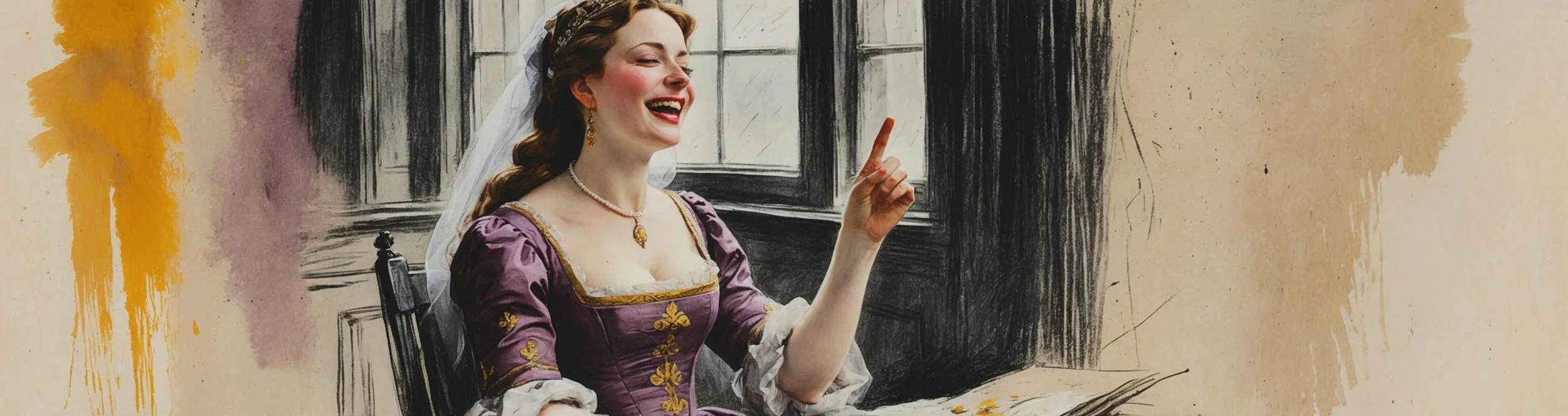
In the French palace, Princess Katharine asks her gentlewoman Alice to teach her English. Word by word – the hand, the fingers, the nails, the arm, the elbow – the lesson proceeds in French and broken English, until it collapses in scandalised laughter when two innocent English words sound obscene to French ears.
Characters appearing: Katharine | Alice
Key themes: Language and Power | Appearance vs Reality
THE FRENCH KING'S PALACE.
[ENTER KATHARINE AND ALICE]
KATHARINE
Alice, tu as ete en Angleterre, et tu parles bien le langage.
Alice, you’ve been to England, and speak the language well.
ALICE
Un peu, madame.
I speak a bit, madame.
KATHARINE
Je te prie, m'enseignez: il faut que j'apprenne a
Please teach me: I must learn to
parler. Comment appelez-vous la main en Anglois?
speak. What do you call ‘la main’ in English?
ALICE
La main? elle est appelee de hand.
‘La main’? It is called the hand.
KATHARINE
De hand. Et les doigts?
The hand. And ‘les doigts’?
ALICE
Les doigts? Ma foi, j'oublie les doigts; mais je me
‘Les doigts’? In truth, I forget ‘les doigts’; but I will
souviendrai. Les doigts? Je pense qu'ils sont
remember. ‘Les doigts’? I think they are
appeles de fingres; oui, de fingres.
called the fingers; yes, the fingers.
KATHARINE
La main, de hand; les doigts, de fingres. Je pense
‘La main’ is the hand; ‘les doigts’ are fingers. I think
que je suis le bon ecolier; j'ai gagne deux mots
I am a good student; I have learnt two words
d'Anglois vitement. Comment appelez-vous les ongles?
of English quickly. What do you call ‘les ongles’?
ALICE
Les ongles? Nous les appelons de nails.
‘Les ongles’? We call them nails.
KATHARINE
De nails. Ecoutez; dites-moi, si je parle bien: de
The nails. Listen; tell me if I’m speaking well: the
hand, de fingres, et de nails.
hand, the fingers, and the nails.
ALICE
C'est bien dit, madame; il est fort bon Anglois.
That’s well spoken, madame; you are very good at English.
KATHARINE
Dites-moi l'Anglois pour le bras.
Tell me the English for ‘le bras.’
ALICE
De arm, madame.
The arm, madame.
KATHARINE
Et le coude?
And ‘le coude’?
ALICE
De elbow.
The elbow.
KATHARINE
De elbow. Je m'en fais la repetition de tous les
The elbow. I will repeat to myself all of the
mots que vous m'avez appris des a present.
words you have taught me from now on.
ALICE
Il est trop difficile, madame, comme je pense.
It is too difficult, madame, as I thought it would be.
KATHARINE
Excusez-moi, Alice; ecoutez: de hand, de fingres,
Excuse me, Alice; listen: the hand, the fingers,
de nails, de arma, de bilbow.
the nails, the arma, and the bilbow.
ALICE
De elbow, madame.
The elbow, madame.
KATHARINE
O Seigneur Dieu, je m'en oublie! De elbow. Comment
Oh good God, I forget it! The elbow. How
appelez-vous le col?
do you say ‘le col’?
ALICE
De neck, madame.
The neck, madame.
KATHARINE
De nick. Et le menton?
The nick. And ‘le menton’?
ALICE
De chin.
The chin.
KATHARINE
De sin. Le col, de nick; de menton, de sin.
The sin. ‘Le col’ is the nick; ‘de menton’ is the sin.
ALICE
Oui. Sauf votre honneur, en verite, vous prononcez
Yes. Indeed it is true that you pronounce
les mots aussi droit que les natifs d'Angleterre.
the words as well as the native English do.
KATHARINE
Je ne doute point d'apprendre, par la grace de Dieu,
I have no doubt that I will learn, by the grace of God,
et en peu de temps.
and in a short time.
ALICE
N'avez vous pas deja oublie ce que je vous ai enseigne?
Haven’t you already forgotten what I taught you?
KATHARINE
Non, je reciterai a vous promptement: de hand, de
No, I’ll recite them to you promptly: the hand, the
fingres, de mails –
fingers, the mails…
ALICE
De nails, madame.
The nails, madame.
KATHARINE
De nails, de arm, de ilbow.
The nails, the arm, the ilbow.
ALICE
Sauf votre honneur, de elbow.
With respect, it’s pronounced elbow.
KATHARINE
Ainsi dis-je; de elbow, de nick, et de sin. Comment
That’s what I said; the elbow, the nick and the sin. How
appelez-vous le pied et la robe?
do you say ‘le pied’ and ‘la robe’?
ALICE
De foot, madame; et de coun.
The foot, madame; and the gown.
KATHARINE
De foot et de coun! O Seigneur Dieu! Ce sont mots
The foot and the gown! Oh dear God! These words
de son mauvais, corruptible, gros, et impudique, et
are rude, corruptible, coarse and immodest, and
non pour les dames d'honneur d'user: je ne voudrais
not for a lady-in-waiting to use. I would not like to
prononcer ces mots devant les seigneurs de France
pronounce these words in front of French lords
pour tout le monde. Foh! Le foot et le coun!
for all the world. Ugh! The foot and the gown.
Neanmoins, je reciterai une autre fois ma lecon
Nevertheless, I will recite my lesson one more time
ensemble: de hand, de fingres, de nails, de arm, de
together: the hand, the fingers, the nails, the arm, the
elbow, de nick, de sin, de foot, de coun!
elbow, the nick, the sin, the foot, the gown!
ALICE
Excellent, madame!
Excellent, madame!
KATHARINE
C'est assez pour une fois: allons-nous a diner.
That’s enough for one day: let’s go to dinner.
[EXEUNT]