ACT 3
Henry V Act 3, Scene 7: Retold in Modern English Verse
The French count their winnings before the battle
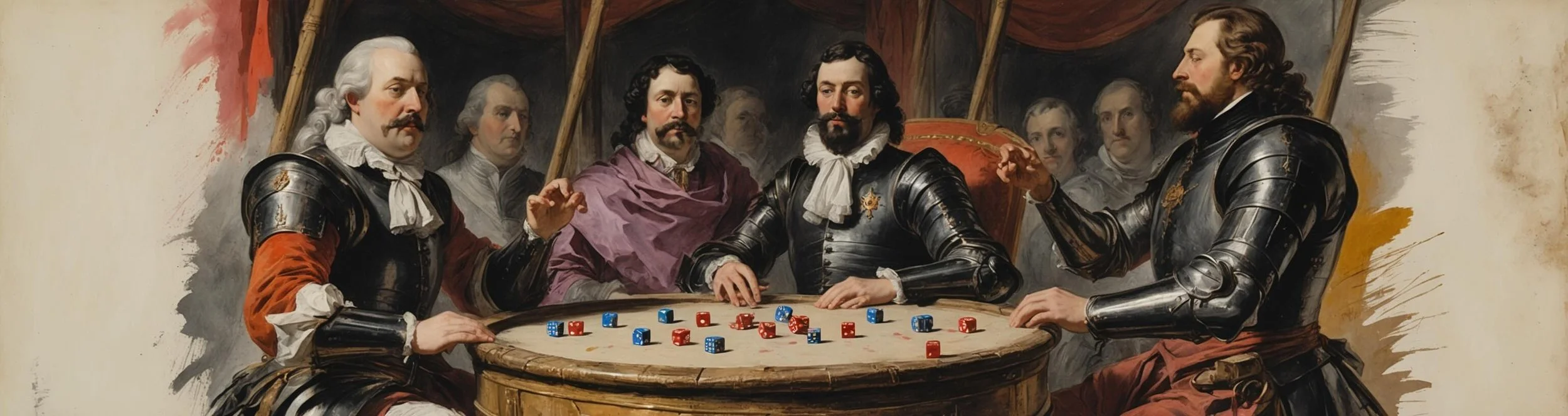
The night before Agincourt, the French camp is impatient for morning. The Dauphin praises his horse past all reason – a beast of the elements, a subject for a sonnet – while Orleans and the Constable trade barbed proverbs at his expense. A messenger reports the English camped within fifteen hundred paces, and the nobles go off to dice for prisoners they have not yet taken.
Characters appearing: Constable | Rambures | Orleans | Dauphin | Messenger
Key themes: Appearance vs Reality | War and Violence
THE FRENCH CAMP, NEAR AGINCOURT.
[ENTER THE CONSTABLE OF FRANCE, THE LORD RAMBURES, ORLEANS, DAUPHIN, WITH OTHERS]
CONSTABLE
Tut! I have the best armour of the world. Would it were day!
Nonsense! I have the world’s best armour. I wish it were day!
ORLEANS
You have an excellent armour; but let my horse
You have excellent armour, but give my horse
have his due.
some credit.
CONSTABLE
It is the best horse of Europe.
It is the best horse in Europe.
ORLEANS
Will it never be morning?
Will it never be morning?
DAUPHIN
My lord of Orleans, and my lord high constable, you
My lord of Orleans, and my lord high constable, are you really
talk of horse and armour?
talking about horses and armour?
ORLEANS
You are as well provided of both as any prince in the world.
You are blessed with both better than any prince in the world.
DAUPHIN
What a long night is this! I will not change my
What a long night this is! I will not swap my
horse with any that treads but on four pasterns.
horse with any other that walks on four legs.
Ca, ha! He bounds from the earth, as if his
There he goes! He bounces across the ground as if his
entrails were hairs; le cheval volant, the Pegasus,
innards were as light as hair; he’s a flying horse, the Pegasus,
chez les narines de feu! When I bestride him, I
breathing fire from his nostrils! When I ride him, I
soar, I am a hawk: he trots the air; the earth
fly like I am a hawk. He trots through the air; the earth
sings when he touches it; the basest horn of his
sings when his hooves touch it; even the sound from his
hoof is more musical than the pipe of Hermes.
worst hoof sounds sweeter than Hermes’ mythical pipe.
ORLEANS
He's of the colour of the nutmeg.
He’s nutmeg-brown in colour.
DAUPHIN
And of the heat of the ginger. It is a beast for
And as fiery as ginger. He’s an animal worthy of the Greek
Perseus: he is pure air and fire; and the dull
hero Perseus: he is pure air and fire; and the boring
elements of earth and water never appear in him, but
elements of earth and water are never reflected in him,
only in patient stillness while his rider mounts
except when he stands patiently still while his rider mounts
him: he is indeed a horse; and all other jades you
him. He is a proper horse; and all the other nags you
may call beasts.
can call beasts.
CONSTABLE
Indeed, my lord, it is a most absolute and excellent horse.
Indeed, my lord, it is a most perfect, fabulous horse.
DAUPHIN
It is the prince of palfreys; his neigh is like the
It is the prince of fine horses; his neigh is like the
bidding of a monarch and his countenance enforces homage.
king issuing commands, and his looks demand respect.
ORLEANS
No more, cousin.
Enough of that, cousin.
DAUPHIN
Nay, the man hath no wit that cannot, from the
No, a man is clueless if he cannot – from the
rising of the lark to the lodging of the lamb, vary
break of day to dusk – heap
deserved praise on my palfrey: it is a theme as
praise upon my horse. It’s a subject as
fluent as the sea: turn the sands into eloquent
vast as the sea; if every grain of sand could speak
tongues, and my horse is argument for them all:
eloquently, they’d all be extolling the virtues of my horse;
'tis a subject for a sovereign to reason on, and for
it’s a subject worthy of the monarch to talk about, and for
a sovereign's sovereign to ride on; and for the
the king-of-kings to ride upon; and for the whole
world, familiar to us and unknown to lay apart
world, both known and unknown, to stop what
their particular functions and wonder at him. I
they are doing and marvel at this horse. I
once writ a sonnet in his praise and began thus:
wrote a sonnet once, praising this horse, and it began:
'Wonder of nature,' –
‘Wonder of nature,’…
ORLEANS
I have heard a sonnet begin so to one's mistress.
I’ve heard a sonnet begin like that when written for a mistress.
DAUPHIN
Then did they imitate that which I composed to my
Then they were copying the one I wrote for my
courser, for my horse is my mistress.
hunting horse, for my horse is my mistress.
ORLEANS
Your mistress bears well.
Your mistress is a good ride.
DAUPHIN
Me well; which is the prescript praise and
I ride her well; which is what one wants and
perfection of a good and particular mistress.
is the very definition of a perfect mistress.
CONSTABLE
Nay, for methought yesterday your mistress shrewdly
Hang on, I thought yesterday your mistress gave
shook your back.
you a rough ride.
DAUPHIN
So perhaps did yours.
Maybe yours did too.
CONSTABLE
Mine was not bridled.
Mine wasn’t tied up.
DAUPHIN
O then belike she was old and gentle; and you rode,
Oh, then maybe she was old and gentle, and you rode her like
like a kern of Ireland, your French hose off, and in
an ill-equipped Irish soldier, indecently riding with your
your straight strossers.
stockings off, wearing tight trousers.
CONSTABLE
You have good judgment in horsemanship.
You have excellent judgement when it comes to horses.
DAUPHIN
Be warned by me, then: they that ride so and ride
Let me warn you, then: those that carelessly ride like that
not warily, fall into foul bogs. I had rather have
end up getting stuck in the mud. I’d rather have
my horse to my mistress.
my horse than have a mistress.
CONSTABLE
I had as lief have my mistress a jade.
I’d willingly let my mistress be an old horse.
DAUPHIN
I tell thee, constable, my mistress wears his own hair.
I tell you, constable, my mistress has his own hair.
CONSTABLE
I could make as true a boast as that, if I had a sow
I could say the same thing if I had a pig
to my mistress.
as my mistress.
DAUPHIN
'Le chien est retourne a son propre vomissement, et
‘The dog has returned to his own vomit, and the
la truie lavee au bourbier;' thou makest use of any thing.
clean pig has returned to the mud;’ you’re clutching at straws.
CONSTABLE
Yet do I not use my horse for my mistress, or any
But yet my horse is not my mistress, nor do I drop in
such proverb so little kin to the purpose.
random sayings that have no relevance to the conversation.
RAMBURES
My lord constable, the armour that I saw in your tent
My lord constable, the suit of armour I saw in your tent
to-night, are those stars or suns upon it?
tonight, were they stars or suns emblazoned on it?
CONSTABLE
Stars, my lord.
Stars, my lord.
DAUPHIN
Some of them will fall to-morrow, I hope.
Some of them will fall off tomorrow, I hope.
CONSTABLE
And yet my sky shall not want.
And yet my sky will still be full of stars.
DAUPHIN
That may be, for you bear a many superfluously, and
That may be so, because you wear far too many, and
'twere more honour some were away.
it would look more honourable if you lost a few.
CONSTABLE
Even as your horse bears your praises; who would
Much like your horse suffers under the weight of your praises;
trot as well, were some of your brags dismounted.
it would trot better with your brags and some of you removed.
DAUPHIN
Would I were able to load him with his desert! Will
If only I could give him more of the praise he deserves! Will
it never be day? I will trot to-morrow a mile, and
it ever be daytime? I will ride out for a mile tomorrow, and
my way shall be paved with English faces.
the route I take will be paved with dead Englishmen.
CONSTABLE
I will not say so, for fear I should be faced out of
I won’t risk saying that, in case I’m the one killed by the
my way: but I would it were morning; for I would
wayside. But I do wish it were morning, for I’m keen
fain be about the ears of the English.
to start hacking at English heads.
RAMBURES
Who will go to hazard with me for twenty prisoners?
Who wants to hazard a bet that I will take twenty prisoners?
CONSTABLE
You must first go yourself to hazard, ere you have them.
You have to go towards the hazard before you take a prisoner.
DAUPHIN
'Tis midnight; I'll go arm myself.
It’s midnight; I’ll go and put my armour on.
[EXIT]
ORLEANS
The Dauphin longs for morning.
The Dauphin is longing for the morning.
RAMBURES
He longs to eat the English.
He wants to eat the English.
CONSTABLE
I think he will eat all he kills.
I think he will eat everyone he kills.
ORLEANS
By the white hand of my lady, he's a gallant prince.
By my mistress’s aristocratic hand, I say he’s a chivalrous prince.
CONSTABLE
Swear by her foot, that she may tread out the oath.
Swear by her foot so she can stamp out the oath.
ORLEANS
He is simply the most active gentleman of France.
He is simply the most active gentleman in France.
CONSTABLE
Doing is activity; and he will still be doing.
He’s certainly active at something, and he’s always doing it.
ORLEANS
He never did harm, that I heard of.
He never hurt anybody, so I’ve heard.
CONSTABLE
Nor will do none to-morrow: he will keep that
Nor will he hurt anyone tomorrow: he’ll keep his
good name still.
reputation intact.
ORLEANS
I know him to be valiant.
I know that he’s brave.
CONSTABLE
I was told that by one that knows him better than you.
I was told that by someone who knows him better than you.
ORLEANS
What's he?
Who’s that?
CONSTABLE
Marry, he told me so himself; and he said he cared
Well, the Dauphin told me that himself, and he said he didn’t
not who knew it.
care who knew it.
ORLEANS
He needs not; it is no hidden virtue in him.
He doesn’t need to hide it; it’s not a hidden strength of his.
CONSTABLE
By my faith, sir, but it is; never any body saw it
I tell you, sir, that it is; no one has ever seen him be brave
but his lackey: 'tis a hooded valour; and when it
except his servant. It’s a well disguised bravery, and when it
appears, it will bate.
appears, it will quickly dissipate.
ORLEANS
Ill will never said well.
Resentful people don’t pay compliments.
CONSTABLE
I will cap that proverb with 'There is flattery in friendship.'
As a retort to that proverb, I’ll say, ‘Friends flatter one another.’
ORLEANS
And I will take up that with 'Give the devil his due.'
And I’ll reply, ‘Always give the devil credit where it’s due.’
CONSTABLE
Well placed: there stands your friend for the
A fine shot: you’ve placed your friend where the
devil: have at the very eye of that proverb with 'A
devil is in the proverb; now I’ll shoot him in the eye with ‘A
pox of the devil.'
pox on the devil.’
ORLEANS
You are the better at proverbs, by how much 'A
You’re so good at proverbs, you prove another: ‘A
fool's bolt is soon shot.'
fool’s arrow is quickly fired.’
CONSTABLE
You have shot over.
You aimed too high.
ORLEANS
'Tis not the first time you were overshot.
It’s not the first time something has gone over your head.
[ENTER A MESSENGER]
MESSENGER
My lord high constable, the English lie within
My lord high constable, the English army are camped within
fifteen hundred paces of your tents.
fifteen hundred steps from your tents.
CONSTABLE
Who hath measured the ground?
Who has measured the distance?
MESSENGER
The Lord Grandpré.
The Lord Grandpré.
CONSTABLE
A valiant and most expert gentleman. Would it were
He’s a brave and highly skilled gentleman. If only it were
day! Alas, poor Harry of England! He longs not for
daytime! Oh dear, poor Harry of England! He doesn’t want
the dawning as we do.
the dawn to arrive like we do.
ORLEANS
What a wretched and peevish fellow is this king of
What an awful, petulant chap this king of
England, to mope with his fat-brained followers so
England is, slouching about with his idiotic followers, so
far out of his knowledge!
far out of his depth!
CONSTABLE
If the English had any apprehension, they would run away.
If the English had any sense, they’d run away.
ORLEANS
That they lack; for if their heads had any
They lack any sense; for if there was any
intellectual armour, they could never wear such heavy
intellectual capacity within their heads, they couldn’t wear
head-pieces.
such heavy helmets.
RAMBURES
That island of England breeds very valiant
That island of England breeds very brave
creatures; their mastiffs are of unmatchable courage.
creatures; their bear-baiting hounds have unmatched courage.
ORLEANS
Foolish curs, that run winking into the mouth of a
Foolish dogs, they run with their eyes closed into the mouth
Russian bear and have their heads crushed like
of a Russian bear and then have their heads crushed like
rotten apples! You may as well say, that's a valiant
rotten apples! You might as well say that they are as brave as
flea that dare eat his breakfast on the lip of a lion.
a flea that dares to eat its breakfast from the lip of a lion.
CONSTABLE
Just, just; and the men do sympathize with the
Exactly: Englishmen are just like the
mastiffs in robustious and rough coming on, leaving
bear-baiting dogs in their ferocity and fighting spirit, leaving
their wits with their wives: and then give them
their brains at home with their wives. And if you give them
great meals of beef and iron and steel, they will
a big meal of beef and arm them with iron and steel weapons,
eat like wolves and fight like devils.
they’ll eat like wolves and fight like devils.
ORLEANS
Ay, but these English are shrewdly out of beef.
Yes, but these English are markedly short of beef right now.
CONSTABLE
Then shall we find to-morrow they have only stomachs
So tomorrow we’ll find that they only have stomachs that need
to eat and none to fight. Now is it time to arm:
filling and no stomach to fight. Now it’s time to arm ourselves:
come, shall we about it?
come on, shall we get going?
ORLEANS
It is now two o'clock: but, let me see, by ten
It is now only two o’clock; by ten
We shall have each a hundred Englishmen.
We’ll each have killed a hundred Englishmen.
[EXEUNT]