The Dauphin
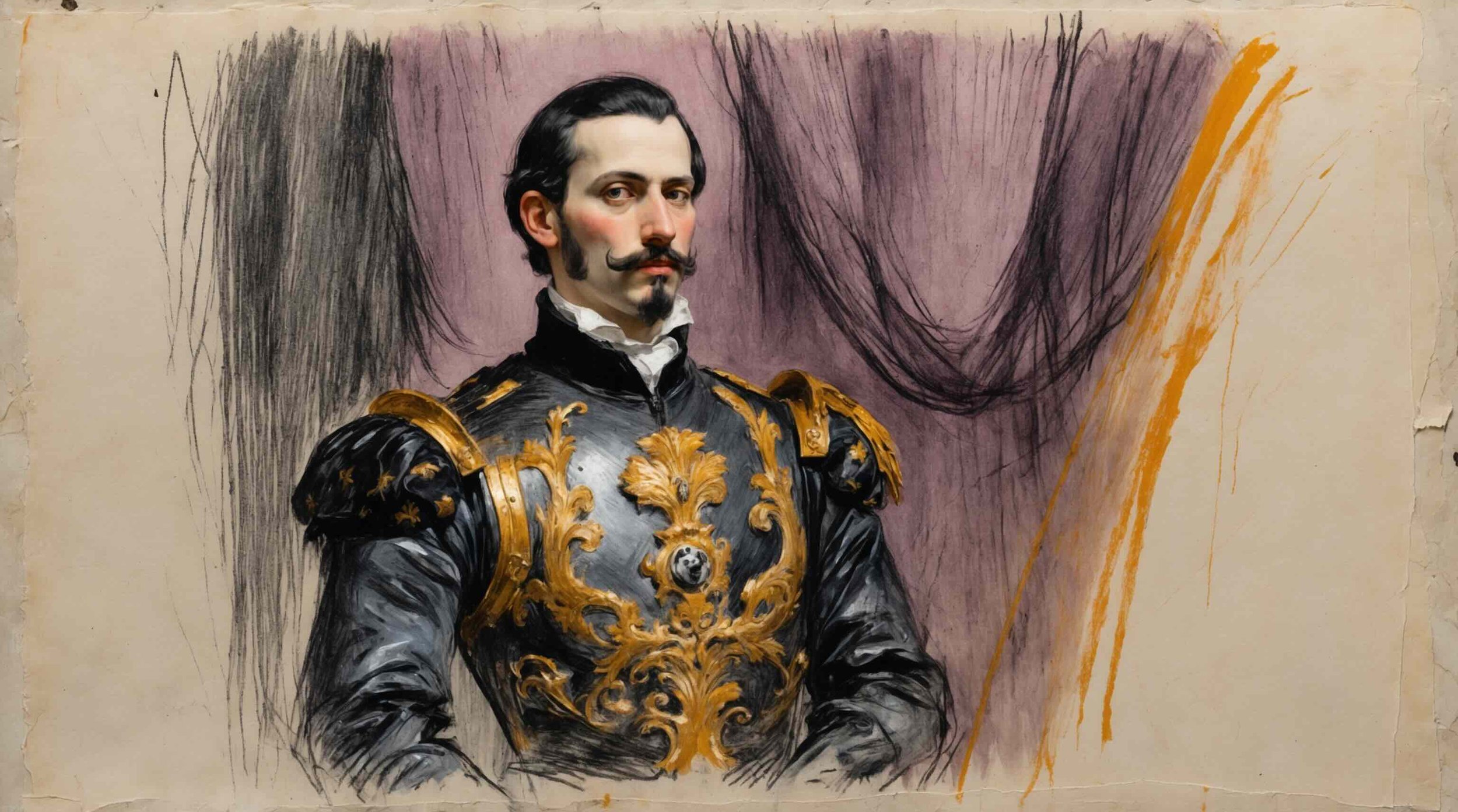
Character Profile – At a Glance
- Role: Heir to the French throne and the play’s principal representative of everything Henry is not. He provokes the war with an insulting gift, spends the night before Agincourt praising his horse, and loses.
- Key Traits: Arrogant, witty, vain about appearances, and startlingly shallow. He is not a fool – his political judgement is occasionally sound – but he cannot take anything seriously for longer than a scene.
- The Core Conflict: The Dauphin has inherited everything Henry had to win. He is the legitimate heir of a great kingdom, and the play arranges for him to be beaten by a man he called a shallow youth.
- Key Actions: Sends Henry a barrel of tennis balls, provoking the invasion. Dismisses England as "idly kinged" in A2S4, and is rebuked by his father and the Constable. Rages at French decline in A3S5. Spends the night before Agincourt in A3S7 praising his horse and quarrelling about mistresses. Boasts of the coming slaughter in A4S2, and in A4S5 finds the battle lost and proposes suicide.
- Famous Quote:
"I had rather have my horse to my mistress."
(Act 3, Scene 7) - The Outcome: He survives Agincourt and disappears from the play. He is not present for the treaty in A5S2, and the settlement that disinherits him in favour of Henry is agreed without him in the room.
A Vain, Giddy, Shallow, Humorous Youth
The Dauphin’s first substantial speech is a piece of military advice that is entirely sensible, and then a piece of character assessment that is entirely wrong. He tells his father that France should arm even in peacetime, and then explains that in this particular case there is nothing to fear.
Original
For, my good liege, she is so idly kinged,
Her sceptre so fantastically borne
By a vain, giddy, shallow, humorous youth,
That fear attends her not.
(Act 2, Scene 4)
Shakespeare Retold (Modern Verse)
For, dear lord, England is so weakly ruled,
Her crown is so ridiculously worn
By a pathetic youth, shallow and foolish
That nobody’s afraid of England.
Four adjectives, and every one of them will be disproved inside three acts. The judgement is not stupid – it is based on Henry’s genuinely disreputable youth, and half of Europe held the same opinion – but it is out of date, and the Dauphin has not troubled to check.
What makes the moment work is the irony sitting underneath it. Every adjective the Dauphin applies to Henry describes the Dauphin, and the play will spend Act 3 demonstrating it. He is the vain one; he is the giddy one; and the shallow, humorous youth who cannot be taken seriously is the man who will spend the night before the decisive battle of his life composing praise for a horse. The Constable of France corrects him immediately, telling him that the English king is nothing like his reputation. The Dauphin’s reply, notably, is that it does not matter what they think as long as their defences are ready – sound doctrine, offered by a man who has just proved he does not believe it.
The Paris Balls
The tennis balls arrive in A1S2, but the audience does not learn who chose them until A2S4, when the Dauphin owns the gift in front of the French court and English ambassadors.
Original
Say, if my father render fair return,
It is against my will; for I desire
Nothing but odds with England: to that end,
As matching to his youth and vanity,
I did present him with the Paris balls.
(Act 2, Scene 4)
Shakespeare Retold (Modern Verse)
Tell him that if my father takes his terms,
I don’t agree with it; for all I want
Is conflict with the English. For that reason,
Aligning with his childish vanity,
I offered him those tennis balls from Paris.
He wants the war. That is the important admission, and it is made openly: if his father accepts Henry’s terms it will be against the Dauphin’s will, because he desires nothing but a quarrel. The tennis balls were not a joke that got out of hand; they were a deliberate provocation, sent to make a peaceful settlement impossible.
The play is doing something careful here. Canterbury has already supplied Henry with a legal claim, and the Church has its own reasons for supplying it. Now the French heir supplies the insult. Between them, the two young men make a war that neither country needs, and each can afterwards say the other started it. The Dauphin’s share of that responsibility is rarely counted against him, because he loses.
My Horse Is My Mistress
A3S7 is the Dauphin’s great scene and the most sustained comic writing the play gives the French. It is the night before Agincourt. The English are starving a few miles away; the French nobles cannot sleep for excitement; and the Dauphin talks about his horse.
Original
Ca, ha! He bounds from the earth, as if his entrails were hairs; le cheval volant, the Pegasus, chez les narines de feu! When I bestride him, I soar, I am a hawk: he trots the air; the earth sings when he touches it; the basest horn of his hoof is more musical than the pipe of Hermes.
(Act 3, Scene 7)
Shakespeare Retold (Modern Verse)
There he goes! He bounces across the ground as if his innards were as light as hair; he’s a flying horse, the Pegasus, breathing fire from his nostrils! When I ride him, I fly like I am a hawk. He trots through the air; the earth sings when his hooves touch it; even the sound from his worst hoof sounds sweeter than Hermes’ mythical pipe.
The writing is genuinely good, and that is the point. This is accomplished, fanciful, classically furnished prose, and it is being spent on an animal. The Dauphin has written a sonnet to the horse, beginning "Wonder of nature"; he tells the company that his horse is his mistress; and when the Constable teases him about it, he defends the horse rather than laughing.
Set this beside the scene that follows it and the design is unmistakable. The Chorus opens Act 4 with the English sitting silent by their fires, "the poor condemned English", thinking about the morning. The French spend the same night talking about clothes, armour and horseflesh, and playing dice for the ransoms of men they have not captured. Nothing in the play is a more efficient piece of characterisation by contrast, and none of it requires the French to be stupid – only to be certain.
All Is Confounded, All!
The Dauphin’s last appearance is nine lines long and comes in the middle of the battle. The French line has broken; the nobles are running; and the man who despised the English king comes on stage in disorder.
Original
Mort de ma vie! All is confounded, all!
Reproach and everlasting shame
Sits mocking in our plumes. O merchante fortune!
(Act 4, Scene 5)
Shakespeare Retold (Modern Verse)
My life has died! And everything is ruined!
Disgrace and shame forever
Will mock our helmets’ feathers. Wretched luck!
"Sits mocking in our plumes" is a superb image and it does the whole job: the feathers the French have been so proud of are still there, on the helmets, and now they are laughing at the men wearing them. The Dauphin’s vanity has survived his army.
What he does next is the last thing we see of him. He proposes that the French nobles stab themselves, then asks whether these are really the wretches they had been playing dice for. There is no plan, no rally and no attempt to hold anything together – only shame, which is what he has cared about all along. The French do return to the field, but it is Bourbon who leads them back, and the Dauphin says nothing further in the play. He is absent from the treaty scene that gives his inheritance to Henry.
"…admire the King and nurture hostile feelings toward him."
— Joel B. Altman, Shakespeare Quarterly, 1991
Key Quotes
Quote 1
But though we think it so, it is no matter:
In cases of defence 'tis best to weigh
The enemy more mighty than he seems:
So the proportions of defence are filled...
(Act 2, Scene 4)
Shakespeare Retold (Modern Verse)
But whatever you think, it doesn’t matter:
When acting in defence, it’s wise to think
The enemy is stronger than he looks.
Thus, weaknesses in our defence are fixed...
Quote Analysis: The Dauphin at his most competent, and the reason he cannot simply be dismissed as a fool. Rebuked by the Constable for underestimating Henry, he concedes the practical point without conceding the personal one: it is prudent to overestimate an enemy whatever you privately think of him. That is sound doctrine, and it is exactly the advice he then fails to take. He goes on despising Henry, arrives at Agincourt certain of victory, and loses. The speech is the play’s way of showing that the French defeat is not caused by ignorance. They know what to do. They simply cannot believe it applies to them.
By faith and honour,
Our madams mock at us, and plainly say
Our mettle is bred out and they will give
Their bodies to the lust of English youth
To new-store France with bastard warriors.
(Act 3, Scene 5)
Shakespeare Retold (Modern Verse)
On my honour,
Our ladies make fun of us, stating plainly
Our bravery’s been bred out of us, and they’ll give
Their bodies to the lustful English youth,
Repopulating France with fighting bastards.
Quote Analysis: The French court reacting to the news that Henry’s army has crossed the Somme, and the reaction is entirely about humiliation. The Dauphin reports that French women are laughing at French men and threatening to breed with the invaders instead. It is a startling thing for an heir to say in front of his father, and it tells us what the war means to him: not territory, not sovereignty, but the fear of being thought unmanly. The same anxiety governs everything he does – the tennis balls, the boasting, the suicide proposal – and it is worth setting beside Harfleur, where the sexual threat the Dauphin only imagines is something Henry says aloud to a town’s governor.
It is the prince of palfreys; his neigh is like the bidding of a monarch and his countenance enforces homage.
(Act 3, Scene 7)
Shakespeare Retold (Modern Verse)
It is the prince of fine horses; his neigh is like the king issuing commands, and his looks demand respect.
Quote Analysis: Every term in the sentence is a term of rank – prince, monarch, homage – and all of them are being spent on a horse. The Dauphin cannot describe anything without reaching for the vocabulary of royalty, and he cannot hear how strange it sounds. The joke sharpens if you remember what he is: the prince of France, on the eve of a battle that will decide his inheritance, awarding princely status to an animal because it looks impressive. The play’s recurring question – whether royalty is a real thing or a set of appearances – gets a comic answer here from the man least equipped to see it.
O perdurable shame! Let's stab ourselves.
Be these the wretches that we played at dice for?
(Act 4, Scene 5)
Shakespeare Retold (Modern Verse)
Such everlasting shame! Let’s kill ourselves.
Are these the lousy men we gambled on?
Quote Analysis: The last two lines the Dauphin speaks, and they contain his whole character. The first proposes suicide as a response to embarrassment; the second is indignation that men so poor should have beaten him. Neither is a thought about the dead, the kingdom, or what to do next. The reference to dice is the play collecting a debt: in A3S7 the French laughed about wagering on English prisoners, and the Chorus described them gambling on the Englishmen they expected to kill. The bet has been settled, and the Dauphin’s only observation is that the winners were not worth losing to.
Key Takeaways
- He Starts the War: The tennis balls are a deliberate provocation, and the Dauphin says openly that he wants a quarrel with England.
- Every Insult Rebounds: "Vain, giddy, shallow" describes the speaker far better than it describes Henry, and the play spends three acts proving it.
- The Horse Scene: A3S7 puts French confidence beside English fear on the same night, and lets the contrast do the work without making the French stupid.
- Not Simply a Fool: His advice to overestimate the enemy is sound. The French lose because they cannot believe good advice applies to them.
Study Questions and Analysis
Who is the Dauphin and what is his function in the play?
"Dauphin" is the title of the heir to the French throne, as "Prince of Wales" is in England. The historical figure behind the part is Louis, Duke of Guyenne, son of Charles VI, who was eighteen at Agincourt and died the following year; the man who would eventually become Charles VII was his younger brother. Shakespeare compresses and simplifies, as he does throughout the histories.
Dramatically the Dauphin exists to be the wrong kind of prince. He is what Henry might have remained: witty, well-born, entirely confident, and untested. His first speech shows the pattern – correct in the general case, wrong in the particular one:
It is most meet we arm us 'gainst the foe;
For peace itself should not so dull a kingdom,
Though war nor no known quarrel were in question,
But that defences, musters, preparations,
Should be maintained, assembled and collected,
As were a war in expectation.
(Act 2, Scene 4)
Shakespeare Retold (Modern Verse)
It’s right we should be ready for a battle,
And not let peace make us become complacent,
Although there is no war on at the moment,
We must ensure we’ve readied our defences,
And keep our army properly prepared
As though we are about to go to war.
The play needs this figure for a specific structural reason. A history in which the enemy is contemptible is a history in which the victory is worth nothing, and a history in which the enemy is admirable is one the audience may not want its own side to win. Joel B. Altman’s "‘Vile Participation’" (Shakespeare Quarterly, 1991) argues that the play generates hostility in its audience and then redirects it outward onto the French; the Dauphin is the principal target that redirection needs.
Peter Saccio’s Shakespeare’s English Kings (1977) remains the most useful place to check how far the play departs from the chronicles here, and the departures are considerable. Shakespeare’s Dauphin is a dramatic construction rather than a portrait.
Why does the Dauphin send Henry tennis balls?
The gift is a compressed insult with at least three edges. Tennis was an aristocratic game associated with idle young men, so the message is that Henry should stick to play. It refers to his reputation from the Henry IV plays, so it says that everyone remembers what he used to be. And it is a public humiliation, delivered by ambassadors in open court, which makes it impossible to ignore.
The Dauphin’s later account of the gift shows that he understood exactly what he was doing, and that provoking a war was the objective rather than a side effect. He tells the English ambassador that he wants "nothing but odds with England".
The provocation succeeds completely. Henry’s reply converts the tennis metaphor into an invasion – matched rackets, a set played in France, the French crown struck into the hazard – and by the end of the scene the war is declared. It is a rare case of a Shakespearean character causing precisely the catastrophe he intended and none of the consequences he expected.
An important qualification belongs here. The tennis balls are not the cause of the war; they are the occasion. Canterbury and Ely have already agreed in A1S1 that encouraging Henry’s French claim would protect Church property, and Canterbury has already delivered sixty lines of Salic Law justification before the ambassadors are admitted. Jonathan Dollimore and Alan Sinfield, in Alternative Shakespeares (1985), read this arrangement as ideology being visibly assembled on stage: the legal case, the religious sanction and the personal insult are stacked in sequence so that the invasion arrives looking inevitable. The Dauphin supplies the emotional pretext for a decision already taken.
What does Act 3, Scene 7 achieve?
It is one of the most efficient scenes in the play, and it works almost entirely by juxtaposition. Nothing happens in it: the French wait for morning, praise their horses and armour, insult each other affectionately, and complain that the night is long.
Would I were able to load him with his desert! Will it never be day? I will trot to-morrow a mile, and my way shall be paved with English faces.
(Act 3, Scene 7)
Shakespeare Retold (Modern Verse)
If only I could give him more of the praise he deserves! Will it ever be daytime? I will ride out for a mile tomorrow, and the route I take will be paved with dead Englishmen.
The boast is grotesque and the impatience is childish, and both are placed a few minutes before the Chorus describes the English "like sacrifices, by their watchful fires". Joel B. Altman (1991) is the best guide to how this machinery works on an audience: the play is building an emotional case, and confidence set against fear will always produce sympathy for the frightened.
Three details are worth noticing in an essay. First, the French are funny, not stupid – the banter is quick and the imagery is good. Second, they are talking about equipment and appearance while the English talk about death and conscience, which is a distinction of seriousness rather than intelligence. Third, the scene ends with the Constable observing that it is now two o’clock and that by ten each Frenchman will have taken a hundred English prisoners. The play has arranged for the French to state the odds themselves, so that no English character has to boast about them afterwards.
Norman Rabkin (1977) noted how carefully Henry V arranges its evidence so that opposite conclusions remain available; A3S7 is one of the few scenes that pushes hard in a single direction, and it is worth asking why the play permits itself that here and almost nowhere else.
Why is the Dauphin kept away from Agincourt in some texts?
This is one of the genuine textual puzzles of the play, and a student who can describe it accurately has something most essays lack.
In A3S5 the French King, listing the nobles who will oppose Henry, ends by telling the Dauphin to stay behind in Rouen with him. The Dauphin objects:
O Dieu vivant! Shall a few sprays of us,
The emptying of our fathers' luxury,
Our scions, put in wild and savage stock,
Spirt up so suddenly into the clouds,
And overlook their grafters?
(Act 3, Scene 5)
Shakespeare Retold (Modern Verse)
Oh God alive! Shall offshoots of our race –
From our forefathers procreating there,
All our descendants raised in savage land –
Grow up so suddenly, above the clouds,
And look down on those who had planted them?
The King’s instruction stands. Yet in the Folio text the Dauphin then appears at Agincourt anyway, in A3S7, A4S2 and A4S5 – which contradicts the order he was given two scenes earlier.
The 1600 Quarto solves the problem: there, the horse-praising and battlefield lines belong to the Duke of Bourbon, and the Dauphin genuinely stays away. The usual explanation, argued at length in Gary Taylor’s Oxford Shakespeare edition (1982), is that Shakespeare revised – either writing the Dauphin out of Act 4 to remove the inconsistency, or writing him in to give the French a stronger comic presence – and that the two texts preserve different stages of that process. Andrew Gurr’s New Cambridge edition (1992) and his separate edition of the Quarto set out the competing accounts.
The consequence for reading is real rather than technical. If Bourbon speaks the Agincourt lines, the Dauphin is a provoker who never faces the consequences, which is a colder joke. If the Dauphin speaks them, we watch the man who called Henry shallow discover what he has started. Most modern productions keep the Folio arrangement, because the second version is better theatre.
Are the French simply caricatures?
Not quite, and the distinction is worth making precisely because the play comes so close to it. The French are vain, over-confident and given to boasting, and Shakespeare plays all of that for laughs. But he also gives them several things a caricature would not get.
The Constable of France is consistently intelligent and repeatedly right; he corrects the Dauphin’s estimate of Henry in A2S4 and is ignored. The French King is dignified throughout and remembers Crécy with real fear. Burgundy’s speech in A5S2, on the ruin the war has made of the French countryside, is the most beautiful sustained piece of writing in the last act and is given to a defeated enemy. And Katharine and Alice are treated with unmistakable affection.
Even the mockery has a serious edge. This exchange comes at dawn on the day of the battle:
Shall we go send them dinners and fresh suits
And give their fasting horses provender,
And after fight with them?
(Act 4, Scene 2)
Shakespeare Retold (Modern Verse)
Shall we send them a meal and give them new clothes,
And give their starving horses food to eat,
Then fight them after that?
It is a joke about how pitiful the English look, and it is also, read straight, an accurate description of the English condition – hungry, ragged, out of supplies. The Dauphin is laughing at facts, which is why the laughter is so exposed a few hours later.
Jonathan Dollimore and Alan Sinfield (1985) argued that "even in this play, which is often assumed to be the one where Shakespeare is closest to state propaganda, the construction of ideology is complex", and the handling of the French is one of their better illustrations. A propaganda play makes the enemy contemptible and leaves it there. This one makes them contemptible, then gives them the play’s finest lament for what the war has cost their country.
How does the Dauphin work as a foil to Henry?
The pairing is systematic, and tracking it is one of the most productive things a student can do with this play.
Both are young heirs. Both are famous for something other than warfare – Henry for taverns, the Dauphin for style. Both make speeches about horses: the Dauphin praises his own in A3S7; Henry, in A4S1, is told by a soldier that a king is only a man and spends a soliloquy agreeing. Both talk about honour: the Dauphin fears its loss, and Henry offers to share it with anyone who bleeds beside him. Both are told they are underestimating something, and only one of them listens.
The deepest contrast is in what they take seriously. The Dauphin’s scale of value is visible in the way he defends his horse against a joke about mistresses:
Be warned by me, then: they that ride so and ride not warily, fall into foul bogs. I had rather have my horse to my mistress.
(Act 3, Scene 7)
Shakespeare Retold (Modern Verse)
Let me warn you, then: those that carelessly ride like that end up getting stuck in the mud. I’d rather have my horse than have a mistress.
An hour before a battle, the Dauphin is winning an argument about a horse. Henry, at the same hour, is in disguise being told by a private soldier that if the King’s cause is bad he will answer for every man who dies.
One caution against reading the contrast too simply. The play does not present Henry as the Dauphin’s moral opposite so much as his more capable version. Henry also seeks a war he does not need, also uses an insult as a pretext, also cares intensely about reputation, and also underestimates nothing because he has been forced to learn. Norman Rabkin’s "Rabbits, Ducks, and Henry V" (1977) is the standard warning against resolving this play into clean oppositions: it "points in two opposite directions, virtually daring us to choose one of the two opposed interpretations it requires of us". The Dauphin makes Henry look admirable. That is his job, and noticing that it is a job is part of reading the play well.
What happens to the Dauphin at the end of the play?
Nothing is shown, and the absence is the point. After A4S5 the Dauphin does not appear again. He has no death scene, no surrender, no final speech, and he is not present in A5S2 when his father agrees the Treaty of Troyes.
That treaty is the most consequential thing that happens to him. Under its terms Henry marries Katharine and is named heir to the French crown, which means the Dauphin is disinherited. The man whose insult began the war loses his inheritance in a scene he does not attend, and nobody on stage mentions him.
Shakespeare had options here and declined all of them. The Dauphin could have been killed at Agincourt, which would have been neat; he could have been brought on to submit, which would have been satisfying; he could have been named in the treaty, which would have been accurate. Instead he is simply dropped, and the play’s attention moves to a courtship.
Historically the outcome was very different, and the difference matters for the Epilogue. The Treaty of Troyes did not hold. Henry died in 1422 and the disinherited Dauphin’s party fought on; within seven years Joan of Arc had raised the siege of Orléans, and the man Shakespeare’s play writes out of the story was crowned Charles VII at Reims. The Chorus’s closing lines about the loss of France describe, from the English side, the Dauphin’s eventual victory. Peter Saccio’s Shakespeare’s English Kings (1977) sets the play beside the chronicle record here, and the gap is instructive: the figure the play treats as a joke outlived its hero and won.