Exeter
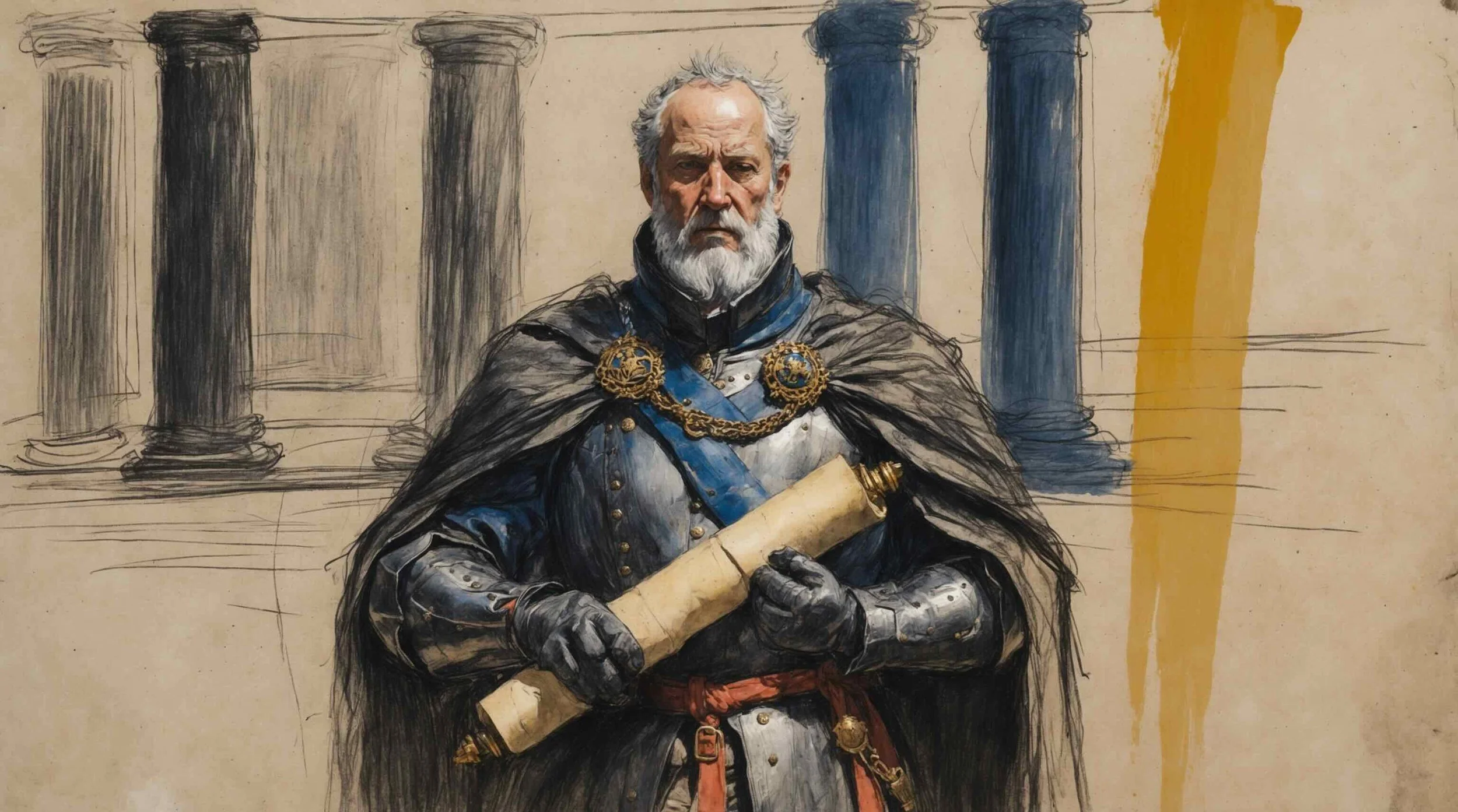
Character Profile – At a Glance
- Role: Thomas Beaufort, Duke of Exeter, Henry’s uncle and the most senior English noble in the play. He is the King’s ambassador, his chief law officer, and the man who does the hard jobs first-hand.
- Key Traits: Formal, unhurried and physically formidable. He speaks the most elaborate diplomatic verse in the play and never once uses it to soften anything. He is also, unexpectedly, the only man in the play who admits to crying.
- The Core Conflict: Exeter carries out the will of the state without visible cost, and then discovers he has one. Nothing in his conduct changes; the A4S6 report simply shows what has been held down underneath it.
- Key Actions: Urges Henry to press his claim in A1S2 and answers the Scottish objection with the beehive argument. Presents the tennis balls to the King. Arrests Cambridge, Scroop and Grey at Southampton in A2S2. Delivers Henry’s ultimatum to the French court in A2S4. Holds the bridge in A3S6 and sentences Bardolph to hang. Reports the deaths of York and Suffolk in A4S6. Reads the treaty articles in A5S2.
- Famous Quote:
"Scorn and defiance; slight regard, contempt…"
(Act 2, Scene 4) - The Outcome: He survives, is trusted throughout, and is the man reading out the terms when the Treaty of Troyes is agreed. He is the only figure who is present at the war’s beginning, its worst moment and its settlement.
The Advised Head Defends Itself at Home
Exeter’s first substantial contribution comes in A1S2, and it is a piece of political argument rather than a display of loyalty. Westmoreland has raised the obvious objection to invading France: the Scots will come over the border the moment the army leaves. Canterbury answers with the famous image of the beehive – a commonwealth of bees, each with its allotted function. Exeter gets there first, and more briskly.
Original
While that the armed hand doth fight abroad,
The advised head defends itself at home;
For government, though high and low and lower,
Put into parts, doth keep in one consent,
Congreeing in a full and natural close,
Like music.
(Act 1, Scene 2)
Shakespeare Retold (Modern Verse)
While armies fight our cause for us abroad,
Our intellect will keep us safe at home;
For government, from nobles down to workers,
Is split, but yet it acts in unity,
Together in a natural harmony,
Like music.
The argument is that a properly ordered state can do two things at once, because its parts are separately capable and jointly harmonious. It is the standard Elizabethan account of political order, and Exeter delivers it as settled fact rather than as an idea to be defended.
The image is worth pausing on. Government as music requires that each part keep to its own line, and the play will spend five acts testing whether the English state actually works like that. Within two scenes three noblemen will be arrested for treason at Southampton, and by Act 3 the Welsh, Irish, Scots and English captains will be quarrelling under the walls of Harfleur. Exeter is stating a theory, and the play is about to audit it. That he never seems to notice the audit is part of what he is.
Bloody Constraint
A2S4 is Exeter’s great scene. He is sent alone into the French court to deliver Henry’s demand for the crown of France, and asked by the French King what will follow a refusal. His answer is two words long, and then he expands it for twenty-five lines.
Original
Bloody constraint; for if you hide the crown
Even in your hearts, there will he rake for it:
Therefore in fierce tempest is he coming,
In thunder and in earthquake, like a Jove,
That, if requiring fail, he will compel;
And bids you, in the bowels of the Lord...
(Act 2, Scene 4)
Shakespeare Retold (Modern Verse)
Then violent coercion; hide the crown
Within your hearts, and he will rip it out.
For he is coming like a wild tempest,
With devastation only Jove could wreak,
Which he’ll be forced to do if you decline...
"Bloody constraint" is one of the coldest phrases in the play, and its placing is a small masterpiece of diplomacy. Exeter has been asked a polite question and gives the honest answer immediately, without cushioning – and only then dresses it up in thunder, earthquakes and Jove. The threat comes first; the rhetoric is decoration.
What follows is stranger still. Exeter goes on to itemise, in advance, the widows’ tears, the orphans’ cries, the dead men’s blood and the groans of unmarried women, and he places all of it on the French King’s head. It is the same manoeuvre Henry will use at Harfleur one act later: describe the horror in detail, and then explain that the person refusing to surrender will be the one who caused it. Exeter performs it faultlessly and without any sign of discomfort. He is the state speaking, and the state has no conscience to embarrass.
I Arrest Thee of High Treason
At Southampton in A2S2, Henry has trapped the three conspirators by asking them to advise him on mercy for a drunk, and then handing them their own indictments. The moment the trap closes, Exeter steps forward and does it three times.
Original
I arrest thee of high treason, by the name of
Richard Earl of Cambridge.
I arrest thee of high treason, by the name of
Henry Lord Scroop of Masham.
I arrest thee of high treason, by the name of
Thomas Grey, knight, of Northumberland.
(Act 2, Scene 2)
Shakespeare Retold (Modern Verse)
I arrest you for high treason, you so named
Richard, Earl of Cambridge.
I arrest you for high treason, you so named
Henry, Lord Scroop of Masham.
I arrest you for high treason, you so named
Thomas Grey, knight, of Northumberland.
The repetition is the whole effect. Shakespeare could have written one arrest covering three men; instead the identical formula is spoken three times, with only the name changing. It sounds like a machine, and it is meant to. Where Henry’s preceding speech is fifty lines of wounded personal betrayal – especially towards Scroop, who had been his intimate – Exeter supplies the procedure that follows the emotion.
The division of labour is characteristic and it recurs. Henry feels the treason; Exeter arrests. Henry orders discipline in the army; Exeter sentences Bardolph. Henry demands the French crown; Exeter goes to Paris and says so. The King keeps the moral weather; his uncle does the paperwork, and the paperwork always includes at least one man’s death.
All My Mother Came Into Mine Eyes
Then, in A4S6, the machine speaks. Exeter has been sent to find the Duke of York, who has been killed in the battle, and comes back to report. What he delivers is not a casualty return but the longest and most tender speech in the play.
Original
So did he turn and over Suffolk's neck
He threw his wounded arm and kissed his lips;
And so espoused to death, with blood he sealed
A testament of noble-ending love.
The pretty and sweet manner of it forced
Those waters from me which I would have stopped;
But I had not so much of man in me,
And all my mother came into mine eyes
And gave me up to tears.
(Act 4, Scene 6)
Shakespeare Retold (Modern Verse)
And then he turned, and over Suffolk’s neck
He lay his wounded arm and kissed his lips;
And so, united as they died, he sealed
A bloodied bond of noble love in death.
This beautifully tender moment forced
My tears to flow which I had tried to stop;
But I could not behave just like a man should,
And, like my mother would, my eyes welled up
And made me cry my eyes out.
The two dying men are described as married – "espoused to death", a testament sealed in blood, a kiss on the lips – and the language is drawn from marriage vows throughout. Whatever else the play does with brotherhood in the Saint Crispin’s Day speech, this is the one place where it is shown rather than promised, and it is shown between two men bleeding to death in mud.
The last three lines are the astonishing part. Exeter reports that he wept, blames it on the woman in him, and apologises for it. This from the man who arrested three noblemen without a change of tone and told a foreign court to expect bloody constraint. It is the only moment in the play when the machinery of the English state visibly has a person inside it. Henry’s reply is that he is fighting the same tears back. Four lines later he orders every prisoner in the camp killed.
"…a righteous war, and seemed as much so to Shakespeare’s public as the war against the Nazis seems to us."
— John Dover Wilson, King Henry V, 1947
Key Quotes
Quote 1
Your brother kings and monarchs of the earth
Do all expect that you should rouse yourself,
As did the former lions of your blood.
(Act 1, Scene 2)
Shakespeare Retold (Modern Verse)
Your fellow kings and monarchs of the world
Expect that you will rise and face the challenge,
Just like your mighty ancestors before you.
Quote Analysis: Part of the chorus of encouragement that surrounds Henry in A1S2, and worth noticing because of who is speaking. This is not a churchman with property to protect; it is the King’s own uncle, invoking family and reputation. "The former lions of your blood" appeals to Edward III and the Black Prince, and the pressure is precisely calibrated: not you should invade France, but everyone is watching to see whether you are the man your ancestors were. Henry has been pushed towards this war by the Church, by the Dauphin’s insult and by his own family, and the play is careful to show all three before he decides.
Scorn and defiance; slight regard, contempt,
And any thing that may not misbecome
The mighty sender, doth he prize you at.
(Act 2, Scene 4)
Shakespeare Retold (Modern Verse)
Scorn and contempt; a general disregard,
And anything that might not seem demeaning
Unto our mighty king, he sends to you.
Quote Analysis: The Dauphin has asked what message Henry sends him personally, and this is it: four abstract nouns of dismissal, delivered to a prince’s face in his father’s court. The qualification in the second and third lines is exquisitely lawyerly – Exeter will insult the Dauphin as far as he can without saying anything unbecoming to his own king. The whole art of the ambassador is in that clause. He is being maximally offensive within the limits of protocol, and the limits are what make the offence land.
There's five to one; besides, they all are fresh.
(Act 4, Scene 3)
Shakespeare Retold (Modern Verse)
That’s five to one; plus all of them are fresh.
Quote Analysis: The odds at Agincourt, stated by the most senior soldier present, in one flat line of arithmetic. Everything the play has been doing rhetorically stops for a moment while somebody counts. What makes the line so effective is that Exeter is not despairing – he is reporting, exactly as he reported the treaty terms and the casualty lists. The Saint Crispin’s Day speech follows within twenty lines, and it never disputes the number. Henry’s answer to five-to-one is not a better count but a different frame: fewer men, larger share of honour.
Farewell, kind lord; fight valiantly to-day:
And yet I do thee wrong to mind thee of it,
For thou art framed of the firm truth of valour.
(Act 4, Scene 3)
Shakespeare Retold (Modern Verse)
Goodbye, kind lord; go fight courageously.
And yet I’m wronging you by telling you this,
For you are the epitome of courage.
Quote Analysis: Exeter says goodbye to Salisbury as the army goes to its positions, and immediately apologises for the encouragement – telling a brave man to be brave is an insult to him. It is a tiny moment and it is the most human thing anyone says before the battle. It also sets up A4S6: Exeter is the character who notices what is owed to individual men, which is why he is the one sent to find York and the one who comes back weeping. Salisbury, for what it is worth, survives; York and Suffolk do not.
Key Takeaways
- The State’s Instrument: Exeter delivers the ultimatum, makes the arrests, holds the bridge and reads the treaty. Where the King feels, Exeter executes.
- Diplomacy With No Padding: "Bloody constraint" answers a polite question honestly and instantly. The elaborate verse that follows is decoration on a threat already delivered.
- The One Man Who Weeps: His A4S6 report of York and Suffolk is the tenderest speech in the play, and he apologises for the tears that come with it.
- Present Throughout: Exeter is in the room for the decision to invade, the treason trial, the ultimatum, the battle and the peace. No other character sees the whole war.
Study Questions and Analysis
Who is Exeter and what is his role in the play?
Thomas Beaufort, Duke of Exeter, was a half-uncle of Henry V – a son of John of Gaunt by Katherine Swynford, and therefore part of the Beaufort line that had been legitimised but barred from the succession. Shakespeare simplifies him into "uncle" and gives him the role of the King’s most trusted senior man.
His function is to be the state in person. Every institutional act in the play passes through him: the arrests, the embassy, the hanging of Bardolph, the treaty articles. He is also the play’s reliable narrator of fact – when a number, a name or a term needs stating without spin, Exeter states it.
His judgement of Scroop’s treason shows the register:
Nay, but the man that was his bedfellow,
Whom he hath dulled and cloyed with gracious favours,
That he should, for a foreign purse, so sell
His sovereign's life to death and treachery.
(Act 2, Scene 2)
Shakespeare Retold (Modern Verse)
It’s strange a man who once was such a close friend,
Someone the king had lavished gifts upon,
Has, for a chunk of foreign cash, sold off
The king’s life, killing him most treasonably.
Two observations follow. First, "bedfellow" here means a trusted intimate rather than anything sexual, though the closeness is the point. Second, Exeter registers the betrayal as a fact about the world and does not become emotional about it, whereas Henry devotes fifty lines of wounded rhetoric to the same man.
Alexander Leggatt’s Shakespeare’s Political Drama (1988) studies the histories as accounts of "the ordering and enforcing, the gaining and losing, of public power in the state", and figures like Exeter are where that ordering becomes visible. He has no private life in the play, no subplot and no ambition. He is what the crown does when it acts.
What does the embassy to the French court in Act 2, Scene 4 reveal?
It is the play’s fullest statement of the English claim, and it is delivered by a subordinate rather than by Henry himself – which is itself significant. Exeter comes with a genealogy in his hand and a demand that the French King abdicate.
He wills you, in the name of God Almighty,
That you divest yourself, and lay apart
The borrowed glories that by gift of heaven,
By law of nature and of nations, 'long
To him and to his heirs; namely, the crown
And all wide-stretched honours that pertain
By custom and the ordinance of times...
(Act 2, Scene 4)
Shakespeare Retold (Modern Verse)
He tells you, in the name of God Almighty,
That you must abdicate and sign away
The land you borrowed as a gift from heaven,
Through laws of nature and the land, belonging
To him and to his heirs; namely, the crown
And all the glorious honours that come with it
As is the custom of the ancient laws...
Notice how many authorities are stacked in seven lines: God, the gift of heaven, the law of nature, the law of nations, custom, and the ordinance of times. Exeter is not arguing; he is asserting that every available source of legitimacy already agrees, and that the French King is merely holding property that belongs to someone else. The word "borrowed" does an enormous amount of work.
The scene also insists that the claim is not opportunistic. Exeter says explicitly that it is "no sinister nor no awkward claim, picked from the worm-holes of long-vanished days" – which is exactly what an audience that has watched A1S1 might suspect it to be, since Canterbury and Ely had a financial motive for supplying it. Lily B. Campbell’s Shakespeare’s "Histories": Mirrors of Elizabethan Policy (1947) placed such scenes in the context of live Elizabethan arguments about just war; Jonathan Dollimore and Alan Sinfield (1985) read them as ideology being visibly assembled.
Whichever line you take, the scene’s dramatic effect is not in doubt: it is here that the audience hears how the war will sound in the mouths of the people conducting it, and it sounds entirely lawful.
Why does Exeter make the arrests at Southampton?
Because Henry cannot. A king who arrests men personally has become a party to a quarrel rather than the source of law, and the play is careful about that distinction. Henry exposes the plot, delivers the reproach, and then says "Arrest them to the answer of the law". Exeter supplies the law.
The way it is written is the point. Three identical sentences, three different names, no comment. Set against Henry’s preceding fifty lines – in which Scroop’s betrayal is compared to a second fall of man – the flatness is deliberate, and it is the flatness of process.
The Southampton scene is also where the play tests its own theory of order, the one Exeter stated in A1S2 with the image of government as music. Three of the highest men in England have taken French money to kill the King, which is exactly what a well-tuned commonwealth is not supposed to produce. The Chorus has already told the audience about it, describing the traitors as England’s "fault" and the country as otherwise sound.
There is one element the play handles delicately. The historical Cambridge’s motive was dynastic rather than financial: he had married into the Mortimer line, whose claim to the throne was arguably better than Henry’s. Shakespeare’s Cambridge gestures at this – he says the gold was not his chief motive – and then says no more. Peter Saccio’s Shakespeare’s English Kings (1977) sets out the genealogy the play declines to explain. The omission matters, because a rival claim would raise the question of Henry’s own title, which the play works hard to keep closed.
What is the significance of Exeter's report of York and Suffolk's deaths?
It is the emotional centre of Act 4 and the play’s only extended treatment of what it looks like when the brotherhood Henry promised at Saint Crispin’s Day is actually paid for.
Two things make it remarkable. The first is the language, which is the language of marriage: York throws his arm over Suffolk’s neck, kisses his lips, and is "espoused to death"; the blood seals "a testament of noble-ending love". Nothing else in the play is written like this. The second is Exeter’s own reaction, and Henry’s response to it:
I blame you not;
For, hearing this, I must perforce compound
With mistful eyes, or they will issue too.
(King Henry, Act 4, Scene 6)
Shakespeare Retold (Modern Verse)
I don’t blame you;
For hearing this I’m forced to fight the tears back
From my own glassy eyes, or else I’ll sob too.
Both men treat weeping as a failure of masculinity that has to be excused. Exeter blames his mother; Henry says he is compounding with misty eyes to stop them overflowing. In a play that has spent four acts insisting on the manliness of war, its two most senior figures spend nine lines apologising for grief.
And then comes the sequence that no production can neutralise. Henry finishes that sentence, hears a fresh alarum, and orders every soldier to kill his prisoners. The distance between the tears and the order is four lines. Readings differ sharply on what to do with this. It can be played as evidence that Henry’s feeling is real and his duty overrides it; it can be played as evidence that the feeling was never load-bearing. Stephen Greenblatt’s "Invisible Bullets" (1988) would call this the play registering royal ruthlessness in full and then folding it into the celebration. Norman Rabkin (1977) would say the arrangement is the point, and that the play refuses to tell us which reading is right.
What does Exeter's beehive argument tell us about order in the play?
The exchange in A1S2 about the Scots is easy to skip and worth reading closely, because it contains the play’s official theory of the state. Westmoreland warns that Scotland will invade the moment the army sails; Exeter replies with a proverb and then dismisses it.
It follows then the cat must stay at home:
Yet that is but a crushed necessity,
Since we have locks to safeguard necessaries,
And pretty traps to catch the petty thieves.
(Act 1, Scene 2)
Shakespeare Retold (Modern Verse)
Then, by that argument, the cat must stay home:
But that concern is surely overstated,
Because our borders all are well defended,
And we can catch all Scotland’s small incursions.
The proverb is "when the cat is away, the mice will play", and Exeter’s answer is that mice can be trapped. The Scots are reduced to vermin and the border to a matter of locks. Canterbury then expands the same argument into the beehive speech, in which every part of the commonwealth – soldiers, merchants, masons, magistrates – performs its function and the whole coheres.
This is orthodox Tudor political thought, and E. M. W. Tillyard’s Shakespeare’s History Plays (1944) built an entire reading of the second tetralogy on the assumption that Shakespeare shared it. Later critics have been less sure. Phyllis Rackin’s Stages of History (1990) argues that the history plays "occupy various sites of contention, between older and newer conceptions of history", and that the orthodoxies they voice are under pressure rather than simply endorsed.
The play’s own evidence supports the second view. The harmonious commonwealth Exeter describes produces, within two scenes, three traitors at Southampton; within three acts, four captains who cannot hold a conversation; and within four, an army in which a man is hanged for stealing a brass plate while the King is being told his cause may be unjust. Nothing refutes Exeter directly. The play simply keeps showing the music going out of tune.
Why does Exeter read the treaty terms in Act 5?
Because the settlement has to be shown as a legal instrument rather than a personal victory, and Exeter is the play’s legal voice. While Henry is courting Katharine, the French and English lords are elsewhere agreeing the articles; when they return, it is Exeter who reports what remains outstanding.
Only he hath not yet subscribed this:
Where your majesty demands, that the King of France...
(Act 5, Scene 2)
Shakespeare Retold (Modern Verse)
But as of yet, he’s not agreed to this point:
The one where your majesty demands the King of France...
The single unsigned clause turns out to concern the exact wording of Henry’s title in French and Latin documents: Notre tres cher fils Henri, Roi d’Angleterre, Heritier de France. After a war, a siege, a massacre of prisoners and the deaths of most of the Eastcheap characters, the last thing standing between the two kingdoms is a formula of address.
The placing is pointed. This bureaucratic detail arrives seconds after the kiss, and it is the play’s way of reminding the audience what the courtship was actually part of. Alexander Leggatt’s Shakespeare’s Political Drama (1988) reads the histories as studies in how public power is gained and held, and the last act of Henry V is a good illustration: the marriage and the title-formula are two clauses of the same document, and Exeter handles both.
It is also worth noting what the clause claims. "Heir of France" disinherits the Dauphin, who is not present and is never mentioned. The Epilogue then tells us the arrangement did not survive Henry’s son. Exeter reads out, in careful legal French and Latin, the sentence that history was about to cancel.
Is Exeter a fully drawn character or a functional one?
The honest answer is that he is mostly functional, and that the play then does something unusual with the one moment where he is not.
The case for "functional" is strong. Exeter has no soliloquy, no private scene, no relationship the play develops, no arc and no change. He appears when an institutional act is required and speaks with the same measured authority every time. In four hundred years of criticism he has attracted very little attention, and the standard editions – Gary Taylor’s Oxford (1982), Andrew Gurr’s New Cambridge (1992) – discuss him mainly as a structural presence.
The case against rests on A4S6, and it is worth making carefully. A purely functional character does not need to be given the play’s most affecting speech, and does not need to weep. If Shakespeare had simply wanted the deaths of York and Suffolk reported, four lines would have served. Giving those thirty lines to the man who arrested three noblemen without inflection creates a specific effect that no other assignment would produce: the audience discovers that the instrument has an interior, at the precise moment the war is at its most costly.
In performance this makes the part more rewarding than it looks on the page, and directors tend to cast it heavily. The most useful way to describe Exeter in an essay is as the play’s weight-bearing character: he holds the institutional world steady so that Henry’s improvisations have something to be measured against. When he cries, we learn what the steadiness has been costing – and the play moves on within four lines, which may be the most eloquent thing about it.