Princess Katharine
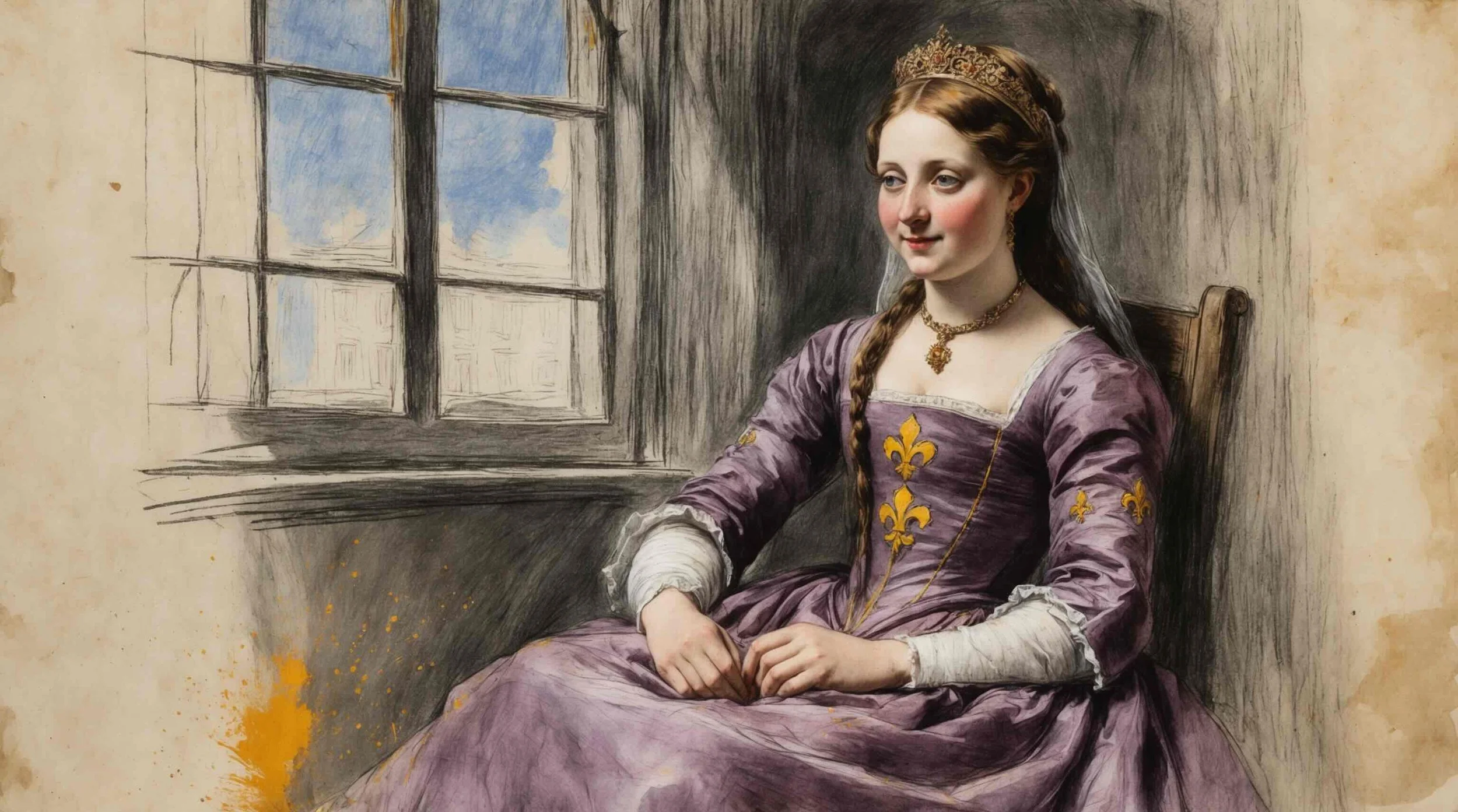
Character Profile – At a Glance
- Role: Daughter of the King and Queen of France, and the woman Henry names among his "capital demands" at the peace table. Her marriage is the term that seals the Treaty of Troyes.
- Key Traits: Quick, watchful and sharper than her broken English makes her look. She learns fast, hears flattery for what it is, and is repeatedly funnier than the men talking to her.
- The Core Conflict: Katharine is a person and a clause in a treaty at the same time. She is courted charmingly by a man who has already secured her in writing, and the play never lets us forget both facts at once.
- Key Actions: Asks her gentlewoman Alice to teach her English, body part by body part, in A3S4 – while Henry’s army is taking her father’s towns. Is named as a term of the treaty in A5S2, courted by Henry in a mixture of French and English, agrees to the match if her father wishes it, refuses to be kissed before marriage, and is kissed.
- Famous Quote:
"Is it possible dat I sould love de enemy of France?"
(Act 5, Scene 2) - The Outcome: She is betrothed to Henry and blessed by her mother as the seal on a peace between two kingdoms. She speaks no lines after the kiss. The Epilogue then reports that the son of this marriage lost everything his father won.
De Hand, De Fingres, De Nails
Katharine’s first scene is one of the strangest Shakespeare ever wrote: a hundred lines of French, almost entirely comprehensible to an English audience only through gesture and guesswork, in which a princess asks her gentlewoman to teach her the names of the parts of the body in English.
Original
KATHARINE: Je te prie, m'enseignez: il faut que j'apprenne a parler. Comment appelez-vous la main en Anglois?
ALICE: La main? elle est appelee de hand.
KATHARINE: De hand. Et les doigts?
(Act 3, Scene 4)
Shakespeare Retold (Modern Verse)
KATHARINE: Please teach me: I must learn to speak. What do you call ‘la main’ in English?
ALICE: ‘La main’? It is called the hand.
KATHARINE: The hand. And ‘les doigts’?
The placing is what makes it unsettling. This scene comes directly after Harfleur, where Henry has stood at the gates and described in detail what his soldiers will do to the town’s daughters if it does not surrender. Now a French princess is learning English, and the vocabulary she learns is a list of her own body: hand, fingers, nails, arm, elbow, neck, chin, foot.
Nobody has told Katharine to do this. She has decided, on her own initiative and before any marriage has been proposed to her, that the useful thing to learn is the language of the invading army. It is the shrewdest act of political forecasting anyone performs in the play, and she is roughly fourteen years old when she performs it. Alice, who has been to England, is her only source, and the two women work through the lesson with the seriousness of students. Katharine is pleased with herself for learning two words quickly. She is also, unmistakably, preparing.
Les Langues des Hommes
Two acts later Henry has won, the treaty is being drafted offstage, and Katharine is left alone with him and Alice to be courted. He begins with the compliment men in comedies begin with, and she does not take it.
Original
O bon Dieu! Les langues des hommes sont
pleines de tromperies.
(Act 5, Scene 2)
Shakespeare Retold (Modern Verse)
Oh, good God! The tongues of men are
full of deceit.
Henry has just told her that an angel is like her and she is like an angel. Her reply is not modesty and not flirtation; it is a general observation about men, delivered in French, to nobody in particular, in his hearing. Alice translates it for him.
What follows is the single most revealing line in the exchange. Henry says: "The princess is the better Englishwoman." Her suspicion of him is, in his account, the thing that makes her English already – and he means it as a compliment. He then adds that he is glad she cannot speak better English, because if she could she might find him too plain a king. The courtship is being conducted, quite openly, on the assumption that she is easier to win in a language she does not fully control.
Dat Is As It Sall Please de Roi Mon Pere
After several hundred words of soldierly plain-speaking, Henry finally puts the question – "break thy mind to me in broken English; wilt thou have me?" Katharine’s answer is one of the most carefully weighted sentences in Shakespeare.
Original
KATHARINE: Dat is as it sall please de roi mon pere.
KING HENRY V: Nay, it will please him well, Kate it shall please him, Kate.
KATHARINE: Den it sall also content me.
(Act 5, Scene 2)
Shakespeare Retold (Modern Verse)
KATHARINE: That is as it shall please the king, my father.
KING HENRY V: Indeed, it will please him greatly, Kate, it will please him, Kate.
KATHARINE: Then it will also please me.
She is asked for her mind and gives her father’s. That is not evasion; it is the accurate constitutional answer for a royal daughter in 1420, and she knows it. Henry cannot accept it, because he wants the appearance of consent as well as the substance of possession, so he tells her what her father will decide – which he is in a position to know, having dictated the terms.
Her second answer is the one that keeps critics arguing. "Then it shall also content me" can be played as warm, as resigned, as ironic, or as flatly procedural, and the text supports every one of them. What it never does is say yes on her own account. She agrees that she will be contented by whatever her father is contented by, which is a statement about the chain of authority rather than about her feelings. In a scene that has spent two hundred lines pretending to be a courtship, this is the moment the treaty shows through.
It Is Not the Custom of France
Henry moves to kiss her hand, and she stops him. It is the only time in the play that anyone physically refuses Henry anything.
Original
Laissez, mon seigneur, laissez, laissez: ma foi, je ne veux point que vous abaissiez votre grandeur en baisant la main d'une de votre seigeurie indigne serviteur; excusez-moi, je vous supplie, mon tres-puissant seigneur.
(Act 5, Scene 2)
Shakespeare Retold (Modern Verse)
Let go, my lord, let go, let go! My word, I would not want you to lower your greatness by kissing the hand of one of your lordship’s unworthy servants. Forgive me, I beg you, my most mighty lord.
The refusal is dressed in courtly self-abasement – she is unworthy, he is mighty – but the repeated laissez, three times, is a woman physically taking her hand back. She then explains that French custom does not permit ladies to be kissed before their weddings.
Henry’s answer is that he and she are the makers of manners, and that the liberty of kings stops the mouths of all find-faults. Then he kisses her. It is done charmingly and it is done anyway, and the argument he uses is that a king is not bound by the customs of a country he has just conquered. Katharine speaks four more words in the play – a brief exchange as her father returns – and then nothing. The rest of the scene is transacted between Henry, her father, Burgundy and the French lords, over a settlement in which she is a clause.
"The play deftly registers every nuance of royal hypocrisy, ruthlessness, and bad faith."
— Stephen Greenblatt, Shakespearean Negotiations, 1988
Key Quotes
Quote 1
Your majesty shall mock at me;
I cannot speak your England.
(Act 5, Scene 2)
Shakespeare Retold (Modern Verse)
Your majesty is making fun of me;
I cannot speak your English.
Quote Analysis: Katharine’s first words to Henry, and they name the danger before he has done anything. She assumes she is about to be laughed at, and she is not wrong – the scene will get much of its comedy from her pronunciation. The slip in the second line is Shakespeare’s finest touch: "your England" for "your English" collapses the language into the country, so that the thing she cannot speak and the thing that has just conquered her father are the same word. She is more accurate than she intends.
KING HENRY V: I will not part with a village of it; I will have it all mine: and, Kate, when France is mine and I am yours, then yours is France and you are mine.
KATHARINE: I cannot tell vat is dat.
(Act 5, Scene 2)
Shakespeare Retold (Modern Verse)
KING HENRY V: I will not let a single village be taken; it will all be mine. And, Kate, when France is mine and I am yours, then France is yours and you are mine.
KATHARINE: I cannot tell what that means.
Quote Analysis: Henry offers Katharine a piece of romantic algebra in which loving him makes France hers, and she declines to solve it. Her reply is usually played for laughs – the French princess losing the thread of an English sentence – but it can be delivered as the flattest possible refusal, and the words support it. The proposition genuinely does not mean anything: France is not becoming hers, and the first half of the sentence has already said so. "I cannot tell what that means" may be the most honest response available to it.
Your majestee ave fausse French enough to deceive de most sage demoiselle dat is en France.
(Act 5, Scene 2)
Shakespeare Retold (Modern Verse)
Your majesty has enough false French to deceive the most savvy young lady in France.
Quote Analysis: The best line Katharine is given, and the one that settles the question of whether she is a passive figure. Henry has just attempted to woo her in laboured French; she tells him his French is good enough to fool the cleverest woman in the country. The compliment and the accusation are the same sentence. "Fausse" carries both meanings at once – his French is faulty, and it is deceitful – and she leaves both running. She has, in one line, warned him that she can see what he is doing and declined to stop him.
Les dames et demoiselles pour etre baisees devant leur noces, il n'est pas la coutume de France.
(Act 5, Scene 2)
Shakespeare Retold (Modern Verse)
The women and young ladies must not be kissed before their wedding, as it’s not the custom in France.
Quote Analysis: The whole political situation in one sentence about etiquette. Katharine appeals to French custom; she is standing in a French palace; and the custom no longer holds, because the man she is addressing has just conquered the country that made it. Henry’s reply says exactly this – kings make manners – and the kiss follows. It is the small domestic version of what has happened at Harfleur and Agincourt, and it is played as charm. Whether an audience laughs or winces here is the best single test of how it is reading the play.
Key Takeaways
- She Prepares Before She Is Asked: Katharine starts learning English in A3S4, long before any marriage is proposed. It is the shrewdest thing anyone does in the play.
- Wit Inside Broken English: Her best lines – on deceitful tongues and on false French – are jokes with edges, and she lands them in a language she barely controls.
- Consent That Is Not Quite Consent: Asked if she will have him, she answers with her father’s will, then agrees to be contented by it. She never says yes on her own account.
- A Clause in a Treaty: Henry lists her among his demands before he woos her. After the kiss she has no more lines, and the scene finishes as a negotiation between men.
Study Questions and Analysis
Who is Princess Katharine and why does she matter to the play?
Katharine of Valois was the youngest daughter of Charles VI of France, born in 1401, and she really did marry Henry V in 1420 under the Treaty of Troyes, which made Henry heir to the French throne and disinherited the Dauphin. Their son became Henry VI. She was about eighteen at the marriage and Henry about thirty-three.
In the play she matters for three reasons. She is the human form the peace settlement takes; she is the only French character the play treats with warmth; and she is the last thing Henry has to acquire. Her two scenes bracket the war – A3S4 comes just after Harfleur, A5S2 after the treaty – so her progress and the campaign’s are the same progress.
Her first line establishes what she is doing about it:
KATHARINE: Alice, tu as ete en Angleterre, et tu parles bien le langage.
ALICE: Un peu, madame.
(Act 3, Scene 4)
Shakespeare Retold (Modern Verse)
KATHARINE: Alice, you’ve been to England, and speak the language well.
ALICE: I speak a bit, madame.
Jean E. Howard and Phyllis Rackin’s Engendering a Nation: A Feminist Account of Shakespeare’s English Histories (1997) is the fullest account of how the history plays use women as the ground on which national settlements are transacted, and Katharine is one of their central examples. Lance Wilcox’s "Katherine of France as Victim and Bride" (Shakespeare Studies, 1985) is the standard starting point on the wooing scenes specifically.
One structural point is worth carrying into an essay. Katharine has more lines than any other woman in the play by a wide margin, and almost all of them are in French. Shakespeare gave the play’s largest female part a language most of his audience could not follow.
What is the English lesson in Act 3, Scene 4 actually doing?
On the surface it is a language-learning joke, and it is genuinely funny in performance: Katharine mispronounces, Alice corrects, and the lesson ends in embarrassment when two English words turn out to sound like French obscenities.
Neanmoins, je reciterai une autre fois ma lecon ensemble: de hand, de fingres, de nails, de arm, de elbow, de nick, de sin, de foot, de coun!
(Act 3, Scene 4)
Shakespeare Retold (Modern Verse)
Nevertheless, I will recite my lesson one more time together: the hand, the fingers, the nails, the arm, the elbow, the nick, the sin, the foot, the gown!
Three things are happening under the joke. The first is that the vocabulary is a body, learned from the top down, by a woman who is about to be transferred between kingdoms. The scene inventories her.
The second is placement. This immediately follows the Harfleur speech, in which Henry promised the town’s daughters to his soldiers. Lance Wilcox (1985) reads Katharine’s position as continuous with that threat – the same violence conducted through marriage rather than through sack – and the sequence of scenes is his strongest evidence.
The third is historical and specific. Juliet Fleming’s "The French Garden: An Introduction to Women’s French" (ELH, 1989) sets the scene beside a real manual published in 1605 for Englishwomen learning French, and shows that such books routinely eroticised female language-learning while granting women no actual authority over language or anything else. Fleming’s essay is the best single explanation of why the scene feels simultaneously charming and uncomfortable: it is reproducing a real genre that felt the same way.
It is worth resisting one over-reading. Katharine is not a victim in this scene; she is the one who requested the lesson, she enjoys her own progress, and her horror at the two rude words is the reaction of a young woman with a strong sense of decorum, played for affection rather than mockery. The discomfort belongs to the play’s arrangement of scenes, not to her conduct within one.
Does Katharine have any real choice about the marriage?
No, and the play is unusually explicit about it. The marriage is a term of the treaty before the courtship begins. In the negotiation that opens A5S2, Henry tells the French that Katharine is among his "capital demands", and the French lords go off to consider the articles while Henry stays behind with her. The scene we watch as a courtship is happening after the point of decision.
What Shakespeare gives her instead of choice is judgement. She sees what is being done and comments on it, and she does it in a language she is still learning:
KING HENRY V: Do you like me, Kate?
KATHARINE: Pardonnez-moi, I cannot tell vat is 'like me.'
(Act 5, Scene 2)
Shakespeare Retold (Modern Verse)
KING HENRY V: Do you like me, Kate?
KATHARINE: I’m sorry, I don’t know what you mean by ‘like me.’
The line can be played as a genuine translation problem or as a refusal to answer, and productions have used both. That ambiguity is the whole of Katharine’s agency: she has no power to decline, and she has considerable power to withhold enthusiasm.
Jean E. Howard and Phyllis Rackin (1997) place the scene within the histories’ broader pattern, in which women become the medium through which male political settlements are ratified. Lance Wilcox (1985) reads it more starkly, as conquest continued by other means. A fair essay should also register the counter-evidence: Shakespeare could have given Katharine four lines and a nod, and instead gave her the longest scene of the fifth act, several jokes at the King’s expense, and a refusal that has to be overruled rather than ignored. That is not agency, but it is not nothing either.
Is the wooing scene romantic comedy or conquest?
It is written to be both, and productions have to choose an emphasis because the two readings cannot be held in equal balance in performance.
The comedy is real. Henry is genuinely funny, the language confusion produces good jokes, Alice's translations are a running gag, and the scene has the shape of the "blunt soldier woos a lady" routine that Elizabethan audiences knew well. Katharine gets some of the best lines:
Sauf votre honneur, le Francois que vous parlez, il est meilleur que l'Anglois lequel je parle.
(Act 5, Scene 2)
Shakespeare Retold (Modern Verse)
Saving your honour, the French you speak is better than the English that I speak.
That is a joke made at a conqueror’s expense by his prisoner-bride, and she gets away with it.
The conquest reading rests on structure rather than tone. Henry has demanded her in the treaty. He tells her that in loving him she will love the friend of France, then says he will not part with a village of it. He overrules her refusal of the kiss by asserting that kings make manners. And the moment the French party returns, Burgundy makes a series of increasingly broad jokes about Katharine’s body and her likely reluctance, which Henry meets in kind, while she says nothing at all.
Stephen Greenblatt’s "Invisible Bullets" (1988) supplies the mechanism that lets both readings coexist: the play "deftly registers every nuance of royal hypocrisy, ruthlessness, and bad faith" and then absorbs the registering into the celebration, so that acknowledging the coercion becomes part of enjoying the ending. Norman Rabkin (1977) would call this the play’s duck-rabbit working exactly as designed. The strongest examination answer names the scene’s comic surface accurately, names the structural facts accurately, and declines to pretend that either cancels the other.
Why does Shakespeare give Katharine so much French?
Roughly two-thirds of Katharine’s lines are in French, and the great majority of the 1599 audience at the Globe would have understood little of it. That is an extraordinary decision for a commercial dramatist, and it must be doing something.
The most persuasive answer is that the incomprehension is the point. An English audience watching A3S4 is in exactly the position Katharine is in for the rest of the play: hearing sounds, catching a word here and there, guessing at meaning from gesture and tone. The scene makes the audience experience the language barrier rather than merely observe it.
It also does something to the war. Everywhere else, the French are the enemy and are spoken of collectively – the Dauphin’s boasting, the lords’ contempt at Agincourt. Katharine’s scenes are the only place the play stops to listen to French people talking to each other about ordinary things, and the effect is humanising. A great deal of the discomfort of Act 5 comes from the fact that the audience has already met Katharine on her own terms.
Michael Neill’s "Broken English and Broken Irish" (Shakespeare Quarterly, 1994) sets Katharine’s French alongside Fluellen’s Welsh, Macmorris’s Irish and Jamy’s Scots, and argues that the play is systematically interested in what happens when English absorbs the languages around it. Read that way, Katharine’s progress from monolingual French princess to broken-English queen-to-be is the same process the four captains scene stages in miniature, and the play’s handling of it is equally unresolved. Claire McEachern’s The Poetics of English Nationhood, 1590–1612 (1996) traces the same corporate fiction of nationhood being built and strained across the period’s writing.
There is a practical footnote worth knowing: A3S4 appears in the 1600 Quarto in a shortened and much less accurate French, which suggests either that the compositor struggled or that the scene was already being trimmed in performance.
What does Katharine's silence at the end of the play mean?
After the kiss, Katharine speaks once more – a brief exchange when her father returns – and then is silent for the remaining hundred lines of the play. During that time Burgundy jokes about her virginity, Henry jokes back, the French King agrees the articles, and Queen Isabel delivers a blessing on the marriage. Katharine stands there.
The last thing said in her defence is said by Alice, and it stalls on a word she does not know. Asked to interpret Katharine’s refusal, Alice reports that it is "not be de fashion pour les ladies of France" and then breaks off: "I cannot tell vat is baiser en Anglish." Even the objection has to be translated, and the translator runs out of vocabulary halfway through. Henry supplies the missing word himself – "To kiss" – and then does it.
Silence in Shakespeare is rarely neutral, and this one has a shape: it begins at the exact moment the personal negotiation ends and the political one resumes. Jean E. Howard and Phyllis Rackin (1997) treat this pattern as characteristic of the histories, where women are audible while their consent is being obtained and inaudible once it has been. Directors have read the silence in opposite ways – as contentment, as shock, as calculation – and the text will carry all of them, because Shakespeare gave her nothing to say.
The Epilogue then adds the final weight. The son of this marriage was crowned in infancy, lost France, and left England bleeding. Katharine’s marriage is the hinge on which the play’s triumph turns into the next century’s civil war, and the play’s last speech says so.
How do modern productions handle Katharine?
The performance history of the part is a useful map of how attitudes to the play have moved, and it is worth a paragraph in an essay because it shows the text’s ambiguities being tested in practice.
Laurence Olivier’s 1944 film, made as wartime morale-building, played the courtship as straightforward romantic comedy: charming, chaste, and untroubled. Kenneth Branagh’s 1989 film, made in a different mood and much darker about the war generally, kept the charm but let the power difference show, and gave Katharine a wariness that the scene does not resolve.
Since the 1990s productions have increasingly staged the scene as a negotiation the audience is meant to feel uneasy about – playing the kiss as an overruling rather than a conclusion, keeping Katharine visibly silent through Burgundy’s jokes, or having her hold herself apart during the final betrothal. Some productions restore A3S4 in full, which strengthens her considerably; others cut it, which reduces her to the wooing scene alone.
The critical shift behind this began with Lance Wilcox’s "Katherine of France as Victim and Bride" (1985) and was consolidated by Juliet Fleming (1989) and by Jean E. Howard and Phyllis Rackin’s Engendering a Nation (1997), which together made it difficult to treat the scene as simply delightful. It is worth adding, though, that the modern consensus is itself a reading rather than a discovery. The evidence for the darker interpretation – the treaty, the demands, the overruled refusal – was always in the text; so were the jokes, the warmth and Katharine’s own wit. Norman Rabkin’s point about the play as a whole applies precisely here: it "points in two opposite directions, virtually daring us to choose one of the two opposed interpretations it requires of us".