Henry V: Act 3, Scene 7 – Analysis
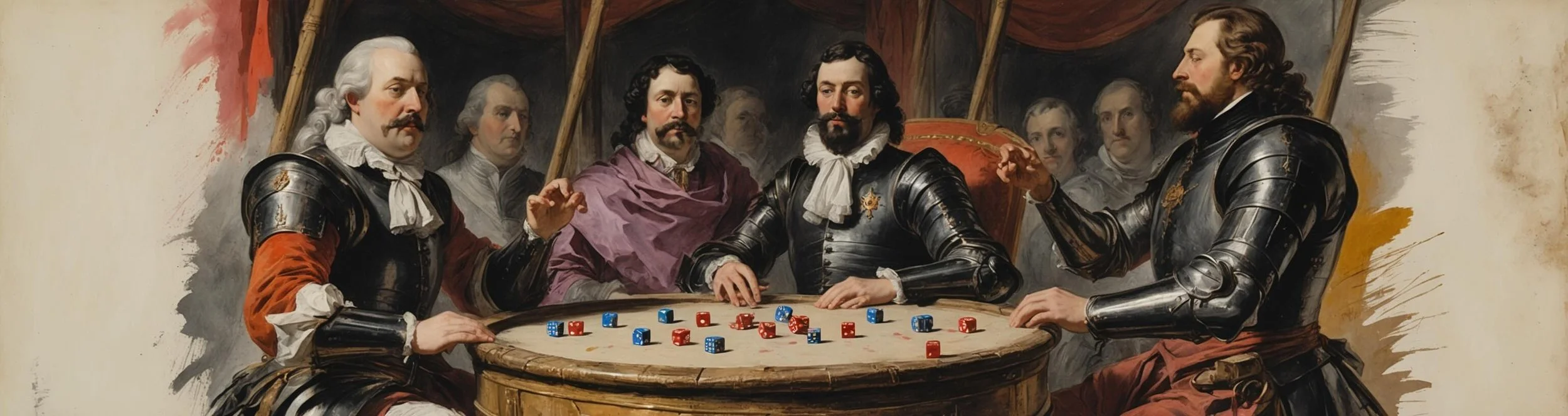
Scene Profile – At a Glance
- Location: The French camp near Agincourt, the night before the battle.
- What Happens: The French commanders pass the longest night of their lives in competitive wit: the Dauphin composes praises of his horse – “my horse is my mistress” – the Constable needles him, and everyone wishes for a morning they are certain will bring an easy massacre of the English.
- Key Characters: The Constable of France, the Dauphin, Orleans and Rambures.
- Dramatic Function: The eve of Agincourt from the French tents – brilliance, boredom and total confidence, staged so the audience can measure it against the English night that follows.
- Famous Quote:
"Then did they imitate that which I composed to my courser, for my horse is my mistress."
(the Dauphin, Act 3, Scene 7) - Why It Matters: Shakespeare gives the French wit, glamour and no seriousness whatever – the night before the battle spent on horses, mistresses and proverbs while the English pray. The contrast is the play’s deepest structural joke.
Scene Summary
Midnight in the French camp, and the lords cannot make morning come faster. The Constable boasts of the best armour in the world; Orleans of the best horse in Europe; and the Dauphin outbids everyone with an aria to his own mount – a flying horse, “le cheval volant”, pure air and fire, the prince of palfreys whose neigh is “like the bidding of a monarch”. He has written it a sonnet beginning “Wonder of nature” – which, Orleans observes, is how sonnets to mistresses begin. The Dauphin is untroubled: “my horse is my mistress.”
The wit turns bawdy, then sour. The Constable needles the prince through a long duel of proverbs, and when the Dauphin leaves to arm himself, the knives come out: the Dauphin’s valour is a “hooded valour” that no one has ever seen but his lackey – he told the Constable of his own bravery himself. Rambures offers a wager on twenty English prisoners.
A messenger reports the English lying within fifteen hundred paces, and the contempt flows freely: poor Harry of England does not long for dawn as they do; the English are mastiffs – brave, stupid dogs who leave their wits with their wives – and, crucially, they are “shrewdly out of beef”, so tomorrow they will have stomachs to eat and none to fight. Orleans closes the scene with the night’s arithmetic: it is two o’clock – and by ten, each French lord will have a hundred Englishmen.
The Prince of Palfreys
The Dauphin’s praise of his horse is the most gorgeous nonsense in the play – and a self-portrait he never notices painting.
Original
It is the prince of palfreys; his neigh is like the bidding of a monarch and his countenance enforces homage.
(the Dauphin, Act 3, Scene 7)
Shakespeare Retold (Modern Verse)
It is the prince of fine horses; his neigh is like the king issuing commands, and his looks demand respect.
The horse ascends, image by image, from animal to monarch: Pegasus, pure air and fire, a neigh like a king’s command, a countenance that “enforces homage”. The joke is double. First, the misdirected artistry – the finest lyric energy in the French camp, spent the night before a battle on livestock; the sonnet that should woo a lady or steel an army praises a horse. Second, the tell: the Dauphin’s ideal of majesty – beautiful, admired, obeyed on sight – is display without substance, exactly the conception of kingship that Henry’s working-day monarchy exists to refute. He describes his horse as everything he believes a prince should be, and the play lets the description convict him.
The Hooded Valour
The moment the Dauphin exits, his own side files its true report.
Original
By my faith, sir, but it is; never any body saw it but his lackey: 'tis a hooded valour; and when it appears, it will bate.
(the Constable, Act 3, Scene 7)
Shakespeare Retold (Modern Verse)
I tell you, sir, that it is; no one has ever seen him be brave except his servant. It’s a well disguised bravery, and when it appears, it will quickly dissipate.
The Constable’s image is from falconry: a “hooded” hawk sits blind and quiet until the hood is removed – and “when it appears, it will bate”, flutter uselessly on the leash rather than fly. The Dauphin’s courage, in other words, is invisible until the moment of action, at which point it will flap and fail. The preceding exchange is just as lethal: the only witness to the prince’s valour is the prince – “he told me so himself”. Shakespeare gives the French their own satirist, and the effect is worth noting for essays: the play’s mockery of the Dauphin needs no English voice, because his colleagues do it better – a command structure that fights with itself the night before its catastrophe.
Mastiffs and Wolves
The French assessment of the English is the scene’s finest irony: accurate in every detail, wrong only in its conclusion.
Original
Just, just; and the men do sympathize with the mastiffs in robustious and rough coming on, leaving their wits with their wives: and then give them great meals of beef and iron and steel, they will eat like wolves and fight like devils.
(the Constable, Act 3, Scene 7)
Shakespeare Retold (Modern Verse)
Exactly: Englishmen are just like the bear-baiting dogs in their ferocity and fighting spirit, leaving their brains at home with their wives. And if you give them a big meal of beef and arm them with iron and steel weapons, they’ll eat like wolves and fight like devils.
The English are bear-baiting mastiffs – ferocious, witless, bred to attack whatever is in front of them – and fed on beef, iron and steel they “eat like wolves and fight like devils”. The Constable means it as a joke about stupidity; the audience hears a scouting report of tomorrow’s disaster. Orleans supplies the fatal comfort – the English are “shrewdly out of beef” – and the Constable draws the conclusion the battle will reverse: stomachs to eat and none to fight. Every fact is right: the English are starving, dogged and outnumbered. The French simply cannot imagine a courage that does not look like theirs – plumed, mounted and well-fed – and the play has built this entire scene so that Agincourt can be the cost of that failure of imagination.
Language and Technique
- Prose wit as characterisation: The whole scene runs in glittering competitive prose – the register of the salon, not the camp. The French are never more charming, or less ready.
- The sonnet joke: A love-sonnet convention (“Wonder of nature”) applied to a horse skewers both the Dauphin and courtly love at once – praise as a genre detached from its object.
- Falconry metaphor: The “hooded valour” that will “bate” – flutter, not fly – is precision mockery in the technical language of the aristocracy’s own sport.
- Animal imagery for the English: Mastiffs, wolves, a flea on a lion’s lip – the French can only conceive English courage as animal stupidity, an error the play prices at ten thousand dead.
- Counting unhatched chickens: Wagers on prisoners, a hundred Englishmen each by ten o’clock – the scene’s arithmetic of certainty, kept for the audience to audit after the battle.
Key Quotes from Act 3, Scene 7
Quote 1
Original
And of the heat of the ginger. It is a beast for Perseus: he is pure air and fire; and the dull elements of earth and water never appear in him...
(the Dauphin, Act 3, Scene 7)
Shakespeare Retold (Modern Verse)
And as fiery as ginger. He’s an animal worthy of the Greek hero Perseus: he is pure air and fire; and the boring elements of earth and water are never reflected in him...
Quote Analysis: The Dauphin’s horse assembled from the four elements – ginger-hot, “pure air and fire”, with the dull earth and water left out. The conceit is learned, elegant and preposterous, and the omission is the point: earth and water are exactly what will win Agincourt – English feet in French mud. The prince has bred even the terrain out of his imagination, and the battle will be fought in the two elements his fantasy excluded.
Original
Then did they imitate that which I composed to my courser, for my horse is my mistress.
(the Dauphin, Act 3, Scene 7)
Shakespeare Retold (Modern Verse)
Then they were copying the one I wrote for my hunting horse, for my horse is my mistress.
Quote Analysis: The line that defines the Dauphin for ever: challenged that his horse-sonnet sounds like a mistress-sonnet, he embraces the confusion – “my horse is my mistress”. The joke he thinks he is making is about devotion; the joke the play makes is about displacement – a prince whose passion, poetry and loyalty have all settled on his mount, the night before his nation needs all three. Quote it in any essay on the French as Henry’s foils: the King’s mistress, by Act 5, is France itself.
Original
It is now two o'clock: but, let me see, by ten
We shall have each a hundred Englishmen.
(Orleans, Act 3, Scene 7)
Shakespeare Retold (Modern Verse)
It is now only two o’clock; by ten
We’ll each have killed a hundred Englishmen.
Quote Analysis: The scene’s exit line and its epitaph: two o’clock now, a hundred Englishmen each by ten. The couplet’s neat arithmetic – time in, corpses out – is confidence at its most bankable, and Shakespeare lets it stand as the last word of the French night precisely so the day can audit it. By ten the next morning, the hundred-per-lord will be French, and the lords themselves will be crying “shame” in Act 4, Scene 5. The play’s cruellest ironies are always spoken by their victims, in advance.
Key Takeaways
- Wit instead of watchfulness: The French spend the night on horses, mistresses and proverb-duels – brilliance with nothing underneath, staged against the English night of prayer.
- The Dauphin is mocked by his own side: The “hooded valour” verdict comes from the Constable, not the English – the French command despises its own prince.
- Accurate contempt, fatal conclusion: Everything the French say about the English – starved, stupid, dogged – is true; only the meaning is wrong. Agincourt is the price of the misreading.
- The audit is set up: A hundred Englishmen each by ten o’clock – the play records the boast so the battle can mark it.
Study Questions and Analysis
What is the point of the long horse conversation?
Characterisation by misdirected passion. The Dauphin’s praise of his horse is technically superb – classical allusion, elemental theory, a sonnet in progress – and aimed at precisely the wrong object on precisely the wrong night:
Original
Nay, the man hath no wit that cannot, from the rising of the lark to the lodging of the lamb, vary deserved praise on my palfrey...
(the Dauphin, Act 3, Scene 7)
Shakespeare Retold (Modern Verse)
No, a man is clueless if he cannot – from the break of day to dusk – heap praise upon my horse....
A man with no wit, he insists, is one who cannot spend from lark-rise to lamb-fold varying praise of his palfrey – eloquence as an aristocratic duty, detached from any purpose. The conversation does three jobs at once. It fills the French night with glitter so the English night (the very next scene the audience sees of the camps, via the Act 4 Prologue) lands with full weight. It defines the Dauphin – the tennis-balls prince, still playing games on the eve of the reckoning. And it quietly indicts a whole class: every French lord present joins the game, because wit is the only currency their world honours. The scene is comedy, and it is also the play’s explanation, in advance, of why ten thousand of these men will be dead by tomorrow night.
What does the Constable really think of the Dauphin?
That he is a coward with excellent publicity – and he says so the moment the prince leaves. The evidence offered is a masterpiece of dry malice:
Original
Marry, he told me so himself; and he said he cared not who knew it.
(the Constable, Act 3, Scene 7)
Shakespeare Retold (Modern Verse)
Well, the Dauphin told me that himself, and he said he didn’t care who knew it.
The Dauphin’s valour is attested by the Dauphin, who “cared not who knew it” – bravery as self-report. Orleans’s loyal protests are dismantled proverb by proverb until the Constable lands the falconry image: a “hooded valour” that no one but his lackey has seen, and which will “bate” – flap uselessly – when unhooded. For essays on the French command, the exchange is structural gold: the army about to fight for France’s honour is led by men who hold its royal heir in contempt, and the contrast with the English camp – where Fluellen’s pedantry, Gower’s sense and the King’s authority mesh into one machine – could not be sharper. Divided glamour against united hunger: the play’s explanation of Agincourt begins in this tent.
Why do the French keep wagering – dice, prisoners, a hundred Englishmen each?
Because the battle, to them, is already won – the only open question is the size of each man’s winnings. Rambures offers to “go to hazard” – play dice – for twenty prisoners; Orleans closes the scene computing a hundred Englishmen per lord by ten o’clock; and the Act 4 Prologue will confirm the habit, describing the “confident and over-lusty French” dicing for the English by their watch-fires. Men gamble for stakes they expect to collect: the wagers are certainty made audible.
Shakespeare keeps the motif so its collapse can be exact. In Act 4, Scene 5, amid the rout, the Dauphin’s cry is precisely a gambler’s: “Be these the wretches that we played at dice for?” – the bet remembered at the moment of losing it. And the arithmetic gets its formal audit in the casualty lists of Act 4, Scene 8: ten thousand French dead against twenty-nine English – the hundred-per-man ratio delivered, inverted. For essays on dramatic structure, the wagers are a model of Shakespeare’s long game: a joke planted in Act 3, sprung in Act 4, and counted in Act 5’s peace.
How do the French see the English – and why does it matter?
As animals: brave, stupid, and edible. The scene’s zoology is comprehensive – the Dauphin will “eat the English”; the island “breeds very valiant creatures” in its mastiffs; and Orleans supplies the scene’s most vivid dismissal:
Original
Foolish curs, that run winking into the mouth of a Russian bear and have their heads crushed like rotten apples! You may as well say, that's a valiant flea that dare eat his breakfast on the lip of a lion.
(Orleans, Act 3, Scene 7)
Shakespeare Retold (Modern Verse)
Foolish dogs, they run with their eyes closed into the mouth of a Russian bear and then have their heads crushed like rotten apples! You might as well say that they are as brave as a flea that dares to eat its breakfast from the lip of a lion.
English courage is a dog running eyes-shut into a bear’s mouth, a flea breakfasting on a lion’s lip – recklessness mistaken for valour by creatures too dim to fear. The Constable’s mastiff analysis completes it: wits left with their wives, fed on beef they fight like devils – but the beef has run out. Every observation is factually sound, which is what makes the passage so useful analytically: the French failure is not intelligence but imagination. Their categories – breeding, display, elan – have no place for hungry, praying, disciplined men who fight because they must. Critics in the providential tradition, most influentially E. M. W. Tillyard in Shakespeare’s History Plays (1944), read this blindness as pride ripening for a fall ordained from above; a secular reading needs nothing more than the play’s own evidence – an aristocracy that could describe its enemy perfectly and understand him not at all.
How does this scene work against the English camp scenes?
As the first panel of the play’s great diptych. Shakespeare builds the eve of Agincourt twice: here, the French night – prose, wit, wagers, horses and boredom – and then, through the Act 4 Prologue and the night scene, the English one – whispers, watch-fires, hard questions and prayer. Every element pairs off. The Dauphin’s sonnet to his horse against Henry’s prayer over his father’s crown; the Constable’s “would it were day!” against the English who “have no great cause to desire the approach of day”; the hundred-Englishmen arithmetic against Williams’s arithmetic of severed limbs at the Last Judgement.
Harold C. Goddard, in The Meaning of Shakespeare (1951), read such juxtapositions as the play’s true method of judgement – scenes commenting on scenes, with the playwright’s verdict delivered by structure rather than statement. The French night is not merely comic relief; it is one half of an argument about what readiness, courage and kingship actually are, whose other half is spoken in the dark across those fifteen hundred paces. An essay that quotes this scene and the night scene together – wit against weight – is reading the play at the level it was built.